
lovethailand home >Northeastern Travel Attractions >Yasothon Travel Attractions >Muang Yasothon >Sing > Bun Khao Sak
TL;DR: Bun Khao Sak, open Held annually on the full moon day of the 10th lunar month; preparation takes, hours Main rituals generally take place from 06.00 – 12.00, with additional.
Bun Khao Sak
Open Days: Held annually on the full moon day of the 10th lunar month; preparation takes place on the 14th waxing day of the 10th lunar month.
Opening Hours: Main rituals generally take place from 06.00 – 12.00, with additional activities following each temple and community’s local practice.
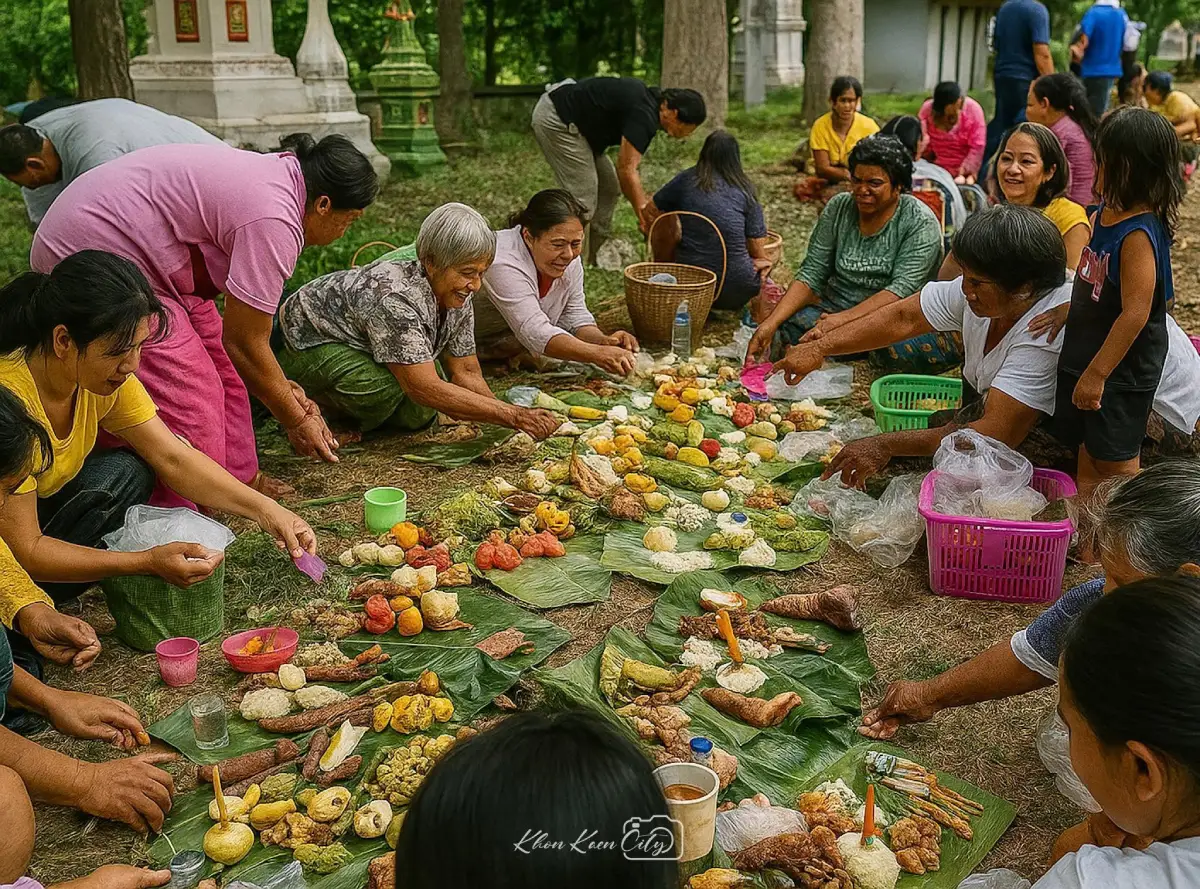
Bun Khao Sak is an important 10th lunar-month merit-making tradition of the Isan people. It is held on the 15th waxing day of the 10th lunar month to dedicate merit to deceased relatives, ancestors, spirits in suffering realms, and pretas. One day before the ceremony, families prepare khao sak, also known in Central Thai as khao krayasat, made from puffed young rice, popped rice, sugarcane syrup or sugar, beans, and sesame. They also prepare sticky-rice parcels, sweets, savoury food, betel nut, betel leaf, cigarettes, and offerings. On the main day, people go to the temple in the morning to give alms, dedicate merit, offer food to monks, and listen to sermons. Around noon, khao sak parcels are hung on trees or fences before a drum or wooden gong is struck to signal spirits to receive the merit. Villagers then take part in yad khao sak, also known as yaeng pret, and some of the collected parcels are taken to rice fields or sacred field points to bless the crops.
Bun Khao Sak is one of the important merit-making traditions of the Isan region and belongs to the Hit Sip Song, the 12-month customary cycle of northeastern Thai communities. The ceremony is held on the 15th waxing day of the 10th lunar month, with preparation taking place on the previous day, the 14th waxing day. Its main purpose is to dedicate merit to deceased relatives, ancestors, benefactors, karmic creditors, spirits in suffering realms, and pretas. At the same time, the tradition is also connected with agricultural belief, because some of the khao sak received from the ritual may be taken back to the fields and placed at sacred field points to bless the rice crop.
The name Bun Khao Sak reflects both merit-making and the idea of offering through a form of allotment. The word sak is associated with salak, meaning a marked or assigned offering. In many communities, food parcels or offerings may include the name of the donor, the person to whom merit is dedicated, or a written intention. The ritual therefore expresses generosity, remembrance, family gratitude, and the relationship between the living and the dead through the temple-centered life of the community.
In Central Thai, khao sak is closely related to khao krayasat, a traditional sweet made for the 10th lunar month. It is usually prepared from puffed young rice, popped rice, sugar or sugarcane syrup, beans, and sesame. In the Isan context, however, khao sak is more than a dessert. It is a ritual food, a gift of merit, a symbol of abundance, a seasonal food shared among relatives, and an offering dedicated to spirits and ancestors.
The central meaning of Bun Khao Sak is merit dedication. Isan people believe that this is a special opportunity for descendants to send merit to grandparents, parents, relatives, and benefactors who have passed away. The merit is also extended to pretas and suffering beings without relatives to make offerings for them. The ceremony therefore goes beyond private family remembrance and becomes an act of compassion for beings in other realms according to Buddhist and local belief.
The preparation day falls on the 14th waxing day of the 10th lunar month. Families prepare khao sak, savoury dishes, sweets, fruits, sticky-rice parcels, betel nut, betel leaf, cigarettes, and other items for merit-making. Khao sak is made by mixing puffed young rice with popped rice, then adding sugarcane syrup or sugar, beans, and sesame. The fragrance of roasted grain, sugar, beans, and sesame gives the food its distinct seasonal character. The process usually begins in the household and brings family members together before the temple ritual.
The making of khao sak is an important family activity. Older family members teach younger generations how to prepare the ingredients, wrap the offerings, and understand the meaning of the tradition. Younger people help buy ingredients, prepare food, arrange banana-leaf parcels, and carry offerings to the temple. Families with relatives living far away may send khao sak to one another as a sign of care and remembrance. The tradition therefore begins in the home before it reaches the temple.
On the morning of the 15th waxing day of the 10th lunar month, villagers bring food, khao sak, small rice parcels, sweets, fruit, and offerings to the temple. They give alms, offer food to monks, and dedicate merit to the deceased. After the monks have finished their meal, people listen to sermons and receive blessings. The tone of the ceremony is one of generosity, remembrance, and reflection on impermanence, death, and the value of doing good.
Around noon, the khao sak distribution ritual takes place. The khao sak parcels are usually wrapped in banana leaves, fastened at both ends, and shaped somewhat like paired rice parcels. Inside may be khao sak, sticky-rice parcels, fish, meat, betel nut, betel leaf, cigarettes, or other items determined by local custom. These parcels represent food and basic necessities prepared for deceased relatives and spirits. The careful wrapping of banana leaves expresses both craftsmanship and sincere intention.
During the ritual, the parcels are hung on trees, fences, or designated areas within the temple or community space. After the offerings are placed, a drum or wooden gong is struck to signal pretas and spirits to come and receive the merit. The sight of banana-leaf parcels hanging from trees and the sound of the drum or gong form one of the most distinctive moments of the tradition. It is a symbolic point where the world of the living and the unseen world are connected through ritual action.
After the signal, villagers take part in yad khao sak, also known as yaeng pret. This involves collecting or competing for the hanging parcels after the spirits have been invited to receive them. The activity is lively and communal, but it remains rooted in ritual meaning. Some of the khao sak or parcel contents may be taken back to the fields and placed in rice fields or at sacred field points to bless the crop. This connects merit-making for the deceased with the hope for agricultural abundance among the living.
The sacred field point, often called ta haek in Isan belief, is an important element of rice-field culture. It represents the first or spiritually significant point of the field, associated with guardian spirits and the well-being of the crop. Placing khao sak there connects merit with rice, ancestors with agriculture, and the temple ritual with the farming landscape. This shows how Isan traditions link religion, family, agriculture, and local belief into one integrated worldview.
Bun Khao Sak also shows the central role of the temple in Isan community life. On the day of the ceremony, the temple becomes more than a religious building. It becomes a gathering place for families, neighbours, monks, elders, children, and returning relatives. People bring food, listen to sermons, exchange greetings, remember their ancestors, and pass cultural knowledge to the next generation. The ceremony keeps the temple at the heart of community life.
In Yasothon Province, Bun Khao Sak fits naturally within the agricultural and Buddhist culture of the local communities. Yasothon has many temple-centered villages and strong Isan cultural roots, so the tradition is not limited to one tourist site. It is practiced in temples and communities across the province according to local schedules and customs. Travelers who want to experience the tradition should choose a temple or community that holds the ceremony on the full moon day of the 10th lunar month and participate respectfully.
In Mueang Yasothon, Wat Mahathat is a useful reference point for understanding the religious and cultural context of the city. It is a royal temple and one of the most important temples in Yasothon. The temple enshrines Phra That Phra Anon and plays a major role in Buddhist activities in the province. A visit to Wat Mahathat can be combined with Ban Sing Tha Old Community, the City Pillar Shrine, Wiman Phaya Thaen, and other nearby cultural attractions.
Wat Mahathat remains an important religious center of Yasothon. Phra Thep Wongsa Chan, the provincial ecclesiastical governor of Yasothon and abbot of Wat Mahathat, has presided over important Buddhist ceremonies in the province. This makes the temple a strong reference point for visitors who want to understand the role of temples in Yasothon’s ritual and community life.
Although Bun Khao Sak is focused on merit dedication, it also strengthens community unity. Every family takes part in some way: preparing food, making khao sak, wrapping banana-leaf parcels, bringing offerings to the temple, listening to sermons, distributing khao sak, and joining yad khao sak. The entire process allows relatives and neighbours to meet, help one another, and remember their ancestors together. It is therefore an important social practice, not only a religious ceremony.
For travelers, Bun Khao Sak should be approached with understanding and respect. This is a merit-making day for the deceased, not a general entertainment festival. Even though the yad khao sak moment can be lively and enjoyable, the core of the tradition is giving, remembrance, compassion, and blessing for the living community. Visitors should dress modestly, behave calmly in the temple area, and respect local instructions.
Photography should be done carefully. Visitors should avoid disturbing almsgiving, food offerings, sermons, or family rituals. Good photo subjects include the making of khao sak, banana-leaf parcels, food offerings, villagers carrying offerings to the temple, and the hanging of khao sak parcels. Close-up photos of monks, elderly people, or families performing merit dedication should be taken only with permission.
The food aspect of Bun Khao Sak is also important. Khao sak reflects seasonal ingredients, rice culture, and local food knowledge. Puffed young rice, popped rice, beans, sesame, sugarcane syrup, and sugar are all connected with rice-based life and local agriculture. When mixed together, they become a ritual food that can be shared, offered, and used as a symbolic link between household, temple, and field.
The belief in pretas and suffering beings reveals the moral depth of the tradition. According to Buddhist and local belief, beings who suffer from past karma may depend on merit dedicated by the living. By preparing food parcels and calling pretas to receive merit, villagers show compassion beyond the boundaries of their own family. The ritual encourages the living to reflect on karma, death, generosity, and the importance of doing good in the present life.
Bun Khao Sak also expresses the value of sharing. Families do not prepare khao sak only for temple offerings. They may also send it to relatives, neighbours, elders, and respected people. This exchange strengthens social ties and confirms the relationship between households. For people who live away from home, the season of Bun Khao Sak can become a reason to return, send offerings, or reconnect with family roots.
As cultural travel, Bun Khao Sak is ideal for visitors who want to understand Isan beyond large parades or festive entertainment. Its power lies in household preparation, temple ritual, family memory, food culture, field blessing, and community participation. Every step has meaning. Travelers who observe carefully will see how Isan culture connects merit, ancestors, rice, water, temple, family, and village into one living tradition.
In Yasothon, visitors can use Wat Mahathat and Mueang Yasothon as a starting point for learning about religious life, then continue to Ban Sing Tha Old Community, Wiman Phaya Thaen, the Toad Museum, Phra Sunthon Ratchawongsa Monument, and Phra That Kong Khao Noi. This route presents Yasothon through merit-making, temple culture, old-town history, local legend, and sacred heritage.
The best time to join Bun Khao Sak is from early morning to noon. Morning is when people bring offerings, give alms, and offer food to monks. After the monks have eaten, sermons and merit dedication take place, followed by the khao sak distribution ritual around noon. Visitors who want to see the preparation process should arrive in the community on the previous day, the 14th waxing day of the 10th lunar month.
In 2026, the 15th waxing day of the 10th lunar month falls on Saturday, 26 September 2026, and the preparation day falls on Friday, 25 September 2026. Because the date follows the lunar calendar, the solar-calendar date changes every year. Visitors should always check the lunar calendar and the announcement of the temple or community they plan to visit for the exact local schedule.
Travel within Yasothon city is convenient. Visitors can use Wat Mahathat as a reference point and continue to nearby attractions in the old town and city center. During important merit-making days, extra travel time is useful because temples may be busier than usual and parking may be limited. Those joining ceremonies in rural communities should contact the temple, local authority, or community leader in advance for ceremony time, parking information, and local etiquette.
Respectful behaviour is essential. Visitors should dress modestly, remain quiet during sermons, avoid walking in front of monks during rituals, and wait until the community signals the correct time before taking part in yad khao sak. The belief in pretas and ancestral spirits should be treated respectfully because it carries deep meaning for the community. With proper conduct, visitors can learn from the tradition without disturbing the people who preserve it.
In summary, Bun Khao Sak brings together Buddhism, local belief, family gratitude, ancestor remembrance, ritual food, rice-field blessing, and village community life. A single khao sak parcel represents more than food. It is merit, memory, compassion, family connection, and hope for abundance in the rice fields. The tradition reveals the heart of Isan culture: generosity, gratitude, respect for ancestors, and the close relationship between people, temples, rice fields, and the unseen world.
| Name | Bun Khao Sak |
| Related Names | Bun Khao Sak, 10th Lunar-Month Merit Festival, Yad Khao Sak, Yaeng Pret, Khao Krayasat, Salak Phat, Khao Sak Parcels, Small Rice Offerings |
| Main Area | Temples and Isan communities, including temples in Yasothon Province such as Wat Mahathat and local community temples in each district |
| Reference Location In Yasothon | Wat Mahathat, Nai Mueang Subdistrict, Mueang Yasothon District, Yasothon Province 35000, Thailand |
| Reference Coordinates | Wat Mahathat Yasothon: 15.7949, 104.1455 |
| Festival Period | The 15th waxing day of the 10th lunar month every year. The preparation day is the 14th waxing day of the 10th lunar month. In 2026, Bun Khao Sak falls on Saturday, 26 September 2026. |
| Highlights | Making khao sak or khao krayasat, wrapping banana-leaf offering parcels, almsgiving, merit dedication, listening to sermons, distributing khao sak, striking a drum or wooden gong to call pretas, and yad khao sak before taking some offerings to rice fields or sacred field points |
| Significance | A merit-making tradition dedicated to deceased relatives, ancestors, suffering beings, and pretas, while also linking merit with rice-field fertility and Isan agricultural life |
| Distinctive Features | A merit ceremony that begins in the household, continues at the temple, includes offerings to the unseen world, and ends with rice-field blessing through khao sak taken back to the fields |
| Main Areas / Zones | 1. Household Preparation Area On The 14th Waxing Day Of The 10th Lunar Month 2. Temple Pavilion For Almsgiving, Food Offering, And Sermons 3. Offering Area For Khao Sak Parcels 4. Trees, Fences, Or Designated Places For Hanging Khao Sak Parcels 5. Drum Or Wooden Gong Signal Point 6. Yad Khao Sak Or Yaeng Pret Area 7. Rice Fields And Sacred Field Points For Crop Blessing 8. Wat Mahathat And Local Community Temples In Yasothon Province |
| Caretaker / Organizer | Local temples, monastic communities, community leaders, local administrative organizations, and Yasothon Provincial Cultural Office. For Wat Mahathat, the abbot is Phra Thep Wongsa Chan, the provincial ecclesiastical governor of Yasothon. |
| Travel Information | For Mueang Yasothon, Wat Mahathat can be used as a reference point. Visitors can travel by private car, rental car, local transport, or public bus to Yasothon city and continue to the temple or community holding the ceremony on the 15th waxing day of the 10th lunar month. |
| Current Status | Still practiced as a 10th lunar-month Isan merit tradition in temples and communities across Yasothon Province |
| Open Days | Held once a year on the 15th waxing day of the 10th lunar month. Major temples in Yasothon city are open daily for merit-making and worship. |
| Opening Hours | Main ritual period is generally 06.00 – 12.00, covering almsgiving, food offerings, sermons, and khao sak distribution. |
| Admission Fee | No Admission Fee; Merit-Making Contributions Are Voluntary |
| Facilities | Temple pavilion, merit-making area, parking areas at temples and communities, temple restrooms, restaurants in Yasothon city, local markets, and accommodations in Mueang Yasothon District |
| Main Contact Number | Wat Mahathat Abbot Office Tel. 080-762-1822 Yasothon Provincial Office Tel. 0-4571-2722 |
| Official Website / Official Page | Yasothon Provincial Website, Yasothon Provincial Cultural Office Channels, And Official Channels Of Participating Temples Or Local Administrative Organizations |
| Nearby Tourist Attractions | 1. Wat Mahathat Yasothon, within the reference area 2. Ban Sing Tha Old Community, about 1 km 3. Singhatha Museum Yasothon, about 1 km 4. Wiman Phaya Thaen And The Toad Museum, about 2 km 5. Yasothon City Pillar Shrine, about 2 km 6. Phra Sunthon Ratchawongsa Monument, about 2 km 7. Bung Noi – Bung Yai Public Park, about 2 km 8. Phra That Kong Khao Noi, about 8 km |
| Nearby Restaurants | 1. Ban Khun Ya Yasothon, about 2 km, Tel. 045-721-141 2. Krua Yai Bua Yasothon, about 2 km, Tel. 094-846-9676, 095-191-4385 3. Phod Pho Yasothon, about 3 km, Tel. 064-306-6665 4. Samrit Restaurant Yasothon, about 3 km, Tel. 086-249-2508 5. Zab E Lee Yasothon, about 3 km, Tel. 045-756-657 6. Scala@Yasothon, about 4 km, Tel. 095-192-2439 |
| Nearby Accommodations | 1. JP Emerald Hotel, about 2 km, Tel. 045-714-456 2. The Zen Hotel Yasothon, about 3 km, Tel. 045-711-455 3. B.M. Grand Hotel, about 3 km, Tel. 045-712-333 4. Chang Yai Jai Dee Hotel Yasothon, about 4 km, Tel. 045-711-123 5. The Green Park Grand Yasothon, about 4 km, Tel. 045-714700-1 6. The Greenpark Grand Hotel Yasothon, about 4 km, Tel. 045-714700-4 |
Frequently Asked Questions (FAQ)
Q: What is Bun Khao Sak?
A: Bun Khao Sak is a 10th lunar-month merit-making tradition of the Isan people. It is held to dedicate merit to deceased relatives, ancestors, suffering beings, and pretas, while also connecting merit with rice-field fertility.
Q: When is Bun Khao Sak held?
A: It is held on the 15th waxing day of the 10th lunar month every year. The preparation day is the 14th waxing day. In 2026, Bun Khao Sak falls on Saturday, 26 September 2026.
Q: What is khao sak made from?
A: Khao sak is made from puffed young rice mixed with popped rice, sugarcane syrup or sugar, beans, and sesame. In Central Thai, it is often known as khao krayasat.
Q: What are the main rituals of Bun Khao Sak?
A: The main rituals include preparing khao sak, giving alms, offering food to monks, listening to sermons, distributing khao sak parcels, striking a drum or wooden gong to call pretas, and taking part in yad khao sak.
Q: What is yad khao sak?
A: Yad khao sak is the act of collecting or competing for khao sak parcels after they have been hung and the spirits have been invited to receive merit. Some of the collected offerings may be taken to rice fields or sacred field points for crop blessing.
Q: How is Bun Khao Sak connected with pretas?
A: Isan people believe that the ritual dedicates merit to pretas and suffering beings who wait for merit from the living. Hanging khao sak parcels and striking a drum or gong symbolize calling them to receive the offering.
Q: Can travelers join Bun Khao Sak?
A: Yes. Travelers can join respectfully by dressing modestly, following temple rules, not disturbing rituals, waiting for the proper time before participating in yad khao sak, and photographing the event with care.
Q: What nearby attractions can be visited with Bun Khao Sak in Yasothon?
A: Nearby places include Wat Mahathat, Ban Sing Tha Old Community, Singhatha Museum Yasothon, Wiman Phaya Thaen, the Toad Museum, Yasothon City Pillar Shrine, Phra Sunthon Ratchawongsa Monument, and Phra That Kong Khao Noi.
 Category: ●Art, Culture and Heritage
 Group: ●Art, Craft Centres, Tradition
Last Update : 1 MonthAgo
 Last Update : 1 MonthAgo
 Historical Sites and Monuments(6)
 Landmarks and Memorials(1)
Art, Craft Centres, Tradition(4)
Landmarks and Memorials(1)
Art, Craft Centres, Tradition(4)
 Museums(1)
 Historic Homes and Cities(1)
 Places of Worship
 Temple(22)
 Church(1)
 Other Sacred Sites(9)
 Research and Development
 Royal Project(2)
 Suburban Living
 Village, Community(3)
 Local Market(1)
 Nature and Wildlife
 National Parks and Marine Reserves(2)
 Mountain (Doi)(2)
 Dam, Reservoir, Lake(7)
 River, Canal(2)
 Bays and Beaches(1)
 Other natural attractions(2)
 Entertainment and Agricultural
 Farms, Parks and Ecotourism(1)


