
lovethailand home >Northeastern Travel Attractions >Yasothon Travel Attractions >Muang Yasothon >Nai Muang > Toom Ka Fire Lighting Festival
TL;DR: Toom Ka Fire Lighting Festival, open Wat Burapha Ban Thung Tae and the community cultural learning area are open, hours 08.00 – 17.00 for general visits; festival activities take place from daytime.
Toom Ka Fire Lighting Festival
Open Days: Wat Burapha Ban Thung Tae and the community cultural learning area are open daily; the Toom Ka Fire Lighting Festival is held during the End of Buddhist Lent period according to the annual official schedule.
Opening Hours: 08.00 – 17.00 for general visits; festival activities take place from daytime into the evening according to the annual programme.
The Toom Ka Fire Lighting Festival in Yasothon Province is a unique End of Buddhist Lent tradition rooted in Ban Thung Tae, Thung Tae Subdistrict, Mueang Yasothon District. The tradition is based on Buddhist faith and the story of the Buddha’s return from Tavatimsa Heaven after preaching to his mother during the rains retreat. Villagers use the natural fruit of the toom ka plant, hollow it out, carve delicate patterns into the shell, and place a candle or light inside. When lit, the soft glow shines through the carved patterns, creating a deeply spiritual atmosphere. The tradition has grown from a local village ritual into a provincial cultural festival and was listed as a national intangible cultural heritage item in 2023. Key places include Wat Burapha Ban Thung Tae, Thung Nong Kham multipurpose ground, and the provincial festival area in Mueang Yasothon District.
The Toom Ka Fire Lighting Festival of Yasothon Province is one of the most distinctive cultural traditions in northeastern Thailand. Its spiritual and cultural heart is Ban Thung Tae in Thung Tae Subdistrict, Mueang Yasothon District. The festival is centered on the making and lighting of toom ka lamps, handcrafted lanterns made from the fruit of a local wild plant. These lamps are offered as Buddhist worship during the End of Buddhist Lent. The result is a festival of soft sacred light, folk craftsmanship, Buddhist devotion, and community cooperation.
The meaning of the festival is closely connected with the Buddhist story of the End of Buddhist Lent. According to Buddhist tradition, after spending the rains retreat in Tavatimsa Heaven and preaching to his mother, the Buddha returned to the human world at the end of the retreat. Buddhists commemorate this event with offerings and lights. In Ban Thung Tae, this faith developed into the practice of lighting toom ka lamps as a form of Buddhist worship. The light represents wisdom, purity, peace, and auspiciousness.
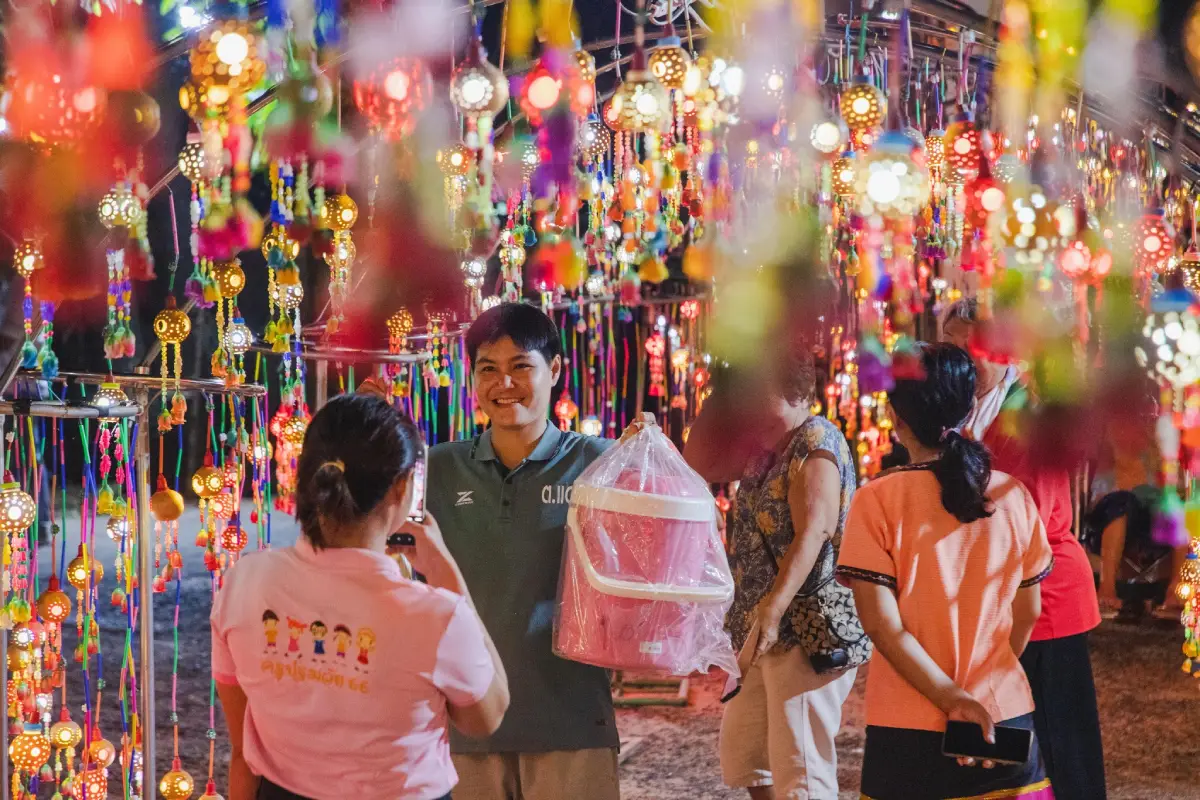
The toom ka lamp is unlike ordinary decorative lighting. It begins with the natural fruit of the toom ka plant, a round fruit with a thin shell and a long stem. Villagers remove the green outer skin, hollow out the flesh and seeds, and leave the shell intact. They then use a pointed knife to carve beautiful patterns into the surface. These patterns may include floral designs, vines, traditional Thai motifs, Buddhist-inspired symbols, natural forms, and creative contemporary designs. When a candle or electric light is placed inside, the light shines through the carved openings and turns the fruit into a glowing lantern.
The making of a toom ka lamp requires skill, patience, and local knowledge. The maker must choose a suitable fruit, remove the inner part without breaking the shell, design the pattern, carve the openings carefully, and place the light safely inside. In the past, candles were used. Today, electric lights are often used for greater convenience and safety, especially when many lamps are hung together in public spaces. Even with modern adaptation, the heart of the tradition remains the same: offering light as an act of Buddhist devotion.
The beauty of toom ka light is gentle and layered. It is not a bright commercial light, but a soft glow that passes through a natural shell and hand-carved patterns. When many lamps are hung together in a temple or festival area, the atmosphere becomes calm, sacred, and visually memorable. Each lamp reflects the work of human hands, the texture of natural material, and the devotion of the community that prepares the festival.
Ban Thung Tae is the origin of this tradition, and Wat Burapha Ban Thung Tae is its most important religious and cultural center. Villagers prepare toom ka lamps, create ceremonial lamp trees, join processions, and bring the lamps to Wat Burapha as Buddhist offerings on the End of Buddhist Lent. The temple therefore functions as a ritual center, a learning space, and a gathering point for community cooperation.
Wat Burapha Ban Thung Tae is also home to the Chalermraj Cultural Center of Thung Tae Subdistrict, which preserves and presents local cultural knowledge, community history, way of life, folk wisdom, important local figures, and old household objects. This cultural learning space helps visitors understand that the Toom Ka Fire Lighting Festival is not an isolated performance. It is part of a broader community landscape shaped by temple life, local craftsmanship, faith, and shared memory.
The Toom Ka Fire Dance is one of the most visually impressive parts of the festival. Performers hold glowing toom ka lamps while moving in graceful patterns. The carved light shifts with the dancers’ hands, creating an atmosphere that is both elegant and mysterious. The dance expresses not only artistic beauty but also community unity, faith, and pride in local heritage. It transforms the handmade lamp into a living element of performance.
From a local village practice, the Toom Ka Fire Lighting tradition was elevated into a provincial festival in 2017. This helped the tradition become better known while still preserving Ban Thung Tae as its cultural source. Provincial-level activities are held in Mueang Yasothon District, including around the district office area according to the annual programme. These activities include toom ka lamp tree contests, demonstrations, creative product contests, cultural performances, local food stalls, community products, and festival entertainment.
The provincial festival expands the role of toom ka beyond the village while keeping its roots intact. Communities from different parts of Mueang Yasothon can join in creating lamp trees, performing local arts, and presenting cultural products. This allows the festival to become a symbol of Yasothon Province, while Ban Thung Tae remains the spiritual and craft center of the tradition.
In 2023, the Toom Ka Fire Lighting tradition was listed as a national intangible cultural heritage item in the category of social practices, rituals, traditions, and festivals. This recognition confirms the importance of the tradition beyond its visual beauty. It is valuable because it includes Buddhist devotion, natural-material craftsmanship, carving knowledge, ritual practice, community participation, and intergenerational transmission.
The tradition remains alive because it is still practiced, taught, performed, and celebrated in real community settings. Elders pass on knowledge of selecting the fruit and carving the shell. Young people learn to make lamps, dance, and take part in community activities. The temple remains the ritual center. The village remains the source of craftsmanship. Visitors continue to come and experience the unique atmosphere of toom ka light each year.
Toom ka products also support the local economy. Villagers have developed various items from the toom ka fruit and its visual identity, including decorative lamps, souvenirs, necklaces, earrings, and small craft objects. These products extend the tradition beyond the festival days and allow visitors to take home a meaningful cultural object. Each piece represents local craftsmanship and the identity of Ban Thung Tae.
Learning about toom ka at Ban Thung Tae is valuable for students, cultural travelers, craft enthusiasts, and visitors who want to understand local wisdom through real practice. Seeing the uncarved fruit, the hollowing process, the carving technique, the lighting method, and the final display makes the festival more meaningful. The beauty seen at night is the result of many hours of careful preparation by the community.
The best time to experience the festival is during the End of Buddhist Lent, especially from late afternoon into the evening. Daytime visits allow travelers to see demonstrations, exhibitions, community products, and local activities. Evening visits reveal the full beauty of the glowing lamps, processions, lamp trees, and Toom Ka Fire Dance. Visitors who want a complete experience should allow at least half a day to one full day.
Ban Thung Tae is about 12 kilometers from Yasothon city. It can be reached by private car, rental car, or local hired transport. During the festival period, visitors should allow extra travel time and follow parking or traffic instructions from the local authority. Wat Burapha Ban Thung Tae and the community activity areas can become busy, especially on the End of Buddhist Lent night and during major processions.
Wat Burapha Ban Thung Tae is the best place to understand the spiritual heart of the tradition. The provincial festival area in Mueang Yasothon is the best place to see larger displays, contests, and public activities. A complete visit should include both contexts: Ban Thung Tae as the cultural origin and Mueang Yasothon as the provincial presentation area.
Visitors should behave respectfully because the festival is based on Buddhist worship. Dress modestly, do not play with the lamps, do not touch lamp trees or ceremonial objects without permission, do not block processions, and do not disturb dancers or ritual participants. Photography is welcome in many areas, but close photographs of monks, elders, craft makers, or performers should be taken with permission.
The charm of the Toom Ka Fire Lighting Festival lies in its ability to turn a simple natural fruit into a sacred lamp. A small wild fruit becomes a glowing object of worship through local hands. A village practice becomes a provincial festival through community effort. A local craft becomes national intangible cultural heritage through continuous transmission. This is why the festival is one of the strongest examples of living culture in Yasothon.
The festival is suitable for families. Children can learn about Buddhist Lent, natural materials, handcraft, and community cooperation. Elderly visitors can enjoy the temple atmosphere, cultural displays, and evening lights. Cultural travelers can observe how religion, craft, performance, and local economy work together within one tradition.
For international travelers, the Toom Ka Fire Lighting Festival offers a deep introduction to Yasothon. It is not a commercial light show, but a living Buddhist and community tradition. The glow of each lamp carries the meaning of faith, patience, craftsmanship, and local identity. Visitors can experience temple life, folk art, dance, community products, and the atmosphere of a real Isan festival in one place.
A practical travel route can begin at Ban Thung Tae in the afternoon, visiting Wat Burapha and the community cultural learning area, then continue into the evening for lamp displays, processions, and dance performances. Visitors who want to connect the trip with Yasothon city can also visit Wiman Phaya Thaen, the Toad Museum, Wat Mahathat, Ban Sing Tha Old Community, Phra Sunthon Ratchawongsa Monument, and Bung Noi – Bung Yai Public Park.
Food and local products add another layer to the festival experience. During the event, visitors can find local food, sweets, drinks, cultural products, and toom ka-inspired souvenirs. Buying local products supports the community directly and helps keep the craft active beyond the festival period.
Even outside the End of Buddhist Lent season, Ban Thung Tae and Wat Burapha remain meaningful cultural learning destinations. Visitors can explore the community cultural center, learn about local history, and understand the background of the festival at its source. Those who want to see the full light display should visit during the annual festival, when the community brings the lamps, processions, and performances together in their complete form.
In summary, the Toom Ka Fire Lighting Festival of Yasothon Province brings together Buddhist faith, the End of Buddhist Lent, natural-material craftsmanship, hand-carved lamps, dance, community cooperation, and cultural economy. Each glowing toom ka lamp is an offering of light, a work of local art, and a symbol of Ban Thung Tae’s living heritage. The festival is one of the most meaningful cultural experiences in Yasothon and one of the clearest examples of how local wisdom can continue to shine across generations.
| Name | Toom Ka Fire Lighting Festival, Yasothon Province |
| Related Names | Toom Ka Fire Lighting, Toom Ka Lantern Festival, Ban Thung Tae Toom Ka Fire Festival, End Of Buddhist Lent Toom Ka Fire Festival, One-Of-A-Kind Toom Ka Festival, Yasothon Toom Ka Fire |
| Origin Area | Ban Thung Tae, Thung Tae Subdistrict, Mueang Yasothon District, Yasothon Province |
| Key Locations | Wat Burapha Ban Thung Tae, Thung Nong Kham Multipurpose Ground, And The Provincial Festival Area Around Mueang Yasothon District Office |
| Reference Address | Wat Burapha, Village No. 1, Ban Thung Tae, Thung Tae Subdistrict, Mueang Yasothon District, Yasothon Province 35000, Thailand |
| Coordinates | Use Ban Thung Tae, Thung Tae Subdistrict, Mueang Yasothon District For Wat Burapha And The Community Cultural Area Use Mueang Yasothon District Office As The Reference Point For The Provincial Festival Area |
| Festival Period | Held during the End of Buddhist Lent period every year, according to the annual schedule announced by Yasothon Province, Wat Burapha, and Thung Tae Municipality |
| Highlights | Hand-carved toom ka lamps, toom ka lamp tree procession, kan lon offering tree procession, Buddhist light offering at Wat Burapha, Toom Ka Fire Dance, toom ka lamp tree contests, lamp-making demonstrations, Miss Toom Ka contest, and local cultural products |
| History / Significance | An End of Buddhist Lent tradition of Ban Thung Tae, in which toom ka fruit is carved into lamps and offered as Buddhist worship. The tradition reflects Buddhist faith, local wisdom, natural-material craftsmanship, and community unity. It was listed as national intangible cultural heritage in 2023. |
| Distinctive Features | Natural toom ka fruit is hollowed, hand-carved, and lit from within, allowing soft light to shine through the carved patterns. The result is a unique cultural light tradition of Ban Thung Tae and Yasothon Province. |
| Main Areas / Zones | 1. Wat Burapha Ban Thung Tae, The Buddhist Offering Area 2. Chalermraj Cultural Center Of Thung Tae Subdistrict Inside Wat Burapha 3. Thung Nong Kham Multipurpose Ground 4. Toom Ka Lamp Tree And Kan Lon Offering Tree Display Area 5. Lamp-Making And Carving Demonstration Area 6. Toom Ka Fire Dance And Cultural Performance Area 7. Toom Ka Product And Local Community Product Zone 8. Provincial Festival Area Around Mueang Yasothon District Office |
| Caretaker / Organizer | Yasothon Province, Department of Cultural Promotion, Yasothon Provincial Cultural Office, Thung Tae Municipality, Wat Burapha Ban Thung Tae, Ban Thung Tae Community, and local cultural networks |
| Abbot Of Wat Burapha | Phra Khru Pariyat Phalakon, Abbot of Wat Burapha Ban Thung Tae |
| Travel Information | From Yasothon city, travel to Thung Tae Subdistrict, about 12 km away, by private car, rental car, or local hired transport. For the provincial festival, travel to Mueang Yasothon District Office or the officially announced festival area. |
| Current Status | Still practiced as an important End of Buddhist Lent tradition of Ban Thung Tae and Yasothon Province. Wat Burapha and the community cultural area continue to serve as learning and preservation spaces for the tradition. |
| Open Days | Wat Burapha and the community cultural area are open daily. The festival is held during the End of Buddhist Lent period according to the annual official schedule. |
| Opening Hours | 08.00 – 17.00 for general visits. Festival activities continue from daytime into the evening according to the annual programme. |
| Admission Fee | No Admission Fee For The Temple, Community Area, And Public Festival Area; Personal Expenses Apply For Food, Drinks, Souvenirs, And Local Products |
| Facilities | Temple area, pavilion, resting areas, community activity ground, multipurpose ground, food and drink stalls during the festival, parking areas announced by the organizer, and accommodations in Yasothon city |
| Main Contact Number | Thung Tae Municipality Tel. 045-583000 Wat Burapha Ban Thung Tae / Phra Khru Pariyat Phalakon Tel. 093-102-8268, 081-621-3542 Yasothon Provincial Office Tel. 0-4571-2722 |
| Official Website / Official Page | Yasothon Provincial Website, Thung Tae Municipality Website, Ministry of Culture Website, and Wat Burapha Ban Thung Tae public communication channels |
| Nearby Tourist Attractions | 1. Wat Burapha Ban Thung Tae, within the same area 2. Chalermraj Cultural Center Of Thung Tae Subdistrict, inside Wat Burapha 3. Thung Nong Kham Multipurpose Ground, about 1 km 4. Wiman Phaya Thaen And The Toad Museum, about 12 km 5. Bung Noi – Bung Yai Public Park, about 12 km 6. Phra Sunthon Ratchawongsa Monument, about 12 km 7. Wat Mahathat Yasothon, about 13 km 8. Ban Sing Tha Old Community, about 13 km |
| Nearby Restaurants | 1. Ban Khun Ya Yasothon, about 13 km, Tel. 045-721-141 2. Krua Yai Bua Yasothon, about 13 km, Tel. 094-846-9676, 095-191-4385 3. Phod Pho Yasothon, about 13 km, Tel. 064-306-6665 4. Samrit Restaurant Yasothon, about 14 km, Tel. 086-249-2508 5. Zab E Lee Yasothon, about 14 km, Tel. 045-756-657 6. Scala@Yasothon, about 15 km, Tel. 095-192-2439 |
| Nearby Accommodations | 1. JP Emerald Hotel, about 13 km, Tel. 045-714-456 2. The Zen Hotel Yasothon, about 14 km, Tel. 045-711-455 3. B.M. Grand Hotel, about 14 km, Tel. 045-712-333 4. Chang Yai Jai Dee Hotel Yasothon, about 15 km, Tel. 045-711-123 5. The Green Park Grand Yasothon, about 15 km, Tel. 045-714700-1 6. The Greenpark Grand Hotel Yasothon, about 15 km, Tel. 045-714700-4 |
Frequently Asked Questions (FAQ)
Q: Where is the Toom Ka Fire Lighting Festival held?
A: Its cultural origin is Wat Burapha Ban Thung Tae in Thung Tae Subdistrict, Mueang Yasothon District. Provincial-level activities are also held in Mueang Yasothon District, including around the district office area according to the annual official schedule.
Q: What is a toom ka lamp?
A: A toom ka lamp is a handcrafted lantern made from the fruit of the toom ka plant. The fruit is hollowed out, carved with patterns, and lit from inside so the light shines through the carved shell as a Buddhist offering.
Q: When is the festival held?
A: The festival is held during the End of Buddhist Lent period every year. The exact dates are announced annually by Yasothon Province, Wat Burapha Ban Thung Tae, and Thung Tae Municipality.
Q: Is there an admission fee?
A: No. The temple, community area, and public festival area can be visited without an admission fee. Personal expenses apply for food, drinks, souvenirs, and local products.
Q: What are the main highlights?
A: Highlights include glowing hand-carved toom ka lamps, lamp tree processions, Buddhist light offerings, Toom Ka Fire Dance, lamp-making demonstrations, lamp tree contests, Miss Toom Ka contest, and local cultural products.
Q: Why is Ban Thung Tae important to this festival?
A: Ban Thung Tae is the origin and living center of the tradition. Local residents make toom ka lamps, organize processions, and offer the lamps at Wat Burapha during the End of Buddhist Lent.
Q: Is the tradition recognized as intangible cultural heritage?
A: Yes. The Toom Ka Fire Lighting tradition was listed as national intangible cultural heritage in 2023 in the category of social practices, rituals, traditions, and festivals.
Q: What nearby attractions can be visited on the same trip?
A: Nearby places include Wat Burapha Ban Thung Tae, Chalermraj Cultural Center of Thung Tae Subdistrict, Wiman Phaya Thaen, the Toad Museum, Wat Mahathat Yasothon, Ban Sing Tha Old Community, Phra Sunthon Ratchawongsa Monument, and Bung Noi – Bung Yai Public Park.
 Category: ●Art, Culture and Heritage
 Group: ●Art, Craft Centres, Tradition
Last Update : 1 MonthAgo
 Last Update : 1 MonthAgo

 Historical Sites and Monuments(6)
 Landmarks and Memorials(1)
Art, Craft Centres, Tradition(4)
Landmarks and Memorials(1)
Art, Craft Centres, Tradition(4)
 Museums(1)
 Historic Homes and Cities(1)
 Places of Worship
 Temple(22)
 Church(1)
 Other Sacred Sites(9)
 Research and Development
 Royal Project(2)
 Suburban Living
 Village, Community(3)
 Local Market(1)
 Nature and Wildlife
 National Parks and Marine Reserves(2)
 Mountain (Doi)(2)
 Dam, Reservoir, Lake(7)
 River, Canal(2)
 Bays and Beaches(1)
 Other natural attractions(2)
 Entertainment and Agricultural
 Farms, Parks and Ecotourism(1)


