
lovethailand home >Northeastern Travel Attractions >Surin Travel Attractions >Samrong Thap >Muen Si > Wat Muen Sri Yai
TL;DR: Wat Muen Sri Yai is located at Ban Muen Sri Yai, Moo 3, Muen Sri Subdistrict, Samrong Thap District, Surin Province 32170, open Daily, hours 08.00 – 17.00.
Wat Muen Sri Yai
Open Days: Daily
Opening Hours: 08.00 – 17.00
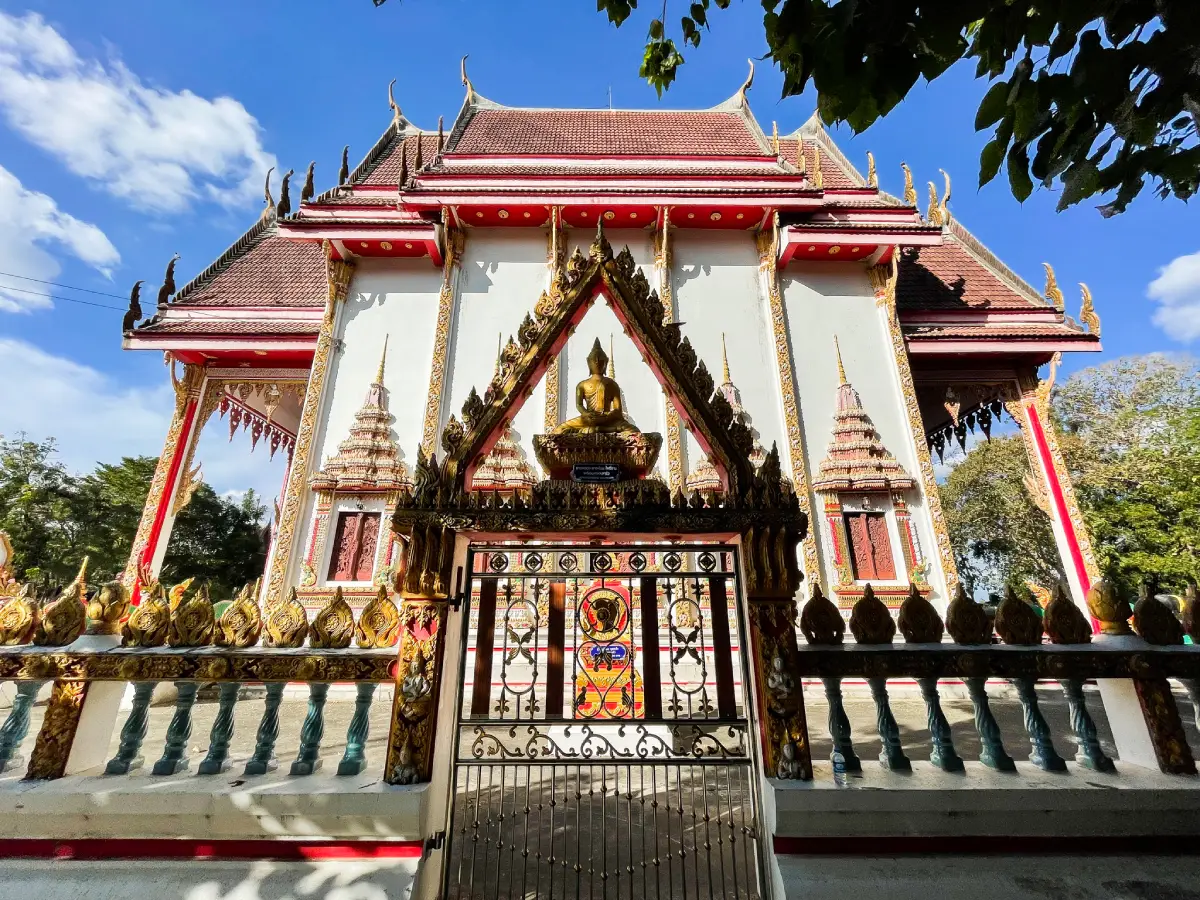
Wat Muen Sri Yai Surin, also known as Wat Ban Muen Sri Yai, is an old community Buddhist temple located in Ban Muen Sri Yai, Moo 3, Muen Sri Subdistrict, Samrong Thap District, Surin Province. The temple belongs to the Mahā Nikāya monastic order and was established in 1797. With more than 200 years of history, it is one of the long-standing temples of the Samrong Thap area. The temple covers about 11 rai and 67 square wah of land and continues to serve as the spiritual center of Ban Muen Sri Yai. It is a living village temple where local people make merit, listen to Dhamma, hold ordinations, organize Kathin and forest-robe offerings, and gather for community Buddhist activities.
The value of Wat Muen Sri Yai does not rest only on its age. Its deeper importance lies in its continuing relationship with the local community. For generations, villagers have come to the temple for Buddhist holy days, food offerings to monks, Dhamma listening, ordinations, funerary rites, merit-making ceremonies, and annual religious events. The temple is therefore not just a physical religious site. It is a shared space of memory, faith, family ties, moral learning, and community unity.
Ban Muen Sri Yai is an old village in Muen Sri Subdistrict, and the temple name is directly connected with the village name. The establishment of the temple in 1797 shows that Buddhism and community life had already become firmly rooted in this area during the early Rattanakosin period. Wat Muen Sri Yai is therefore both a Buddhist temple and a local historical marker. It helps explain how village settlement, agricultural life, and religious faith developed together in Samrong Thap District.
The temple grounds are closely connected with the surrounding village landscape. The northern and western sides border public roads, the southern side borders a pond, and the eastern side borders a seedling field area. This setting reflects the character of a rural agricultural community. The temple is surrounded by roads, water, fields, and village life. It is not separated from the everyday world of local people, but stands at the center of it.
The ordination hall is one of the most important sacred areas of Wat Muen Sri Yai. It measures about 7.90 meters wide and 22 meters long and was built in 1976. In Thai Buddhism, an ordination hall is the central building for formal Sangha acts, including ordination and other monastic ceremonies. Visitors should approach this area respectfully, dress modestly, remove shoes before entering sacred buildings, and keep quiet while inside or near the worship area.
The sermon hall measures about 14.20 meters wide and 24.70 meters long and was built in 1989. It is one of the most important community buildings of the temple. In rural Thai temples, sermon halls are used not only for listening to Dhamma, but also for merit-making, meetings, ceremonies, community gatherings, and annual religious events. At Wat Muen Sri Yai, the sermon hall represents the practical connection between monks and laypeople.
The temple has 2 monks’ residences made of wood. These are the living, study, and practice spaces of monks who stay at the temple. Visitors should respect the monastic residence area as a private religious zone. They should not enter without permission, make loud noise, or take intrusive photographs. Respecting this boundary is part of proper conduct at a working Thai temple.
The funeral merit-making hall is a concrete building used for funerary rites and memorial ceremonies. This building shows one of the most important roles of a community temple. When a family experiences loss, the temple becomes a place for Buddhist chanting, merit dedication, remembrance, and community support. Monks lead the rites, relatives gather, and neighbors help one another. In this way, Wat Muen Sri Yai supports villagers in both joyful and difficult moments of life.
One of the important sacred objects of the temple is a carved wooden Buddha image. Wooden Buddha images in old rural temples are valuable because they preserve the devotion of earlier generations and the craftsmanship of local artisans. Their beauty does not depend on luxury or monumental size, but on age, simplicity, sacred meaning, and the community’s continued care. Visitors should pay respect to this image as part of the temple’s spiritual heritage.
The recorded monastic history of Wat Muen Sri Yai includes a long line of abbots: Phra Ton, Phra Ti, Phra Sing, Phra Phui, Phra Khan, Phra Khut, Phra Hom, Phra Mui, Phra Jian, Phra Pong Paphassaro, Phra Lueam, Phra Li Yanasaro, Phra Phao Khantiko, Phra Naeng Phatthako, Phra Thongdi, and Phra Bunthan Inthawiro. This continuity of leadership shows that the temple has been maintained across many generations by monks and villagers together.
The current abbot of Wat Muen Sri Yai is Phra Khru Inthaveerathamkit. In earlier temple-history records, the abbot appears under the name Phra Bunthan Inthawiro, who has served in the temple’s monastic line since 1993. The present monastic title reflects the continuing role of the same temple leadership tradition. Under current monastic care, the temple remains active with resident monks, Buddhist ceremonies, and community religious events.
Wat Muen Sri Yai also has a role in Buddhist education through its Dhamma study school. A temple that supports Dhamma education does more than conduct ceremonies. It helps monks, novices, and local learners understand Buddhist doctrine, monastic discipline, morality, and correct practice. This educational role strengthens the temple’s importance as a source of knowledge and spiritual guidance for the local community.
The Dhamma study role gives the temple deeper meaning. Monks and novices who study Buddhist teachings can better serve the community through chanting, preaching, ceremonial guidance, and moral instruction. Laypeople also benefit from having a temple where religious knowledge remains active. For this reason, Wat Muen Sri Yai is both a place of worship and a place of Buddhist learning.
Annual religious events keep the temple alive throughout the year. Kathin, forest-robe offerings, Buddhist Lent, the end of Buddhist Lent, ordinations, funerary rites, Buddhist holy day merit-making, and other community merit-making ceremonies all bring people back to the temple. These events are not only religious ceremonies. They also strengthen kinship, renew local identity, and support the maintenance of the temple.
Buddhist holy days are especially meaningful at Wat Muen Sri Yai. Villagers come to offer food to monks, receive precepts, listen to Dhamma, and dedicate merit to ancestors. In an agricultural community, holy days create a pause from farming, household work, and daily responsibilities. They allow people to return to gratitude, generosity, moral conduct, and peace of mind. The temple therefore helps balance everyday work with spiritual life.
Kathin is one of the most important annual ceremonies at Wat Muen Sri Yai. After the end of Buddhist Lent, villagers and devotees offer robes, donations, and necessary items to the monks. Kathin helps maintain temple buildings, support monastic life, and reconnect people who have moved away from the village for work. It is both a religious ceremony and a community reunion.
Ordination ceremonies also show the temple’s role in family and village life. In Thai Buddhist culture, ordination connects sons, parents, relatives, monks, and the whole community. When an ordination is held, villagers help prepare the ceremony, welcome guests, cook food, and share merit. The temple becomes a place of joy, gratitude, and continuity of Buddhism at local level.
Funerary rites reveal another essential role of the temple. When a family loses a loved one, Wat Muen Sri Yai becomes a place for chanting, merit dedication, remembrance, and community support. Monks guide the ceremony through Buddhist teachings, while relatives and neighbors help the grieving family. This function makes the temple a refuge in times of sorrow and a visible center of compassion.
Wat Muen Sri Yai is also connected with the wider cultural landscape of Muen Sri Subdistrict. A nearby historical site, Prasat Ban Khok Prasat or Prasat Muen Sri Noi, is located in Ban Muen Sri Klang, Moo 2, Muen Sri Subdistrict. This ancient site contains remains of a religious structure and brick chedi elements, with restoration and structural support carried out in 1987. Visiting the temple together with this nearby site helps travelers see both the ancient historical layer and the living Buddhist layer of the local area.
The temple is suitable for travelers interested in old temples, village Buddhism, rural communities, and local history. It is not a commercial attraction with large crowds. Its value lies in its peaceful atmosphere, long history, local monastic line, Dhamma study role, wooden Buddha image, and continued use by the community. Travelers who visit respectfully will understand how Buddhism remains part of everyday life in rural Surin.
A meaningful visit should begin with paying respect at the main worship area. Visitors may then observe the ordination hall, sermon hall, temple courtyard, funeral merit-making hall, and monastic areas from an appropriate distance. On Buddhist holy days or during annual ceremonies, visitors may see local people offering food, listening to Dhamma, and participating in temple activities. These scenes show the living role of the temple more clearly than architecture alone.
Visitors should dress modestly, speak quietly, avoid entering monks’ private areas without permission, and keep the temple clean. Photography should be done respectfully, without disturbing monks, villagers, or ceremonies. Wat Muen Sri Yai is a working community temple, so visitors should treat it as a sacred and active religious space rather than an ordinary photo location.
Getting There to Wat Muen Sri Yai is most convenient by private car, rental car, or chartered vehicle. From Surin city, travel toward Samrong Thap District, then continue to Muen Sri Subdistrict and Ban Muen Sri Yai. The distance from Surin city is about 55 – 60 km depending on the route. From Samrong Thap town, the journey is shorter and can be combined with other local temples, restaurants, and cultural sites.
Travelers should navigate specifically to “Wat Muen Sri Yai, Muen Sri Subdistrict, Samrong Thap District, Surin Province” or “Wat Muen Sri Yai, Ban Muen Sri Yai, Moo 3.” Since the name Muen Sri appears in several local place names, including the subdistrict, village, and nearby ancient site, using the full destination name helps avoid confusion.
There is no admission fee for general worship, merit-making, and ordinary visits to Wat Muen Sri Yai. Visitors may donate according to their faith through proper temple donation points. Those who wish to visit as a group, make a formal offering, or study the temple history should contact the temple or local authority in advance, especially during major merit-making events.
Facilities at the temple are typical of a rural community temple. Visitors can expect an ordination hall, sermon hall, monks’ residences, funeral merit-making hall, temple courtyard, toilets, parking, and areas for merit-making. It is best to visit with respect for the temple’s real religious function and local community atmosphere rather than expecting a commercial tourism setup.
Wat Muen Sri Yai can be combined with nearby places in Samrong Thap District, including Prasat Ban Khok Prasat or Prasat Muen Sri Noi, the Four Ethnic Groups Market, Wat Ket Worararam, Wat Takhian Phositaram, Wat Bun Sano, and Sikhoraphum Sanctuary. With more time, travelers can continue to Surin city for Surin National Museum, Wat Burapharam, and the Surin City Pillar Shrine.
Restaurants near the temple are mainly located in Samrong Thap town and along the district’s main roads. Visitors can find cafés, grilled pork restaurants, coffee shops, noodle shops, seafood restaurants, and local Thai eateries. It is practical to plan meals before or after the temple visit because Ban Muen Sri Yai is a rural village area with fewer restaurant choices than the district town.
Accommodation options are available in Samrong Thap, Sikhoraphum, and Surin city. Travelers who want to stay closest to the temple may choose a resort in Samrong Thap. Those planning to combine the trip with Sikhoraphum Sanctuary may stay in Sikhoraphum. For the widest choice of hotels, restaurants, markets, railway access, and services, Surin city is the most convenient base for a multi-district trip.
For international visitors, Wat Muen Sri Yai offers a clear example of a long-standing Thai village temple in northeastern Thailand. It shows that Buddhism in Thailand exists not only in famous urban temples, but also in small local temples that support daily life, moral learning, community unity, and family ceremonies. A visit here helps travelers understand Surin beyond its better-known attractions.
International visitors should dress modestly, remove shoes before entering sacred buildings, avoid entering monastic residence areas without permission, speak quietly, avoid intrusive photography, and respect local worshippers. Wat Muen Sri Yai is a living religious space, and respectful conduct allows visitors to experience its atmosphere properly.
Overall, Wat Muen Sri Yai is valuable because of its long history, continuous monastic leadership, community role, Dhamma education, and connection with the cultural landscape of Muen Sri Subdistrict. From its establishment in 1797 to its present role under Phra Khru Inthaveerathamkit, the temple continues to serve as a center of faith for Ban Muen Sri Yai.
In summary, Wat Muen Sri Yai Surin is a Mahā Nikāya community temple with religious, historical, educational, and cultural value. It has an ordination hall, sermon hall, wooden monks’ residences, funeral merit-making hall, carved wooden Buddha image, and Dhamma study role. It remains a peaceful spiritual center of Ban Muen Sri Yai and a meaningful place for worship, merit-making, local history, and understanding rural Buddhist life in Samrong Thap District.
| Name | Wat Muen Sri Yai Surin / Wat Ban Muen Sri Yai |
| Location | Ban Muen Sri Yai, Moo 3, Muen Sri Subdistrict, Samrong Thap District, Surin Province 32170 |
| Address | Wat Muen Sri Yai, Ban Muen Sri Yai, Moo 3, Muen Sri Subdistrict, Samrong Thap District, Surin Province 32170 |
| Community Coordinates | Approximately 15.00479, 103.96456 |
| Highlights | Old temple established in 1797, Mahā Nikāya community temple, ordination hall built in 1976, sermon hall built in 1989, carved wooden Buddha image, Dhamma study school, and peaceful village-temple atmosphere |
| History | Established in 1797, Wat Muen Sri Yai is one of the old temples of Ban Muen Sri Yai and has been maintained through a long line of abbots and local community support |
| Name Origin | The temple name comes from Ban Muen Sri Yai, the village where the temple is located, reflecting the close connection between the temple and the local community |
| Distinctive Features | The temple covers about 11 rai and 67 square wah, with an ordination hall, sermon hall, 2 wooden monks’ residences, funeral merit-making hall, and community merit-making areas |
| Temple Boundary | North borders a public road, south borders a pond, east borders a seedling field area, and west borders a public road |
| Travel Information | From Surin city, travel toward Samrong Thap District, then continue to Muen Sri Subdistrict and Ban Muen Sri Yai. The distance is about 55 – 60 km and is most convenient by private car, rental car, or chartered vehicle |
| Current Status | Open for worship, merit-making, and Buddhist community activities. The temple remains active with resident monks and continues to serve Ban Muen Sri Yai as a spiritual center |
| Open Days | Daily |
| Opening Hours | 08.00 – 17.00 |
| Fees | No Admission Fee For General Worship And Merit-Making. Donations May Be Made According To Faith |
| Facilities | Ordination hall, sermon hall, monks’ residences, funeral merit-making hall, temple courtyard, merit-making area, toilets, and parking according to local temple conditions |
| Main Areas / Zones | 1. Ordination Hall, about 7.90 meters wide and 22 meters long, built in 1976 2. Sermon Hall, about 14.20 meters wide and 24.70 meters long, built in 1989 3. Two Wooden Monks’ Residences 4. Concrete Funeral Merit-Making Hall 5. Carved Wooden Buddha Image Area 6. Dhamma Study School Area 7. Temple Courtyard And Community Merit-Making Area 8. Monastic Residence Area 9. Funerary And Village Activity Area |
| Important Sacred Object | One carved wooden Buddha image, an important sacred object reflecting local devotion and traditional craftsmanship |
| Important Rituals / Traditions | Buddhist holy day merit-making, Dhamma listening, food offerings to monks, Kathin, forest-robe offerings, ordinations, Buddhist Lent, the end of Buddhist Lent, funerary rites, and Dhamma study activities |
| Abbot / Caretaker | Phra Khru Inthaveerathamkit, Abbot of Wat Muen Sri Yai; earlier temple history records Phra Bunthan Inthawiro as abbot from 1993 onward |
| Important Former Abbots | Phra Ton, Phra Ti, Phra Sing, Phra Phui, Phra Khan, Phra Khut, Phra Hom, Phra Mui, Phra Jian, Phra Pong Paphassaro, Phra Lueam, Phra Li Yanasaro, Phra Phao Khantiko, Phra Naeng Phatthako, Phra Thongdi, and Phra Bunthan Inthawiro |
| Local Information Contact | Muen Sri Subdistrict Municipality Office, Tel. 044-558-593 |
| Nearby Tourist Attractions | 1. Prasat Ban Khok Prasat Or Prasat Muen Sri Noi, Ban Muen Sri Klang, about 6 km 2. Four Ethnic Groups Market, Samrong Thap Municipality, about 8 km 3. Wat Ket Worararam, Ban Dod, Samrong Thap District, about 9 km 4. Wat Takhian Phositaram, Ban Takhian, about 10 km 5. Wat Bun Sano, Sano Subdistrict, Samrong Thap District, about 14 km 6. Sikhoraphum Sanctuary, Sikhoraphum District, about 30 km 7. Surin National Museum, about 55 km, Tel. 044-513-272, 044-513-274 |
| Nearby Restaurants | 1. Kaokan Cafe, Samrong Thap District, about 8 km, Tel. 093-487-6290 2. Phet Lamphu Mookata, Samrong Thap Branch, about 8 km, Tel. 044-569-470 3. N’Joy Coffee Thu, Samrong Thap District, about 8 km, Tel. 082-449-5254 4. Kuay Tiew Ruea Mor Din Nai Kon 341 Surin – Samrong Thap, about 9 km, Tel. 080-073-1956 5. Prathumphon Restaurant, Samrong Thap District, about 8 km, Tel. 082-368-8971 6. Fresh Seafood Restaurant, Samrong Thap District, about 9 km, Tel. 082-488-9383 |
| Nearby Accommodations | 1. Huai Saeng Chan Resort, Samrong Thap District, about 10 km, Tel. 044-569-375 2. Jamjuree Resort, Sikhoraphum District, about 30 km, Tel. 044-560-289, 089-190-5156 3. The Wood Surin, Mueang Surin District, about 58 km, Tel. 063-023-7999 4. Thong Tarin Hotel, Mueang Surin District, about 58 km, Tel. 044-514-281, 085-300-8858 5. Maneerote Hotel Surin, Mueang Surin District, about 59 km, Tel. 044-514-569 6. Slive Hotel Surin, Mueang Surin District, about 60 km, Tel. 044-060-322, 044-060-323 |
Frequently Asked Questions (FAQ)
Q: Where Is Wat Muen Sri Yai Surin Located?
A: Wat Muen Sri Yai is located in Ban Muen Sri Yai, Moo 3, Muen Sri Subdistrict, Samrong Thap District, Surin Province 32170.
Q: When Is Wat Muen Sri Yai Open?
A: Wat Muen Sri Yai is open daily from 08.00 to 17.00.
Q: Is There An Admission Fee?
A: No. There is no admission fee for general worship and merit-making. Visitors may donate according to their faith.
Q: When Was Wat Muen Sri Yai Established?
A: Wat Muen Sri Yai was established in 1797, making it one of the old community temples of Samrong Thap District.
Q: What Is The Main Highlight Of Wat Muen Sri Yai?
A: The main highlights are its long history since 1797, ordination hall, sermon hall, carved wooden Buddha image, Dhamma study school, and peaceful community-temple atmosphere.
Q: Who Is The Current Abbot Of Wat Muen Sri Yai?
A: Phra Khru Inthaveerathamkit is the current abbot of Wat Muen Sri Yai. Earlier temple history records the abbot under the name Phra Bunthan Inthawiro.
Q: How Is Wat Muen Sri Yai Connected With Buddhist Education?
A: The temple supports Buddhist education through its Dhamma study school, helping monks, novices, and local learners study Buddhist teachings and monastic discipline.
Q: What Nearby Places Can Be Visited With Wat Muen Sri Yai?
A: Nearby places include Prasat Ban Khok Prasat or Prasat Muen Sri Noi, the Four Ethnic Groups Market, Wat Ket Worararam, Wat Takhian Phositaram, Wat Bun Sano, Sikhoraphum Sanctuary, and Surin National Museum.
 Category: ●Places of Worship
 Group: ●Temple
Last Update : 2 MonthAgo
 Last Update : 2 MonthAgo
 Click to Access the Navigation Map GPS
 Art, Culture and Heritage
 Historical Sites and Monuments(11)
 Landmarks and Memorials(2)
 Art, Craft Centres, Tradition(5)
 Museums(1)
Temple(15)
Museums(1)
Temple(15)
 Other Sacred Sites(1)
 Suburban Living
 Village, Community(9)
 Local Market(1)
 Nature and Wildlife
 National Parks and Marine Reserves(2)
 Mountain (Doi)(2)
 Dam, Reservoir, Lake(6)
 Waterfalls(1)
 River, Canal(2)
 Other natural attractions(4)
 Entertainment and Agricultural
 Farms, Parks and Ecotourism(2)


