
lovethailand home >Northeastern Travel Attractions >Surin Travel Attractions >Chum Phon Buri >Kra Bueang > Wat Thung Sawang Hua Na Kham (Wat Ban Hua Na Kham)
TL;DR: Wat Thung Sawang Hua Na Kham (Wat Ban Hua Na Kham) is located at Ban Hua Na Kham, Moo 3, Krabueang Subdistrict, Chumphon Buri District, Surin Province 32190, open Daily, hours 08.00 – 17.00.
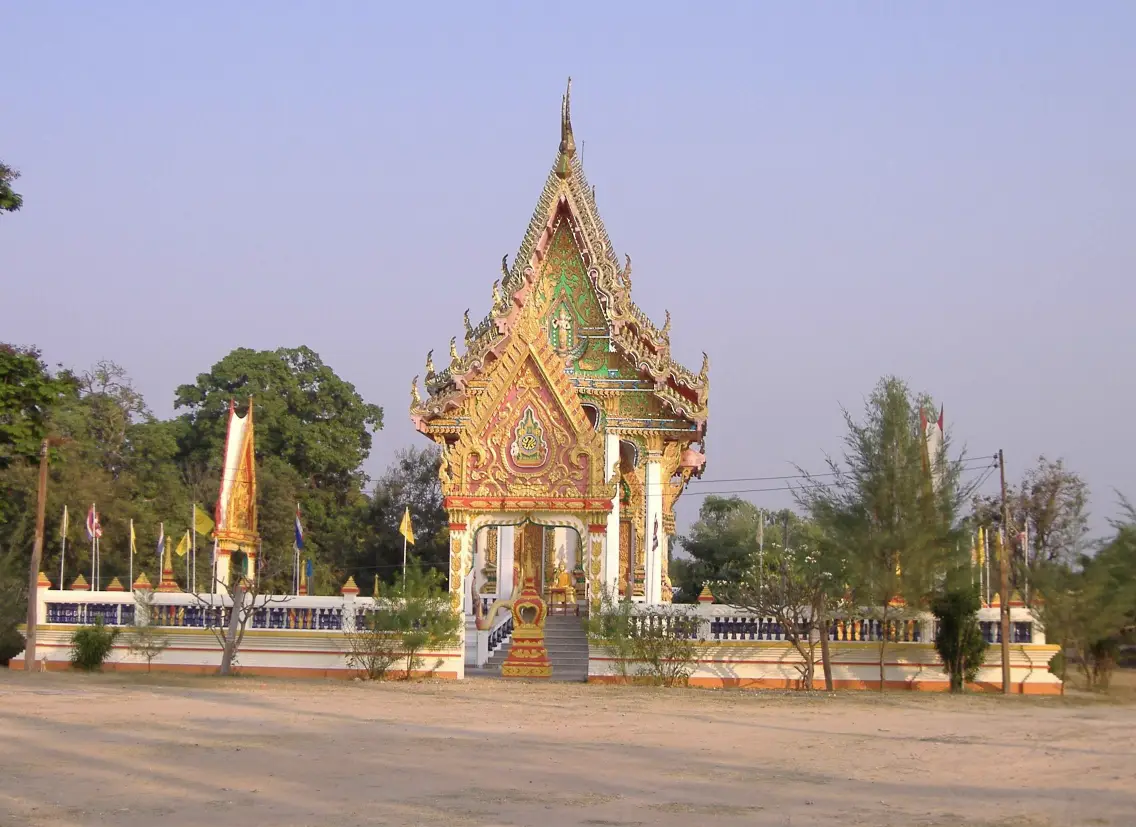
Wat Thung Sawang Hua Na Kham (Wat Ban Hua Na Kham)
Open Days: Daily
Opening Hours: 08.00 – 17.00
Wat Thung Sawang Hua Na Kham Surin, also known locally as Wat Ban Hua Na Kham, is an important community temple in Ban Hua Na Kham, Moo 3, Krabueang Subdistrict, Chumphon Buri District, Surin Province. This temple is closely connected with the history, faith, and everyday life of the village. It serves as a place for merit-making, Buddhist ceremonies, community gatherings, Dhamma listening, and local memory. Unlike large urban temples that attract visitors through grand architecture, Wat Thung Sawang Hua Na Kham is meaningful because it represents the living role of a rural Thai temple at the heart of a local community.
The temple’s story is closely associated with Luang Pho Hu Khon, a monk remembered in local oral history as an important figure in the early formation of the temple. According to elders in the village, Luang Pho Hu Khon came from Wat Ban Dong Bang together with the group of Nai Luang Phrom during the period when people settled in the Ban Hua Na Kham area. At first, he established a small monastic residence inside the village so that the newly settled community would have a place for worship, moral guidance, and Buddhist practice.
In the early period of settlement, a small monastic residence was essential to village life. It provided a sacred center where people could make merit, receive Buddhist teachings, perform ceremonies, and strengthen their sense of community. For a rural Isan village, a temple was never only a religious building. It was also a social institution, a place of memory, a community meeting point, and a source of emotional stability. Wat Thung Sawang Hua Na Kham grew from this practical and spiritual need.
The monastic residence was later moved from inside the village to a new site on public land east of the village, about 100 meters from the residential area. This area is known locally as Don Pu Chao. The temple land covers about 7 rai. Local elders say that in the past, on Buddhist holy days, sounds of gongs and drums could be heard from the present temple area. This story gives the site a sacred quality in local memory and helps explain why the community continued to regard the place with respect.
Luang Pho Hu Khon is regarded as the first abbot of Wat Thung Sawang Hua Na Kham. His role was not limited to leading religious ceremonies. He helped establish the spiritual foundation of the village. As the community grew, the temple developed with it. The transition from a small monastic residence to a proper village temple reflects the growth of Ban Hua Na Kham itself: from settlement, to community formation, to a stable village with its own religious center.
Today, Wat Thung Sawang Hua Na Kham is led by Phra Ajarn Prayote Wachirayano. The temple continues to function as a Buddhist place of worship and a community center. Local people visit the temple for merit-making, ceremonies, Buddhist holy days, family events, and communal activities. The abbot’s role in a rural temple includes not only maintaining the religious buildings, but also preserving the relationship between monks and laypeople, sustaining faith, and keeping the temple accessible to all generations.
The name “Wat Thung Sawang Hua Na Kham” reflects both landscape and community identity. “Thung Sawang” evokes an open field and the brightness of faith, while “Hua Na Kham” is the name of the village where the temple is located. The temple name therefore connects land, village, and religion in one expression. When local people speak of Wat Thung Sawang Hua Na Kham, they refer not only to a temple, but also to the shared memory and identity of Ban Hua Na Kham.
Krabueang Subdistrict is a Buddhist community, and temples play a central role in local life. Wat Thung Sawang Hua Na Kham is one of the religious institutions of the subdistrict. It is connected with Buddhist holy days, Kathin ceremonies, forest-robe offerings, ordinations, funerary rites, village merit-making, and community gatherings. Such temples form the cultural structure of rural Thailand, where religion, family, education, and social life remain deeply connected.
The charm of Wat Thung Sawang Hua Na Kham lies in its simplicity. Visitors should not expect a large tourist complex or monumental architecture. Instead, they will find a rural temple that belongs closely to its village. The temple courtyard, Dhamma hall, merit-making areas, and quiet surroundings show how Buddhism functions in everyday village life. This makes the temple valuable for travelers who want to understand Surin through real communities rather than only through famous landmarks.
On Buddhist holy days, the temple becomes especially meaningful. Local people gather to make merit, offer food to monks, listen to Dhamma, observe precepts, and meet one another. The local story of hearing gongs and drums on Buddhist holy days reflects the importance of sound in temple culture. In village life, the sound of a drum or gong calls people to the temple, marks sacred time, and turns an ordinary day into a day of religious awareness.
The temple’s location about 100 meters from the village allows it to remain close to community life while preserving a calm atmosphere for religious activities. Many rural temples in Isan are located on slightly raised ground or public land near the village. This arrangement gives the temple both accessibility and sacred distance. Wat Thung Sawang Hua Na Kham follows this pattern, making it a familiar yet spiritually distinct place for local residents.
The temple is also connected with children and local education. The Ban Hua Na Kham area includes an early childhood training center associated with Wat Thung Sawang Hua Na Kham. This reflects the broader role of Thai temples in rural society. A temple may serve not only adults who come for ceremonies, but also children, families, elders, and the wider community. In this way, Wat Thung Sawang Hua Na Kham is part of the social foundation of Krabueang Subdistrict.
Although Wat Thung Sawang Hua Na Kham is not one of the most widely promoted tourist temples in Surin, it has strong cultural value. It preserves the story of settlement, the memory of Luang Pho Hu Khon, the sacred significance of Don Pu Chao, and the continuing religious life of Ban Hua Na Kham. For travelers interested in local culture, this kind of temple offers a deeper understanding of how villages grow around Buddhist faith and how temples remain central to rural life.
A visit to Wat Thung Sawang Hua Na Kham gives travelers another perspective on Surin Province. Surin is often known for elephants, silk, Khmer ruins, and major city temples. However, the province is also made up of many small community temples that quietly sustain everyday faith. These temples are important because they show Buddhism not as a tourist display, but as a living practice connected with families, villages, and local memory.
Visitors should begin by paying respect at the main worship area of the temple, then spend time walking quietly around the grounds. If local residents or monks are present, visitors should speak politely and listen respectfully. Many stories about rural temples are kept in oral memory rather than written records. Listening to local people can make the visit more meaningful and help visitors understand the temple beyond its physical appearance.
The atmosphere of Wat Thung Sawang Hua Na Kham is best appreciated slowly. It is a place for quiet worship, simple merit-making, and respectful observation. Travelers should approach the temple as a living religious space, not as a staged attraction. Its value comes from its connection with the village, its history, and its continuing use by local people. This makes it suitable for cultural travelers who want to experience the quieter side of Surin.
The temple can also be included in a Chumphon Buri cultural route. Nearby places such as Thung Kula Lake, Wat Ko Kaeo Yannawa, Wat Pracha Sangkhom, and other local attractions help visitors understand the northern part of Surin Province. A half-day or full-day route can combine temple worship, rural scenery, local food, and lakeside relaxation. This kind of route is suitable for travelers who prefer local experiences over crowded tourist destinations.
Thung Kula Lake is one of the most convenient nearby places to combine with the temple. The large water body in Chumphon Buri District offers open scenery, lakeside food, resting areas, and a relaxed rural atmosphere. Visiting the temple and the lake on the same route allows travelers to experience both the spiritual and natural sides of the district.
Wat Ko Kaeo Yannawa is another nearby Buddhist site that can be included in the route. It has its own religious history and is connected with the construction of a pagoda and broader Buddhist activities. Visiting both Wat Thung Sawang Hua Na Kham and Wat Ko Kaeo Yannawa helps travelers see different types of temples in Chumphon Buri: one deeply rooted in a village community, and another with more prominent religious structures and wider ceremonial significance.
Getting to Wat Thung Sawang Hua Na Kham is most convenient by private car, rental car, or chartered vehicle. The temple is located in Ban Hua Na Kham, Krabueang Subdistrict, Chumphon Buri District, some distance from Surin city. Travelers should head toward Chumphon Buri District and then continue into Krabueang Subdistrict. Using the temple name or Ban Hua Na Kham as a navigation point is the most practical way to reach the site.
Getting There from Surin city takes about one hour or more depending on the route and road conditions. Travelers should follow the main road toward Chumphon Buri District, then continue to Krabueang Subdistrict and Ban Hua Na Kham. From Chumphon Buri town, the distance is shorter and suitable for combining with nearby local attractions. Group visitors should contact local people or the subdistrict office in advance if they plan to organize formal merit-making or a community visit.
There is no admission fee for general worship and merit-making at Wat Thung Sawang Hua Na Kham. Visitors may make donations according to their faith through the proper donation points provided by the temple. Donations should be made respectfully and in accordance with local temple practice. If visitors wish to offer items, arrange ceremonies, or visit as a group, they should ask the temple or local community first.
Temple etiquette is important. Visitors should dress modestly, keep shoulders covered, wear appropriate trousers or skirts, speak quietly, avoid entering monks’ private areas without permission, and not touch Buddha images or ritual objects improperly. Photography should be respectful and should not disturb monks or villagers who are making merit. Cleanliness is also important because a village temple is maintained through community care.
For international visitors, Wat Thung Sawang Hua Na Kham offers a valuable introduction to rural Buddhist life in Surin. The temple shows how Buddhism is woven into village life through merit-making, ceremonies, childhood learning, elder memory, and community identity. It is not a place designed primarily for tourism, and that is exactly what makes it meaningful. It allows visitors to see the authentic relationship between temple and village.
In summary, Wat Thung Sawang Hua Na Kham is a quiet but culturally important temple in Ban Hua Na Kham. Its story begins with Luang Pho Hu Khon and a small monastic residence, continues through the move to Don Pu Chao, and remains alive through the present role of the temple under Phra Ajarn Prayote Wachirayano. The temple is a spiritual record of the village, a place for merit-making, and a gateway to understanding local life in Chumphon Buri District.
Travelers who visit Wat Thung Sawang Hua Na Kham will gain a deeper view of Surin beyond famous landmarks. They will see the quiet strength of a rural temple, the role of monks in community life, the memory of early settlement, and the way Buddhist faith continues to shape village culture. Combined with Thung Kula Lake and other nearby places, the temple offers a meaningful local route for those who want to experience Surin with depth, respect, and cultural understanding.
| Name | Wat Thung Sawang Hua Na Kham Surin / Wat Ban Hua Na Kham |
| Location | Ban Hua Na Kham, Moo 3, Krabueang Subdistrict, Chumphon Buri District, Surin Province 32190 |
| Address | Wat Thung Sawang Hua Na Kham, Ban Hua Na Kham, Moo 3, Krabueang Subdistrict, Chumphon Buri District, Surin Province 32190, located at Don Pu Chao east of the village, about 100 meters from the community |
| Highlights | A rural village temple, the story of Luang Pho Hu Khon, Don Pu Chao sacred ground, community merit-making, early childhood learning area, and a local route connected with Thung Kula Lake |
| History | The temple began as a small monastic residence established by Luang Pho Hu Khon during the early settlement of Ban Hua Na Kham. It was later moved to public land at Don Pu Chao, covering about 7 rai, and has continued as the village temple of Ban Hua Na Kham |
| Name Origin | “Thung Sawang” evokes open fields and the brightness of faith, while “Hua Na Kham” is the name of the village where the temple is located |
| Distinctive Features | A community temple closely connected with village settlement, oral history, Buddhist holy days, local merit-making, and the rural Buddhist life of Krabueang Subdistrict |
| Travel Information | From Surin city, head toward Chumphon Buri District, then continue to Krabueang Subdistrict and Ban Hua Na Kham. The distance from Surin city is about 70 – 80 km depending on the route |
| Current Status | Open for worship, merit-making, and Buddhist community activities. The temple remains one of the religious institutions of Krabueang Subdistrict and continues to serve Ban Hua Na Kham |
| Open Days | Daily |
| Opening Hours | 08.00 – 17.00 |
| Fees | No Admission Fee For General Worship And Merit-Making |
| Facilities | Temple courtyard, merit-making area, Dhamma hall, religious ceremony area, early childhood training center area, toilets, and parking according to village temple conditions |
| Main Areas / Zones | 1. Main Worship Area 2. Dhamma Hall And Merit-Making Area 3. Temple Courtyard And Community Activity Area 4. Don Pu Chao Temple Ground 5. Wat Thung Sawang Hua Na Kham Early Childhood Training Center Area 6. Merit And Village Ceremony Area 7. Route Connecting Ban Hua Na Kham With The Temple |
| Important Rituals / Traditions | Buddhist holy day merit-making, Dhamma listening, food offerings to monks, Kathin, forest-robe offerings, ordinations, village merit ceremonies, funerary rites, and other Buddhist ceremonies of Ban Hua Na Kham |
| Abbot / Caretaker | Phra Ajarn Prayote Wachirayano, Abbot of Wat Thung Sawang Hua Na Kham; the temple serves Ban Hua Na Kham, Krabueang Subdistrict, Chumphon Buri District, Surin Province |
| Local Information Contact | Krabueang Subdistrict Administrative Organization, Tel. 044-060-573, 089-280-9079 |
| Nearby Tourist Attractions | 1. Thung Kula Lake, Phrai Khla Subdistrict, Chumphon Buri District, about 18 – 22 km 2. Wat Ko Kaeo Yannawa, Chumphon Buri District, about 16 – 20 km 3. Wat Pracha Sangkhom, Chumphon Buri District, about 12 – 16 km 4. Wat Pho Ngam Ban Yawuek, Chumphon Buri District, about 20 – 25 km 5. Tang Thaworn Melon Farm, Yawuek Subdistrict, Chumphon Buri District, about 22 – 28 km 6. Elephant Study Center, Ban Ta Klang, Tha Tum District, about 60 – 70 km |
| Nearby Restaurants | 1. Som-O Restaurant, Thung Kula Lake, about 18 – 22 km, Tel. 088-727-0064 2. Pa Ruai Restaurant, Thung Kula Lake, about 18 – 22 km, Tel. 092-440-9463 3. Ton Or Restaurant, Zone 3, Thung Kula Lake, about 18 – 22 km, Tel. 082-578-8531 4. Than Tawan Restaurant, Zone 3, Thung Kula Lake, about 18 – 22 km, Tel. 061-514-3803 5. Pae Je Sunee Restaurant, Thung Kula Lake Zone 7, about 18 – 22 km, Tel. 096-407-5858, 083-207-6703 6. Tha Pae Nong Nawa Pae Suk Samran Nawa, about 18 – 22 km, Tel. 093-538-9149, 097-080-6763 |
| Nearby Accommodations | 1. Modern New Resort, Krabueang Subdistrict, Chumphon Buri District, about 8 – 12 km, Tel. 088-341-7779 2. Okay Resort Chumphon Buri, about 12 – 16 km, Tel. 083-841-4170 3. Namnow Resort Chumphon Buri, about 14 – 18 km, Tel. 081-251-3405 4. Piamsuk Resort Chumphon Buri, about 14 – 18 km, Tel. 044-596-217 5. X-Keroy Resort & Hotel, Satuek District, Buriram Province, about 45 – 55 km, Tel. 082-148-6608 6. Sahapattana Grand Hotel, Satuek District, Buriram Province, about 45 – 55 km, Tel. 044-681-555 |
Frequently Asked Questions (FAQ)
Q: Where Is Wat Thung Sawang Hua Na Kham Located?
A: Wat Thung Sawang Hua Na Kham is located in Ban Hua Na Kham, Moo 3, Krabueang Subdistrict, Chumphon Buri District, Surin Province 32190.
Q: When Is Wat Thung Sawang Hua Na Kham Open?
A: The temple is open daily from 08.00 to 17.00.
Q: Is There An Admission Fee?
A: No. There is no admission fee for general worship and merit-making. Visitors may donate according to their faith.
Q: Who Is The Abbot Of Wat Thung Sawang Hua Na Kham?
A: Phra Ajarn Prayote Wachirayano is the abbot of Wat Thung Sawang Hua Na Kham.
Q: How Did Wat Thung Sawang Hua Na Kham Begin?
A: It began as a small monastic residence established by Luang Pho Hu Khon during the early settlement of Ban Hua Na Kham. It was later moved to Don Pu Chao east of the village.
Q: What Makes The Temple Important?
A: The temple is important as the spiritual center of Ban Hua Na Kham, preserving the story of Luang Pho Hu Khon, Don Pu Chao, Buddhist holy day traditions, and community merit-making.
Q: What Nearby Places Can Be Visited With The Temple?
A: Nearby places include Thung Kula Lake, Wat Ko Kaeo Yannawa, Wat Pracha Sangkhom, Wat Pho Ngam Ban Yawuek, and other local sites in Chumphon Buri District.
Q: What Should Visitors Wear To The Temple?
A: Visitors should dress modestly, wear appropriate trousers or skirts, speak quietly, avoid disturbing monks or villagers, and keep the temple area clean.
 Category: ●Places of Worship
 Group: ●Temple
Last Update : 2 MonthAgo
 Last Update : 2 MonthAgo
 Click to Access the Navigation Map GPS
Wat Thung Sawang Hua Na Kham (Wat Ban Hua Na Kham) Map
Recommend

 Art, Culture and Heritage
 Historical Sites and Monuments(11)
 Landmarks and Memorials(2)
 Art, Craft Centres, Tradition(5)
 Museums(1)
Temple(15)
Museums(1)
Temple(15)
 Other Sacred Sites(1)
 Suburban Living
 Village, Community(9)
 Local Market(1)
 Nature and Wildlife
 National Parks and Marine Reserves(2)
 Mountain (Doi)(2)
 Dam, Reservoir, Lake(6)
 Waterfalls(1)
 River, Canal(2)
 Other natural attractions(4)
 Entertainment and Agricultural
 Farms, Parks and Ecotourism(2)


