
lovethailand home >Northeastern Travel Attractions >Surin Travel Attractions >Si Khora Phum >Nong Lek > Wat Nong Lek
TL;DR: Wat Nong Lek is located at Ban Nong Lek, Moo 3, Kra-Om Subdistrict, Samrong Thap District, Surin Province 32170, open Daily, hours 08.00 – 17.00.
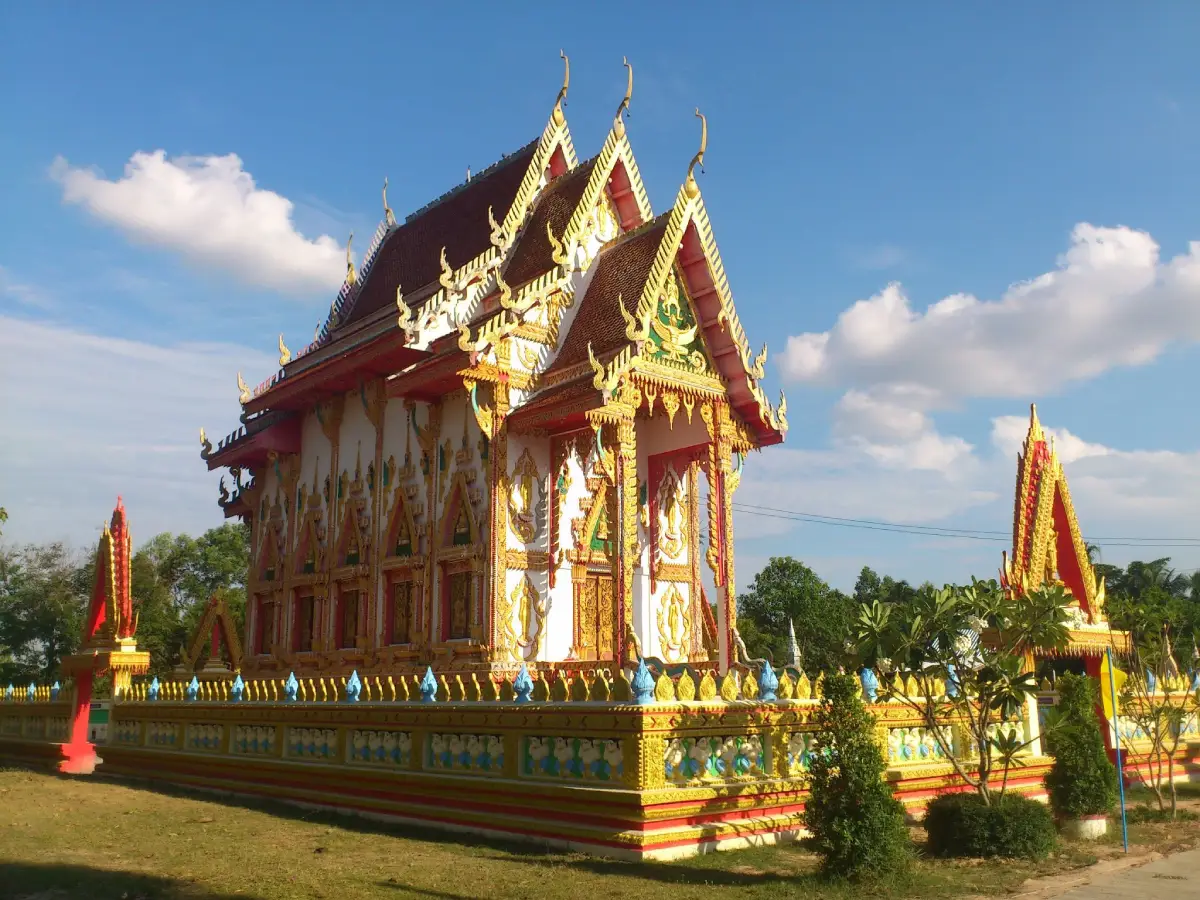
Wat Nong Lek
Open Days: Daily
Opening Hours: 08.00 – 17.00
Wat Nong Lek Surin, also known as Wat Ban Nong Lek, is a community Buddhist temple located in Ban Nong Lek, Moo 3, Kra-Om Subdistrict, Samrong Thap District, Surin Province. It is a local temple under the Mahā Nikāya monastic order and has long served as the spiritual center of Ban Nong Lek. The temple was established in 1941 and covers about 8 rai and 2 ngan of land. One of its most meaningful features is an old ordination hall that local villagers have continued to maintain as part of the temple’s shared heritage.
Wat Nong Lek is not a large urban tourist temple. Its value lies in its role as a living village temple where Buddhism remains closely connected with everyday community life. Villagers come here for merit-making, Buddhist holy days, Kathin ceremonies, forest-robe offerings, ordinations, family rituals, funerary rites, and community gatherings. For visitors who want to understand rural Surin beyond famous landmarks, elephants, silk, or Khmer ruins, this temple offers a clear example of how Buddhism functions at village level.
The history of Wat Nong Lek reflects the gradual formation of a rural community in lower northeastern Thailand. Before the temple was officially established in 1941, the site had roots as a monastic resting place and a Buddhist space cared for by local people. Traveling monks and monks who stayed in the area helped create a place for villagers to make merit, receive teachings, and hold ceremonies. Over time, the community developed the site into a stable village temple recognized within the formal monastic structure.
The name “Nong Lek” is closely tied to the village itself. In the local landscape, names of villages, ponds, fields, roads, schools, and temples often preserve the memory of settlement. Wat Nong Lek is therefore not merely a temple with an administrative name. It is part of the identity of Ban Nong Lek. The temple, the village, the school, the roads, and the surrounding farmland together form a cultural landscape where religion and daily life are closely connected.
Kra-Om Subdistrict and Samrong Thap District are agricultural areas where community relationships remain important. In such rural settings, temples serve many functions at once. They are places of worship, meeting spaces, moral centers, ceremonial grounds, and emotional shelters for local people. Wat Nong Lek plays this role for Ban Nong Lek and nearby communities. It allows villagers to practice Buddhism close to home without needing to travel to larger temples in the city.
The old ordination hall of Wat Nong Lek deserves special attention. It is one of the temple’s most meaningful physical features because it represents the devotion of villagers who have continued to preserve it. In a rural temple, an old ordination hall is not only an architectural structure. It is a sacred space where important monastic acts and community memories have taken place. Maintaining it is a way of preserving both Buddhist faith and the history of the village.
The temple’s monastic history includes Phra Athikan Thongphun Yanatharo, recorded in the temple history as an important monk connected with the development of Wat Nong Lek in the modern period. Current updated information identifies Phra Khru Wibun Panyathon as the abbot of Wat Nong Lek. This continuity of monastic leadership helps the temple remain active as a Buddhist institution and allows local faith to continue across generations.
In a rural temple, the role of monks goes beyond performing rituals. Monks offer moral guidance, teach Dhamma, provide counsel, lead ceremonies, and maintain the relationship between the temple and the village. Wat Nong Lek continues to function through this close connection between monks and laypeople. The temple remains meaningful because villagers still use it regularly and because monastic presence gives the community a trusted spiritual center.
As a Mahā Nikāya temple, Wat Nong Lek belongs to the wider Thai Sangha structure while remaining firmly rooted in local life. This makes the temple both a village institution and part of the broader Buddhist administration of Surin Province. The temple supports Buddhist observances, community ceremonies, merit-making, and the preservation of local religious customs. Its role is modest in size but substantial in cultural meaning.
Within Samrong Thap District, Wat Nong Lek represents the importance of village temples in rural society. Larger temples may function at city or provincial level, but village temples carry Buddhism into everyday life. They are the places where people make merit as children, return for family ceremonies as adults, and continue to visit in old age. Wat Nong Lek has this kind of long-term relationship with the people of Ban Nong Lek.
Annual merit-making events reveal the strength of the temple’s community role. Kathin, forest-robe offerings, Buddhist holy days, ordinations, and family merit ceremonies bring villagers together. People help prepare food, arrange ceremonial objects, welcome guests, and support the temple according to their ability. These events are not only religious occasions. They also renew community ties and reconnect relatives who may have moved away for work.
Buddhist holy days are especially important in village life. Local people come to the temple to offer food to monks, listen to Dhamma, observe precepts, and dedicate merit to ancestors. In rural communities, Buddhist holy days create a rhythm that balances work, family, and spiritual reflection. Wat Nong Lek provides a place where villagers can pause from farming, work, and daily responsibilities to focus on generosity, morality, and peace of mind.
Ordination ceremonies are another important part of the temple’s life. In Thai Buddhist culture, ordination connects sons, parents, relatives, the temple, and the whole village. When an ordination is held, Wat Nong Lek becomes the center of the ceremony. Family members and villagers come together to support the novice or monk, make merit, and share in the religious joy of the event. These ceremonies help keep Buddhist tradition alive at community level.
Funerary rites also show the temple’s importance. When a family faces loss, the temple becomes a place of chanting, remembrance, and communal support. Monks chant Buddhist texts, relatives gather, and neighbors help the grieving family. In this way, Wat Nong Lek is present not only during joyful occasions, but also during the most difficult moments of village life. This is one reason village temples remain central to Thai rural society.
Wat Nong Lek also preserves local history. The story of its official establishment in 1941, its earlier roots as a monastic resting place, its old ordination hall, and its connection with the surrounding village all help explain how Ban Nong Lek developed as a community. The temple is therefore a historical marker as well as a religious space. It records the way local people organized their social and spiritual life around Buddhism.
The area around the temple reflects the character of a rural Surin village. Farmland, local roads, homes, and community institutions form the wider setting of the temple. This relationship between temple, school, village, and agricultural landscape is important because it shows how religion, education, family, and work coexist in rural life. A visitor who walks quietly around the temple can understand this relationship more clearly than from a map alone.
The main attraction of Wat Nong Lek is its authenticity as a community temple. Visitors will find a calm village atmosphere, a preserved old ordination hall, a temple courtyard used for community events, and religious spaces that are still active. It is not a commercial attraction. Its meaning comes from real use by local people. This makes the temple suitable for cultural travelers who prefer quiet, local places over crowded tourist sites.
Visitors interested in local architecture should pay attention to the old ordination hall. Old temple buildings in rural Thailand often reflect local craftsmanship, available materials, and the collective effort of villagers. Even when they are not as elaborate as royal temples or major tourist temples, they are valuable because they show how ordinary communities built and preserved sacred spaces. At Wat Nong Lek, the old ordination hall is part of the temple’s cultural identity.
A respectful visit should begin with paying homage at the main worship area. Visitors may then walk quietly around the temple grounds and observe the old ordination hall, courtyard, and community spaces. Temple etiquette is important: dress modestly, speak quietly, avoid entering monks’ private areas without permission, and do not disturb monks or villagers who are making merit. If visitors want to learn more about the temple history, they should ask monks or local elders politely.
The best time to visit is in the morning or late afternoon, when the weather is more comfortable and the temple atmosphere is calm. Those who wish to observe local religious life may visit on Buddhist holy days or during major Buddhist festivals such as Makha Bucha, Visakha Bucha, Asalha Bucha, Buddhist Lent, the end of Buddhist Lent, or Kathin season. During ceremonies, visitors should be especially careful not to interrupt ritual activities.
Wat Nong Lek can be included in a cultural route through Samrong Thap District. Nearby places include the Four Ethnic Groups Market in Samrong Thap, local community areas, Sikhoraphum Sanctuary, Surin National Museum, Wat Burapharam, and Surin City Pillar Shrine. A traveler can begin with Wat Nong Lek to see a rural temple, stop for food in Samrong Thap, then continue to historical or cultural attractions in nearby districts.
The Four Ethnic Groups Market in Samrong Thap helps visitors understand the cultural diversity of this part of Surin. Surin Province is home to several cultural groups, including Kui, Khmer, Lao, and Thai Khorat communities. Combining a visit to Wat Nong Lek with a local market or community area helps visitors see how Buddhism, village life, food, language, and local identity exist together in daily life.
Sikhoraphum Sanctuary is another suitable place to combine with Wat Nong Lek. It represents the ancient Khmer cultural layer of Surin, while Wat Nong Lek represents the living Buddhist life of a modern rural community. Visiting both places in one trip gives travelers a broader view of lower-Isan culture: ancient stone sanctuaries, present-day temples, local villages, and the continuity of sacred landscapes.
Getting There to Wat Nong Lek is most convenient by private car, rental car, or chartered vehicle. From Surin city, travel toward Samrong Thap District, then continue to Kra-Om Subdistrict and Ban Nong Lek. The distance from Surin city is about 55 km, depending on the route. From Samrong Thap town, the journey is shorter and can be combined with restaurants, local markets, or other nearby community sites.
Because several places share the name Wat Nong Lek in Surin and other provinces, visitors should confirm that their navigation destination is Wat Nong Lek, Ban Nong Lek, Moo 3, Kra-Om Subdistrict, Samrong Thap District, Surin Province. This detail is important for avoiding confusion with temples of the same name in other districts.
There is no admission fee for general worship and merit-making at Wat Nong Lek. Visitors may make donations according to their faith through proper temple donation points. If visiting as a group, offering many items, or organizing a formal merit-making activity, it is appropriate to contact the temple or local community in advance. This keeps the visit orderly and respectful.
Facilities at the temple are typical of a village temple. Visitors can expect a main worship area, old ordination hall, temple courtyard, merit-making area, Dhamma or activity spaces, toilets, and parking according to local conditions. It is best to approach the temple as a community religious space rather than a full-service tourist attraction. Visitors should help keep the area clean and preserve the quiet atmosphere.
Restaurants for visitors are mostly located in Samrong Thap town and along the Surin – Samrong Thap route. Options include cafés, seafood restaurants, grilled pork restaurants, noodle shops, and local Thai restaurants. Planning meals before or after the temple visit is practical because the immediate village area may have fewer restaurant choices than the district town.
Accommodation near Wat Nong Lek includes resorts in Samrong Thap and nearby districts such as Sikhoraphum, as well as hotels in Surin city. Staying in Samrong Thap or Sikhoraphum is practical for travelers who want to stay closer to the temple, while staying in Surin city is better for those who want more choices of hotels, restaurants, transport, and other attractions.
For international visitors, Wat Nong Lek is a clear example of a rural Thai Buddhist temple. It shows how Buddhism is woven into village life through merit-making, holy days, ordinations, funerary rites, and community cooperation. It is not a temple designed mainly for tourism, and this is precisely why it is meaningful. It allows visitors to see living Buddhism at the level of a real village community.
Wat Nong Lek Surin is therefore suitable for travelers who want to understand the quiet and local side of Surin Province. The temple was officially established in 1941, preserves an old ordination hall, remains active under monastic leadership, and continues to serve Ban Nong Lek as a center of faith and community life. A visit here offers calm, simplicity, and a deeper view of how local Buddhist culture continues in rural Surin.
In summary, Wat Nong Lek is a village temple with deep community value. Its importance is not measured by size or fame, but by its connection with the people of Ban Nong Lek. It preserves local Buddhist life, old temple heritage, communal memory, and the relationship between monks and villagers. Travelers who visit respectfully will gain a more grounded understanding of Surin beyond its better-known tourist attractions.
| Name | Wat Nong Lek Surin / Wat Ban Nong Lek |
| Location | Ban Nong Lek, Moo 3, Kra-Om Subdistrict, Samrong Thap District, Surin Province 32170 |
| Address | Wat Nong Lek, Ban Nong Lek, Moo 3, Kra-Om Subdistrict, Samrong Thap District, Surin Province 32170 |
| Highlights | A rural community temple, old ordination hall preserved by local villagers, official establishment in 1941, peaceful village atmosphere, and a central role in Ban Nong Lek merit-making traditions |
| History | Established as a temple in 1941, with earlier roots as a monastic resting place and community-supported Buddhist site before developing into the village temple of Ban Nong Lek under the Mahā Nikāya order |
| Name Origin | The name comes from Ban Nong Lek, the village where the temple is located, reflecting the close connection between the temple and the local community |
| Distinctive Features | A peaceful village temple covering about 8 rai and 2 ngan, with an old ordination hall, merit-making areas, and an active role in Buddhist holy days, Kathin, forest-robe offerings, ordinations, and funerary rites |
| Travel Information | From Surin city, head toward Samrong Thap District, then continue to Kra-Om Subdistrict and Ban Nong Lek. The distance is about 55 km and is suitable for private cars, rental cars, or chartered vehicles |
| Current Status | Open for worship, merit-making, and Buddhist community activities. The temple remains an active rural temple serving Ban Nong Lek and nearby communities |
| Open Days | Daily |
| Opening Hours | 08.00 – 17.00 |
| Fees | No Admission Fee For General Worship And Merit-Making |
| Facilities | Old ordination hall, main worship area, temple courtyard, merit-making space, religious activity area, toilets, and parking according to village temple conditions |
| Main Areas / Zones | 1. Old Ordination Hall 2. Main Buddha Image And Worship Area 3. Dhamma Hall Or Merit-Making Area 4. Temple Courtyard For Village Activities 5. Buddhist Ceremony And Funerary Rite Area 6. Monastic Residence Area 7. Route Connecting Ban Nong Lek Community With The Temple |
| Important Rituals / Traditions | Buddhist holy day merit-making, Dhamma listening, food offerings to monks, Kathin, forest-robe offerings, ordinations, village merit ceremonies, funerary rites, and local Buddhist ceremonies of Ban Nong Lek |
| Abbot / Caretaker | Phra Khru Wibun Panyathon, Abbot of Wat Nong Lek; the temple history also records Phra Athikan Thongphun Yanatharo as an important former monastic leader in the temple’s development period |
| Local Information Contact | Kra-Om Subdistrict Administrative Organization, Tel. 081-185-4646 |
| Nearby Tourist Attractions | 1. Four Ethnic Groups Market, Samrong Thap Municipality, about 12 km 2. Samrong Thap District Town And Local Market Area, about 12 km 3. Sikhoraphum Sanctuary, Sikhoraphum District, about 32 km 4. Surin National Museum, about 55 km, Tel. 044-513-272, 044-513-274 5. Wat Burapharam Royal Temple, about 58 km 6. Surin City Pillar Shrine, about 58 km |
| Nearby Restaurants | 1. Kaokan Cafe, Samrong Thap District, about 13 km, Tel. 093-487-6290 2. Fresh Seafood Restaurant, Samrong Thap District, about 11 km, Tel. 082-488-9383 3. Phet Lamphu Mookata, Samrong Thap Branch, about 12 km, Tel. 044-569-470 4. N’Joy Coffee Thu, Samrong Thap District, about 12 km, Tel. 082-449-5254 5. Kuay Tiew Ruea Mor Din Nai Kon 341 Surin – Samrong Thap, about 13 km, Tel. 080-073-1956 6. Prathumphon Restaurant, Samrong Thap District, about 13 km, Tel. 082-368-8971 |
| Nearby Accommodations | 1. Huai Saeng Chan Resort, Samrong Thap District, about 12 km, Tel. 044-569-375 2. Jamjuree Resort, Sikhoraphum District, about 32 km, Tel. 044-560-289, 089-190-5156 3. Songobdee Resort, Surin – Sikhoraphum Route, about 48 km, Tel. 083-989-8961 4. The Wood Surin, Mueang Surin District, about 58 km, Tel. 063-023-7999 5. Thong Tarin Hotel, Mueang Surin District, about 58 km, Tel. 044-514-281, 085-300-8858 6. Maneerote Hotel Surin, Mueang Surin District, about 59 km, Tel. 044-514-569 |
Frequently Asked Questions (FAQ)
Q: Where Is Wat Nong Lek Surin Located?
A: Wat Nong Lek is located in Ban Nong Lek, Moo 3, Kra-Om Subdistrict, Samrong Thap District, Surin Province 32170.
Q: When Is Wat Nong Lek Open?
A: The temple is open daily from 08.00 to 17.00.
Q: Is There An Admission Fee?
A: No. There is no admission fee for general worship and merit-making. Visitors may donate according to their faith.
Q: When Was Wat Nong Lek Established?
A: Wat Nong Lek was officially established in 1941, with earlier roots as a monastic resting place and a Buddhist site supported by local villagers.
Q: What Is The Main Highlight Of Wat Nong Lek?
A: The main highlight is its old ordination hall preserved by local villagers, along with its peaceful rural temple atmosphere and its role as the merit-making center of Ban Nong Lek.
Q: Who Is The Current Abbot Of Wat Nong Lek?
A: Current updated information identifies Phra Khru Wibun Panyathon as the abbot of Wat Nong Lek. The temple history also records Phra Athikan Thongphun Yanatharo as an important former monastic leader.
Q: What Nearby Places Can Be Visited With Wat Nong Lek?
A: Nearby places include the Four Ethnic Groups Market in Samrong Thap, Sikhoraphum Sanctuary, Surin National Museum, Wat Burapharam Royal Temple, and Surin City Pillar Shrine.
Q: What Should Visitors Wear To Wat Nong Lek?
A: Visitors should dress modestly, wear appropriate trousers or skirts, speak quietly, avoid disturbing monks or villagers, and keep the temple area clean.
 Category: ●Places of Worship
 Group: ●Temple
Last Update : 2 MonthAgo
 Last Update : 2 MonthAgo
 Click to Access the Navigation Map GPS
 Art, Culture and Heritage
 Historical Sites and Monuments(11)
 Landmarks and Memorials(2)
 Art, Craft Centres, Tradition(5)
 Museums(1)
Temple(15)
Museums(1)
Temple(15)
 Other Sacred Sites(1)
 Suburban Living
 Village, Community(9)
 Local Market(1)
 Nature and Wildlife
 National Parks and Marine Reserves(2)
 Mountain (Doi)(2)
 Dam, Reservoir, Lake(6)
 Waterfalls(1)
 River, Canal(2)
 Other natural attractions(4)
 Entertainment and Agricultural
 Farms, Parks and Ecotourism(2)


