
lovethailand home >Northeastern Travel Attractions >Surin Travel Attractions >Samrong Thap >Nong Phai Lom > Wat Sawang Arom (Changkhao)
TL;DR: Wat Sawang Arom (Changkhao) is located at Ban Changkhao, Moo 10, Nong Phai Lom Subdistrict, Samrong Thap District, Surin Province 32170, open Daily, hours 08.00 – 17.00.
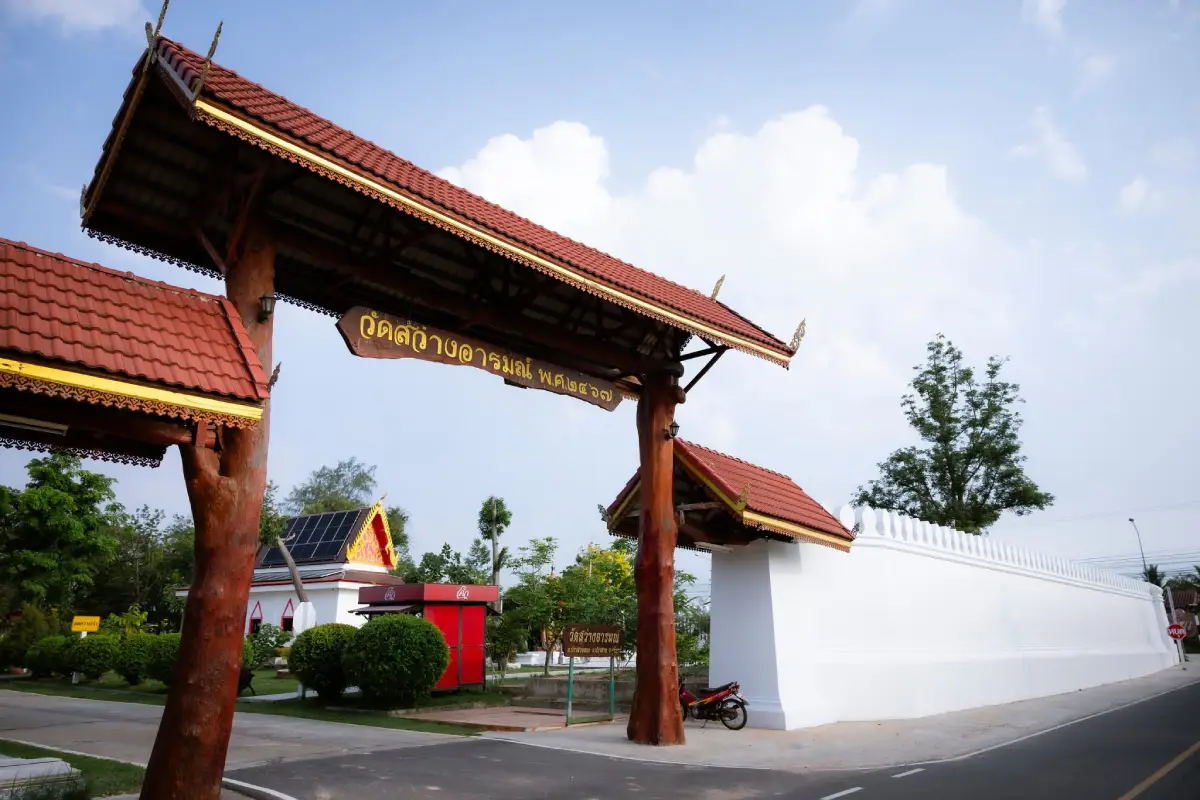
Wat Sawang Arom (Changkhao)
Open Days: Daily
Opening Hours: 08.00 – 17.00
Wat Sawang Arom (Changkhao) Surin, also known historically as Wat Ban Changkhao, is an old community Buddhist temple located in Ban Changkhao, Moo 10, Nong Phai Lom Subdistrict, Samrong Thap District, Surin Province. The temple belongs to the Mahā Nikāya monastic order and covers about 7 rai, 2 ngan, and 30 square wah of land. It has long served as the spiritual center of Ban Changkhao, a rural community with deep Kui or Suai cultural roots. The temple is known for its peaceful and shady grounds, its dignified sermon halls, its old ordination hall tradition, its ancient Buddha images, and its strong historical role as a center of Buddhist education in the Samrong Thap area.
The name Wat Sawang Arom means a temple of bright or serene mind, but local memory still closely connects the temple with its earlier name, Wat Ban Changkhao. The name “Changkhao” is linked to the Kui language and local oral history. According to community memory, the word refers to bears that once came to drink water from the village pond when the original settlement area was still surrounded by forest. For this reason, the temple is not only a Buddhist site. It is part of the origin story of Ban Changkhao and reflects the connection between language, landscape, settlement, and local belief.
Ban Changkhao was founded in 1757 by Nai Khun Suriwong and a group of Kui people who migrated from Ban Siri in Kra-Om Subdistrict. At first, the settlement consisted of only 7 households on the western side of the village pond. Later, after a serious epidemic and local concerns connected with the original settlement site, villagers moved to the northern side of the pond in 1854. They then donated land together to establish a temple as the spiritual center of the village. Wat Sawang Arom therefore grew directly from community faith and has remained inseparable from the identity of Ban Changkhao ever since.
The temple began to take clear form in 1873 when Phra Achan Suk Sumalu led villagers to build a small wooden kuti for monks to stay during the rains retreat. At that time, Nai Boonchan Simachan served as the village headman of Ban Changkhao. In 1877, Phra Achan Lu Simachan led villagers to build a large wooden sermon hall with a corrugated metal roof, a wooden bell tower, and a brick-and-plaster ordination hall with wooden posts and a corrugated metal roof. The temple received its royal boundary for the ordination hall in 1880, confirming its religious status and making it one of the most developed temples in the subdistrict at that time.
Wat Sawang Arom became especially important because of its role in Buddhist education. Between 1903 and 1942, the temple had as many as about 150 monks and novices in residence because it operated as a Dhamma study center teaching Nak Tham levels of Buddhist education. Many monks and novices who studied at the temple later helped develop other temples, took on monastic administrative roles, or entered public service after leaving the monkhood. This history shows that Wat Sawang Arom was once a major source of Buddhist knowledge and religious training in the Samrong Thap area.
The temple’s educational role made it more than a village place of worship. It served as a center of knowledge, discipline, and Dhamma transmission. Local people supported the temple strongly because they saw its value for both religious life and community advancement. The reputation of Wat Sawang Arom as a Dhamma study center helped give Ban Changkhao a respected place in the religious landscape of Nong Phai Lom Subdistrict and nearby areas.
The ordination hall is one of the most important sacred areas of the temple. The first ordination hall, built in 1877, followed an old Isan style using brick, plaster, wooden posts, and a corrugated metal roof. Inside it was a principal Buddha image made of stucco in the Mara-vijaya posture. In 1962, during the time of Phra Achan Wankham as abbot, the old ordination hall had become too damaged to restore, and the temple grounds were low and prone to flooding. The roof structure of the old ordination hall was removed, the old principal Buddha image was preserved, and a new ordination hall was built over the original consecrated area after the ground was raised.
The principal Buddha image in the ordination hall is one of the most important sacred objects at Wat Sawang Arom. It is more than 100 years old and is made of stucco in the Mara-vijaya posture by local craftsmen. The lap width is about 1.90 meters, and the height from base to the top of the Buddha’s head is about 2.45 meters. The original base was about 2 meters high, though the base area was covered when the new ordination hall was built over the old site. This Buddha image connects the present temple directly with the earlier ordination hall and the faith of past generations.
The temple also preserves ancient wooden Buddha images more than 100 years old. These images, carved in the Mara-vijaya posture by local craftsmen, were originally kept in the old ordination hall. They come in several sizes, including lap widths of about 9 inches, 7 inches, 5 inches, and 3 inches, totaling more than ten images. Their value lies not in grandeur, but in their age, craftsmanship, and connection with local devotion. They are part of the spiritual heritage of Ban Changkhao.
During the period of Phra Khru Suchit Thammanurak, also known as Sanguan Santacitto, the temple requested a new royal boundary in 2006 because the original boundary document had been lost. Phra Khru Suchit Thammanurak was an important former abbot and the first monk of Wat Sawang Arom to receive the title of Phra Khru. He also served as an ecclesiastical subdistrict chief. He played a major role in developing the temple, including the construction of new sermon halls, new monks’ residences, and several facilities that remain visible today.
The temple grounds are organized into 4 main zones: the Buddhavasa area, the Dhammavasa area, the monastic residence area, and the funerary and public activity area. The Buddhavasa area includes the ordination hall and the main sacred Buddha image. The Dhammavasa area includes sermon halls, bell towers, kitchen facilities, and utility buildings. The monastic residence area includes monks’ residences and meditation kutis. The funerary and public area includes the crematorium, funeral hall, former abbots’ memorial chedi, Pu Ta Shrine, concrete courtyard, parking area, community activity space, and shaded garden areas.
The Dhammavasa area contains 2 important sermon halls. The first is a Thai-style reinforced concrete building with tiled roof, glass doors and windows, and tiled floor, measuring about 18 meters wide and 32 meters long. The second is an applied Thai-style reinforced concrete building with tiled floor and Thai-style roof, measuring about 16 meters wide and 28 meters long. These halls are among the temple’s most visually dignified and functional buildings. They support merit-making, Dhamma listening, meetings, Buddhist ceremonies, village activities, and events organized by local monastic and public bodies.
The sermon halls are important because they show how the temple functions as a public community space. In rural Thai temples, a sermon hall is not used only for listening to monks teach Dhamma. It is also a place where villagers gather, hold ceremonies, welcome guests, organize community meetings, and work with local authorities. At Wat Sawang Arom, the halls also support monastic training activities, including Dhamma outreach training for the Nong Phai Lom subdistrict monastic community.
The monastic residence area includes newer monks’ residences built to replace older wooden structures. The main residence is an applied Thai-style reinforced concrete building with a tiled roof, measuring about 12 meters wide and 15 meters long. There is also a former abbot’s residence, meditation kutis, and many toilets. Visitors should treat this area with special respect because it is where monks live, rest, study, and practice. It is not an ordinary public sightseeing area.
The funerary and public activity zone shows the temple’s deep role in community life. It includes the crematorium, funeral hall, former abbots’ memorial chedi, Pu Ta Shrine, parking area, and concrete courtyard used for village activities. This zone supports funerary rites, memorial ceremonies, village merit-making, and public events. It shows that Wat Sawang Arom serves local people through every stage of life, not only during joyful religious occasions but also during moments of loss and remembrance.
The temple also has old Bodhi trees, landscaped areas, a Dhamma courtyard, small forest areas, and shaded spaces. Local people have continued to support the temple by donating additional land, developing water areas, and planting trees to make the grounds more peaceful. The calm atmosphere of Wat Sawang Arom therefore comes not only from nature, but from continuous community care. The temple is a shared space that villagers have preserved together.
The Pu Ta Shrine inside the temple reflects the coexistence of Buddhism and local belief in lower northeastern Thailand. In Kui and Isan communities, respect for ancestors, guardian spirits, and sacred local beings remains part of village life. The shrine does not conflict with Buddhism; instead, it shows how local communities maintain multiple layers of faith within one sacred landscape. Wat Sawang Arom therefore represents both Buddhist devotion and local cultural identity.
Current temple history identifies Phra Aphai Paphassaro as acting abbot and caretaker of Wat Sawang Arom. Phra Khru Suchit Thammanurak, or Sanguan Santacitto, remains an important former abbot remembered for his contribution to temple development. He was the first titled Phra Khru of the temple and served as an ecclesiastical subdistrict chief. After his passing in 2016, he donated his body as a cadaver teacher to Khon Kaen University for medical education, which added another meaningful dimension to his legacy of service and generosity.
The recorded line of abbots includes Phra Achan Suk, Phra Achan Lu, Phra Achan Suri, Phra Achan Sali, Phra Achan Thongsai, Phra Achan Boonmee, Phra Achan Duang, Phra Achan Wankham, Phra Khru Suchit Thammanurak, and Phra Aphai Paphassaro. This line of monastic leadership shows that Wat Sawang Arom has been maintained across many generations. The temple is a shared heritage created by monks and villagers over time, not the work of only one period or one person.
Wat Sawang Arom continues to play an important role in annual community religious life. Key activities include Buddhist holy day merit-making, Dhamma listening, food offerings to monks, Kathin, forest-robe offerings, ordinations, Buddhist Lent, the end of Buddhist Lent, funerary rites, Mahachat sermons, and Dhamma outreach training for the Nong Phai Lom monastic community. These activities keep the temple active throughout the year and make it a living center of faith.
The Mahachat sermon is especially meaningful because it teaches the Vessantara Jataka, a Buddhist story centered on generosity, sacrifice, and compassion. When the temple holds a Mahachat sermon, villagers gather to listen, make merit, support the temple, and strengthen community bonds. This type of event preserves both Buddhist teaching and local tradition. It also gives people who have moved away from the village a reason to return and reconnect with their home community.
Kathin and forest-robe offerings reveal the strength of local faith. After Buddhist Lent, villagers and devotees come together to offer robes, donations, and necessary items to the monks. These ceremonies help maintain temple buildings, support monastic life, and renew the relationship between monks and laypeople. At Wat Sawang Arom, such events are part of the temple’s continuing life and show the devotion of Ban Changkhao people.
Buddhist holy days are important in the rhythm of rural life. Villagers come to the temple to offer food, receive precepts, listen to Dhamma, and dedicate merit to ancestors. For an agricultural community, holy days create moments of pause from farming, gardening, trade, and family duties. The temple helps people return to gratitude, morality, and mental calm.
Ordination ceremonies are another important part of the temple’s role. In Thai Buddhist culture, ordination connects sons, parents, relatives, monks, and the whole village. When an ordination takes place, the temple becomes the center of the ceremony. Villagers help prepare the venue, welcome guests, and share merit. This makes the temple a place of joy, gratitude, and continuity of Buddhism at community level.
Funerary rites and memorial ceremonies show another essential role of Wat Sawang Arom. When a family experiences loss, the temple becomes a place for chanting, merit dedication, remembrance, and community support. Monks lead the rites, relatives gather, and neighbors help one another. This makes the temple a refuge in difficult times and a place where compassion becomes visible through community action.
A meaningful visit to Wat Sawang Arom should begin with paying respect to the principal Buddha image in the ordination hall. Visitors can then continue to the sermon halls, bell tower, former abbots’ memorial chedi, Pu Ta Shrine, Dhamma courtyard, gardens, and shaded areas around the temple. Those who wish to make merit may offer donations or Sangha Dana through proper temple channels.
Visitors should dress modestly, speak quietly, avoid entering monastic residence areas without permission, avoid disturbing monks or worshippers, and keep the temple clean. If visiting during a ceremony or community event, visitors should give priority to the ritual space and follow guidance from temple caretakers or local residents. This is a living community temple, so respectful behavior is essential.
Getting There to Wat Sawang Arom (Changkhao) is most convenient by private car, rental car, or chartered vehicle. From Surin city, travel toward Samrong Thap District, then continue to Nong Phai Lom Subdistrict and Ban Changkhao. The distance from Surin city is about 58 km depending on the route. From Samrong Thap town, the temple is about 5 km away. Visitors should navigate to “Wat Sawang Arom, Ban Changkhao, Nong Phai Lom Subdistrict, Samrong Thap District” to avoid confusion with other temples of the same name.
There is no admission fee for general worship, merit-making, and ordinary temple visits. Visitors may donate according to their faith. Those who wish to organize a group activity, make a formal offering, or study the temple history should contact the temple or local community in advance, especially during major merit-making events or when the sermon halls are being used for monastic and community activities.
Wat Sawang Arom can be included in a Samrong Thap cultural route. Nearby places include the Four Ethnic Groups Market, Wat Takhian Phositaram, Wat Ket Worararam, Wat Muen Si Yai, Wat Bun Sano, Sikhoraphum Sanctuary, and Surin National Museum. This route is suitable for travelers interested in old temples, Kui community history, Buddhist education, local belief, and rural Surin culture.
For international visitors, Wat Sawang Arom (Changkhao) offers a valuable introduction to Surin at community level. The temple tells the story of Kui settlement, village relocation, the development of a Buddhist center, Dhamma education, ancient Buddha images, and the continuing role of monks and villagers in preserving a sacred place. It is not a commercial attraction, but a real rural temple where Buddhism remains part of daily life.
In summary, Wat Sawang Arom (Changkhao) Surin is an old community temple with strong religious, historical, educational, and cultural value. It began through the faith of Ban Changkhao villagers, preserves a century-old principal Buddha image and ancient wooden Buddha images, has dignified sermon halls, maintains a peaceful atmosphere, and continues to serve the community through merit-making, Buddhist education, ceremonies, and local activities. Visitors who come here can make merit, learn local history, and experience the calm strength of a rural temple rooted deeply in Samrong Thap District.
| Name | Wat Sawang Arom (Changkhao) Surin / Wat Ban Changkhao |
| Location | Ban Changkhao, Moo 10, Nong Phai Lom Subdistrict, Samrong Thap District, Surin Province 32170 |
| Address | Wat Sawang Arom, Ban Changkhao, Moo 10, Nong Phai Lom Subdistrict, Samrong Thap District, Surin Province 32170, near Ban Changkhao School and about 5 km from Samrong Thap town |
| Highlights | Old community temple of Ban Changkhao, century-old principal Buddha image, ancient wooden Buddha images, dignified sermon halls, former Dhamma study center, shady temple grounds, and spiritual center of Nong Phai Lom Subdistrict |
| History | The temple began in 1873 when Phra Achan Suk Sumalu and Ban Changkhao villagers built a small wooden kuti. In 1877, the community built a sermon hall, bell tower, and ordination hall. The temple received its royal boundary in 1880 and received a new royal boundary in 2006 after the original document was lost |
| Name Origin | The temple was formerly known as Wat Ban Changkhao. The name Changkhao comes from a Kui-language word connected with bears in local oral history. The temple was later officially named Wat Sawang Arom |
| Distinctive Features | A Mahā Nikāya community temple covering about 7 rai, 2 ngan, and 30 square wah, with an ordination hall, 2 sermon halls, monks’ residences, bell tower, crematorium, funeral hall, former abbots’ memorial chedi, Pu Ta Shrine, Dhamma courtyard, gardens, and shaded areas |
| Travel Information | From Surin city, travel toward Samrong Thap District, then continue to Nong Phai Lom Subdistrict and Ban Changkhao. The distance is about 58 km from Surin city and about 5 km from Samrong Thap town. Private cars, rental cars, and chartered vans are the most convenient options |
| Current Status | Open for worship, merit-making, and Buddhist community activities. The temple remains active as a religious and community center of Ban Changkhao and Nong Phai Lom Subdistrict |
| Open Days | Daily |
| Opening Hours | 08.00 – 17.00 |
| Fees | No Admission Fee For General Worship And Merit-Making. Donations May Be Made According To Faith |
| Facilities | Ordination hall, sermon halls, bell tower, monks’ residences, crematorium, funeral hall, toilets, parking area, activity courtyard, Dhamma courtyard, gardens, shaded areas, and community merit-making spaces |
| Main Areas / Zones | 1. Buddhavasa Area And Ordination Hall, about 20 meters x 40 meters 2. Century-Old Principal Buddha Image In Mara-vijaya Posture 3. Ancient Wooden Buddha Images In Mara-vijaya Posture 4. Dhammavasa Area And Two Sermon Halls 5. Bell Towers, Kitchen, And Utility Building 6. Monastic Residence Area, Former Abbot’s Residence, And Meditation Kutis 7. Funerary Area, Crematorium, Funeral Hall, And Activity Courtyard 8. Former Abbots’ Memorial Chedi And Pu Ta Shrine 9. Dhamma Courtyard, Garden, Forested Area, And Shaded Temple Grounds |
| Important Sacred Objects | The principal Buddha image in the ordination hall, about 135 years old, made of stucco in Mara-vijaya posture by local craftsmen, with a lap width of about 1.90 meters and height of about 2.45 meters; ancient carved wooden Buddha images more than 100 years old in several sizes |
| Important Rituals / Traditions | Buddhist holy day merit-making, Dhamma listening, food offerings to monks, Kathin, forest-robe offerings, ordinations, funerary rites, Mahachat sermons, Buddhist Lent, the end of Buddhist Lent, and Dhamma outreach training of the Nong Phai Lom monastic community |
| Abbot / Caretaker | Phra Aphai Paphassaro, Acting Abbot And Temple Caretaker; an important former abbot was Phra Khru Suchit Thammanurak (Sanguan Santacitto), the temple’s first titled Phra Khru and former ecclesiastical subdistrict chief of Si Suk |
| Local Information Contact | Nong Phai Lom Subdistrict Administrative Organization, Tel. 044-069-555 |
| Nearby Tourist Attractions | 1. Four Ethnic Groups Market, Samrong Thap Municipality, about 5 km 2. Wat Takhian Phositaram, Ban Takhian, about 6 km 3. Wat Ket Worararam, Ban Dod, about 5 km 4. Wat Muen Si Yai, Muen Si Subdistrict, about 10 km 5. Wat Bun Sano, Sano Subdistrict, about 14 km 6. Sikhoraphum Sanctuary, Sikhoraphum District, about 34 km 7. Surin National Museum, about 58 km, Tel. 044-513-272, 044-513-274 |
| Nearby Restaurants | 1. Kaokan Cafe, Samrong Thap District, about 5 km, Tel. 093-487-6290 2. Phet Lamphu Mookata, Samrong Thap Branch, about 5 km, Tel. 044-569-470 3. N’Joy Coffee Thu, Samrong Thap District, about 5 km, Tel. 082-449-5254 4. Kuay Tiew Ruea Mor Din Nai Kon 341 Surin – Samrong Thap, about 6 km, Tel. 080-073-1956 5. Prathumphon Restaurant, Samrong Thap District, about 5 km, Tel. 082-368-8971 6. Fresh Seafood Restaurant, Samrong Thap District, about 6 km, Tel. 082-488-9383 |
| Nearby Accommodations | 1. Huai Saeng Chan Resort, Samrong Thap District, about 7 km, Tel. 044-569-375 2. Jamjuree Resort, Sikhoraphum District, about 34 km, Tel. 044-560-289, 089-190-5156 3. The Wood Surin, Mueang Surin District, about 58 km, Tel. 063-023-7999 4. Thong Tarin Hotel, Mueang Surin District, about 58 km, Tel. 044-514-281, 085-300-8858 5. Maneerote Hotel Surin, Mueang Surin District, about 59 km, Tel. 044-514-569 6. Slive Hotel Surin, Mueang Surin District, about 60 km, Tel. 044-060-322, 044-060-323 |
Frequently Asked Questions (FAQ)
Q: Where Is Wat Sawang Arom (Changkhao) Located?
A: Wat Sawang Arom is located in Ban Changkhao, Moo 10, Nong Phai Lom Subdistrict, Samrong Thap District, Surin Province 32170.
Q: When Is Wat Sawang Arom (Changkhao) Open?
A: The temple is open daily from 08.00 to 17.00.
Q: Is There An Admission Fee?
A: No. There is no admission fee for general worship and merit-making. Visitors may donate according to their faith.
Q: What Is The Main Highlight Of Wat Sawang Arom (Changkhao)?
A: The main highlights are the century-old principal Buddha image, ancient wooden Buddha images, dignified sermon halls, the temple’s former role as a Dhamma study center, and its peaceful community-temple atmosphere.
Q: Who Oversees Wat Sawang Arom (Changkhao)?
A: Phra Aphai Paphassaro serves as acting abbot and temple caretaker. Phra Khru Suchit Thammanurak (Sanguan Santacitto) was an important former abbot and the temple’s first titled Phra Khru.
Q: How Is The Temple Connected With Kui Community History?
A: Ban Changkhao was founded by Kui or Suai settlers, and the name Changkhao is connected with a Kui-language word for bear. The temple grew as the spiritual center of this local community.
Q: What Nearby Places Can Be Visited With Wat Sawang Arom (Changkhao)?
A: Nearby places include the Four Ethnic Groups Market, Wat Takhian Phositaram, Wat Ket Worararam, Wat Muen Si Yai, Wat Bun Sano, Sikhoraphum Sanctuary, and Surin National Museum.
Q: What Should Visitors Wear To Wat Sawang Arom (Changkhao)?
A: Visitors should dress modestly, keep shoulders covered, wear appropriate trousers or skirts, speak quietly, avoid disturbing monks or worshippers, and keep the temple area clean.
 Category: ●Places of Worship
 Group: ●Temple
Last Update : 2 MonthAgo
 Last Update : 2 MonthAgo
 Click to Access the Navigation Map GPS
Wat Sawang Arom (Changkhao) Map
Recommend

 Art, Culture and Heritage
 Historical Sites and Monuments(11)
 Landmarks and Memorials(2)
 Art, Craft Centres, Tradition(5)
 Museums(1)
Temple(15)
Museums(1)
Temple(15)
 Other Sacred Sites(1)
 Suburban Living
 Village, Community(9)
 Local Market(1)
 Nature and Wildlife
 National Parks and Marine Reserves(2)
 Mountain (Doi)(2)
 Dam, Reservoir, Lake(6)
 Waterfalls(1)
 River, Canal(2)
 Other natural attractions(4)
 Entertainment and Agricultural
 Farms, Parks and Ecotourism(2)


