
lovethailand home >Northeastern Travel Attractions >Surin Travel Attractions >Samrong Thap >Samrong Thap > Wat Ket Worararam
TL;DR: Wat Ket Worararam is located at Moo 11, Ban Dod, Samrong Thap Subdistrict, Samrong Thap District, Surin Province 32170, open Daily, hours 08.00 – 17.00.
Wat Ket Worararam
Open Days: Daily
Opening Hours: 08.00 – 17.00
Wat Ket Worararam Surin is one of the important old community temples of Samrong Thap District, Surin Province. Located in the Ban Dod and Ban Samrong Thap community area, Samrong Thap Subdistrict, the temple belongs to the Mahā Nikāya monastic order and has served local people for generations. The temple was established in 1757, making it one of the long-standing Buddhist temples in this part of Surin. It is known for its beautiful ordination hall, Buddhist education role, Sunday Buddhist study center, peaceful atmosphere, and preservation of Soraphanya chanting, a distinctive form of melodic Buddhist recitation in northeastern Thai culture.
The significance of Wat Ket Worararam is not based only on its age. Its true importance lies in its continuous role as a spiritual center for Ban Samrong Thap, Ban Dod, Ban Mai Si Samrong, Ban Ngio, and nearby communities. Local people come to the temple for merit-making, Buddhist holy days, ordinations, funerary rites, Kathin ceremonies, forest-robe offerings, Dhamma learning, and village gatherings. In this sense, the temple is not only a religious site. It is a shared space of memory, kinship, culture, education, and community identity.
Samrong Thap community is connected with Kui or Kuay cultural roots, one of the important ethnic groups of Surin Province. The history of the community includes migration, settlement, old village sites, relocation of the temple, and local beliefs about auspicious village layout. Wat Ket Worararam is therefore closely tied to the history of settlement in this area. The temple stands as a cultural marker of how Buddhism, local belief, and community organization developed together in lower northeastern Thailand.
As the community expanded, Ban Samrong Thap and Ban Dod became connected but administratively distinct local areas. Wat Ket Worararam continued to serve as a shared spiritual center for both communities and nearby villages. This reflects the role of rural Thai temples very clearly. A village temple is not only for one group of people. It often becomes a common sacred space where several communities perform rituals, renew kinship, and preserve cultural identity together.
The temple covers about 8 rai of land and is located near community roads and educational institutions. This setting shows the close relationship between temple, school, village, and daily life. The temple grounds include an ordination hall, sermon hall, multipurpose pavilion, monks’ residences, worship areas, and spaces used for community merit-making. The atmosphere is quiet and local. Visitors will not find the large-scale commercial character of a major tourist temple. Instead, they will encounter a living community temple that still serves people in ordinary life.
The ordination hall is one of the main highlights of Wat Ket Worararam. It measures about 8 meters wide and 18 meters long and was built in 1962. The temple received its royal boundary for the ordination hall on 12 March 1965. In Thai Buddhism, an ordination hall is the most important ceremonial building for monastic acts, including ordination and formal Sangha activities. The beauty and continued preservation of the ordination hall reflect the devotion of local people who have maintained the temple as a sacred place over many generations.
The temple also has a sermon hall measuring about 12 meters wide and 27 meters long, built in 1974. This hall is used for Dhamma listening, merit-making, meetings, and Buddhist activities involving monks and laypeople. There is also a multipurpose pavilion measuring about 10 meters wide and 18 meters long, built in 1988, together with two monks’ residences. These buildings make the temple fully functional as a community Buddhist center, supporting worship, education, ceremonies, and public activities.
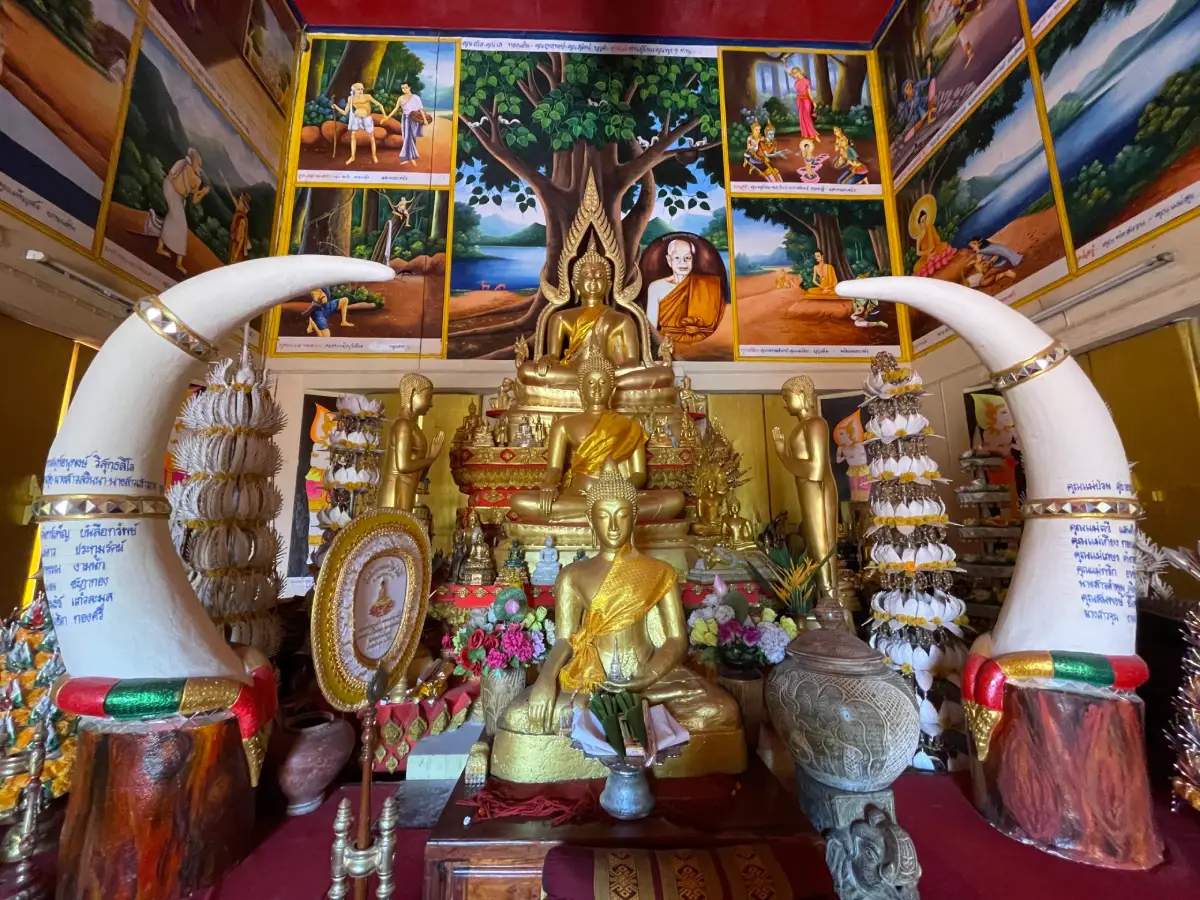
Important sacred objects in the temple include seated meditation Buddha images, a blessing-posture Buddha image, and images of the Buddha’s two chief disciples, Phra Moggallana and Phra Sariputta. The meditation Buddha images represent calmness, inner stability, and contemplation. The blessing-posture Buddha image conveys compassion and auspiciousness. Together, these sacred images form the spiritual center of the temple and provide visitors with meaningful places for worship and reflection.
One of the most important roles of Wat Ket Worararam is Buddhist education. The temple opened its Dhamma study school in 1953, providing monks, novices, and local learners with access to Buddhist teachings and monastic discipline. A temple with a Dhamma school does more than perform ceremonies. It preserves knowledge, transmits doctrine, and helps maintain the foundation of Buddhist life in the community. This educational role is one reason the temple has remained important for such a long time.
In 1990, Wat Ket Worararam opened a Sunday Buddhist study center. This made the temple accessible to children, youth, and laypeople who wanted to learn moral principles in a structured but approachable way. Sunday Buddhist education helps young people understand gratitude, compassion, discipline, responsibility, and respect. In a rural community, such a center gives the temple a role in shaping future generations, not only in preserving rituals.
Wat Ket Worararam is also known as a place that preserves Soraphanya chanting. Soraphanya is a melodic form of Buddhist recitation that carries Dhamma teachings through rhythm, melody, and meaningful words. In northeastern Thai culture, this form of chanting is both religious and artistic. It teaches moral values, expresses devotion, and preserves the sound heritage of the community. A temple that continues to support Soraphanya chanting plays an important role in conserving intangible cultural heritage.
Soraphanya chanting requires memory, voice control, rhythm, pronunciation, and understanding of meaning. It is not simply a performance. It is a form of Dhamma learning and mental discipline. In the past, such chanting was heard in merit-making events and temple activities. As society has changed, temples that continue to preserve Soraphanya have become even more valuable. Wat Ket Worararam is therefore important for visitors interested in Isan Buddhist sound culture and community heritage.
The current abbot of Wat Ket Worararam is Phra Khru Wisutthi Woralangkar. Recent temple activity information also identifies Phra Samu Theerasak Chanthathiro as a temple coordinator. The presence of monks and organized temple activities shows that Wat Ket Worararam remains active today. It is not only a historical temple from the past, but a functioning Buddhist institution that continues to serve the community in the present.
The temple history records several former abbots, including Phra Khe, Phra La, Phra Mi, Phra Sim, Phra Nam, Phra Wan, Phra Khru Borikhut Si Khorakhun, Phra Li, and Phra Khru Phromkhet Khanaphithak. This line of monastic leadership shows the continuity of the temple across generations. An old temple such as Wat Ket Worararam is the result of many monks and villagers working together over time. Its present identity is built from centuries of care, faith, and community support.
Kathin is one of the most important annual ceremonies at Wat Ket Worararam. After the end of Buddhist Lent, local people and devotees come together to offer robes and donations to the monks. Kathin is both a religious ceremony and a community event. It helps maintain temple buildings, supports monastic life, and reconnects villagers, relatives, and people who have moved away for work. For Samrong Thap people, Kathin is a visible expression of unity and shared faith.
Other important activities include forest-robe offerings, ordinations, Buddhist holy day merit-making, Buddhist Lent, the end of Buddhist Lent, Makha Bucha, Visakha Bucha, Asalha Bucha, funerary rites, and village merit ceremonies. These events show how the temple participates in every stage of community life. People come to the temple in joyful times, in reflective times, and during moments of grief. This is why rural temples remain so important in Thai society.
Buddhist holy days reveal the living character of Wat Ket Worararam. Local people offer food to monks, observe precepts, listen to Dhamma, and dedicate merit to ancestors. Parents may bring children to the temple so they can learn manners and become familiar with Buddhist practice. Such days create a rhythm in local life, giving people time to pause from work, farming, trade, and family duties in order to return to generosity, morality, and inner calm.
Ordination ceremonies at Wat Ket Worararam are meaningful for families and the entire community. In Thai Buddhist culture, ordination is an act of gratitude to parents and a way of connecting young men with the temple and the Sangha. When an ordination is held, villagers help prepare the ceremony, cook food, welcome guests, and share merit. The event strengthens kinship and keeps Buddhist tradition alive at village level.
Funerary rites and memorial ceremonies show another side of the temple’s role. When a family loses a loved one, the temple becomes a place for chanting, remembrance, and community support. Monks lead the rites, relatives dedicate merit, and neighbors help one another. In this way, Wat Ket Worararam is present not only during celebrations, but also during the difficult moments of life.
From an architectural perspective, the ordination hall is the most important building for visitors to observe respectfully. It represents Buddhist sacred space and the craftsmanship of the local community. Visitors should remove shoes before entering, dress modestly, speak quietly, and avoid disturbing worshippers or monks. Photography should be done respectfully, without inappropriate poses or disruption of religious activities.
The sermon hall and multipurpose pavilion show how the temple functions in everyday life. These buildings are used not only for sermons, but also for meetings, merit-making, ceremonies, and community gatherings. In a rural temple, such halls are where monks and laypeople interact most often. They help preserve the relationship between the temple and the village in a practical, visible way.
The monks’ residences and monastic areas should be respected as private religious living spaces. Visitors should not enter without permission, take intrusive photographs, or make noise near these areas. Understanding the boundary between public worship areas and monastic residence areas is part of proper temple etiquette.
Wat Ket Worararam is suitable for travelers who want to understand local Surin beyond the more famous attractions. It offers history, Buddhist education, an old ordination hall, community rituals, Kui cultural context, and Soraphanya chanting heritage. Visitors can see how the past and present remain connected: the temple was established in 1757, but it still serves people through education, worship, and cultural preservation today.
A good visit should allow at least 45 minutes to 1 hour. Visitors can pay respect to the Buddha images, observe the ordination hall, walk through the temple grounds, and learn about the temple’s educational and cultural roles. Those visiting during a ceremony or merit-making event should allow more time and be careful not to interrupt the ritual space.
Getting There to Wat Ket Worararam is most convenient by private car, rental car, or chartered vehicle. From Surin city, travel toward Samrong Thap District. The distance is about 55 – 60 km depending on the route. Once entering Samrong Thap Municipality, navigate to Wat Ket Worararam, Ban Dod, or Wat Ket Worararam Samrong Thap. The temple is located within the community area and is convenient for continuing to nearby restaurants, markets, and local attractions.
Travelers coming from Sikhoraphum or nearby districts can combine Wat Ket Worararam with Sikhoraphum Sanctuary, Wat Muen Si Yai, Wat Bun Sano, and the Four Ethnic Groups Market. This route is suitable for people interested in old temples, local communities, Kui cultural identity, and the quieter cultural side of Surin Province.
There is no admission fee for general worship and merit-making at Wat Ket Worararam. Visitors may donate according to their faith through proper temple donation points. Those who wish to offer large items, organize a group ceremony, or use the temple as part of an educational visit should contact the temple in advance to ensure proper arrangements.
Facilities at the temple are typical of a community temple. Visitors can expect an ordination hall, sermon hall, multipurpose pavilion, temple courtyard, merit-making areas, toilets, and parking according to site conditions. It is best to visit with respect for the temple’s quiet atmosphere and local religious function rather than expecting a commercial tourism setup.
Restaurants near the temple are available in Samrong Thap town, including cafés, grilled pork restaurants, noodle shops, seafood restaurants, coffee shops, and local eateries. Visitors can plan meals before or after the temple visit. For more options, they may continue to Sikhoraphum District or return to Surin city.
Accommodation near Wat Ket Worararam includes resorts in Samrong Thap and Sikhoraphum, while Surin city offers a wider choice of hotels, restaurants, transportation, and services. Staying in Samrong Thap or Sikhoraphum is practical for travelers focusing on this local route. Staying in Surin city is better for those planning to visit several districts in one trip.
For international visitors, Wat Ket Worararam is a valuable example of a historic rural Buddhist temple in lower northeastern Thailand. It shows that Surin is not only about elephants, silk, and Khmer ruins. It also has living community temples where Buddhist education, chanting traditions, moral teaching, and village faith continue in daily life. Foreign visitors should dress modestly, remove shoes before entering sacred buildings, avoid disturbing monks, and respect ongoing community activities.
Wat Ket Worararam is therefore a meaningful destination for travelers who want to understand Surin through community history, Buddhist practice, education, Kui cultural context, and Isan sound heritage. Its long history from 1757, its ordination hall, its Dhamma school, its Sunday Buddhist study center, and its preservation of Soraphanya chanting all make the temple more than a place for worship. It is a cultural learning space of Samrong Thap.
In summary, Wat Ket Worararam Surin is an old temple with religious, historical, educational, and cultural value. It remains a spiritual center for Ban Samrong Thap and Ban Dod, preserves important Buddhist objects, supports Dhamma education, maintains Sunday Buddhist learning, and conserves Soraphanya chanting. Visitors can make merit, pay respect, observe the temple architecture, learn local history, and experience the living role of a rural Buddhist temple in Surin Province.
| Name | Wat Ket Worararam Surin / Wat Ket Worararam Ban Dod Samrong Thap |
| Location | Moo 11, Ban Dod, Samrong Thap Subdistrict, Samrong Thap District, Surin Province 32170 |
| Address | Wat Ket Worararam, Ban Samrong Thap – Ban Dod Community Area, Samrong Thap Subdistrict, Samrong Thap District, Surin Province 32170 |
| Highlights | Old temple established in 1757, beautiful ordination hall, Dhamma school, Sunday Buddhist study center, Soraphanya chanting preservation, and spiritual center of the Samrong Thap – Ban Dod community |
| History | Established in 1757 and granted its royal boundary on 12 March 1965. It is an old Mahā Nikāya community temple that has continuously served Samrong Thap people |
| Name Origin | The temple name is associated with the old Samrong Thap community, while Ban Dod is a community area historically connected with Ban Samrong Thap and still shares Wat Ket Worararam as a common spiritual center |
| Distinctive Features | A peaceful community temple on about 8 rai of land, with an ordination hall, sermon hall, multipurpose pavilion, monks’ residences, sacred Buddha images, and spaces for worship, Buddhist education, and local cultural activities |
| Travel Information | From Surin city, travel toward Samrong Thap District for about 55 – 60 km, then continue into Samrong Thap Municipality and Ban Dod. Private cars, rental cars, and chartered vans are the most convenient options |
| Current Status | Open for worship, merit-making, and Buddhist activities. The temple remains active with resident monks and continues to serve the Samrong Thap community |
| Open Days | Daily |
| Opening Hours | 08.00 – 17.00 |
| Fees | No Admission Fee For General Worship And Merit-Making |
| Facilities | Ordination hall, sermon hall, multipurpose pavilion, monks’ residences, temple courtyard, merit-making area, toilets, parking, and Buddhist activity spaces according to local temple conditions |
| Main Areas / Zones | 1. Ordination Hall, about 8 meters wide and 18 meters long, built in 1962 2. Sermon Hall, about 12 meters wide and 27 meters long, built in 1974 3. Multipurpose Pavilion, about 10 meters wide and 18 meters long, built in 1988 4. Two Monks’ Residences 5. Buddha Image And Sacred Object Area 6. Dhamma School Area 7. Sunday Buddhist Study Center Area 8. Soraphanya Chanting Preservation Area 9. Temple Courtyard And Community Merit-Making Area |
| Important Sacred Objects | Two seated meditation Buddha images about 40 inches wide, one seated meditation Buddha image about 49 inches wide, one blessing-posture Buddha image about 29 inches wide, and images of Phra Moggallana and Phra Sariputta |
| Important Rituals / Traditions | Buddhist holy day merit-making, Dhamma listening, food offerings to monks, Kathin, forest-robe offerings, ordinations, funerary rites, Makha Bucha, Visakha Bucha, Asalha Bucha, Buddhist Lent, the end of Buddhist Lent, and Soraphanya chanting preservation activities |
| Abbot / Caretaker | Phra Khru Wisutthi Woralangkar, Abbot of Wat Ket Worararam; recent activity information also identifies Phra Samu Theerasak Chanthathiro as a temple coordinator |
| Temple Contact Number | 044-569-242 |
| Local Information Contact | Samrong Thap Subdistrict Administrative Organization, Tel. 044-569-279 |
| Nearby Tourist Attractions | 1. Four Ethnic Groups Market, Samrong Thap Municipality, about 1 km 2. Wat Takhian Phositaram, Samrong Thap Subdistrict, about 3 km 3. Wat Muen Si Yai, Muen Si Subdistrict, Samrong Thap District, about 9 km 4. Wat Bun Sano, Sano Subdistrict, Samrong Thap District, about 12 km 5. Sikhoraphum Sanctuary, Sikhoraphum District, about 30 km 6. Surin National Museum, about 55 km, Tel. 044-513-272, 044-513-274 7. Wat Burapharam Royal Temple, Mueang Surin District, about 58 km |
| Nearby Restaurants | 1. Kaokan Cafe, Samrong Thap District, about 1 km, Tel. 093-487-6290 2. Phet Lamphu Mookata, Samrong Thap Branch, about 1 km, Tel. 044-569-470 3. N’Joy Coffee Thu, Samrong Thap District, about 1 km, Tel. 082-449-5254 4. Kuay Tiew Ruea Mor Din Nai Kon 341 Surin – Samrong Thap, about 2 km, Tel. 080-073-1956 5. Fresh Seafood Restaurant, Samrong Thap District, about 2 km, Tel. 082-488-9383 6. Prathumphon Restaurant, Samrong Thap District, about 1 km, Tel. 082-368-8971 |
| Nearby Accommodations | 1. Huai Saeng Chan Resort, Samrong Thap District, about 3 km, Tel. 044-569-375 2. Jamjuree Resort, Sikhoraphum District, about 30 km, Tel. 044-560-289, 089-190-5156 3. The Wood Surin, Mueang Surin District, about 58 km, Tel. 063-023-7999 4. Thong Tarin Hotel, Mueang Surin District, about 58 km, Tel. 044-514-281, 085-300-8858 5. Maneerote Hotel Surin, Mueang Surin District, about 59 km, Tel. 044-514-569 6. Slive Hotel Surin, Mueang Surin District, about 60 km, Tel. 044-060-322, 044-060-323 |
Frequently Asked Questions (FAQ)
Q: Where Is Wat Ket Worararam Surin Located?
A: Wat Ket Worararam is located in the Ban Dod and Samrong Thap community area, Samrong Thap Subdistrict, Samrong Thap District, Surin Province 32170.
Q: When Is Wat Ket Worararam Open?
A: Wat Ket Worararam is open daily from 08.00 to 17.00.
Q: Is There An Admission Fee?
A: No. There is no admission fee for general worship and merit-making. Visitors may donate according to their faith.
Q: When Was Wat Ket Worararam Established?
A: Wat Ket Worararam was established in 1757 and received its royal boundary on 12 March 1965.
Q: What Is The Main Highlight Of Wat Ket Worararam?
A: The main highlights are its beautiful ordination hall, long history, Dhamma school, Sunday Buddhist study center, and preservation of Soraphanya chanting.
Q: Who Is The Current Abbot Of Wat Ket Worararam?
A: Phra Khru Wisutthi Woralangkar is the abbot of Wat Ket Worararam.
Q: How Is Wat Ket Worararam Connected With Soraphanya Chanting?
A: The temple is known as a place that preserves Soraphanya chanting, a melodic Buddhist recitation tradition of Isan that transmits Dhamma teachings, faith, and local sound heritage.
Q: What Nearby Places Can Be Visited With Wat Ket Worararam?
A: Nearby places include the Four Ethnic Groups Market, Wat Takhian Phositaram, Wat Muen Si Yai, Wat Bun Sano, Sikhoraphum Sanctuary, Surin National Museum, and Wat Burapharam Royal Temple.
 Category: ●Places of Worship
 Group: ●Temple
Last Update : 3 WeekAgo
 Last Update : 3 WeekAgo
 Click to Access the Navigation Map GPS
 Art, Culture and Heritage
 Historical Sites and Monuments(11)
 Landmarks and Memorials(2)
 Art, Craft Centres, Tradition(5)
 Museums(1)
Temple(15)
Museums(1)
Temple(15)
 Other Sacred Sites(1)
 Suburban Living
 Village, Community(9)
 Local Market(1)
 Nature and Wildlife
 National Parks and Marine Reserves(2)
 Mountain (Doi)(2)
 Dam, Reservoir, Lake(6)
 Waterfalls(1)
 River, Canal(2)
 Other natural attractions(4)
 Entertainment and Agricultural
 Farms, Parks and Ecotourism(2)


