
lovethailand home >Northeastern Travel Attractions >Surin Travel Attractions >Prasat >Chuea Phloeng > Kanop Ting Tong Performance
TL;DR: Kanop Ting Tong Performance is located at Ban Pho Kong Community, Chuea Phloeng Subdistrict, Prasat District, Surin Province 32140, open Monday – Sunday, hours 08.00 – 17.00; the performance activity lasts about 60 minutes.
Kanop Ting Tong Performance
Open Days: Monday – Sunday
Opening Hours: 08.00 – 17.00; the performance activity lasts about 60 minutes
Kanop Ting Tong Performance in Surin, also written as Kanop Ting Tong or Kanop Ting Tong dance, is one of Surin’s most distinctive folk performing arts. Its important learning base is Ban Pho Kong Community in Chuea Phloeng Subdistrict, Prasat District, Surin Province. This lively performance imitates the movement of a praying mantis through jumping, swaying, playful gestures, quick body movement, and rhythmic interaction between male and female performers. With local music accompanying the dance, Kanop Ting Tong expresses humor, energy, community creativity, and the cultural identity of lower northeastern Thailand.
For travelers who want to understand Surin beyond ordinary sightseeing, Kanop Ting Tong offers a meaningful cultural experience. It is not simply a dance performed for entertainment. It brings together Thai-Khmer language, local music, folk humor, creative costume design, and the memory of Surin’s communities. Ban Pho Kong is therefore one of the best places to learn about this performance because the community allows visitors to experience the dance, Thai-Khmer language, silk weaving, local food, community products, and village life in one cultural setting.
The name “Kanop Ting Tong” or “Kanop Ting Tong” comes from the Thai-Khmer language used in lower Isan and means “praying mantis.” The choice of this name reflects the way local people observe nature carefully and turn everyday life into artistic expression. The praying mantis has a remarkable posture, with raised forelegs, sharp movements, quick turns, swaying gestures, and playful interaction. These natural movements were transformed into dance gestures that are easy to recognize, enjoyable to watch, and full of local character.
The history of Kanop Ting Tong is closely linked with Nai Ten Trakandi, an important figure in the origin story of the performance. Around 1947, he traveled into the lower Khmer region to trade fermented fish. On his return journey, he saw a pair of praying mantises moving and interacting in a striking way. Impressed by their gestures, he remembered the scene and later developed the idea of turning the movement of the praying mantis into a performance for people to enjoy.
Nai Ten later shared the idea with Nai Huean Trongsoondee, a leader of a kantruem music group active around Ram Boe Village and nearby villages in Prasat District. Together, they adapted the mantis movements to local music. When they played music at ordination ceremonies, weddings, Kathin ceremonies, and village festivals, they added the Kanop Ting Tong movements to make the event more enjoyable. At first, the performance involved only 2 dancers, representing a male and a female praying mantis. Later, it developed into a group performance with more dancers depending on the size of the stage and the occasion.
Kanop Ting Tong began as playful folk entertainment among local musicians, but it gradually became a recognized performing art of Surin Province. Its charm lies in the combination of lively rhythm, humorous movement, and direct communication with the audience. It does not follow the refined style of court dance. Instead, its beauty comes from quick rhythm, energetic movement, comic expression, and the performer’s ability to imitate nature in a joyful and accessible way.
In the 1960s, Kanop Ting Tong began to gain wider recognition when it was promoted and performed outside Surin. The performance was later adapted for larger stages, with changes in songs, lyrics, costumes, and the number of dancers. Thai-Khmer lyrics remained important, while Thai-language verses were also added so that broader audiences could understand the story and character of the dance. This adaptation allowed the performance to remain rooted in its original community while becoming easier for audiences from other regions to appreciate.
Ban Pho Kong plays a central role in preserving and transmitting Kanop Ting Tong. The community is a cultural learning destination where visitors can experience local performing arts, silk weaving, Thai-Khmer language, community-based tourism, and rural life. The village name comes from a local bodhi tree that bent into a curved shape; in Khmer, the word “kong” refers to a curve. The name Ban Pho Kong therefore reflects both the landscape and the language of the community.
Ban Pho Kong is also known for silk. Its silk weaving knowledge, local craftsmanship, and community products make the village a rich cultural destination. Visitors may learn about mulberry cultivation, silkworm raising, silk reeling, dyeing, and weaving. When Kanop Ting Tong is combined with silk, food, language, and village storytelling, Ban Pho Kong becomes a destination with deep cultural content rather than a simple performance venue.
The Kanop Ting Tong activity at Ban Pho Kong emphasizes visitor participation. Travelers do not only sit and watch the performance. They can learn its origin, try on Kanop Ting Tong costumes, practice the jumping and swaying movements of the praying mantis, learn Thai-Khmer words, and create a small souvenir using Thai-Khmer language. This hands-on format keeps the culture alive by allowing visitors to experience it through movement, sound, language, and memory.
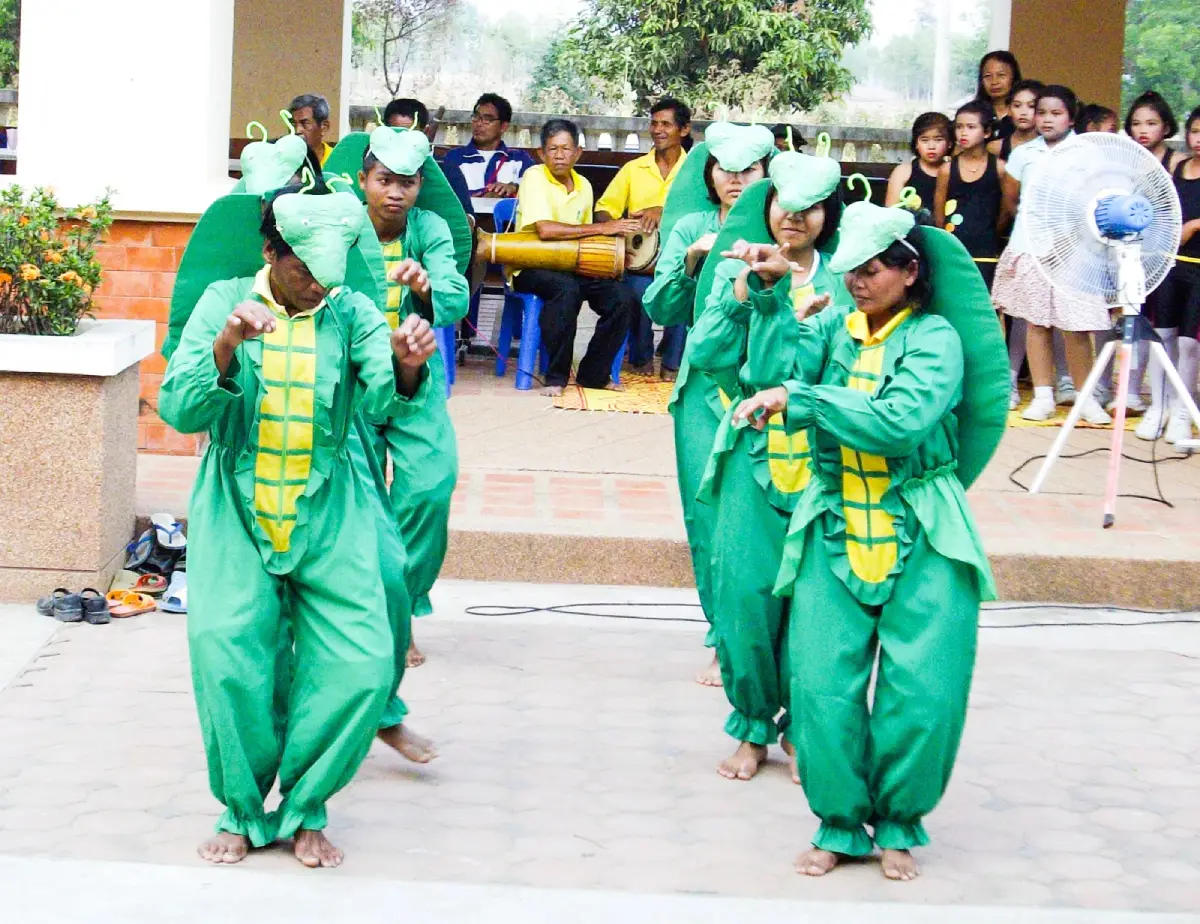
The costumes of Kanop Ting Tong show how a simple village performance developed into a structured folk art. In the early period, performers wore ordinary local clothing. Later, green costumes were designed to imitate the color and form of the praying mantis. The costume includes headpieces, wings, and body elements that help the audience recognize the mantis character. Male and female performers represent male and female mantises, making the dance playful, flirtatious, and full of movement between partners.
Music is essential to Kanop Ting Tong because rhythm gives the dance its energy. Traditional instruments associated with the performance include klong thon or skuan drums, pi nai or pi chalai, saw duang, saw u, and ching. The music is lively and suitable for fast movements. Some lyrics are in Thai-Khmer, and additional verses may be composed for particular occasions such as merit-making events, weddings, ordinations, Kathin ceremonies, and community festivals.
The performance usually divides dancers into female and male sides, representing female and male praying mantises. At the start, dancers enter the performance area to the rhythm of the Kanop Ting Tong music. They sway, jump, turn, and change gestures according to the rhythm. The dance uses hands, arms, legs, body, face, and eyes to imitate the praying mantis. The result is a performance that combines comedy, rhythm, playful interaction, and community expression.
Important dance movements follow the behavior of a praying mantis. The performance begins with a wai khru section to pay respect to teachers and transmitters of the art. It continues with movements such as the mantis wiping its mouth after eating, shielding its eyes to look for prey, teasing gestures between partners, touching or nudging gestures, and playful approaches between male and female mantises. These movements make the story easy to follow even for visitors who do not understand all the lyrics.
The artistic value of Kanop Ting Tong lies in the combination of nature imitation and cultural creativity. A small insect observed in daily life became the source of music, costume, movement, humor, and community identity. This transformation shows how local people can turn the ordinary into art by observing nature closely and expressing it through the human body.
Kanop Ting Tong also has linguistic value because many of its words, lyrics, and cultural explanations are connected with Thai-Khmer language. Preserving the performance also helps preserve language. When young people learn the dance, they learn not only movement but also vocabulary, pronunciation, meaning, and cultural context. This makes the performance an important bridge between artistic training and language transmission.
Socially, Kanop Ting Tong brings together people of different generations. Elders preserve the stories and explain the past. Adults help organize costumes, music, activities, and community hospitality. Young people learn the dance and take part in performances. Visitors support the local economy by joining activities and buying community products. The performance remains alive because the community continues to teach, perform, explain, and share it.
As a tourism experience, Kanop Ting Tong is best suited to travelers who value creative cultural learning. A visit to Ban Pho Kong may include watching the dance, learning about silk weaving, tasting local food, speaking with community storytellers, and purchasing local products. This kind of travel supports the local economy directly and gives folk culture a practical role in contemporary community life.
Ban Pho Kong is open for community tourism throughout the year. The official tourism information lists its opening days as Monday to Sunday, from 08.00 to 17.00. The Kanop Ting Tong performance activity takes about 60 minutes. The community welcomes families, groups of friends, study groups, and organizations. Facilities include a meeting room, parking, toilets, Wi-Fi, storytelling guides, and both cash and online payment options.
Traveling to Ban Pho Kong is most convenient by private car. From Prasat District Office, follow Highway 24 on the Surin – Prasat route for about 10 km, then turn into the village road for about 2 km. Travelers using the Bangkok – Prasat bus route can get off at Prasat junction and contact the community for pickup. The village can be visited as a day trip from Surin city or as an overnight cultural stay through the community homestay experience.
Getting There from Surin city takes travelers toward Prasat District. The distance is about 45 – 50 km depending on the starting point in the city. After reaching the Prasat area, continue toward Chuea Phloeng Subdistrict and Ban Pho Kong. A private car or rental car is the most practical option because travelers can also visit nearby attractions such as Prasat Ban Phluang, Prasat Ban Phlai, local restaurants, and other places in Prasat District.
Visitors who want to see Kanop Ting Tong should contact the community in advance. The performance is a community-based tourism activity that requires preparation of dancers, costumes, music, and narration. Advance contact helps the community arrange the activity properly and allows visitors to enjoy a complete experience, including watching the performance, trying costumes, practicing dance movements, learning Thai-Khmer words, and exploring other parts of the community.
Visitor etiquette is important. Dress appropriately for the place and activity, avoid alcohol and disruptive behavior, do not make loud noise at night, ask before photographing people or private homes, and follow the guidance of community storytellers or hosts. When joining dance practice, participate respectfully because Kanop Ting Tong is a living cultural heritage of the community, not merely a temporary entertainment activity.
Local food is another element that enriches a visit to Ban Pho Kong. The community is associated with dishes such as bo dong, local crab curry, stuffed frog, banana-stem curry, bamboo shoot curry, and traditional sweets. Food connects visitors to the taste, language, and memory of the village. Experiencing local food together with Kanop Ting Tong gives travelers a more complete understanding of Surin’s cultural life.
Community souvenirs at Ban Pho Kong include silk products and locally designed items. Visitors interested in craft can learn how Surin silk reflects skill, patience, and local identity. Buying community products supports weavers, local makers, and the cultural activities that the village continues to preserve.
Kanop Ting Tong has many layers of value. The first is entertainment through lively rhythm and mantis-like movement. The second is the wisdom of turning nature into art. The third is the preservation of Thai-Khmer language, music, and community memory. The fourth is the use of culture as a foundation for creative tourism. The fifth is its power to show younger generations that folk performing arts still have meaning in the present day.
For travelers planning a trip to Surin, Kanop Ting Tong at Ban Pho Kong is a valuable cultural stop, especially for those who want hands-on learning rather than passive sightseeing. Whether watching the praying mantis dance, trying on costumes, practicing the movements, listening to Thai-Khmer language, tasting local food, or exploring silk weaving, each activity opens a new window into Surin as a province of diverse and creative cultural roots.
Kanop Ting Tong should therefore not be seen only as a dance that imitates a praying mantis. It is a folk performance that reveals careful observation of nature, the humor of the community, the beauty of Thai-Khmer language, the connection between music and the body, and the ability of Surin people to keep their culture alive. Travelers who see and join the activity will understand that the charm of Surin is not found only in ancient Khmer ruins, elephants, or silk, but also in the rhythm, laughter, and small dance gestures born from a praying mantis in local memory.
| Name | Kanop Ting Tong Performance Surin / Kanop Ting Tong Dance At Ban Pho Kong Community |
| Location | Ban Pho Kong Community, Chuea Phloeng Subdistrict, Prasat District, Surin Province 32140 |
| Address | Ban Pho Kong, Chuea Phloeng Subdistrict, Prasat District, Surin Province 32140 |
| Highlights | Praying mantis-inspired folk dance, local music, Thai-Khmer language, green mantis-style costumes, and creative community tourism activities |
| History | The origin story dates to around 1947, when Nai Ten Trakandi observed the movement of a praying mantis and adapted it into a local folk performance that later became one of Surin’s distinctive performing arts |
| Name Origin | “Kanop Ting Tong” or “Kanop Ting Tong” is a Thai-Khmer term meaning praying mantis |
| Distinctive Features | Dancers represent male and female praying mantises, using jumping, swaying, teasing gestures, and rhythmic movement with local music |
| Travel Information | From Prasat District, take Highway 24 on the Surin – Prasat route for about 10 km, then turn into Ban Pho Kong for about 2 km; from Surin city, the distance is about 45 – 50 km |
| Current Status | Open as a community-based cultural tourism activity at Ban Pho Kong and promoted as a creative tourism activity based on lower-Isan intangible cultural heritage |
| Open Days | Monday – Sunday |
| Opening Hours | 08.00 – 17.00; the performance activity lasts about 60 minutes |
| Facilities | Meeting room for about 50 people, audio equipment, parking for about 20 cars, about 15 toilets, Wi-Fi, cash and online payment, and Thai-Khmer and Thai-speaking community storytellers |
| Main Areas / Zones | 1. Kanop Ting Tong Performance Area 2. Thai-Khmer Language Learning Area 3. Silk Weaving And Textile Activity Area 4. Community Homestay Area 5. Local Food And Souvenir Area 6. Thai-Khmer Language Souvenir Activity Area |
| Caretaker / Community Contacts | Khun Suthit Jaemsai, Tel. 063-532-9444 Khun Nopparat Samanya, Tel. 062-419-5888 |
| Official Website / Official Page | Facebook: https://www.facebook.com/banphokongcommunity |
| Nearby Tourist Attractions | 1. Ban Pho Kong Community, about 0 km 2. Ban Prasat Antique Museum, about 8 km 3. Prasat Ban Phlai, about 10 km 4. Prasat Ban Phluang, about 18 km 5. Surin National Museum, about 45 km |
| Nearby Restaurants | 1. Phet Prasat Restaurant, about 12 km, Tel. 044-551-166 2. Nong Beer Restaurant, Prasat District, about 12 km, Tel. 081-760-7317 3. Southern Coffee Lotus Prasat Surin, about 12 km 4. Café Amazon Prasat District Branch, about 12 km 5. Restaurants In Prasat District Market Area, about 12 km |
| Nearby Accommodations | 1. Ban Pho Kong Homestay, about 0 km, Tel. 063-532-9444, 062-419-5888 2. Maneerote Hotel Surin, about 43 km, Tel. 044-514-569 3. Slive Hotel Surin, about 43 km, Tel. 044-060-233 4. Martina Hotel Surin, about 44 km, Tel. 044-713-555 5. Hop Inn Surin, about 45 km, Tel. 02-080-2222 |
Frequently Asked Questions (FAQ)
Q: What is Kanop Ting Tong Performance in Surin?
A: Kanop Ting Tong is a Surin folk performance inspired by the movement of a praying mantis. It uses local music, lively gestures, and Thai-Khmer cultural elements.
Q: Where can visitors learn about Kanop Ting Tong?
A: The main learning base is Ban Pho Kong Community in Chuea Phloeng Subdistrict, Prasat District, Surin Province 32140.
Q: When is Ban Pho Kong Community open?
A: The community is open Monday to Sunday from 08.00 to 17.00. The Kanop Ting Tong activity lasts about 60 minutes.
Q: What does Kanop Ting Tong mean?
A: Kanop Ting Tong is a Thai-Khmer term meaning praying mantis, which is the natural model for the dance movements.
Q: What makes Kanop Ting Tong distinctive?
A: Its distinctive features are mantis-like jumping, swaying, teasing movements, colorful green costumes, local music, and playful interaction between male and female dancers.
Q: Can visitors participate in the activity?
A: Yes. Visitors can learn the history, try on costumes, practice dance movements, learn Thai-Khmer words, and join creative community activities.
Q: How do visitors get to Ban Pho Kong?
A: From Prasat District, take Highway 24 on the Surin – Prasat route for about 10 km, then turn into the village for about 2 km. From Surin city, the distance is about 45 – 50 km.
Q: Should visitors contact the community in advance?
A: Yes. Advance contact is recommended because the performance requires preparation of dancers, costumes, music, and community storytellers.
 Category: ●Art, Culture and Heritage
 Group: ●Art, Craft Centres, Tradition
Last Update : 2 MonthAgo
 Last Update : 2 MonthAgo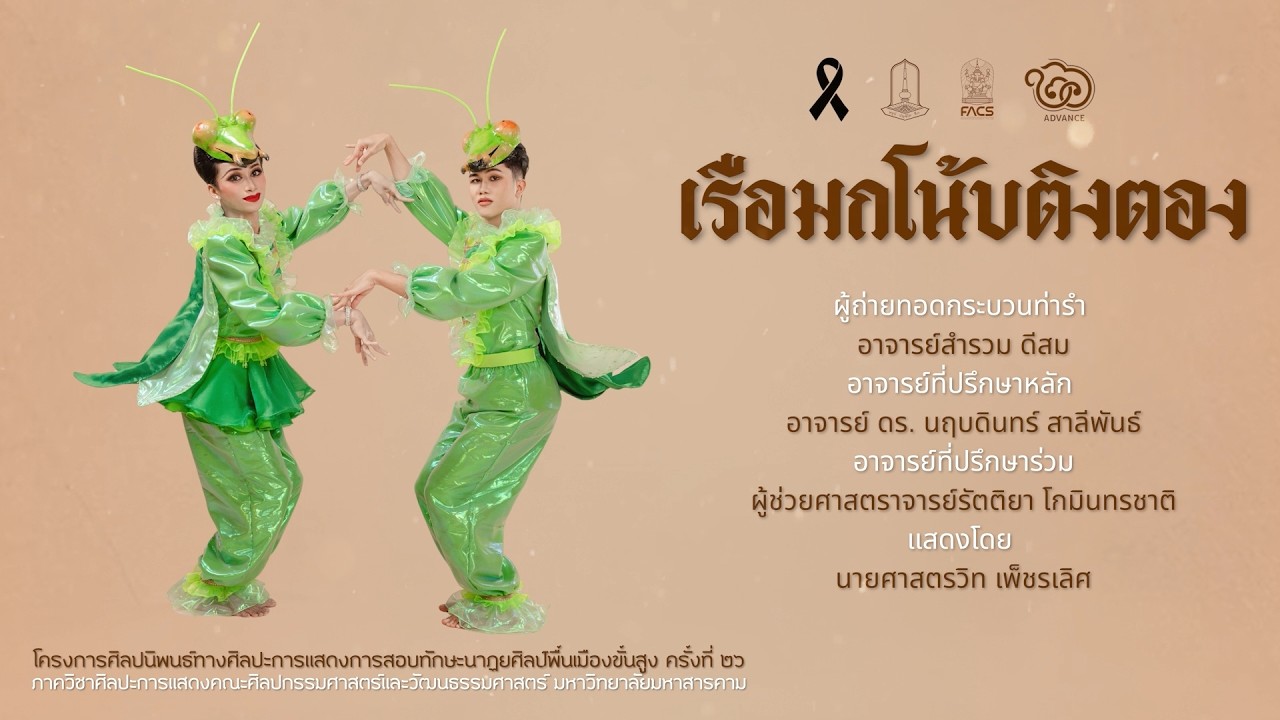

 Historical Sites and Monuments(11)
 Landmarks and Memorials(2)
Art, Craft Centres, Tradition(5)
Landmarks and Memorials(2)
Art, Craft Centres, Tradition(5)
 Museums(1)
 Places of Worship
 Temple(15)
 Other Sacred Sites(1)
 Suburban Living
 Village, Community(9)
 Local Market(1)
 Nature and Wildlife
 National Parks and Marine Reserves(2)
 Mountain (Doi)(2)
 Dam, Reservoir, Lake(6)
 Waterfalls(1)
 River, Canal(2)
 Other natural attractions(4)
 Entertainment and Agricultural
 Farms, Parks and Ecotourism(2)


