
lovethailand home >Northeastern Travel Attractions >Surin Travel Attractions >Tha Tum >Nong Bua > Mun River
TL;DR: Mun River is located at Riverside area of the Mun River, Nong Bua Subdistrict, Tha Tum District, Surin Province, open Daily, hours 24 Hours.
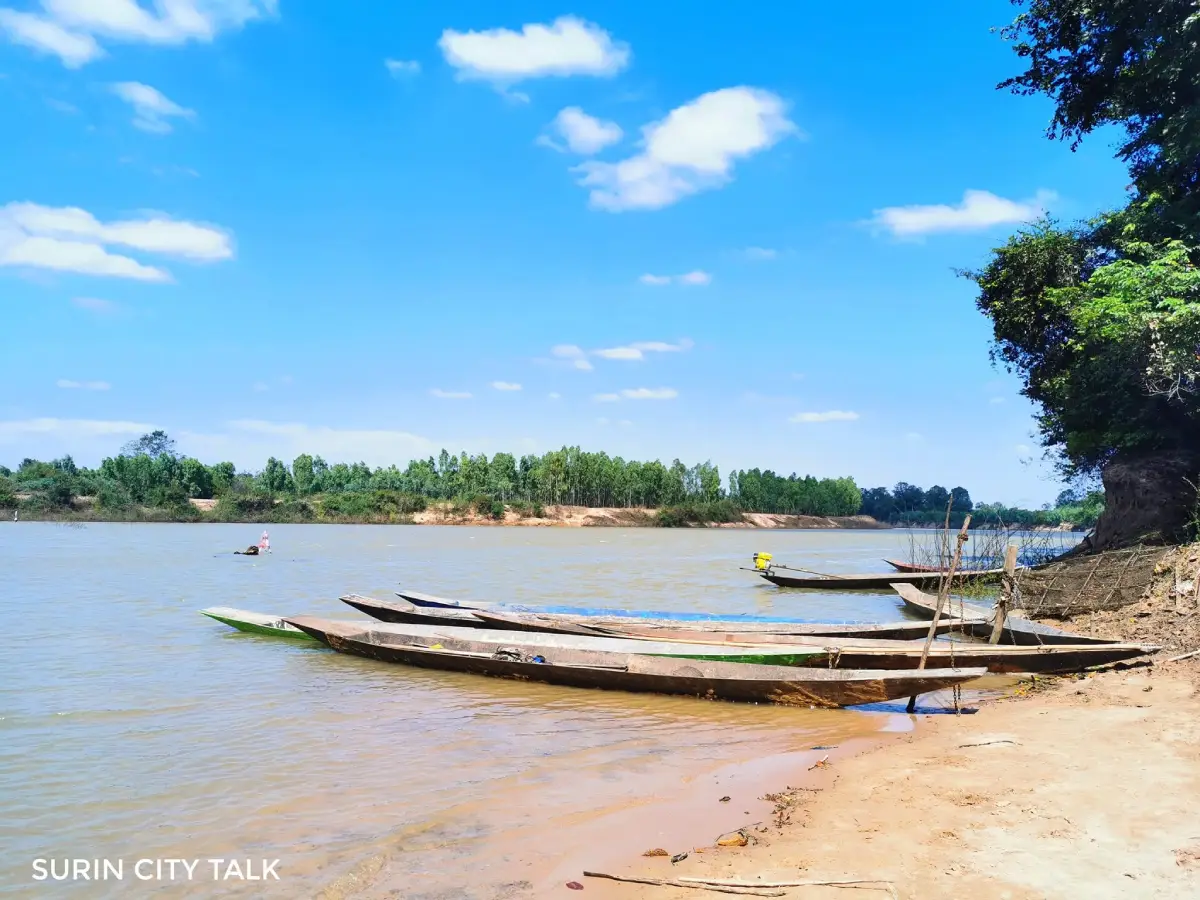
Mun River
Open Days: Daily
Opening Hours: 24 Hours
The Mun River in Surin, especially around Nong Bua Subdistrict and Ban Muang Mun in Tha Tum District, is a peaceful riverside natural attraction that reveals a quieter side of southern Isan. This section of the river is known for its wide waterway, clean white sandbanks during suitable seasonal water levels, rural riverside scenery, and the close relationship between the river and local communities. It is suitable for relaxing by the river, taking photographs, walking along the bank, and connecting the trip with nearby attractions such as Wang Thalu, the Elephant Study Center at Ban Ta Klang, Elephant World Surin, Wat Phra Phutthabat Phanom Din, Prasat Nang Bua Tum, and other cultural sites in Tha Tum District.
The Mun River is one of the major rivers of northeastern Thailand, and its presence in Surin Province has long shaped local settlement, agriculture, fishing, community life, and cultural routes. In Tha Tum District, the river passes through a landscape that remains calm and strongly local. Visitors can see a broad river flowing past rice fields, riverside trees, small community areas, local boats, and seasonal sandbanks. This makes the place suitable for travelers who prefer quiet natural scenery rather than crowded commercial attractions.
The beauty of the Mun River in Surin is not limited to the water itself. It comes from the whole riverside setting: the width of the river, the soft morning and evening light, the line of trees along the bank, the pale sand that appears when water levels are lower, and the everyday life of people who live close to the river. On a clear day, the area feels open, simple, and peaceful. It is a good place to sit, enjoy the breeze, watch sunset light on the water, and photograph the rural atmosphere of southern Isan.
Ban Muang Mun in Nong Bua Subdistrict is one of the communities that clearly reflects the connection between local life and the Mun River. The name of the village itself contains the word “Mun,” showing how closely the community is tied to this waterway. The riverside area functions as a local landscape, a resting place, a viewpoint, and a living memory of the community. For travelers, this is a meaningful place to stop along a Tha Tum route, see the Mun River closely, and experience a riverside atmosphere that has not been heavily transformed for mass tourism.
The river becomes especially attractive from the dry season into the early rainy season, when lower water levels reveal sandbanks and more accessible riverside areas. These white sandbanks create the feeling of a freshwater beach in Isan. Visitors can sit, take photographs, and enjoy the scenery along the riverbank. During the rainy season, the river rises, the current becomes stronger, and the scenery changes into a broader and more powerful river landscape. The timing of the visit therefore greatly affects the experience.
For the most pleasant atmosphere, visitors should come in the morning or late afternoon. Morning offers a quiet mood, cooler air, and glimpses of local life by the river. Late afternoon is ideal for warm light, river reflections, and sunset photographs. These times are more comfortable than midday, when the riverside can be hot and exposed to strong sunlight.
The Mun River is not only a natural waterway. It is also an important cultural and geographical axis of southern Isan. The river connects communities across several northeastern provinces and has influenced settlement, farming, livestock raising, fishing, and cultural exchange for generations. In Tha Tum District, the river still shows how nature and daily life remain linked. Travelers who look beyond the view will understand that this is a cultural landscape as much as a natural one.
Geographically, Tha Tum District includes lowland areas connected with the Mun River and many local water sources. These conditions support rice farming, fishing, local livestock, and riverside community life. A trip to the Mun River in this area therefore shows more than a scenic river. It reveals a wider image of Surin: river, rice fields, villages, temples, roads, and local communities forming one continuous rural landscape.
The riverside route also connects with Surin’s elephant culture. Tha Tum District is home to Ban Ta Klang Elephant Village, the Elephant Study Center, and Wang Thalu, an important area related to the Mun River and Chi River. Wang Thalu is where the 2 rivers meet and has cultural significance for elephant-related traditions and local beliefs. Travelers who begin at the Mun River in Nong Bua can continue to understand the larger river landscape through the elephant culture of Ban Ta Klang.
The Elephant Study Center and Ban Ta Klang Elephant Village are among the most meaningful attractions to combine with the Mun River route. They show the relationship between people, elephants, and water in southern Isan. The Kui or Kuy people of Ban Ta Klang have a distinctive elephant-raising culture, where elephants are not treated merely as working animals but as members of families and communities. Traveling from the Mun River to Ban Ta Klang gives visitors a deeper view of nature, culture, and local identity.
Wang Thalu is another important stop near the Mun River travel route. It is known as the area where the Chi River and the Mun River converge before the water continues downstream. The place is important both geographically and culturally. In the past, it was connected with elephant-related rituals of local communities. Today, it remains a natural riverside attraction that helps visitors understand the wider Mun River basin.
Tha Tum District also has religious and historical attractions that make the trip more complete. Wat Phra Phutthabat Phanom Din is a forest temple with a peaceful atmosphere along the Surin-Tha Tum route. Prasat Nang Bua Tum is a local ancient site reflecting Khmer cultural influence in Surin. Together with the Mun River, these places create a route that includes nature, local life, Buddhist culture, ancient history, and elephant heritage.
The strength of the Mun River in Surin lies in its simplicity. Visitors will not find the dense facilities of a major urban tourist destination, but they will find a calm riverbank and a real local atmosphere. It is suitable for slow travel, landscape photography, quiet rest, and travel routes connecting Tha Tum District with nearby cultural attractions. The value of the place is not in luxury or activity volume, but in its openness, natural river scenery, and community character.
For families traveling with children, the riverside area can be used as a place to learn about rivers, freshwater sandbanks, riverside ecosystems, and local life. Children should be supervised closely and should not be allowed to approach the water alone. The river is a natural environment and water conditions can change according to season, rainfall, and river level. Enjoying the view from the bank is safer than entering the water without local guidance.
Photographers should consider timing carefully. For images of sandbanks and clear riverside details, a lower water period with soft light is ideal. For wide river scenery and a peaceful rural mood, late afternoon is especially suitable. The golden light on the water adds depth to the scene and captures the calm character of the Mun River in southern Isan.
Responsible travel is important along the Mun River. Visitors should take all trash away, avoid leaving food waste or plastic on the riverbank, avoid damaging riverside plants, and avoid driving onto soft sand or fragile riverside areas. The riverbank is both a resting place and a living space for local people. Respectful behavior helps keep the site clean and welcoming.
Getting There is most convenient by private car or rental car. From Surin city, travel toward Tha Tum District, then continue to Nong Bua Subdistrict and Ban Muang Mun. The drive from Surin city to Tha Tum takes about 1 hour, and the route to the riverside communities continues from there. Travelers already in Tha Tum can reach the Nong Bua and Ban Muang Mun area more easily as a local riverside stop.
Travelers without private transport can take a bus or van from Surin to Tha Tum and then arrange local transport to Nong Bua Subdistrict. Planning ahead is useful because some riverside viewpoints are not directly served by public transportation. Travelers who want to visit several places in one trip, such as the Mun River, Wat Phra Phutthabat Phanom Din, Prasat Nang Bua Tum, and the Elephant Study Center, will find a private car or hired vehicle more practical.
For food, Tha Tum District has several restaurants and cafes that are useful stops before or after visiting the river. Options include Tha Tum Pochana, Krua Khun Kea Tha Tum, Camomile Cafe’@Tha Tum, Sweetheart@Tha Tum, and other local restaurants in the district center. The town area has more food options than the riverside itself, so visitors should plan meals in Tha Tum before or after visiting the river.
For accommodation, Tha Tum District offers hotels, resorts, and guesthouses such as NP View Resort, The Modern Resort, Banlang Hotel Resort & Swimmingpool, Srithongkul Riverside Hotel, and Phawinee Resort. Staying in Tha Tum is practical for travelers who want to visit the Mun River, local temples, ancient sites, and elephant attractions without returning to Surin city on the same day.
Facilities directly by the river are local and simple. Visitors should bring drinking water, a hat, sun protection, insect repellent, suitable footwear for sand or riverside ground, and a bag for carrying trash back out. During the day, the riverside can be hot. In the evening, visitors should keep a phone or light source ready if they plan to leave after sunset.
The Mun River in Surin is suitable for nature lovers, photographers, families, visitors interested in local river culture, and travelers who want to connect the river with Surin’s elephant heritage. The destination is not built around luxury or entertainment. Its appeal lies in the broad river, seasonal sandbanks, village atmosphere, and a living riverside landscape that continues to serve the local community.
A 1-day route can begin from Surin city in the morning, continue to Tha Tum District, stop at Wat Phra Phutthabat Phanom Din or Prasat Nang Bua Tum, have lunch in Tha Tum, and visit the Mun River in Nong Bua during the afternoon or evening. Travelers with more time can add the Elephant Study Center, Ban Ta Klang Elephant Village, Wang Thalu, and Elephant World Surin to make the trip richer.
For a 2-day trip, visitors can stay overnight in Tha Tum and divide the route into 2 themes. The first day can focus on the Mun River, local temples, and riverside scenery. The second day can focus on Ban Ta Klang, the Elephant Study Center, Wang Thalu, and elephant culture. This route gives a fuller view of Surin beyond the provincial capital.
The best way to experience the Mun River in Tha Tum is to travel slowly. Visitors should spend time sitting by the water, observing riverside life, speaking politely with local people, and appreciating the river as a living place rather than only a scenic background. This approach makes the visit more meaningful and helps travelers understand why the Mun River has remained important to communities in northeastern Thailand for generations.
Important safety points should not be ignored. Visitors should not swim in unknown areas, should avoid steep banks and unstable sand, and should stay away from the river during heavy rain or high-water conditions. The Mun River is a large natural river, and its water level and current can change with the season. Resting and sightseeing from the bank is the best way to enjoy the area safely.
For foreign travelers, the Mun River in Surin offers an authentic view of rural southern Isan. It is not a highly commercialized attraction, but a real riverside community landscape. Visitors can see a large northeastern river, seasonal freshwater sand, quiet village scenery, and routes connected with Surin’s elephant culture. A rental car or car with driver is the most convenient way to travel, especially when combining several attractions in one route.
In summary, the Mun River in Surin’s Tha Tum District is a peaceful natural attraction for riverside relaxation, seasonal white sandbanks, rural photography, and cultural travel connected with elephants, temples, Wang Thalu, and local ancient sites. Its appeal lies in calm scenery, natural simplicity, and the relationship between the river and the communities along its banks. For the best experience, visit in the morning or late afternoon, travel by private vehicle, and respect the local riverside environment.
| Name | Mun River, Surin |
| Location | Riverside area of the Mun River, Nong Bua Subdistrict, Tha Tum District, Surin Province |
| Address | Nong Bua Subdistrict, Tha Tum District, Surin 32120, Thailand |
| Coordinates | Ban Muang Mun area: 15.35233, 103.74591 |
| Highlights | A broad section of the Mun River in Tha Tum District, with clean white sandbanks during suitable seasonal water levels and a calm riverside community atmosphere |
| History | Part of the Mun River basin, which has long been important to northeastern Thailand for settlement, farming, fishing, local livelihoods, and riverside culture |
| Name Origin | The Mun River is the main river of the Mun basin, while Ban Muang Mun reflects a local community name directly connected with the river. |
| Distinctive Features | Wide river scenery, seasonal freshwater sandbanks, rural riverside views, and travel routes connected with Surin elephant culture |
| Travel Information | From Surin city, travel toward Tha Tum District, then continue to Nong Bua Subdistrict and Ban Muang Mun. Private car, rental car, or hired local transport is the most convenient option. |
| Current Status | Open to visitors as a natural riverside and local community area |
| Open Days | Daily |
| Opening Hours | 24 Hours; morning and late afternoon are the best times to visit. |
| Fees | No admission fee for the general open riverside area |
| Facilities | Open riverside areas, local community rest points, nearby local roads, and restaurants and accommodations in Tha Tum District |
| Main Areas / Zones | 1. Mun River riverside area 2. Seasonal sandbank area 3. Riverside viewpoints and photography spots 4. Ban Muang Mun community 5. Route connected with Wang Thalu and Tha Tum attractions |
| Caretaker / Related Authority | Nong Bua Subdistrict area is under Nong Bua Subdistrict Administrative Organization, Tha Tum District, Surin Province. |
| Main Contact Number | Nong Bua Subdistrict Administrative Organization Tel. 0-4459-1526 |
| Official Website / Official Page | Nong Bua Subdistrict Administrative Organization, Tha Tum District, Surin Province |
| Nearby Tourist Attractions | 1. Wat Ampawarin, Ban Muang Mun, 1 km 2. Prasat Nang Bua Tum, 12 km 3. Wat Phra Phutthabat Phanom Din, 16 km 4. Wang Thalu, 24 km 5. Elephant Study Center, Ban Ta Klang Elephant Village, 25 km 6. Elephant World Surin, 27 km 7. Thung Kula Lake, 31 km |
| Nearby Restaurants | 1. Tha Tum Pochana, 9 km, Tel. 044-591-039, 083-382-8880 2. Camomile Cafe’@Tha Tum, 9 km, Tel. 094-894-5500, 064-582-5642 3. Sweetheart@Tha Tum, 9 km, Tel. 098-098-9808 4. Krua Khun Kea Tha Tum, 10 km, Tel. 084-832-1680, 092-504-7919 5. PunThai Coffee PTF Tha Tum, 11 km, Tel. 091-545-9859 6. Lek Pochana Tha Tum, 9 km, Tel. 044-591-066 |
| Nearby Accommodations | 1. Srithongkul Riverside Hotel, 8 km 2. NP View Resort, 10 km, Tel. 089-579-0156 3. The Modern Resort, 10 km, Tel. 044-591-844 4. Banlang Hotel Resort & Swimmingpool, 11 km, Tel. 093-572-7231 5. Baan Rai Chomchan Resort, 10 km, Tel. 044-591-033 6. Phawinee Resort, 11 km, Tel. 044-591-188 |
Frequently Asked Questions (FAQ)
Q: Where is the Mun River in Surin located?
A: This article refers to the Mun River area in Nong Bua Subdistrict, Tha Tum District, Surin Province, especially around Ban Muang Mun, where visitors can experience riverside scenery and local community life.
Q: What are the opening hours of the Mun River in Surin?
A: The riverside area is open daily for 24 hours, but morning and late afternoon are the best times to visit for cooler weather and better light.
Q: Is there an admission fee for the Mun River in Surin?
A: No. There is no admission fee for the general open riverside area. Main costs are transportation, food, and accommodation if staying overnight.
Q: When is the best time to visit the Mun River in Surin?
A: The dry season to early rainy season is suitable for seeing seasonal sandbanks, while morning and late afternoon are best for views, photography, and relaxation.
Q: What makes the Mun River in Surin interesting?
A: Its highlights include a wide river view, seasonal white sandbanks, the Ban Muang Mun riverside community, rural scenery, and routes connected with Surin elephant culture.
Q: How can travelers get to the Mun River in Surin?
A: Travel from Surin city to Tha Tum District, then continue to Nong Bua Subdistrict and Ban Muang Mun. Private car, rental car, or hired local transport is the most convenient way.
Q: What nearby attractions can be combined with the Mun River?
A: Travelers can combine the river with Prasat Nang Bua Tum, Wat Phra Phutthabat Phanom Din, Wang Thalu, the Elephant Study Center, Ban Ta Klang Elephant Village, Elephant World Surin, and Thung Kula Lake.
Q: Is the Mun River in Surin suitable for foreign travelers?
A: Yes. It is suitable for foreign travelers who want to experience riverside nature, rural southern Isan, and Surin elephant culture. A rental car or car with driver is recommended for convenience.
 Category: ●Nature and Wildlife
 Group: ●River, Canal
Last Update : 2 MonthAgo
 Last Update : 2 MonthAgo
 Click to Access the Navigation Map GPS
 Art, Culture and Heritage
 Historical Sites and Monuments(11)
 Landmarks and Memorials(2)
 Art, Craft Centres, Tradition(5)
 Museums(1)
 Places of Worship
 Temple(15)
 Other Sacred Sites(1)
 Suburban Living
 Village, Community(9)
 Local Market(1)
 National Parks and Marine Reserves(2)
 Mountain (Doi)(2)
 Dam, Reservoir, Lake(6)
 Waterfalls(1)
River, Canal(2)
Waterfalls(1)
River, Canal(2)
 Other natural attractions(4)
 Entertainment and Agricultural
 Farms, Parks and Ecotourism(2)


