
lovethailand home >Northeastern Travel Attractions >Surin Travel Attractions >Lam Duon >Chok Nuea > Prasat Tapiang Tia
TL;DR: Prasat Tapiang Tia is located at Within Wat Prasat Thep Nimit, Lamduan District, Surin Province, open Daily, hours 09.00 – 17.00. Highlights include A brick-built square sanctuary with 5 lotus-bud-shaped spires, located inside Wat Prasat Thep Nimit.
Prasat Tapiang Tia
Open Days: Daily
Opening Hours: 09.00 – 17.00
Prasat Tapiang Tia in Surin Province is an important historic sanctuary in Lamduan District, located within the grounds of Wat Prasat Thep Nimit along Highway 2077 near kilometre markers 33-34, with a local access road leading about 7 km further to the temple area. The sanctuary is best known for its brick-built square form, 5 lotus-bud-shaped spires, east-facing orientation, and Lao-style architectural character associated with the late Ayutthaya to early Rattanakosin period. The name “Tapiang Tia” comes from a local Khmer expression meaning “Duck Pond,” reflecting an older landscape connected with ponds, water sources, and local memory. This is a meaningful destination for travelers interested in local history, Southern Isan architecture, temple-based heritage, and quieter cultural routes in Surin Province.
Prasat Tapiang Tia has a distinct identity when compared with many of the more widely known Khmer sanctuaries in Surin. Although the word “prasat” is often associated with ancient Khmer stone temples, this monument has architectural features closer to Lao-influenced religious architecture from a later historical period. The structure is built of brick, arranged in a square plan with layered sections and crowned by 5 lotus-bud-like spires. Rather than resembling sandstone Khmer sanctuaries, it is closer in spirit to a That or chedi-like sanctuary found in Lao and Isan Buddhist traditions. This makes Prasat Tapiang Tia especially valuable for travelers who want to understand that the architectural heritage of Southern Isan is not limited to Khmer monuments alone, but also includes later local Buddhist forms shaped by Lao, Isan, and Khmer cultural interaction.
The sanctuary’s location within Wat Prasat Thep Nimit gives the place a living religious context. Visitors do not encounter the monument as an isolated ruin standing apart from daily life. Instead, the ancient brick structure remains within an active temple environment, surrounded by a rural community, local roads, and the quiet rhythm of Lamduan District. This setting gives Prasat Tapiang Tia a calm and intimate atmosphere. It is not a large commercial tourist site, and that is part of its appeal. Visitors can walk slowly, observe the architecture, appreciate the temple grounds, and experience how historical memory continues to exist within a living community.
The name “Tapiang Tia” or “Trapiang Tia” is a key part of the site’s identity. In the local Khmer language, “trapiang” refers to a pond, pool, reservoir, excavated pit, or natural water source. The word “tia” means duck. Together, the name can be understood as “Duck Pond.” This name preserves an older memory of the surrounding landscape, where water, seasonal wetlands, birds, and village life were closely connected. Understanding the name helps visitors see the sanctuary not only as an architectural object but also as part of a cultural landscape shaped by water, language, and local community memory.
Architecturally, Prasat Tapiang Tia is simple but carefully composed. The brick sanctuary has a square plan and faces east, a direction widely associated with sunrise, renewal, auspiciousness, and sacred orientation in many religious traditions across Southeast Asia. The layered square plan creates a sense of upward movement, leading the eye toward the upper section and the 5 lotus-bud spires. In Buddhist art and architecture, the lotus is often connected with purity, spiritual awakening, and peacefulness. Within the context of Wat Prasat Thep Nimit, these lotus-bud forms give the monument both architectural beauty and symbolic meaning.
The brickwork is one of the most important details to observe. Brick gives the sanctuary a warm, earthy surface and reflects a different construction technique from stone temples made of sandstone or laterite. Creating a square layered structure with multiple spires required knowledge of proportion, load, and structural balance. Although the sanctuary has weathered through time, its essential form remains readable. Visitors should look at the brick lines, the corners, the entrance direction, the body of the structure, and the spire arrangement. These details help reveal how local builders translated religious meaning into a built form.
Prasat Tapiang Tia is generally described as Lao-style architecture from the late Ayutthaya period to the early Rattanakosin period. This historical positioning is important because Surin is often remembered mainly through its Khmer heritage, including famous sites such as Prasat Sikhoraphum, Prasat Ta Muean Thom, Prasat Phum Pon, and Prasat Yai Ngao. Prasat Tapiang Tia adds another layer to that story. It represents a later period when Buddhist temple architecture in Isan reflected Lao cultural influence and local adaptation. The monument therefore helps broaden the understanding of Surin’s past beyond the ancient Khmer world alone.
The relationship between Prasat Tapiang Tia and Wat Prasat Thep Nimit also gives the site social importance. Several travel sources describe the temple as a place connected with people seeking to stop drinking alcohol, suggesting that the temple has long served not only as a religious space but also as a place of healing and personal change. For visitors, this means the site should be approached respectfully. Even when the main purpose is to see the ancient sanctuary, travelers are entering a temple environment that continues to hold religious and social meaning for local people.
Traveling to Prasat Tapiang Tia is easiest by private car. The main route follows Highway 2077, a road connecting Surin town, Lamduan, and Sangkha. Around kilometre markers 33-34, visitors turn onto a local road and continue for about 7 km to Wat Prasat Thep Nimit. This route also makes it possible to combine the sanctuary with nearby attractions such as Nong Khu Pine Forest Park, Prasat Sikhoraphum, Surin National Museum, and other historical sites in Surin Province. Travelers coming from Surin town should allow enough time for a relaxed drive, local road conditions, and photo stops along the way.
The area around the sanctuary is quiet and rural. It does not have the dense tourist facilities found around larger attractions, so visitors should prepare water, a hat, or an umbrella, especially during hot hours. The best time to visit is in the morning or late afternoon, when the light is softer and the temperature is more comfortable. These times also make the brick texture and lotus-bud spires more photogenic. Photographers should look for angles that show the full arrangement of the 5 spires together with the temple surroundings, as this is the defining visual identity of the site.
A good way to explore the sanctuary is to begin with the overall structure. Stand back and observe the square form, the east-facing orientation, and the layered architectural composition. Then move closer to study the brickwork and the lotus-bud spires. The east-facing entrance is worth noting because it reflects a sacred spatial logic found in many religious structures in the region. Visitors should avoid climbing, touching, striking, or moving any part of the monument. Brick monuments are more fragile than they may appear, and responsible travel is essential for preserving the site.
What makes Prasat Tapiang Tia especially interesting is the way it connects history, religion, language, and local identity. The name is Khmer in origin, the architectural style reflects Lao influence, and the site stands in a Thai Buddhist temple in Surin, a province shaped by Thai, Khmer, Kui, and Lao cultural layers. These overlapping identities are not contradictions. They are precisely what make Southern Isan culturally rich. The sanctuary is a clear example of how communities, languages, beliefs, and artistic forms can coexist in one place across generations.
Compared with larger Khmer stone sanctuaries in Surin, Prasat Tapiang Tia is smaller and more modest. It does not display the same type of sandstone lintels or monumental scale found at some other sites. Its value lies in a different kind of beauty: the brick structure, the 5 lotus-bud spires, the Lao-influenced form, and its peaceful temple setting. Travelers familiar with Khmer ruins may find this site refreshing because it reveals a later and more local layer of Surin’s religious architecture. It is particularly suitable for visitors who prefer quiet heritage sites and deeper cultural interpretation rather than only famous landmarks.
For trip planning, Prasat Tapiang Tia can be included in a Lamduan cultural and nature route. A practical route can begin from Surin town, continue along Highway 2077, stop at Nong Khu Pine Forest Park, then visit Wat Prasat Thep Nimit and Prasat Tapiang Tia. Travelers may return to Lamduan town or Surin town for food and accommodation. This route works well for a half-day or full-day trip and gives visitors a balanced experience of nature, local heritage, and rural Surin.
For travelers interested in the broader history of Surin Province, the route can be extended to Prasat Sikhoraphum, Prasat Chang Pi, or Surin National Museum. Connecting these places helps visitors understand the variety of religious architecture in Surin, from ancient Khmer sanctuaries to later local Buddhist monuments. Prasat Tapiang Tia should therefore not be treated as a short stop only. It is part of a wider cultural map that explains how different artistic traditions developed and continued within the province.
Because the sanctuary is located inside a temple, visitors should dress modestly, keep their voices low, avoid disturbing monks or temple activities, and respect the religious character of the place. Do not climb the monument, touch the bricks unnecessarily, remove fragments, write on any surface, or leave rubbish behind. Photography is appropriate when done respectfully, but equipment should not be placed against the structure. The best way to appreciate a place like this is to observe carefully and leave it undisturbed.
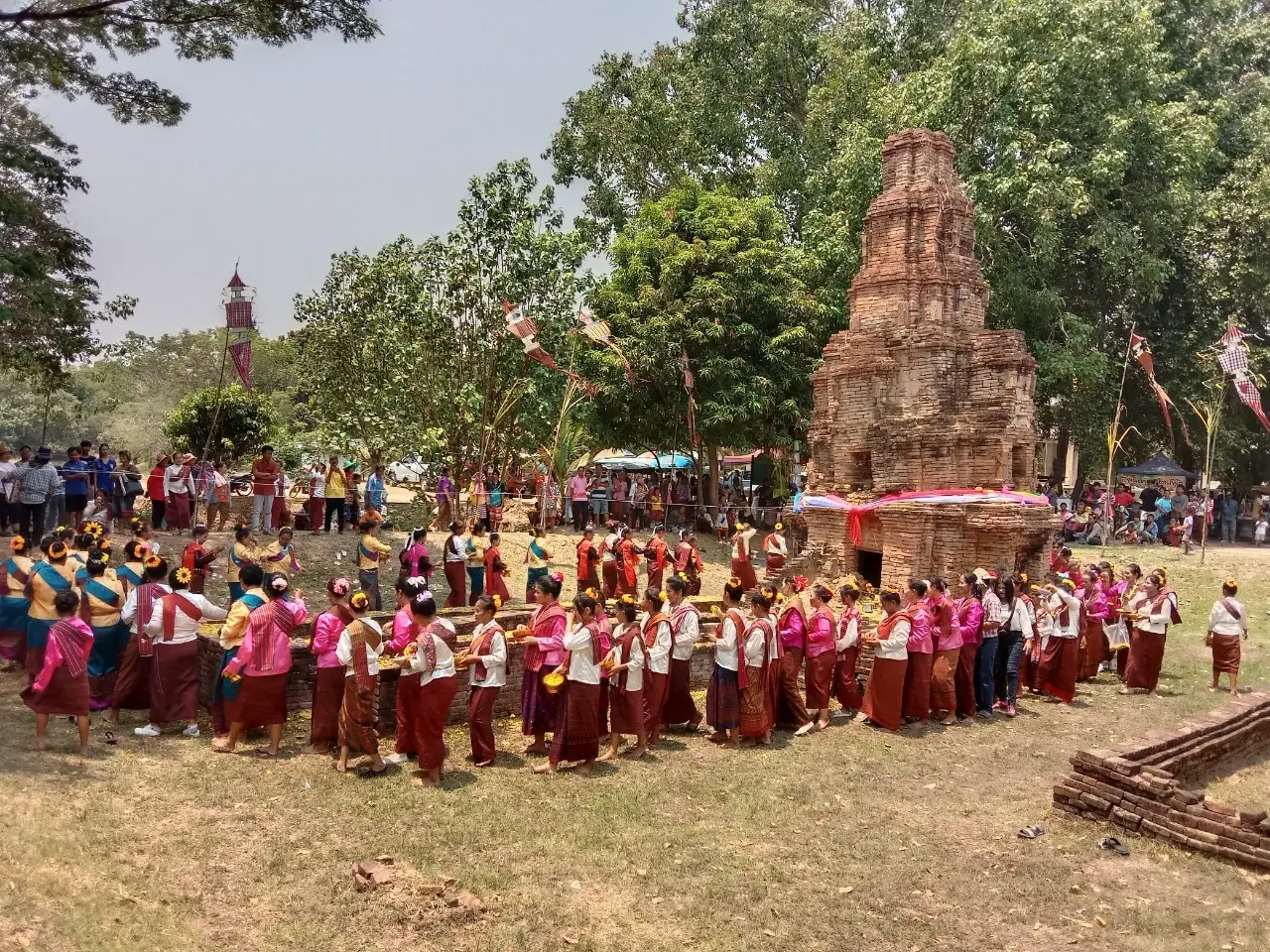
Local cultural activities connected with the legend of Prasat Tapiang Tia are another sign that the site remains meaningful today. Ritual events and cultural preservation activities show that the sanctuary is still part of the community’s living memory. When official cultural and heritage agencies help oversee the use of the area for local events, it reinforces the need to balance cultural life with conservation. Travelers visiting during community ceremonies should be respectful, avoid obstructing rituals, and observe local customs carefully.
Lamduan District has a slow and quiet character that suits travelers who enjoy meaningful stops rather than crowded destinations. Prasat Tapiang Tia is ideal for those who like local stories, language-based place names, brick religious architecture, and peaceful temple landscapes. It is not a destination built around grandeur. Its strength lies in its specific identity, quietness, and the way it reveals a lesser-known layer of Surin’s cultural history.
A general visit usually takes about 30 minutes to 1 hour. Travelers who want to photograph the structure, study the architecture, or walk through the temple grounds should allow more time. A slower visit helps reveal details that are easy to miss at first glance, such as the layered square plan, the spire arrangement, the relationship between the sanctuary and the temple, and the rural surroundings. Speaking politely with local people may also help visitors understand the site’s community context, but it is important not to interrupt temple routines.
Prasat Tapiang Tia’s greatest value is that it presents Surin from a different angle. Surin is not only a province of elephants and ancient Khmer ruins. It is also a province of layered local cultures, Buddhist temples, Khmer-language place names, Lao-influenced architecture, and rural communities that preserve memory through place. This sanctuary brings those layers together in one quiet location. For foreign travelers seeking a more thoughtful experience of Southern Isan, Prasat Tapiang Tia is a worthwhile destination beyond the standard tourist route.
Overall, Prasat Tapiang Tia is a meaningful historical and cultural attraction in Lamduan District, Surin Province. Its brick square form, 5 lotus-bud spires, east-facing orientation, temple setting, and name meaning “Duck Pond” all contribute to its identity. The site offers architectural insight, linguistic heritage, community memory, and a peaceful temple atmosphere. It is best visited with time, care, and respect, especially by travelers who want to understand Surin beyond its most famous attractions.
| Name | Prasat Tapiang Tia, also known as Prasat Trapiang Tia |
| Location | Within Wat Prasat Thep Nimit, Lamduan District, Surin Province |
| Address | Ban Nong Ko / Ban Yasook, Tapiang Tia Subdistrict, Lamduan District, Surin 32220, Thailand |
| Highlights | A brick-built square sanctuary with 5 lotus-bud-shaped spires, located inside Wat Prasat Thep Nimit |
| History / Period | Lao-style religious architecture associated with the late Ayutthaya to early Rattanakosin period |
| Name Origin | Tapiang Tia or Trapiang Tia comes from local Khmer and means Duck Pond; trapiang refers to a pond, pool, or water source, while tia means duck |
| Distinctive Features | A brick sanctuary with a square plan, 4 layered sections, an east-facing orientation, and 5 lotus-bud-shaped spires |
| Travel Information | Follow Highway 2077 near kilometre markers 33-34, then turn onto a local road for about 7 km to Wat Prasat Thep Nimit |
| Current Status | Open to visitors and remains a maintained heritage area used for local cultural activities |
| Open Days | Daily |
| Opening Hours | 09.00 – 17.00 |
| Fees | No admission fee |
| Main Areas / Zones | 1. Brick sanctuary 2. East-facing front area 3. Five lotus-bud spires 4. Wat Prasat Thep Nimit temple grounds 5. Heritage viewing area |
| Caretaker / Coordinating Agencies | Wat Prasat Thep Nimit, Surin National Museum under the Fine Arts Department, and the 10th Regional Office of Fine Arts, Nakhon Ratchasima |
| Main Contact Number | Tourism Authority of Thailand, Surin Office Tel. 044-514447 Surin National Museum Tel. 044-513274 |
| Part 2: Nearby Attractions, Restaurants, And Accommodations | The following options help travelers plan a route through Lamduan District, Surin town, and nearby areas. Distances are approximate road distances |
| Nearby Tourist Attractions | 1. Nong Khu Pine Forest Park, about 8 km 2. Lamduan City Pillar Shrine, about 16 km 3. Prasat Sikhoraphum, about 28 km 4. Surin National Museum, about 36 km 5. Surin City Pillar Shrine, about 39 km 6. Wat Burapharam Royal Monastery, about 40 km |
| Nearby Restaurants | 1. Map Photchana Lamduan, about 16 km, Tel. 086-866-7869 2. Im Aroi Buffet Khao Kaeng And Made-To-Order Food, about 16 km, Tel. 096-867-0047 3. Coffee Com Lamduan, about 16 km, Tel. 090-975-7089 4. Saeng Tawan Restaurant Lamduan Branch, about 16 km, Tel. 085-311-3095 5. Good Friends Lamduan, about 16 km, Tel. 093-512-5100 6. Ko Deng-Ho Deng Noodle Shop Opposite BAAC Lamduan, about 16 km, Tel. 098-517-5923 |
| Nearby Accommodations | 1. Mueang Mai Resort Lamduan, about 16 km, Tel. 081-760-7897 2. S-House Hotel Surin, about 34 km, Tel. 081-790-0177 3. Destino Hotel Surin, about 35 km, Tel. 096-324-7879 4. Seven Bee Boutique Hotel - Surin, about 39 km, Tel. 089-355-5777 5. Maneerote Hotel Surin, about 40 km, Tel. 044-539-477, 044-539-478, 044-539-479 |
Frequently Asked Questions (FAQ)
Q: Where is Prasat Tapiang Tia located?
A: Prasat Tapiang Tia is located within Wat Prasat Thep Nimit in Lamduan District, Surin Province, near Highway 2077 around kilometre markers 33-34, with a local road leading about 7 km to the temple.
Q: What are the opening days and hours?
A: The sanctuary is open daily from 09.00 to 17.00.
Q: Is there an admission fee?
A: There is no admission fee. Visitors should enter respectfully, as the sanctuary is located within a temple compound.
Q: What does the name Tapiang Tia mean?
A: Tapiang Tia or Trapiang Tia is a local Khmer name meaning Duck Pond. Trapiang refers to a pond or water source, while tia means duck.
Q: What is the main highlight of Prasat Tapiang Tia?
A: The main highlight is the brick-built square sanctuary with 5 lotus-bud-shaped spires, an east-facing orientation, and Lao-style architectural character from the late Ayutthaya to early Rattanakosin period.
Q: How long should travelers spend at the site?
A: A general visit takes about 30 minutes to 1 hour. Visitors interested in photography or architecture should allow more time.
Q: What nearby attractions can be combined with this trip?
A: Nearby options include Nong Khu Pine Forest Park, Lamduan City Pillar Shrine, Prasat Sikhoraphum, Surin National Museum, and Wat Burapharam Royal Monastery.
Q: How should visitors behave at Prasat Tapiang Tia?
A: Visitors should dress modestly, walk carefully, avoid climbing or touching the ancient brick structure, keep the temple grounds clean, and respect the religious atmosphere.
 Category: ●Art, Culture and Heritage
 Group: ●Historical Sites and Monuments
Last Update : 2 MonthAgo
 Last Update : 2 MonthAgo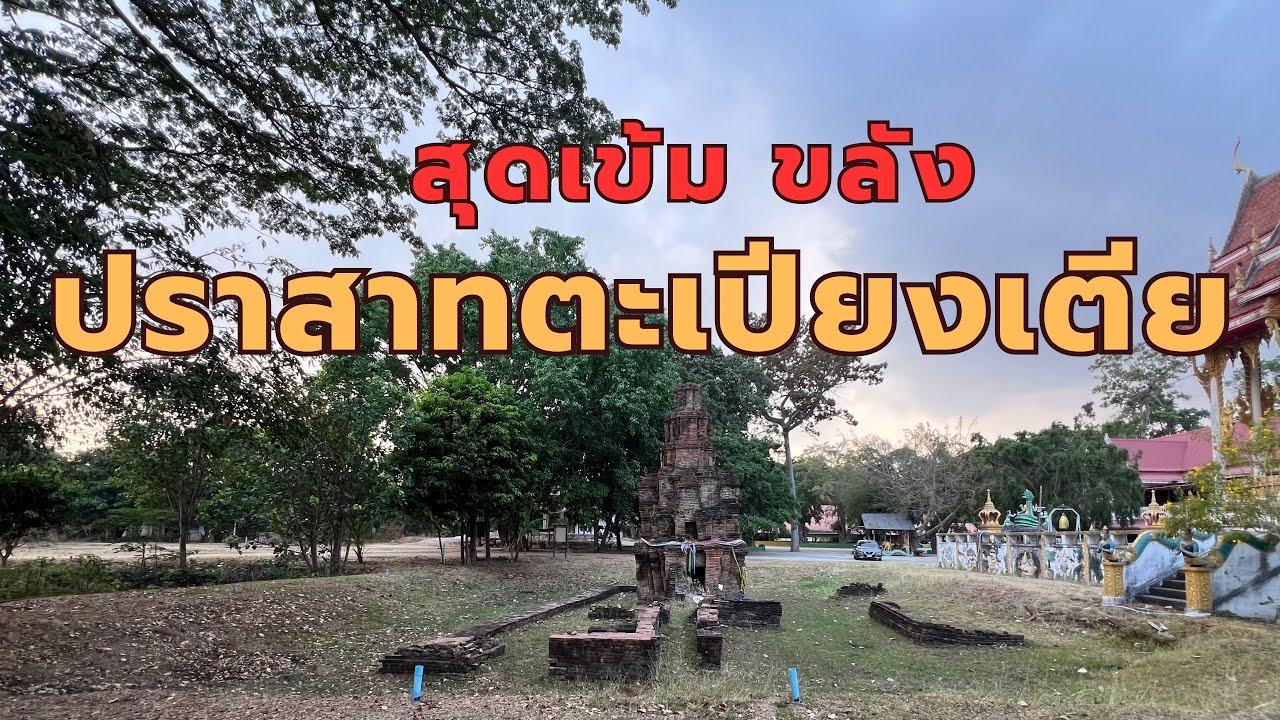
 Click to Access the Navigation Map GPS
Prasat Tapiang Tia Map
Recommend
 Historical Sites and Monuments(11)
 Landmarks and Memorials(2)
 Art, Craft Centres, Tradition(5)
 Museums(1)
 Places of Worship
 Temple(15)
 Other Sacred Sites(1)
 Suburban Living
 Village, Community(9)
 Local Market(1)
 Nature and Wildlife
 National Parks and Marine Reserves(2)
 Mountain (Doi)(2)
 Dam, Reservoir, Lake(6)
 Waterfalls(1)
 River, Canal(2)
 Other natural attractions(4)
 Entertainment and Agricultural
 Farms, Parks and Ecotourism(2)


