
lovethailand home >Northeastern Travel Attractions >Si Sa Ket Travel Attractions >Khun Han >Bak Dong > Wat Samrong Kiat
TL;DR: Wat Samrong Kiat is located at Ban Samrong Kiat, Moo 8, Bak Dong Subdistrict, Khun Han District, Si Sa Ket Province 33150, Thailand, open Daily, hours 08.00 - 17.00.
Wat Samrong Kiat
Open Days: Daily
Opening Hours: 08.00 - 17.00
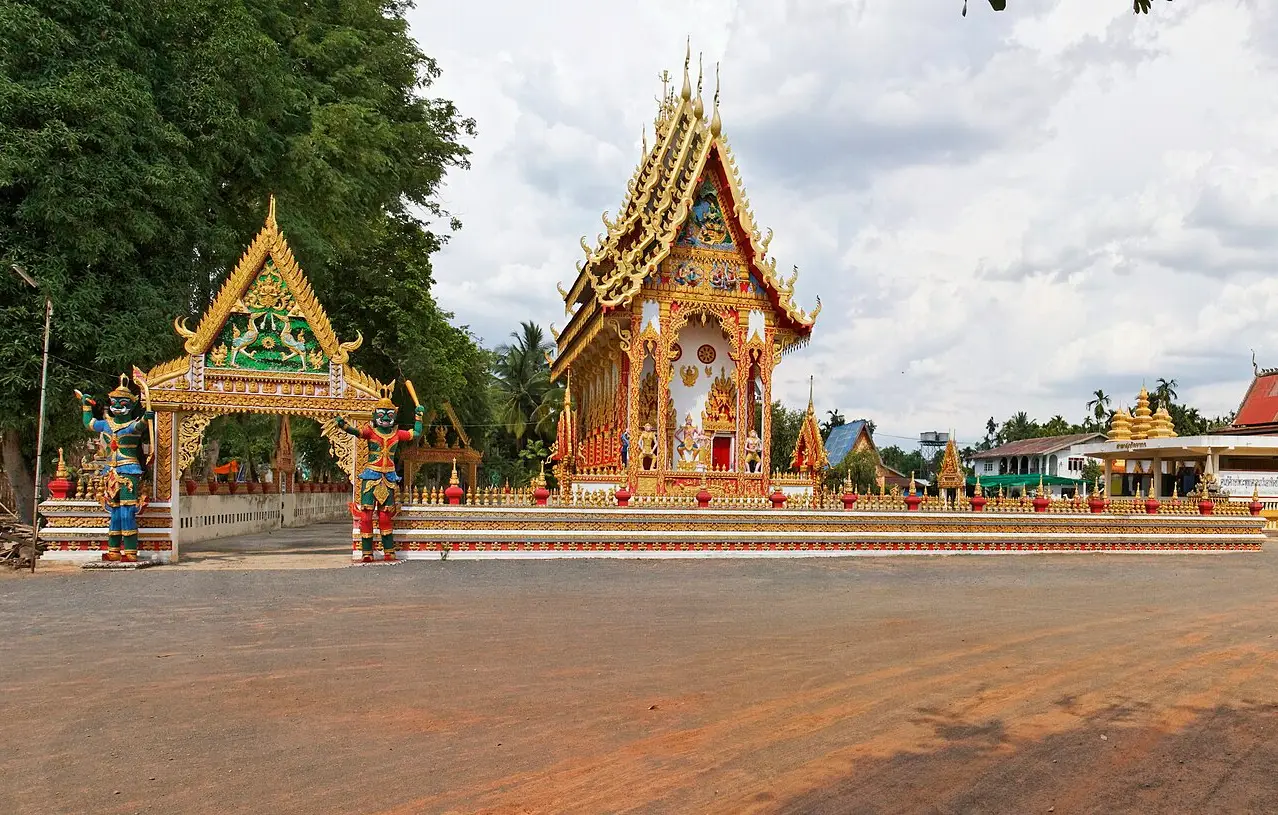
Wat Samrong Kiat, Si Sa Ket is an important local Buddhist temple in Ban Samrong Kiat, Moo 8, Bak Dong Subdistrict, Khun Han District, Si Sa Ket Province. The temple covers 11 rai, 3 ngan, and 60 square wah, and belongs to the Mahanikaya order of Thai Buddhism. It serves as a religious, moral, and cultural center for Ban Samrong Kiat and nearby villages. The most revered sacred object here is Luang Pho Phra Ta Ton, a very small Khmer-style Buddha image that has become the spiritual heart of the community and one of the most meaningful Buddhist images in the Khun Han area.
Wat Samrong Kiat was formally established in 1914 and received its royal boundary, or Wisungkham Sima, on 28 April 1982. The temple was initiated by Nai Sok and Nai Sao, who wanted to create a proper Buddhist place for enshrining Phra Ta Ton and for supporting the religious life of the local community. Over time, the temple developed its main religious buildings and community facilities, including the ordination hall, sermon hall, bell tower, crematorium, merit-making hall, Phra Ta Ton vihara, five-spired prasat, meditation and resting pavilion, temple walls, and community activity areas.
The name “Samrong Kiat” is connected with local geography, vegetation, and language. In the past, there was a large samrong tree growing in a pond in the village area, and water hyacinths were found in the same wetland. Local Khmer-speaking villagers called water hyacinth “trao kit.” The combination of the samrong tree, the pond, the Khmer local term, and the village name became part of the identity of the temple. This makes the name Wat Samrong Kiat more than a religious label; it preserves the relationship between trees, water, local language, and the life of a Lower Isan borderland community.
The identity of the temple is inseparable from Luang Pho Phra Ta Ton. Local temple tradition tells that the Buddha image was discovered by Nai Ta Ton, a Lower Khmer man who had relatives in Ban Samrong Kiat and often traveled to the village. One day, he set a fish trap in a stream south of the village. When he returned to collect the trap the next morning, he found no fish. Instead, a small Buddha image was caught inside. He brought the image to Wat Samrong Kiat and offered it to the temple. When the abbot informed villagers of the discovery, people came in large numbers to worship the image. From that time onward, the image became known as Luang Pho Phra Ta Ton, named after the man who discovered and offered it.
Luang Pho Phra Ta Ton is a Khmer-style Buddha image in the posture of subduing Mara. It is very small, measuring about 4 inches across the lap and about 5 inches high. The image was made from flower pollen mixed with lac or resin and shaped into a Buddha figure. Its small size does not reduce its importance. On the contrary, the combination of its rare material, its discovery legend, and its connection with the village gives it a strong sacred identity. For the people of Ban Samrong Kiat, the image is not simply an object of worship but a living symbol of faith, protection, and community memory.
A major part of the temple’s sacred history concerns the attempt to move Luang Pho Phra Ta Ton to Khukhan. In 1877, Phraya Khukhan Phakdi Si Nakhon Lamduan, the governor of Khukhan, came to invite the Buddha image to be enshrined in Khukhan town. A procession of elephants and horses was arranged, and the image was placed on an elephant. When the procession left the temple and approached Huai Tha Bridge, strong winds blew from all four directions, heavy rain fell, elephants and horses knelt down, and thunder roared across the area. The governor then declared that if the storm stopped, he would return Luang Pho Phra Ta Ton to Wat Samrong Kiat. The storm stopped, and the image was brought back to the temple, where it has remained ever since.
This story gives Luang Pho Phra Ta Ton a special sacred status in local belief. Devotees continue to come to the temple to pray for blessings, peace of mind, family well-being, health, and good fortune. The traditional way of fulfilling a vow to Luang Pho Phra Ta Ton is deeply Buddhist in character. Many devotees fulfill vows through temporary or long-term ordination, turning personal faith into merit-making, self-discipline, and a return to the Dhamma. This shows that devotion to Luang Pho Phra Ta Ton is not limited to worldly wishes but is also tied to spiritual practice and moral cultivation.
Today, Luang Pho Phra Ta Ton remains the principal sacred image of Wat Samrong Kiat. The temple also has two replica images of Phra Ta Ton, one black and one gold, so that visitors can worship more conveniently while preserving the original image. In addition, the temple has a principal Buddha image in the ordination hall and three Buddha images in the sermon hall. These sacred images support the religious activities of the community and provide several worship points for visitors who come to make merit.
The ordination hall is one of the most important buildings in the temple. It measures about 30 meters wide and 40 meters long and was built in 1973. It is the main space for formal Sangha ceremonies and contains the principal Buddha image of the temple. The size of the ordination hall reflects the strength of local faith and the determination of villagers to build a complete Buddhist institution in their community. For visitors, the ordination hall is a key place to understand the temple’s religious role.
The sermon hall measures about 12 meters wide and 21 meters long and was built in 1982. It functions as a space for merit-making, Dhamma listening, community gatherings, religious ceremonies, and village activities. Inside the sermon hall are three Buddha images. This building shows the social role of the temple. In rural Thai communities, a sermon hall is not only a place for religious teaching; it is also a communal space where villagers gather for important events throughout the year.
The four-story bell tower, built in 1993, adds to the temple’s physical identity and ritual function. In Thai temple life, the sound of the bell is connected with time, ceremonies, and mindfulness. The crematorium, built in the same year, serves the funeral needs of the community, while the merit-making hall, built in 1997, provides space for ceremonies related to death, remembrance, and family merit. These structures show that Wat Samrong Kiat supports the full cycle of community life, from worship and education to mourning and remembrance.
The Phra Ta Ton vihara, built in 2000, is the spiritual focus of the temple. It gives Luang Pho Phra Ta Ton a proper sacred space for worship and allows visitors to pay respect in a calm and organized setting. For many visitors, this vihara is the heart of the visit. It is the place where the story of the discovered Buddha image, the village’s faith, and the ongoing Buddhist practice of the community come together.
The five-spired prasat, completed in 2006, adds a strong Lower Isan character to the temple. Its form reflects the cultural background of Si Sa Ket and Khun Han, where Khmer influence, local Buddhist faith, and regional artistic memory are deeply connected. The prasat is not an ancient Khmer sanctuary, but its form resonates with the visual language of Khmer-influenced sacred architecture in the region. It helps visitors understand that Wat Samrong Kiat belongs to a cultural landscape shaped by Buddhism, Khmer local identity, and the Phanom Dong Rak borderland.
The Sala Phak Chai, built in 2003, represents the temple’s role as a place of emotional and spiritual rest. Its name means a pavilion for resting the heart. This reflects the function of a village temple as more than a ceremonial site. It is a place where people come to slow down, sit quietly, reflect, talk with others, make merit, and regain inner steadiness. In this way, the temple provides both religious support and emotional shelter for the community.
The temple walls around all four sides were built in 1996, and the wall surrounding the ordination hall was built in 2004. These walls give the temple clear boundaries and help define the sacred area. Although village temples are generally open to everyone, a temple boundary helps create a sense of order, respect, and protection for religious activities. Within the temple compound, visitors enter a space intended for merit, quietness, and respectful behavior.
Wat Samrong Kiat is currently led by Phra Athikan Uthai Mahapunyo, the abbot of the temple. He oversees the temple together with resident monks, the Ban Samrong Kiat community, and local agencies in Khun Han District. The care of a village temple includes maintaining buildings, supporting religious ceremonies, welcoming devotees, preserving the sacred image of Luang Pho Phra Ta Ton, and providing a stable place for Buddhist practice and community gatherings.
The temple’s present role is to strengthen morality and ethics among villagers of Ban Samrong Kiat and surrounding communities. Elderly residents come to make merit. Children and young people learn Buddhist manners and local history. Families use the temple for ceremonies connected with life events. Villagers gather here for Buddhist holy days, robe-offering ceremonies, funerals, and community activities. Wat Samrong Kiat therefore remains an active institution that shapes the moral and social life of the village.
A meaningful visit should begin at the Phra Ta Ton vihara. Visitors should dress modestly, remove shoes where required, and enter the worship area quietly. After paying respect to Luang Pho Phra Ta Ton, visitors can continue to see the replica images, the ordination hall, sermon hall, bell tower, five-spired prasat, merit-making hall, and other temple areas. Walking slowly through the temple allows visitors to understand its different layers: sacred legend, Buddhist devotion, Khmer-influenced culture, and the everyday life of the local community.
For visitors interested in Lower Isan culture, Wat Samrong Kiat is especially valuable. It preserves a local Khmer-language element in its name, a Khmer-style Buddha image, a strong miracle tradition surrounding Luang Pho Phra Ta Ton, and sacred architecture connected with the cultural background of Si Sa Ket. Khun Han District is a borderland area connected with the Phanom Dong Rak range and Khmer-speaking communities. The temple therefore helps explain how Buddhism in Lower Isan is deeply connected with local language, landscape, oral tradition, and regional art.
Getting There is most convenient by private car or hired local transport. From Si Sa Ket city, travel toward Khun Han District through Phayu and Phrai Bueng, then continue to Bak Dong Subdistrict and Ban Samrong Kiat. The road distance from Si Sa Ket city is about 80 kilometers. From Khun Han town, the temple is about 20 kilometers away. Travelers using public transport should get off in Khun Han town and continue by local vehicle to Bak Dong and Ban Samrong Kiat.
Wat Samrong Kiat can be combined naturally with Samrong Kiat Waterfall, also known as Namtok Pisat, because both are in the Ban Samrong Kiat and Bak Dong area. A good route is to visit the temple in the morning, pay respect to Luang Pho Phra Ta Ton, and then continue to the waterfall for nature recreation. With more time, visitors can extend the route to Huai Chan Waterfall, Wat Pa Maha Chedi Kaew, Wat Phrai Phatthana, the Luang Pu Suang memorial area, Pha Ya Kupri Viewpoint, or the route toward Khao Phra Wihan National Park.
The best time to visit the temple is in the morning or late afternoon before closing. Morning provides a quiet atmosphere for worship and walking through the temple grounds. Late afternoon is convenient for travelers who plan to continue to local waterfalls or nearby attractions. For those combining the temple with Samrong Kiat Waterfall, September to February is the most suitable period for seeing the waterfall at its best, as the surrounding nature is greener and the water level is usually stronger.
There is no fixed tourist admission fee at Wat Samrong Kiat. Visitors may enter during opening hours to pay respect to Luang Pho Phra Ta Ton, make merit, and explore public areas of the temple. Donations, flowers, garlands, candles, incense, and merit-making offerings are voluntary according to personal faith. This keeps the temple open and accessible to villagers, pilgrims, students, cultural travelers, and international visitors.
Proper etiquette is important because the temple is both a living Buddhist monastery and a sacred community heritage site. Visitors should dress modestly, remove shoes where required, speak quietly, avoid touching Buddha images or sacred objects without permission, avoid climbing on buildings or the five-spired prasat, avoid disturbing monks or worshippers, avoid littering, and help keep the temple clean. Respectful behavior supports the calm atmosphere that gives the temple its meaning.
For international visitors, Wat Samrong Kiat offers a clear introduction to a local Buddhist temple in Lower Isan. It presents a small but highly revered Khmer-style Buddha image, a sacred discovery legend, Khmer local language in the temple name, a village temple structure, and a route connected with waterfalls and mountain-edge nature in Khun Han District. Visitors can see that Thai Buddhism is not only expressed through large royal temples or famous urban monuments. It also lives in village temples where local memory, faith, language, and community life continue together.
Wat Samrong Kiat is therefore more than a village temple. It is a place where Luang Pho Phra Ta Ton, the story of Nai Ta Ton, the name Samrong Kiat, Khmer-influenced art, local Buddhist practice, and the life of Ban Samrong Kiat community are held together in one sacred landscape. A visit here shows that the power of a temple does not depend on the physical size of its sacred image or the scale of its buildings. It comes from shared faith, continuous care, and the ability of a community to preserve meaning across generations.
| Place Name | Wat Samrong Kiat, Si Sa Ket |
| Related Names | Wat Samrong Kiat Luang Pho Phra Ta Ton, Wat Ban Samrong Kiat, Luang Pho Phra Ta Ton, Phra Ta Ton |
| Place Type | Local Buddhist Temple, Mahanikaya Monastery, Faith-Based Cultural Attraction, And Local Heritage Learning Site In Khun Han District |
| Location | Ban Samrong Kiat, Moo 8, Bak Dong Subdistrict, Khun Han District, Si Sa Ket Province 33150, Thailand |
| Coordinates | 14.53083, 104.49028 |
| Temple Area | 11 Rai, 3 Ngan, 60 Square Wah |
| Distance From Key Points | About 20 km from Khun Han town and about 80 km from Si Sa Ket city by road |
| Significance | A village temple of Ban Samrong Kiat and the home of Luang Pho Phra Ta Ton, a small Khmer-style Buddha image deeply revered by the local community |
| Historical Summary | The temple was established in 1914 and received its Wisungkham Sima on 28 April 1982. Nai Sok and Nai Sao initiated the temple as a place to enshrine Phra Ta Ton and to serve as the Buddhist center of the community. |
| Name Origin | The name is connected with a large samrong tree in a pond and the local Khmer term “trao kit” for water hyacinth, together with the village name Samrong Kiat. |
| Main Sacred Image | Luang Pho Phra Ta Ton, a Khmer-style Buddha image in the Mara-vijaya posture, about 4 inches across the lap and about 5 inches high, made from flower pollen mixed with lac or resin |
| Replica Images | Two replica images of Phra Ta Ton, one black and one gold, are provided for worship and devotional practice. |
| Main Temple Buildings | Ordination Hall, 30 m wide and 40 m long, built in 1973 Sermon Hall, 12 m wide and 21 m long, built in 1982 Four-Story Bell Tower, built in 1993 Crematorium, 5 m wide and 15 m long, built in 1993 Merit-Making Hall, 8 m wide and 18 m long, built in 1997 Phra Ta Ton Vihara, built in 2000 Sala Phak Chai, built in 2003 Five-Spired Prasat, completed in 2006 |
| Abbot / Caretaker | Phra Athikan Uthai Mahapunyo, Abbot Of Wat Samrong Kiat, together with resident monks, Ban Samrong Kiat community, and local agencies in Khun Han District |
| Current Status | Active Buddhist temple and faith-based cultural destination where visitors can pay respect to Luang Pho Phra Ta Ton, make merit, and learn about the local history of Ban Samrong Kiat during opening hours |
| Open Days | Daily |
| Opening Hours | 08.00 - 17.00 |
| Admission Fee | Free Admission. Donations, flowers, garlands, candles, incense, and merit-making offerings are voluntary according to personal faith. |
| Main Areas / Zones | 1. Luang Pho Phra Ta Ton Vihara Zone 2. Black And Gold Phra Ta Ton Replica Zone 3. Ordination Hall Zone 4. Sermon Hall Zone 5. Five-Spired Prasat Zone 6. Sala Phak Chai Zone 7. Bell Tower Zone 8. Merit-Making Hall And Crematorium Zone 9. Temple Courtyard And Merit-Making Area 10. Luang Pho Phra Ta Ton And Ban Samrong Kiat Heritage Learning Zone |
| Facilities | Temple courtyard, Luang Pho Phra Ta Ton worship area, halls, merit-making spaces, parking in areas arranged by the temple or community, and basic services in Ban Samrong Kiat |
| Related Contact | Khun Han District Office, Tel. 045-679-035 Khun Han Subdistrict Municipality, Tel. 045-679-227 Samrong Kiat Waterfall, Tel. 063-565-9399 Si Sa Ket Provincial Office Of Buddhism, Tel. 045-622645 |
| Travel Information | From Si Sa Ket city, travel toward Khun Han District through Phayu and Phrai Bueng, then continue to Bak Dong Subdistrict and Ban Samrong Kiat. The distance is about 80 km by road. From Khun Han town, the temple is about 20 km away. Private car, van, or hired local transport is recommended. |
| Visitor Etiquette | Dress modestly, keep quiet, remove shoes where required, do not touch Buddha images or sacred objects without permission, do not climb on buildings or the five-spired prasat, respect monks and worshippers, and keep the temple clean. |
| Nearby Tourist Attractions | 1. Samrong Kiat Waterfall / Namtok Pisat, about 5 km, Tel. 063-565-9399 2. Ban Samrong Kiat Community, about 0 km 3. Huai Chan Waterfall / Kanthrom Waterfall, about 25 km 4. Wat Pa Maha Chedi Kaew / Million Bottle Temple, about 24 km, Tel. 084-524-3770 5. Khun Han Town, about 20 km 6. Lung Serm Volcano Durian Garden, about 25 km 7. Wat Phrai Phatthana / Luang Pu Suang Memorial, about 40 km, Tel. 099-625-3859 8. Pha Ya Kupri Viewpoint, about 43 km 9. Pha Mo I Daeng / Khao Phra Wihan National Park, about 55 km 10. Si Sa Ket City, about 80 km |
| Nearby Restaurants | 1. BJ Coffee House, Khun Han, about 20 km, Tel. 098-214-6024 2. Cho Cher Coffee & Bakery, Khun Han, about 20 km, Tel. 091-014-0622 3. MOMOCHA Taiwanese Bubble Tea Khun Han, about 20 km, Tel. 064-959-0476, 062-441-9235 4. Indy Coffee Bar & Restaurant, Khun Han, about 20 km, Tel. 099-069-5889 5. Wang Kung Restaurant, Khun Han, about 21 km, Tel. 087-244-6364 6. Pongsin Resort & Restaurant, about 18 km, Tel. 088-375-5199 |
| Nearby Accommodations | 1. Pongsin Resort & Restaurant, Khun Han, about 18 km, Tel. 088-375-5199 2. Peace Pool Resort, Khun Han, about 20 km, Tel. 081-879-5822 3. Rerawadi Resort & Spa, Khun Han, about 20 km, Tel. 087-128-0095 4. Cheyenne Resort, Khukhan, about 43 km, Tel. 085-024-4829, 045-966-585 5. Bansuansrisuparb Hotel, Khukhan, about 47 km, Tel. 087-245-9125, 080-240-7090 6. B2 Sisaket Boutique & Budget Hotel, Mueang Si Sa Ket, about 83 km, Tel. 052-009-161, 088-263-2897 |
Frequently Asked Questions (FAQ)
Q: Where is Wat Samrong Kiat located?
A: Wat Samrong Kiat is located in Ban Samrong Kiat, Moo 8, Bak Dong Subdistrict, Khun Han District, Si Sa Ket Province. It is an important village temple in the same wider area as Samrong Kiat Waterfall.
Q: What are the opening days and hours?
A: Wat Samrong Kiat is open daily from 08.00 to 17.00. Visitors can pay respect to Luang Pho Phra Ta Ton, make merit, and walk around public temple areas during these hours.
Q: Is there an admission fee?
A: There is no fixed tourist admission fee. Donations, flowers, garlands, incense, candles, and merit-making offerings are voluntary according to personal faith.
Q: What is Luang Pho Phra Ta Ton?
A: Luang Pho Phra Ta Ton is a small Khmer-style Buddha image in the Mara-vijaya posture, about 4 inches across the lap and about 5 inches high. It was made from flower pollen mixed with lac or resin and is the main sacred image of Wat Samrong Kiat.
Q: Who is the current abbot of Wat Samrong Kiat?
A: The current abbot is Phra Athikan Uthai Mahapunyo, who oversees the temple together with resident monks, the Ban Samrong Kiat community, and local agencies in Khun Han District.
Q: What are the main highlights inside the temple?
A: Main highlights include the Luang Pho Phra Ta Ton vihara, black and gold Phra Ta Ton replica images, ordination hall, sermon hall, bell tower, five-spired prasat, Sala Phak Chai, and community Buddhist activity areas.
Q: How can visitors get to Wat Samrong Kiat?
A: From Si Sa Ket city, travel toward Khun Han District through Phayu and Phrai Bueng, then continue to Bak Dong Subdistrict and Ban Samrong Kiat. The distance is about 80 km by road. From Khun Han town, the temple is about 20 km away.
Q: What nearby places can be visited on the same trip?
A: Nearby places include Samrong Kiat Waterfall, Huai Chan Waterfall, Wat Pa Maha Chedi Kaew, Khun Han town, Wat Phrai Phatthana, Luang Pu Suang Memorial, Pha Ya Kupri Viewpoint, and Pha Mo I Daeng.
 Category: ●Places of Worship
 Group: ●Temple
Last Update : 2 MonthAgo
 Last Update : 2 MonthAgo
 Click to Access the Navigation Map GPS
 Art, Culture and Heritage
 Historical Sites and Monuments(12)
 Landmarks and Memorials(1)
 Art, Craft Centres, Tradition(8)
Temple(13)
Art, Craft Centres, Tradition(8)
Temple(13)
 Other Sacred Sites(3)
 Suburban Living
 Village, Community(2)
 Nature and Wildlife
 National Parks and Marine Reserves(2)
 Dam, Reservoir, Lake(7)
 Waterfalls(5)
 River, Canal(5)
 Bays and Beaches(2)
 Entertainment and Agricultural
 Zoos and Aquariums(1)
 Farms, Parks and Ecotourism(3)


