
lovethailand home >Northeastern Travel Attractions >Si Sa Ket Travel Attractions >Uthum Phon Phisai >Kha Yung > Prasat Wat Sa Kamphaeng Noi
TL;DR: Prasat Wat Sa Kamphaeng Noi is located at Wat Thep Prasat Sa Kamphaeng Noi, Ban Klang, Khayung Subdistrict, Uthumphon Phisai District, Si Sa Ket Province, open Daily, hours 08.30 – 16.30.
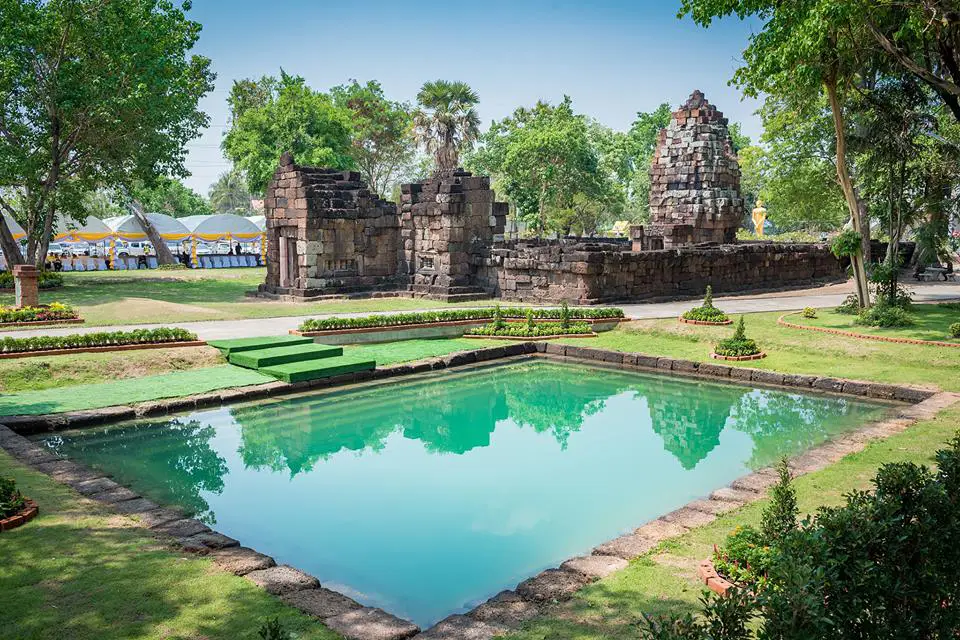
Prasat Wat Sa Kamphaeng Noi
Open Days: Daily
Opening Hours: 08.30 – 16.30
Prasat Wat Sa Kamphaeng Noi in Si Sa Ket Province is an ancient Khmer archaeological site located within Wat Thep Prasat Sa Kamphaeng Noi at Ban Klang, Khayung Subdistrict, Uthumphon Phisai District. The site lies close to Si Sa Ket city along Highway 226, making it one of the easiest Khmer heritage sites in the province to visit. The monument consists of a main sanctuary, a vihara or library building, a laterite enclosure wall, an eastern gopura, and water features arranged according to the sacred layout of ancient Khmer religious architecture. The site preserves evidence of both Baphuon-style art from around the 16th Buddhist century and Bayon-style architecture associated with the arokayasala, or ancient Khmer hospital chapel, of King Jayavarman VII in the 18th Buddhist century.
Prasat Wat Sa Kamphaeng Noi is an important destination for travelers who want to understand the Khmer heritage of Lower Northeastern Thailand beyond the more famous large monuments. Although it is smaller than Prasat Wat Sa Kamphaeng Yai, its historical value is substantial. The site clearly preserves the layout of an arokayasala, a sacred hospital chapel that connected healing, faith, water, and community welfare in the ancient Khmer world. For foreign travelers, this monument offers a concise yet meaningful introduction to how religion and public welfare were expressed through architecture in the reign of King Jayavarman VII.
The monument is located inside an active Buddhist temple. This gives the site a special atmosphere because ancient Khmer remains and present-day Buddhist life exist together in the same sacred space. Visitors can walk quietly around the laterite structures, observe the pond, and also experience the calm environment of a local Thai temple. The site is not crowded, which makes it suitable for slow cultural travel, heritage photography, educational visits, and travelers who prefer places with strong historical meaning rather than large tourist crowds.
The main structures are built primarily of laterite with sandstone used for important architectural and decorative elements. The main sanctuary faces east, following the sacred orientation commonly found in Khmer religious architecture. The east-facing entrance reflects the symbolic meaning of sunrise, light, renewal, and ritual entry. The laterite enclosure wall defines the sacred precinct, while the eastern gopura functions as the formal gateway into the inner area. This arrangement shows that the site was carefully planned rather than built as an isolated structure.
One of the most important pieces of evidence associated with the site is a lintel depicting Varuna, the deity of rain, seated on a pedestal supported by 3 swans above a kirtimukha face. This lintel belongs to the Baphuon artistic style and dates to around the 16th Buddhist century. Varuna is connected with water, rain, fertility, and cosmic order. The presence of this imagery is especially meaningful when viewed together with the ponds and water features around the monument, showing how water shaped both the symbolism and the physical landscape of the site.
The Varuna lintel indicates that the site had an earlier religious layer related to Brahmanical-Hindu belief before the Bayon-period transformation. Later, during the reign of King Jayavarman VII, the site was adapted or expanded with architectural features connected to the arokayasala system. This makes Prasat Wat Sa Kamphaeng Noi valuable because it preserves more than one phase of religious meaning. It shows how Khmer sacred sites could be reused, reinterpreted, and connected with different traditions over time.
The arokayasala was not a hospital in the modern clinical sense. It was a sacred healing space connected with Mahayana Buddhist belief, especially the cult of Bhaisajyaguru, the Medicine Buddha. In the ancient Khmer world, healing was not separated from spiritual protection, ritual order, and royal compassion. Hospital chapels were built in many parts of the empire, and they reflected the idea that the suffering of the people was a concern of the ruler. Prasat Wat Sa Kamphaeng Noi is one of the sites that helps visitors understand this important aspect of Khmer civilization.
A typical arokayasala layout includes a main sanctuary, an auxiliary building or library, an enclosing wall, an eastern gopura, and a pond usually located toward the northeastern side. Prasat Wat Sa Kamphaeng Noi contains these key components. The main sanctuary formed the sacred core. The vihara or library building supported ritual functions. The laterite wall marked the boundary of the sacred precinct. The gopura created the transition from ordinary space into sacred space. The pond completed the healing landscape by connecting water, ritual purity, and symbolic restoration.
The water features are among the most meaningful parts of the site. In front of the sanctuary is a large pond, and within the arokayasala layout is a laterite-edged pond on the northeastern side. Water in Khmer sacred architecture was connected with purification, fertility, prosperity, and healing. In the context of a hospital chapel, water becomes even more important because it reinforces the idea of restoration and well-being. The ponds at Prasat Wat Sa Kamphaeng Noi are therefore not merely scenic elements; they are part of the monument’s original sacred logic.
The site is also associated with Bhaisajyaguru, the Medicine Buddha, whose cult was central to the religious meaning of many arokayasala sites. Bhaisajyaguru represents healing, compassion, and the removal of suffering. Understanding this meaning helps visitors see the monument not simply as an old stone structure but as a place that once represented hope, care, and sacred protection for the community.
Prasat Wat Sa Kamphaeng Noi is particularly interesting because it combines Baphuon and Bayon elements. The Baphuon-style Varuna lintel reflects an earlier religious and artistic layer, while the Bayon-style layout and arokayasala association reflect Mahayana Buddhist influence in the reign of King Jayavarman VII. This layered history makes the site important for understanding religious transformation in Lower Northeastern Thailand. It shows that ancient monuments were not static; they could change in meaning and function as political and religious contexts shifted.
The name Sa Kamphaeng Noi is connected with the physical features of the site: the pond, the wall, and the smaller scale of the enclosure compared with larger monuments nearby. The name also distinguishes it from Prasat Wat Sa Kamphaeng Yai, another major Khmer sanctuary in Uthumphon Phisai District. Today the site is located within Wat Thep Prasat Sa Kamphaeng Noi, showing how the ancient monument continues to exist within an active religious and community landscape.
A good way to explore the site is to begin at the eastern side, where the main approach and gopura are located. From there, visitors can enter the laterite enclosure, observe the main sanctuary, and then study the vihara or library building. After examining the main structures, visitors should walk toward the northeastern pond and then view the larger pond in front of the sanctuary. This walking sequence helps reveal the logic of the arokayasala layout and the relationship between architecture and water.
The main areas of interest include the eastern entrance zone, the gopura, the laterite enclosure wall, the main sanctuary, the vihara or library building, the northeastern laterite-edged pond, the large pond in front of the sanctuary, and the active temple area. Because the site is compact, visitors can explore it without difficulty. However, careful observation is important because the historical meaning lies in the arrangement of the structures as much as in the individual stones.
The atmosphere is peaceful and shaded. The monument is easy to access from the main road, yet it feels calm once visitors enter the temple grounds. This makes it a suitable stop for travelers moving between Si Sa Ket city and Uthumphon Phisai. The site is also suitable for families, students, photographers, and travelers interested in Khmer archaeology. A normal visit takes about 30–60 minutes, while travelers who want to study the arokayasala layout, photograph the pond, and examine the laterite structures should allow around 1–1.30 hours.
For photography, the best angles include the front view of the sanctuary and pond, the gopura framing the entrance, the laterite wall, and the pond area that gives the site a calm reflective atmosphere. Morning and late afternoon light are especially suitable because they make the laterite texture and shadows more visible. Visitors should photograph responsibly and avoid climbing, touching fragile stones, or moving any architectural fragments.
Because the site is located inside an active temple, respectful dress and behavior are important. Visitors should avoid loud behavior, climbing on the ancient structures, writing on stones, moving fragments, touching carvings unnecessarily, or leaving litter. Responsible travel helps preserve the monument and respects the monks and local community who continue to care for the temple area.
Prasat Wat Sa Kamphaeng Noi is easy to reach from Si Sa Ket city. The site is about 8–10 km away along Highway 226 on the Si Sa Ket-Uthumphon Phisai route. Travelers coming from Si Sa Ket city will find the temple along the roadside. Travelers coming from Uthumphon Phisai can take Highway 2083 and continue onto Highway 226 toward Si Sa Ket city for about 10 km. A private car, rental car, or motorcycle is the most convenient way to visit, especially if travelers want to combine several sites in one day.
Getting There is straightforward because the site is close to the main road. Visitors without private transport can travel along the Si Sa Ket-Uthumphon Phisai route and arrange local transport to the temple area. Daytime travel is recommended because it is easier to see the entrance, walk around the site, and observe the details of the laterite structures and water features.
Prasat Wat Sa Kamphaeng Noi can be combined with several nearby attractions. From Si Sa Ket city, travelers can visit the Si Sa Ket Aquarium, the City Pillar Shrine, Wat Maha Phuttharam, and then continue to Prasat Wat Sa Kamphaeng Noi. Travelers who want a fuller Khmer heritage route can continue to Prasat Wat Sa Kamphaeng Yai, a larger and more complete Khmer monument in Uthumphon Phisai District. Visiting both Sa Kamphaeng Noi and Sa Kamphaeng Yai on the same day gives a clearer understanding of Khmer architecture in this part of Si Sa Ket.
The site is also valuable as an outdoor learning space. It helps explain Khmer temple planning, laterite construction, sacred water features, Mahayana Buddhist healing belief, and the role of the Medicine Buddha in the arokayasala system. Students and cultural travelers can understand from the real site that ancient Khmer monuments did not all serve the same purpose. Some were Hindu shrines, some were community temples, and some were hospital chapels connected with healing and public welfare.
In the wider context of Si Sa Ket Province, Prasat Wat Sa Kamphaeng Noi helps complete the province’s Khmer heritage story. Si Sa Ket contains many Khmer archaeological sites, including Prasat Wat Sa Kamphaeng Yai, Prasat Ta Leng, Prasat Prang Ku, Prasat Ban Samo, and others. Each site has a different character. Prasat Wat Sa Kamphaeng Noi is especially important because of its arokayasala layout and its link to the healing culture of the Bayon period.
The value of Prasat Wat Sa Kamphaeng Noi lies in the clarity of its layout and the depth of its meaning. The Baphuon-style Varuna lintel tells the story of water, rain, and earlier Hindu symbolism. The Bayon-style arokayasala layout tells the story of Mahayana Buddhist healing. The ponds show the sacred role of water. The laterite wall and gopura show the boundary of sacred space. The active temple setting shows how ancient heritage continues to coexist with present-day local life.
For foreign travelers seeking a meaningful cultural stop near Si Sa Ket city, Prasat Wat Sa Kamphaeng Noi is a compact but highly informative site. It is easy to access, free to visit, peaceful, and historically rich. A visit here offers more than a view of ancient laterite remains; it offers a direct encounter with the Khmer idea of healing, sacred water, religious transformation, and community-centered heritage in Lower Northeastern Thailand.
| Name | Prasat Wat Sa Kamphaeng Noi, also known as Prasat Sa Kamphaeng Noi |
| Location | Wat Thep Prasat Sa Kamphaeng Noi, Ban Klang, Khayung Subdistrict, Uthumphon Phisai District, Si Sa Ket Province |
| Address | Khayung Subdistrict, Uthumphon Phisai District, Si Sa Ket 33120, Thailand |
| Coordinates | 15.146262, 104.247169 |
| Highlights | Main sanctuary, vihara or library building, laterite enclosure wall, eastern gopura, large pond, and Bayon-period arokayasala layout linked with ancient Khmer healing belief |
| History | Originally connected with Baphuon-style Khmer art around the 16th Buddhist century, then adapted or expanded in the 18th Buddhist century as a Bayon-period arokayasala during the reign of King Jayavarman VII |
| Name Origin | The name Sa Kamphaeng Noi is connected with the pond and laterite enclosure wall, while the current temple is known as Wat Thep Prasat Sa Kamphaeng Noi |
| Distinctive Features | Laterite main sanctuary and vihara enclosed by a laterite wall, eastern gateway, and sacred ponds that complete the arokayasala layout |
| Key Evidence | Varuna lintel in Baphuon style, kirtimukha motif, swan-supported pedestal, laterite gopura, laterite wall, vihara or library building, laterite-edged pond, and Bayon-style hospital chapel layout |
| Travel Information | From Si Sa Ket city, take Highway 226 on the Si Sa Ket-Uthumphon Phisai route for about 8–10 km. The temple is located near the roadside. From Uthumphon Phisai, take Highway 2083 and continue on Highway 226 toward Si Sa Ket city for about 10 km. |
| Current Status | Open to visitors as an archaeological site inside Wat Thep Prasat Sa Kamphaeng Noi and a Khmer Bayon-style heritage learning site in Si Sa Ket Province |
| Open Days | Daily |
| Opening Hours | 08.30 – 16.30 |
| Fees | Free Admission |
| Facilities | Parking inside the temple area, walking area around the archaeological site, pond, shaded surroundings, and Buddhist temple area |
| Main Areas / Zones | 1. Eastern entrance area 2. Gopura or main gateway 3. Laterite enclosure wall 4. Main sanctuary 5. Vihara or library building 6. Laterite-edged pond on the northeastern side 7. Large pond in front of the sanctuary 8. Wat Thep Prasat Sa Kamphaeng Noi temple area |
| Abbot / Caretaker | Phra Athikan Bunbandan Supanyo, abbot of Wat Thep Prasat Sa Kamphaeng Noi, and the Fine Arts Department through the 10th Regional Office of Fine Arts, Nakhon Ratchasima, as the ancient monument authority |
| Local Contact | Khayung Subdistrict Administrative Organization, Tel. 0-4582-6176 10th Regional Office of Fine Arts, Nakhon Ratchasima, Tel. 044-471518 |
| Official Website / Official Page | Khayung Subdistrict Administrative Organization: khayung.go.th 10th Regional Office of Fine Arts, Nakhon Ratchasima: finearts.go.th/fad10 |
| Nearby Tourist Attractions | 1. Si Sa Ket Aquarium, about 10 km 2. Si Sa Ket City Pillar Shrine, about 10 km 3. Wat Maha Phuttharam / Luang Pho To, about 11 km 4. Prasat Wat Sa Kamphaeng Yai, about 22 km 5. Wat Phra That Rueang Rong, about 23 km |
| Nearby Restaurants | 1. Coffee House Ban Kafe, about 5 km, Tel. 095-621-4246 2. Duang Dee Restaurant, about 9 km, Tel. 045-691-399 3. Ka-Fe Cha Uthumphon Phisai, about 10 km, Tel. 098-474-4458 4. Shabu Thai Ban Uthumphon Phisai, about 10 km, Tel. 086-856-4330 5. Jungle Cafe Uthumphon Phisai Branch, about 10 km, Tel. 063-751-1771 |
| Nearby Accommodations | 1. Onanong Resort, Uthumphon Phisai District, about 18 km, Tel. 081-910-7046, 089-012-7059 2. U-Siket Resort, Mueang Si Sa Ket District, about 14 km, Tel. 094-539-0688, 045-814-767 3. Kaewkwan Resort, Mueang Si Sa Ket District, about 15 km, Tel. 086-450-1859 4. Tree House Hotel Si Sa Ket, about 16 km, Tel. 045-611-563, 080-477-7854 5. First Garden Home Resort, Mueang Si Sa Ket District, about 17 km, Tel. 045-612-613 |
Frequently Asked Questions (FAQ)
Q: Where is Prasat Wat Sa Kamphaeng Noi located?
A: Prasat Wat Sa Kamphaeng Noi is located inside Wat Thep Prasat Sa Kamphaeng Noi at Ban Klang, Khayung Subdistrict, Uthumphon Phisai District, Si Sa Ket Province, about 8–10 km from Si Sa Ket city.
Q: What are the opening hours of Prasat Wat Sa Kamphaeng Noi?
A: The site is open daily from 08.30 to 16.30. Morning and late afternoon are the best times for walking and photography.
Q: Is there an admission fee for Prasat Wat Sa Kamphaeng Noi?
A: No. Admission is free. Visitors should respect both the temple area and the ancient monument.
Q: Why is Prasat Wat Sa Kamphaeng Noi important?
A: It is an ancient Khmer site with Baphuon-style art and Bayon-period architecture, closely associated with the arokayasala or hospital chapel system of King Jayavarman VII.
Q: What should visitors not miss at Prasat Wat Sa Kamphaeng Noi?
A: Key highlights include the main sanctuary, vihara or library building, laterite enclosure wall, gopura, laterite-edged pond, large front pond, and the story of the Varuna lintel in Baphuon style.
Q: How can travelers get to Prasat Wat Sa Kamphaeng Noi?
A: From Si Sa Ket city, take Highway 226 toward Uthumphon Phisai for about 8–10 km. The temple is located near the main road, and private car or rental car is the most convenient option.
Q: How long should travelers spend at Prasat Wat Sa Kamphaeng Noi?
A: A general visit takes around 30–60 minutes. Travelers interested in the arokayasala layout, water features, and Khmer architecture should allow around 1–1.30 hours.
Q: What nearby places can be visited with Prasat Wat Sa Kamphaeng Noi?
A: Nearby places include Si Sa Ket Aquarium, Si Sa Ket City Pillar Shrine, Wat Maha Phuttharam, Prasat Wat Sa Kamphaeng Yai, and Wat Phra That Rueang Rong.
 Category: ●Art, Culture and Heritage
 Group: ●Historical Sites and Monuments
Last Update : 3 MonthAgo
 Last Update : 3 MonthAgo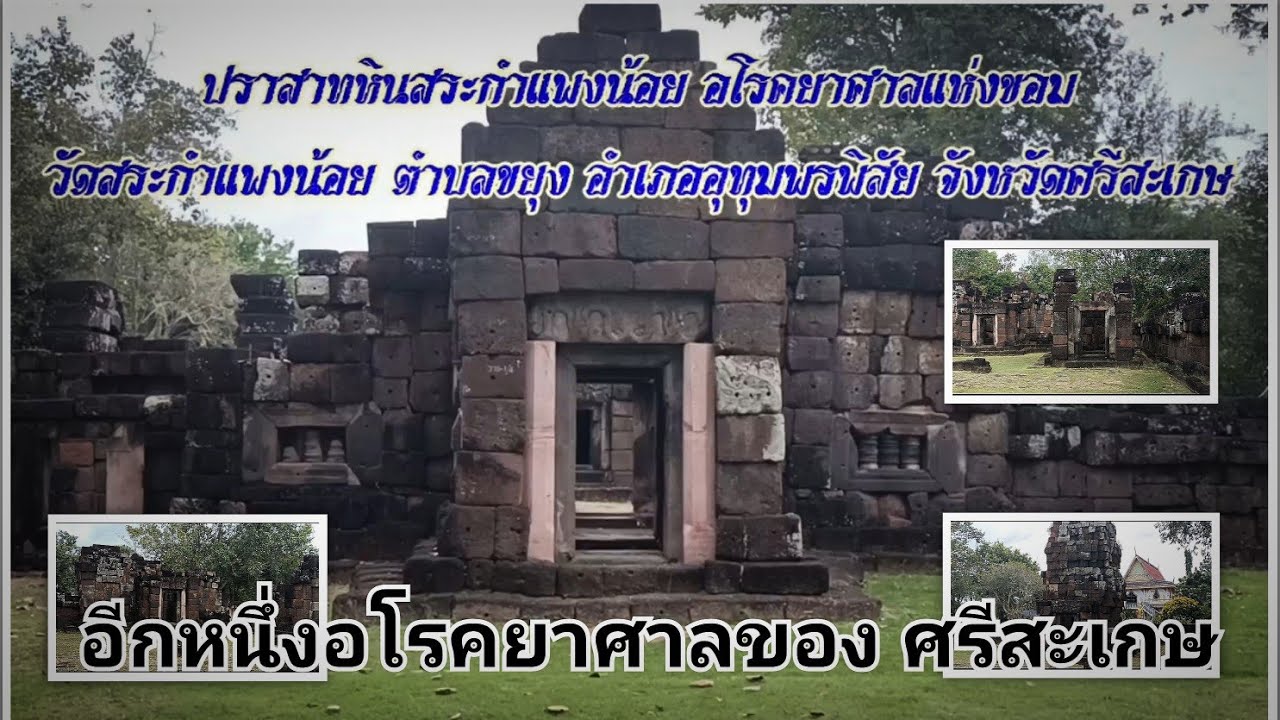
 Click to Access the Navigation Map GPS
Prasat Wat Sa Kamphaeng Noi Map
 Historical Sites and Monuments(12)
 Landmarks and Memorials(1)
 Art, Craft Centres, Tradition(8)
 Places of Worship
 Temple(13)
 Other Sacred Sites(3)
 Suburban Living
 Village, Community(2)
 Nature and Wildlife
 National Parks and Marine Reserves(2)
 Dam, Reservoir, Lake(7)
 Waterfalls(5)
 River, Canal(5)
 Bays and Beaches(2)
 Entertainment and Agricultural
 Zoos and Aquariums(1)
 Farms, Parks and Ecotourism(3)
 Travel Articles, Recipes
 Travel Review, Food Review(1)


