
lovethailand home >North Travel Attractions >Mae Hong Son Travel Attractions >Pai >Wiang Nuea > Poi Lu Kong Lo Tradition
TL;DR: Poi Lu Kong Lo Tradition, open Once a year on the full moon day of the 3rd lunar month (Magha Puja Day), hours Main rituals take place in the evening – night. Highlights include Building and lighting a firewood stupa as a Buddhist offering.
Poi Lu Kong Lo Tradition
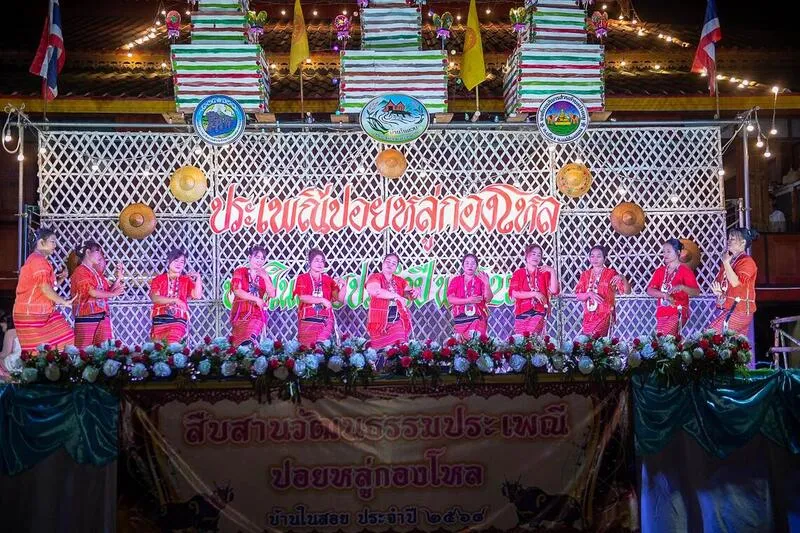
Open Days: Once a year on the full moon day of the 3rd lunar month (Magha Puja Day)
Opening Hours: Main rituals take place in the evening – night
Poi Lu Kong Lo is a traditional Lanna festival in Northern Thailand that reflects deep-rooted Buddhist faith and a strong connection to nature. The highlight of this tradition is the gathering of firewood to build a ceremonial “Kong Lo” structure, which is later lit as an offering to the Buddha, symbolizing light, warmth, and merit-making.
This tradition takes place on the full moon day of the 3rd lunar month, coinciding with Magha Puja Day, an important Buddhist holy day. It commemorates the spontaneous gathering of 1,250 monks to listen to the Buddha’s teaching. On this auspicious day, villagers perform acts of merit, believing that offering firewood and lighting the Kong Lo will bring great blessings and prosperity.
The Kong Lo itself is built collectively by villagers who bring firewood to the temple according to their faith. The wood is then arranged into a structure resembling a stupa, decorated with colorful paper, flags, and traditional ornaments. The top is often made from easily flammable wood such as pine to ensure a bright and steady flame.
In the evening of the ceremony, villagers gather at the temple to participate in Buddhist rituals such as chanting and listening to sermons. After the religious ceremony, the Kong Lo is lit, creating a radiant and warm atmosphere that symbolizes enlightenment and unity.
Beyond its religious significance, the festival also reflects the traditional way of life in Northern Thailand. Historically, the 3rd lunar month is one of the coldest periods of the year, so lighting a large fire provided warmth to the community. At the same time, it brought people together, strengthening social bonds and fostering unity.
The act of building and lighting the Kong Lo represents generosity and collective participation. Everyone contributes according to their ability, whether through materials, labor, or support, making it a powerful symbol of communal harmony.
Today, Poi Lu Kong Lo is still preserved in many northern provinces such as Chiang Mai, Lamphun, Lampang, and Mae Hong Son, where Lanna culture remains strong. It continues to be an important cultural and religious event that attracts both locals and visitors interested in authentic Thai traditions.
| Name | Poi Lu Kong Lo |
| Region | Northern Thailand (Lanna) |
| Period | Full moon day of the 3rd lunar month (Magha Puja) |
| Highlights | Building and lighting a firewood stupa as a Buddhist offering |
| Significance | Merit-making, warmth, light, and community unity |
| Rituals | Offering firewood, building Kong Lo, Buddhist ceremonies, and lighting the fire at night |
Frequently Asked Questions (FAQ)
Q: When is Poi Lu Kong Lo celebrated?
A: It is held annually on the full moon day of the 3rd lunar month, which coincides with Magha Puja Day.
Q: What is Poi Lu Kong Lo?
A: It is a Northern Thai tradition where villagers build and light a firewood structure as an offering to the Buddha.
Q: Why is the firewood arranged like a stupa?
A: The stupa shape symbolizes Buddhism and represents devotion to the Buddha.
Q: What does the fire symbolize?
A: The fire represents light, warmth, wisdom, and the accumulation of merit.
Q: Where can this festival be experienced?
A: It can be seen in many northern provinces such as Chiang Mai, Lamphun, Lampang, and Mae Hong Son.
 Category: ●Art, Culture and Heritage
 Group: ●Art, Craft Centres, Tradition
Last Update : 4 MonthAgo
 Last Update : 4 MonthAgo
Recommend

 Historical Sites and Monuments(1)
 Landmarks and Memorials(1)
Art, Craft Centres, Tradition(10)
Landmarks and Memorials(1)
Art, Craft Centres, Tradition(10)
 Museums(3)
 Educational Places
 Educational Gardens, Farm(1)
 Places of Worship
 Temple(81)
 Other Sacred Sites(1)
 Research and Development
 Royal Project(4)
 Suburban Living
 Village, Community(19)
 Local Market(4)
 Nature and Wildlife
 National Parks and Marine Reserves(5)
 Mountain (Doi)(5)
 Dam, Reservoir, Lake(2)
 Waterfalls(12)
 Hot Springs(6)
 Caves(13)
 Flower Field(2)
 River, Canal(3)
 Other natural attractions(1)
 Entertainment and Agricultural
 Farms, Parks and Ecotourism(2)
 Shopping
 Shopping and Night Market(1)
 Travel Articles, Recipes
 Travel Review, Food Review(1)


