
lovethailand home >North Travel Attractions >Mae Hong Son Travel Attractions >Kun Yuam >Khun Yuam > Poi Ja Tee Tradition
TL;DR: Poi Ja Tee Tradition, Mae Hong Son attractions : Art, Culture and Heritage, Art, Craft Centres, Tradition.
Poi Ja Tee Tradition
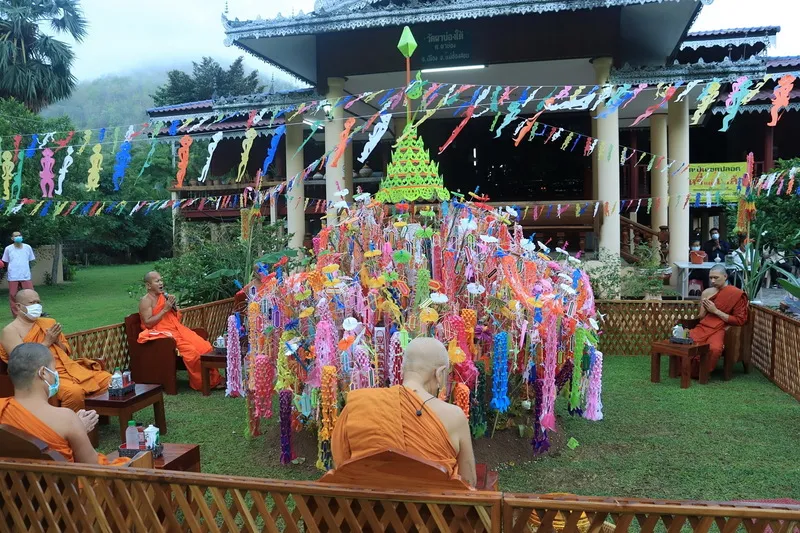
Open Days: Held once a year around Visakha Bucha Day according to the lunar calendar
Opening Hours: According to the annual ritual schedule, with important activities during the day and at night
Poy Ja Tee, the Sand Pagoda Worship Festival of Mae Hong Son, is one of the most meaningful Tai Yai traditions in northern Thailand. The festival is traditionally held on the 15th waxing moon of the 6th lunar month, which coincides with Visakha Bucha Day. It is performed as an act of devotion to the Buddha, a ritual of misfortune-cleansing, and a way of welcoming good fortune at the beginning of the agricultural season.
Although the tradition can be found in many villages across Mae Hong Son Province, the most prominent and best-known setting is Wat Phra Non in Mueang Mae Hong Son. The festival there has been continued for well over a century, making it one of the province’s most important living cultural traditions. For local Tai Yai communities, this is not just an annual event. It is a ritual deeply tied to faith, agricultural hope, and communal identity.
The central act of the festival is the building of sand pagodas inside the temple grounds. Villagers bring sand together and shape it into pagoda forms, then decorate them with flowers, incense, candles, flags, tung banners, and other offerings. In the daytime, the pagodas appear as delicate ritual structures created from simple local materials. At night, when lanterns and lights are added, they become even more striking and spiritually atmospheric.
What makes Poy Ja Tee especially powerful is the meaning attached to sand itself. Sand is ordinary, humble, and locally available, yet through ritual and devotion it is transformed into a sacred offering. This reflects a larger northern Thai and Tai Yai understanding of merit-making: the value of the offering lies not in luxury, but in sincere faith and the collective effort of the community.
The festival is also closely tied to the agricultural cycle. It takes place at the beginning of the planting season, when villagers hope for a good year ahead. There is a shared belief that worshipping the sand pagoda and offering it to the Buddha helps remove bad fortune from the previous year and brings blessing, harmony, and success in farming. In this way, the ritual joins religion, seasonal life, and community psychology into one meaningful ceremony.
The ritual process begins with the community bringing sand into the temple and shaping it into pagoda forms. These are then decorated beautifully with local ritual objects. Once the pagodas are complete, people gather for merit-making activities including food offerings to monks, communal meals, and religious observances. The formal offering of the sand pagoda becomes the climax of the event, transforming the handmade structure into a full act of Buddhist devotion.
Another important part of the festival is the listening to sermons and receiving blessings from monks. This strengthens the spiritual dimension of the event and reminds participants that the sand pagoda is not merely decorative. It is a ritual object tied to Buddhist merit, moral reflection, and communal renewal. The ceremony concludes in many places with the firing of bong fai, or traditional rockets, adding an energetic and festive layer to the sacred atmosphere.
From a cultural point of view, Poy Ja Tee is also a vivid expression of Tai Yai aesthetics. The use of flags, tung banners, flowers, lamps, and carefully arranged ritual objects shows the artistic sensibility of the local community. This means the festival is not only religious but also visually distinctive, making it one of the most memorable cultural events in Mae Hong Son for both locals and visitors.
The tradition also has a strong social function. Every stage of the festival depends on cooperation, from transporting sand to decorating the pagodas and preparing food. Families, elders, temple supporters, and younger generations all take part. That shared labor turns the event into a powerful form of communal bonding. Poy Ja Tee is therefore not only about spiritual blessing. It is also about maintaining harmony and solidarity within the village.
For cultural travelers, this festival offers a rare chance to witness a living northern Thai tradition that is still genuinely rooted in local belief. The event is not staged simply for tourism. It remains meaningful to the community, and that is precisely what gives it depth. Visitors who arrive with respect will see more than a beautiful ceremony. They will see how faith, agriculture, memory, and local identity continue to shape life in Mae Hong Son.
Getting There to the best-known festival site at Wat Phra Non is straightforward. The temple is located at 22 Phadung Muai To Road, Chong Kham Subdistrict, Mueang Mae Hong Son, near the foot of the road leading to Wat Phra That Doi Kong Mu. Travelers can reach Mae Hong Son from Chiang Mai via Highway 108 or through the Pai route on Highway 1095. Once in town, Wat Phra Non is easy to access by private car, rental motorbike, local vehicle, or on foot from the central town area.
Visitors who want to join the atmosphere respectfully should dress modestly, avoid stepping into ritual areas unnecessarily, and be mindful that the sand pagodas and offering arrangements carry religious meaning. The more respectfully one observes the event, the more clearly the deeper value of the festival can be appreciated.
Overall, Poy Ja Tee is one of Mae Hong Son’s most meaningful cultural traditions. It combines Buddhist devotion, seasonal hope, local craftsmanship, and communal solidarity in a form that is both visually beautiful and spiritually rich. For anyone interested in northern Thai culture beyond the surface, it is a tradition well worth understanding.
| Name | Poy Ja Tee / Sand Pagoda Worship Festival |
| Province | Mae Hong Son |
| Main Venue | Wat Phra Non, Mueang Mae Hong Son |
| Address | 22 Phadung Muai To Road, Chong Kham, Mueang Mae Hong Son, Mae Hong Son 58000 |
| Highlights | Building sand pagodas, decorating them with flowers, candles, flags, tung banners, lamps, and ending with bong fai firing |
| History | A long-standing Tai Yai village tradition, especially prominent at Wat Phra Non, where it has been observed for well over 120 years |
| Significance | An act of devotion to the Buddha for removing misfortune, bringing blessing, and strengthening hope at the start of the farming season |
| Festival Time | Traditionally on the 15th waxing moon of the 6th lunar month, coinciding with Visakha Bucha Day |
| Distinctive Features | Using sand to form pagodas as sacred offerings in a highly communal and visually beautiful ritual |
| Main Rituals | Carrying sand into the temple, building and decorating pagodas, making offerings, listening to sermons, and ending with rocket firing |
| Travel Information | Reach Mae Hong Son via Highways 108 or 1095, then continue to Wat Phra Non on Phadung Muai To Road in the town area |
| Current Status | Still actively observed in Mae Hong Son, with annual festival activity continuing at Wat Phra Non |
| Open Days | According to the annual ritual calendar |
| Opening Hours | According to the festival schedule each year |
| Fees | No admission fee for the temple |
| Main Contact Number | Wat Phra Non 053-611-312 |
| Official Website / Official Page | thai.tourismthailand.org, msn.onab.go.th |
| Nearby Tourist Attractions | 1) Wat Phra That Doi Kong Mu 1 km 2) Wat Kam Ko 1 km 3) Wat Chong Kham & Wat Chong Klang 2 km 4) Jong Kham Lake 2 km 5) Mae Hong Son Walking Street 2 km |
| Nearby Restaurants | 1) Champ Cafe Prajak 0.1 km Tel. 098-392-8697, 082-192-5877 2) Salawin Home Restaurant 2 km 3) Pizza Primavera 2 km 4) Little Good Things 2 km 5) Restaurants around Jong Kham Lake 2 km |
| Nearby Accommodations | 1) Piya Guesthouse 2 km Tel. 053-611-260 2) Rom Thai House 2 km 3) Sarm Mork Guest House 2 km 4) Palm House Normal Loft 2 km 5) Jeerang Countryside Resort 3 km |
Frequently Asked Questions (FAQ)
Q: What is Poy Ja Tee?
A: It is the Tai Yai sand pagoda worship festival in Mae Hong Son, held as an act of devotion to the Buddha and for blessing and protection.
Q: When is Poy Ja Tee held?
A: Traditionally on the 15th waxing moon of the 6th lunar month, which coincides with Visakha Bucha Day.
Q: What is the main highlight of the festival?
A: The main highlight is the communal building of sand pagodas and decorating them beautifully as offerings to the Buddha.
Q: Why do local people believe the ritual is important?
A: They believe it helps remove misfortune from the past year and brings good fortune, harmony, and agricultural success.
Q: Where is the best-known place to see the festival?
A: Wat Phra Non in Mueang Mae Hong Son is one of the best-known and longest-established places for the festival.
Q: Can travelers attend the event?
A: Yes, travelers may observe the event respectfully, wearing modest clothing and being mindful of ritual areas.
Q: What happens after the main ritual?
A: In many places, the celebration continues with bong fai rocket firing after the religious ceremonies are completed.
 Category: ●Art, Culture and Heritage
 Group: ●Art, Craft Centres, Tradition
Last Update : 4 MonthAgo
 Last Update : 4 MonthAgo
Recommend

 Historical Sites and Monuments(1)
 Landmarks and Memorials(1)
Art, Craft Centres, Tradition(10)
Landmarks and Memorials(1)
Art, Craft Centres, Tradition(10)
 Museums(3)
 Educational Places
 Educational Gardens, Farm(1)
 Places of Worship
 Temple(81)
 Other Sacred Sites(1)
 Research and Development
 Royal Project(4)
 Suburban Living
 Village, Community(19)
 Local Market(4)
 Nature and Wildlife
 National Parks and Marine Reserves(5)
 Mountain (Doi)(5)
 Dam, Reservoir, Lake(2)
 Waterfalls(12)
 Hot Springs(6)
 Caves(13)
 Flower Field(2)
 River, Canal(3)
 Other natural attractions(1)
 Entertainment and Agricultural
 Farms, Parks and Ecotourism(2)
 Shopping
 Shopping and Night Market(1)
 Travel Articles, Recipes
 Travel Review, Food Review(1)


