
lovethailand home >North Travel Attractions >Mae Hong Son Travel Attractions >Pang Mapha >Na Pu Pom > Tham Pha Daeng Cave
TL;DR: Tham Pha Daeng Cave is located at Na Pu Pom Subdistrict, Pang Mapha District, Mae Hong Son Province, open Best visited in the dry season only, hours Best visited during daytime.

Tham Pha Daeng Cave
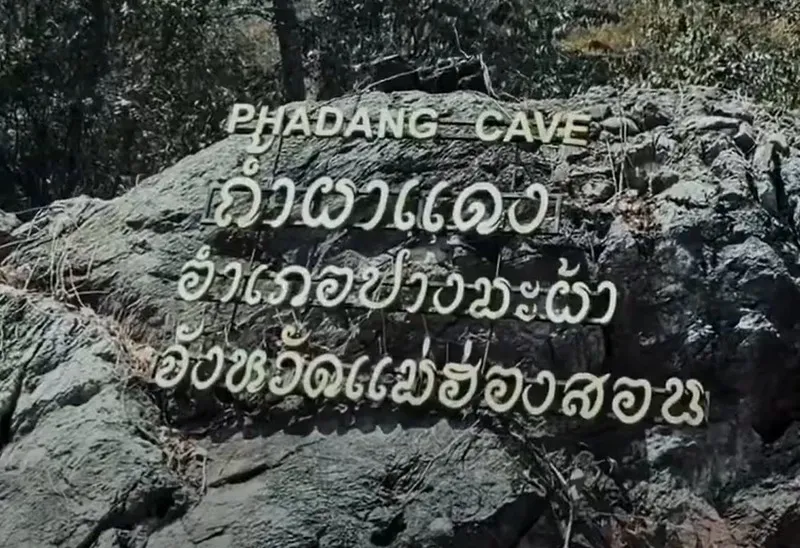
Open Days: Best visited in the dry season only
Opening Hours: Best visited during daytime
Tham Pha Daeng in Mae Hong Son Province is one of Pang Mapha’s most distinctive cave sites. It may not be the largest cave in the district, but it stands out for a very specific combination of features: it is a small stream-through cave that can be walked through in the dry season, it is known for striking red calcite crystal formations, and it is associated with one of the longest Phi Man log coffins found in Mae Hong Son. This makes Tham Pha Daeng much more than a simple cave visit. It is a place where geology, underground water, and archaeological significance meet in a single landscape.
The cave is located in Na Pu Pom Subdistrict, Pang Mapha District, around 50 kilometers from Mae Hong Son town. To get there, travelers follow Highway 1095 toward Soppong, then turn left toward Ban Thong Sa Lae and continue for about 8 kilometers. Around 2 kilometers before the village, the cave area lies on the western side of the road. The site is defined by a stream flowing through the cave passage, which is exactly what gives the cave its particular character. Water is not just a background feature here. It shapes the experience, the terrain, and the seasonal conditions of access.
One of the most important practical facts about Tham Pha Daeng is that it should only be visited in the dry season. Although the cave is relatively modest in scale compared with some of the more demanding cave systems in Pang Mapha, water level is a decisive factor. During the rainy season, the stream rises and makes travel through the cave difficult and potentially unsafe. The cave’s identity as a stream-through cave is therefore inseparable from the question of timing. Anyone planning to visit should think season first, not simply distance or convenience.
Physically, the cave is a stream passage about 1 kilometer long, with a walk-through distance of approximately 1,275 meters. The cave is not famous for gigantic cathedral-like chambers, but for the unusual beauty of its mineral surfaces. The most famous feature is the broad band of red calcite crystal, which gives the cave its name. Under natural or directed light, this red calcite creates a visual signature that is very different from the more familiar gray, white, or cream tones seen in many limestone caves. This is why even travelers who have visited other caves in Mae Hong Son often remember Tham Pha Daeng as something visually unique.
In addition to the red calcite, the cave also contains creamy white calcite clusters and attractive stalactites and stalagmites. The beauty of Tham Pha Daeng lies in contrast: red against white, wet against dry, crystal texture against darker stone surfaces, and moving water against still mineral formations. For travelers interested in geology and cave formation, this makes the cave especially rewarding because it provides a concentrated view of mineral variation in a relatively small cave environment.
The significance of Tham Pha Daeng extends beyond the cave passage itself. About 300 meters north of the cave, there is a limestone rock shelter area where prehistoric paintings have been found. The shelter stretches along a north-south line and faces east, adding another cultural layer to the landscape around the cave. This means that Tham Pha Daeng is not only a geological attraction. It is part of a wider cultural and archaeological zone that helps explain how people used the limestone environment of Pang Mapha in the past.
The cave is also associated with Phi Man coffin culture, and local descriptions emphasize that one of the longest Phi Man coffins in Mae Hong Son was found here. That detail gives the site a stronger link to the wider archaeological story of Pang Mapha, which is already well known for log coffin cave sites. In this sense, Tham Pha Daeng is part of a much larger network of caves that hold both natural beauty and evidence of ancient ritual or burial practices.
Although the cave can be walked through in principle, general visitors are advised to explore only the shallower and safer sections unless they are with experienced local guidance. If visitors go deeper, the difficulty increases quickly because the route involves water, slippery surfaces, and seasonal changes in the passage. In the rainy season especially, the higher water level can make the interior much more challenging. For this reason, visitors should not enter the cave alone and should instead arrange for local guidance from residents or people familiar with the area.
This is one of the most important points to understand about Tham Pha Daeng. It sits in a middle ground between easy tourist caves and full expedition caves. It is more approachable than extremely demanding systems like Mae Lana Cave, but it still requires judgment, seasonal awareness, and respect for stream-cave conditions. That balance makes it especially suitable for travelers who want a more authentic cave experience without immediately stepping into the hardest level of cave adventure.
Another appealing aspect of Tham Pha Daeng is that it still feels relatively natural and uncommercialized. It has not been heavily transformed into a mass-tourism cave. As a result, the experience remains closer to real cave travel: uneven surfaces, changing water conditions, and a sense of discovery rather than a controlled show-cave format. For many travelers, that sense of rawness is part of the attraction.
The stream itself is central to the atmosphere of the cave. The flowing water adds movement, sound, moisture, and a changing seasonal rhythm to the site. It also determines when the cave is safe to visit and how deep a visitor can reasonably go. In a cave like this, water is not just scenery — it is the main force shaping access and mood. This is why Tham Pha Daeng should always be approached as a living natural environment, not a static attraction.
For photographers, the cave offers strong visual material. The red calcite bands, white calcite clusters, and wet rock surfaces create textures that look especially dramatic under directional lighting. The stream passage also adds reflection and contrast. At the same time, photography inside requires care because the floor can be slippery and conditions may change quickly. The beauty is very real, but so is the need for caution.
Tham Pha Daeng also works very well as part of a Pang Mapha route. Travelers can combine it with Tham Lod, Doi Kiew Lom Viewpoint, Phi Man archaeology-related sites, Ban Jabo, and other community-based attractions in the district. This makes the cave especially useful for visitors who want a day or two in Pang Mapha that combines scenery, geology, archaeology, and local atmosphere rather than only scenic viewpoints.
What makes the cave especially valuable for readers and travelers is that it should not be reduced to a vague description like “a beautiful cave.” Its strength comes from several layers together: a dry-season stream cave, unusual red and white calcite, archaeological relevance through Phi Man coffin culture, and a nearby rock shelter with prehistoric paintings. When understood this way, Tham Pha Daeng becomes a site with a much stronger identity and far greater depth than its size alone might suggest.
Its relative quietness is another advantage. Because it is not one of the most crowded attractions in Mae Hong Son, visitors who appreciate peaceful, less commercial natural places often find it especially appealing. There is still a sense of actually encountering a site rather than being processed through a tourist facility. That atmosphere matters for travelers who prefer places that still feel grounded in their landscape.
Ultimately, Tham Pha Daeng deserves attention because it holds together several different kinds of value. It is a walk-through stream cave in the dry season, a mineral site known for red calcite, a place connected to Phi Man coffin culture, and part of a broader archaeological landscape with rock paintings nearby. For anyone looking for a Mae Hong Son destination that offers natural beauty with historical depth and a moderate sense of adventure, Tham Pha Daeng is a very worthwhile addition to a Pang Mapha itinerary — as long as it is visited in the right season and with the right level of care.
Getting There from Mae Hong Son town, take Highway 1095 toward Pang Mapha and Soppong, then turn left toward Ban Thong Sa Lae and continue about 8 kilometers. Around 2 kilometers before the village, the cave area is on the western side of the road. Entering the cave and going beyond the shallow front section is best done with local guidance, especially because water levels and footing conditions can vary with the season.
| Name | Tham Pha Daeng |
| Place Summary | A small stream-through cave in Pang Mapha, best known for broad red calcite crystal bands, white calcite clusters, and links to Phi Man coffin culture. |
| Location | Na Pu Pom Subdistrict, Pang Mapha District, Mae Hong Son Province |
| Highlights | Broad red calcite formations, creamy white calcite clusters, stalactites, stalagmites, a walk-through stream cave route, and a notable Phi Man coffin find |
| History / Importance | An important Pang Mapha cave in both geological and archaeological terms, linked to log coffin culture and a nearby prehistoric painted rock shelter |
| Name Origin | Named after the broad red calcite formations inside the cave |
| Distinctive Features | A stream-through cave with a walk-through distance of about 1,275 meters, suitable mainly for dry-season visits and best explored with local guidance |
| Travel Information | From Mae Hong Son town, take Highway 1095 toward Soppong, then turn left toward Ban Thong Sa Lae for about 8 km; the cave lies about 2 km before the village on the western side of the road |
| Current Status | Best visited only in the dry season and not recommended as a solo cave entry site |
| Open Days | Best visited in the dry season only |
| Opening Hours | Best visited during daytime |
| Facilities | Natural cave conditions; flashlight, non-slip footwear, and local guidance are recommended for deeper entry |
| Caretaker | Local communities in Pang Mapha / local administrative authorities in Na Pu Pom |
| Main Contact Number | Mae Hong Son tourism information: 0-5361-2982 to 3 |
| Nearby Tourist Attractions | 1. Tham Pha Mon – 10 km 2. Tham Lod – 13 km. Tel. 0-5361-7218 3. Phi Man Long Long Rak Cave – 14 km. Tel. Soppong SAO 080-034-6787 4. Doi Kiew Lom Viewpoint – 11 km 5. Ban Jabo Community – 21 km |
| Nearby Restaurants | 1. Ban Kaew Mora – 13 km. Tel. 081-765-2144 2. Ton Chok – 14 km. Tel. 084-950-1319, 094-636-4040 3. Chamakao Pang Mapha – 15 km. Tel. 088-260-5591 4. Kiew Lom Café – 11 km. Tel. 094-969-3949 5. Ban Jabo Hanging Leg Noodles – 21 km. Tel. 096-195-2685 |
| Nearby Accommodations | 1. Cave Lodge – 13 km. Tel. 053-617-203, 091-890-0764 2. Rim Doi Bungalows – 13 km. Tel. 089-553-6041, 089-851-2890 3. Baan Rim Lang – 16 km. Tel. 086-916-2647, 085-334-2373 4. Soppong River Inn – 16 km. Tel. 053-617-107, 081-250-8425 5. Little Eden Guesthouse – 16 km. Tel. 089-952-8870 |
Frequently Asked Questions (FAQ)
Q: Where is Tham Pha Daeng located?
A: It is in Na Pu Pom Subdistrict, Pang Mapha District, Mae Hong Son Province, on the route toward Ban Thong Sa Lae.
Q: When is the best season to visit Tham Pha Daeng?
A: The cave is best visited in the dry season because water levels rise significantly during the rainy season.
Q: What makes Tham Pha Daeng special?
A: It is known for its broad red calcite crystal bands, white calcite clusters, stream-through cave passage, and connection to Phi Man coffin culture.
Q: Can tourists enter the cave alone?
A: It is not recommended. Visitors should not go in alone, especially beyond the shallow sections, and local guidance is strongly advised.
Q: Why is Tham Pha Daeng important archaeologically?
A: The cave is linked to a notable Phi Man coffin find and lies near a rock shelter area with prehistoric paintings.
Q: What kind of traveler would enjoy Tham Pha Daeng?
A: It suits travelers interested in caves, geology, archaeology, and natural places that still feel relatively raw and uncrowded.
Q: What can I combine with Tham Pha Daeng on the same trip?
A: Good nearby options include Tham Pha Mon, Tham Lod, Doi Kiew Lom Viewpoint, Phi Man archaeology-related sites, and Ban Jabo.
 Category: ●Nature and Wildlife
 Group: ●Caves
Last Update : 2 MonthAgo
 Last Update : 2 MonthAgo
 Click to Access the Navigation Map GPS
Tham Pha Daeng Cave Map
Recommend

 Art, Culture and Heritage
 Historical Sites and Monuments(1)
 Landmarks and Memorials(1)
 Art, Craft Centres, Tradition(10)
 Museums(3)
 Educational Places
 Educational Gardens, Farm(1)
 Places of Worship
 Temple(81)
 Other Sacred Sites(1)
 Research and Development
 Royal Project(4)
 Suburban Living
 Village, Community(19)
 Local Market(4)
 National Parks and Marine Reserves(5)
 Mountain (Doi)(5)
 Dam, Reservoir, Lake(2)
 Waterfalls(12)
 Hot Springs(6)
Caves(13)
Hot Springs(6)
Caves(13)
 Flower Field(2)
 River, Canal(3)
 Other natural attractions(1)
 Entertainment and Agricultural
 Farms, Parks and Ecotourism(2)
 Shopping
 Shopping and Night Market(1)
 Travel Articles, Recipes
 Travel Review, Food Review(1)


