
lovethailand home >North Travel Attractions >Mae Hong Son Travel Attractions >Kun Yuam >Mae Yuam Noi > Namtok Mae Surin National Park
TL;DR: Namtok Mae Surin National Park is located at Ban Hua Mae Surin, Mae Ukho Subdistrict, Mueang Mae Hong Son District, Mae Hong Son Province, open Open Daily, hours 08:30 – 16:30.
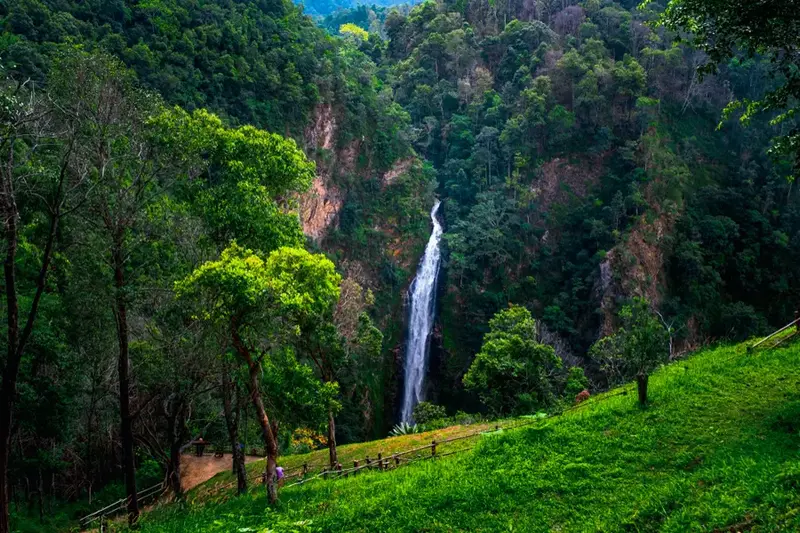
Namtok Mae Surin National Park
Open Days: Open Daily
Opening Hours: 08:30 – 16:30
Namtok Mae Surin National Park is one of the most impressive natural destinations in Mae Hong Son Province and one of the most remarkable waterfall parks in Northern Thailand. Its reputation comes not only from the dramatic beauty of Mae Surin Waterfall itself, but also from the park’s vast mountain landscape, rich forest ecosystems, and the sense of remoteness that gives the area a truly immersive natural atmosphere.
The park is located in Ban Hua Mae Surin, Mae Ukho Subdistrict, around 50 kilometers from Mae Hong Son town. Covering 247,875 rai, it was officially declared a national park on October 29, 1981. Today, it remains both a protected conservation area and a major nature attraction for travelers who want to experience Mae Hong Son beyond the usual town highlights.
If explained simply, Namtok Mae Surin National Park is ideal for 3 main groups of travelers. First, it is perfect for people who want to see a truly dramatic waterfall in a wild mountain setting. Second, it suits travelers who enjoy quiet nature destinations more than commercial attractions. Third, it is especially rewarding for visitors interested in forests, mountain geography, biodiversity, and seasonal landscape changes, because the park offers much more than a single viewpoint.
The star attraction is Mae Surin Waterfall, a spectacular single-tier waterfall dropping from a cliff roughly 100 meters high. It is widely recognized as one of the tallest and most beautiful waterfalls in Northern Thailand. Because the water descends in one uninterrupted fall rather than over multiple tiers, the visual effect is especially dramatic, particularly during the rainy season when the volume is strongest.
The beauty of the waterfall is not only about height. Its position within a steep valley surrounded by thick forest gives it a strong sense of scale and wilderness. On humid days, especially in the rainy season, the mist rising from the waterfall softens the view and adds an atmospheric quality that makes the area feel almost cinematic.
Geographically, the park is dominated by complex mountain ranges running from north to south. Elevations range from around 300 to 1,752 meters above sea level. Doi Pui is the highest peak, followed by several other important mountains that act as watersheds for many streams. These streams eventually feed into the Pai River and the Yuam River, making the park an important upstream watershed area.
The vegetation is highly diverse. The park contains hill evergreen forest, mixed deciduous forest, dry dipterocarp forest, and pine forest. Each ecosystem supports different plant and animal communities, which gives the area high ecological value and makes it especially meaningful for travelers interested in environmental diversity.
Hill evergreen forest is generally found along ridges or higher elevations above around 800 meters. These moist areas support important tree species and rich undergrowth, while also providing habitat for wildlife such as leopards, white-handed gibbons, northern spectacled langurs, porcupines, squirrels, rare birds, reptiles, frogs, and butterflies.
Mixed deciduous forest is found in valley and stream areas between roughly 350 and 600 meters above sea level. These forests include many valuable native tree species, bamboo, and medicinal plants. Wildlife recorded in this forest type includes deer, civets, bats, junglefowl, woodpeckers, drongos, snakes, geckos, frogs, and various butterflies.
Dry dipterocarp forest is the most widespread forest type in the park. It appears from around 350 to 1,400 meters above sea level and supports birds of prey, owls, barbets, woodpeckers, squirrels, lizards, and numerous insects. Although it may appear more open than evergreen forest, it is ecologically important and forms a major part of the park’s identity.
Pine forest, found on higher ridges, adds another layer of scenic interest. These areas often feel very different from the lower forest zones and are notable not only for two-needle and three-needle pines, but also for the orchids that can be found in suitable conditions. This variation in vegetation helps explain why the park feels so diverse, even within a single trip.
The waterways of the park also support a number of fish and water birds. Streams and rivers within the park provide habitats for species that depend on clean flowing water, underlining the importance of the park as a healthy watershed ecosystem rather than just a sightseeing destination.
In terms of climate, the park enjoys a relatively cool mountain environment throughout the year. The rainy season lasts from May to October and is the best time to see the waterfall at full force, although travel can sometimes be less convenient because of wet roads and heavy rain. The cool season from November to February offers comfortable weather and easier road conditions, making it one of the best times for general sightseeing. The hot season from March to April can be warm, but the mountain and forest setting still helps moderate the overall feel of the landscape.
For photographers, the waterfall is naturally the main subject, but the park offers more than one frame. The surrounding cliffs, forest textures, distant ridges, and changing weather patterns all contribute to the character of the area. Morning to late morning is often the most practical time to visit, especially if you want clearer visibility and more comfortable walking conditions.
It is important to understand that Mae Surin Waterfall is not the kind of waterfall where visitors typically walk down easily to play in the water. Its appeal lies more in viewing the waterfall from designated viewpoints and appreciating the scale of the cliff and valley setting. Travelers who come with that expectation usually appreciate the site far more than those expecting a casual swimming stop.
In practical trip planning, Namtok Mae Surin National Park works very well as part of a one-day nature route. It can be combined with Doi Mae Ukho and the Bua Tong fields in season, then followed by a return to Mae Hong Son town for cultural attractions such as Wat Phra That Doi Kong Mu, Jong Kham Lake, Wat Chong Kham–Chong Klang, or the evening walking street. This combination gives visitors both a mountain nature experience and a town atmosphere in the same day.
Getting There The park is best reached by private car from Mae Hong Son town. The route is around 50 kilometers and follows mountain roads, so drivers should allow sufficient time and drive carefully, especially during the rainy season or when fog is present. Even so, the drive itself is part of the experience, with forested scenery and broad mountain views along the way.
Overall, Namtok Mae Surin National Park offers much more than a famous waterfall. It is a destination where visitors can appreciate the relationship between mountains, forests, streams, wildlife, and seasonal climate. For travelers looking for a genuine Mae Hong Son nature experience—something large in scale, quiet in mood, and rich in ecological meaning—this park deserves a place high on the itinerary.
| Name | Namtok Mae Surin National Park |
| Location Summary | A national park best known for Mae Surin Waterfall, a dramatic single-tier waterfall about 100 meters high, surrounded by complex mountain terrain and diverse forest ecosystems in Mae Hong Son Province. |
| Location | Ban Hua Mae Surin, Mae Ukho Subdistrict, Mueang Mae Hong Son District, Mae Hong Son Province |
| History | Officially established as a national park on October 29, 1981 |
| Distinctive Features | Single-tier waterfall, mountain valleys, evergreen forest, mixed deciduous forest, dry dipterocarp forest, and pine forest |
| Travel Information | Approximately 50 km from Mae Hong Son town. Best reached by private car via mountain roads. |
| Current Status | Open to visitors as usual |
| Open Days | Open Daily |
| Opening Hours | 08:30 – 16:30 |
| Fees | Thai Adult 40 THB / Child 20 THB, Foreigner Adult 200 THB / Child 100 THB |
| Caretaker | Department of National Parks, Wildlife and Plant Conservation |
| Main Contact Number | 0 5306 1073 |
| Nearby Tourist Attractions | 1. Doi Mae Ukho / Bua Tong Fields – about 6 km 2. Wat Phra That Doi Kong Mu – about 48 km 3. Wat Chong Kham – Chong Klang – about 46 km 4. Jong Kham Lake – about 46 km 5. Mae Hong Son Walking Street – about 46 km |
| Nearby Restaurants | 1. Fern Restaurant – about 40 km. Tel. 053-686110, 093-3148222, 081-8815281 2. Bai Fern Restaurant – about 46 km. Tel. 053-611374 3. Chong Kham Restaurant – about 46 km. Tel. 053-611321 4. Restaurant at Fern Resort – about 40 km. Tel. 053-686110 5. Restaurants around Jong Kham Lake / Mae Hong Son town – about 46 km |
| Nearby Accommodations | 1. Fern Resort – about 40 km. Tel. 053-686110, 093-3148222, 081-8815281 2. The Imperial Mae Hong Son Resort – about 42 km. Tel. 053-684444 3. B2 Mae Hong Son Premier Hotel – about 46 km. Tel. 053-699778 4. Palmhouse – about 46 km 5. Piya Guesthouse – about 46 km |
Frequently Asked Questions (FAQ)
Q: How high is Mae Surin Waterfall?
A: Mae Surin Waterfall is approximately 100 meters high and is known as one of the most impressive single-tier waterfalls in Northern Thailand.
Q: When is the best time to visit Namtok Mae Surin National Park?
A: The rainy season is best for seeing the waterfall at full strength, while the cool season offers easier travel and comfortable weather.
Q: Can this park be visited as a day trip?
A: Yes. It works very well as a one-day trip combined with Doi Mae Ukho, Bua Tong fields, and Mae Hong Son town attractions.
Q: Is the park suitable for children and elderly visitors?
A: Yes, but extra care is recommended near viewpoints, cliffs, and slippery areas, especially in the rainy season.
Q: What makes this park special beyond the waterfall itself?
A: Its mountain landscape, watershed significance, diverse forest types, and wildlife habitats make it one of the most ecologically interesting parks in Mae Hong Son.
 Category: ●Nature and Wildlife
 Group: ●National Parks and Marine Reserves
Last Update : 5 MonthAgo
 Last Update : 5 MonthAgo
 Click to Access the Navigation Map GPS
Namtok Mae Surin National Park Map
Recommend

 Art, Culture and Heritage
 Historical Sites and Monuments(1)
 Landmarks and Memorials(1)
 Art, Craft Centres, Tradition(10)
 Museums(3)
 Educational Places
 Educational Gardens, Farm(1)
 Places of Worship
 Temple(81)
 Other Sacred Sites(1)
 Research and Development
 Royal Project(4)
 Suburban Living
 Village, Community(19)
 Local Market(4)
National Parks and Marine Reserves(5)
Local Market(4)
National Parks and Marine Reserves(5)
 Mountain (Doi)(5)
 Dam, Reservoir, Lake(2)
 Waterfalls(12)
 Hot Springs(6)
 Caves(13)
 Flower Field(2)
 River, Canal(3)
 Other natural attractions(1)
 Entertainment and Agricultural
 Farms, Parks and Ecotourism(2)
 Shopping
 Shopping and Night Market(1)
 Travel Articles, Recipes
 Travel Review, Food Review(1)


