
Home >North
>Mae Hong Son >Muang Mae Hong Son
>Chong Kham
> Spirit-veneration tradition of the Tai Yuan
TL;DR: Spirit-veneration tradition of the Tai Yuan, open There is no fixed annual festival date. The practice depends on the ritual, hours According to the schedule of each household or community ritual.
Spirit-veneration tradition of the Tai Yuan
Open Days: There is no fixed annual festival date. The practice depends on the ritual needs of each family or community.
Opening Hours: According to the schedule of each household or community ritual.
The spirit-veneration tradition of the Tai Yuan is one of the important foundations of Lanna culture and remains highly valuable for understanding Thai culture in the broader relationship between Buddhism and local belief systems. Among the Tai Yuan, also known as Khon Mueang, the idea of “spirits” does not simply refer to something frightening. It forms a cultural system that explains the relationship between human beings, ancestors, households, communities, nature, and unseen protective forces that guide people to live within inherited moral and social boundaries.
Within northern Thailand, including areas where people of Tai Yuan background are present in Mae Hong Son Province, belief in spirits reflects a worldview in which Buddhism and folk belief are not separated into two completely different spheres. Instead, they are closely intertwined. People may go to the temple, make merit, listen to sermons, and live within Buddhist practice, while at the same time continuing to respect ancestral spirits, household spirits, and inherited cultural taboos. In this sense, both systems of belief work together rather than standing in opposition.
At the center of the Tai Yuan spirit-veneration tradition is the idea of honoring lineage and maintaining ties with one’s ancestors. In this worldview, ancestral spirits are not merely the souls of the dead. They remain spiritually present as guardians, witnesses, and moral forces within the lives of their descendants. Ritual offerings and acts of reverence are therefore more than requests for blessings. They are a declaration that the living still remember their roots, their elders, and the obligations that bind family members across generations.
In Tai Yuan belief, spirits exist at multiple levels and serve different roles. Some are considered protective spirits connected to the household and kinship line. Others are associated with communities or sacred spaces. Still others are treated with caution because they belong to the category of potentially harmful forces. This structure reveals how spirit belief also works as a social framework. Spirits are not only supernatural beings. They also function as moral reference points that help regulate family conduct, respect for elders, and adherence to custom.
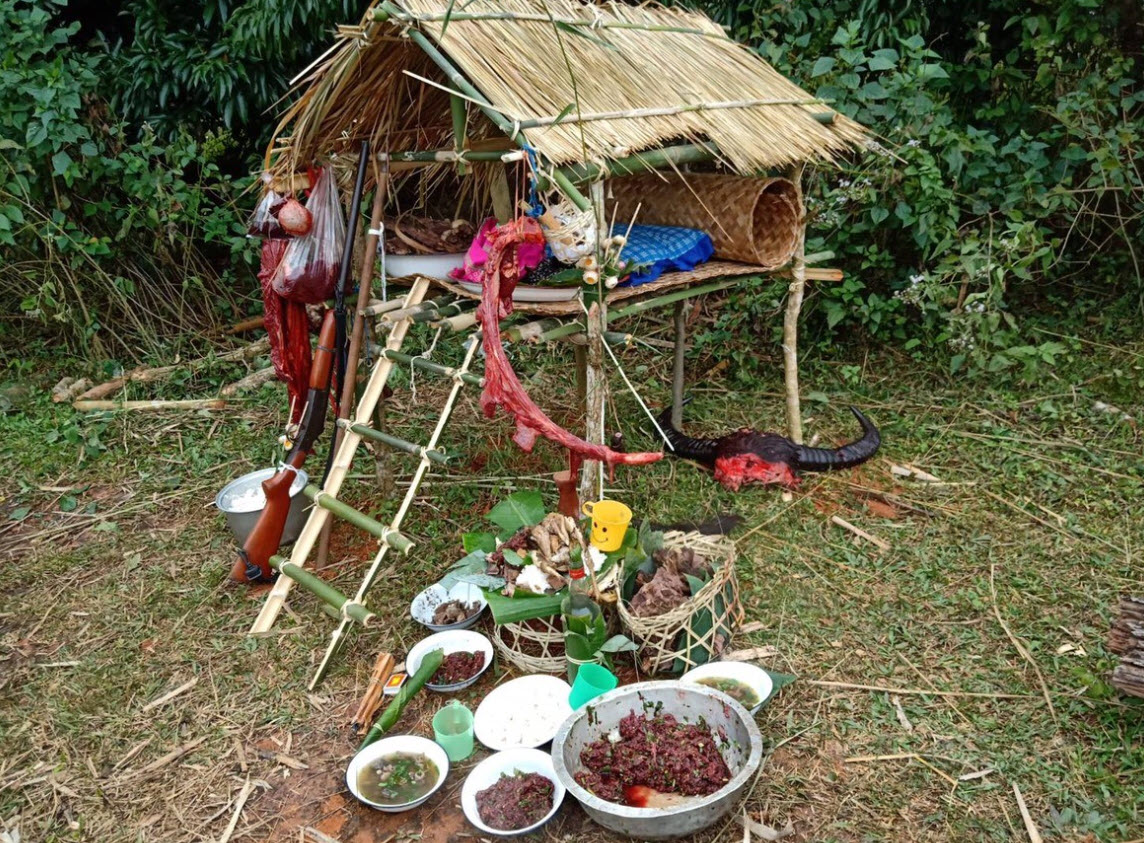
In ritual terms, spirit-veneration among the Tai Yuan often begins with the careful preparation of offerings. These may include rice, fish, savory dishes, sweets, fruit, flowers, incense, candles, and other items that carry symbolic meaning for the ancestor or spirit being honored. The preparation of offerings is not a trivial matter. It reflects intention, care, and reverence. Each item can symbolize abundance, gratitude, filial duty, and the desire to maintain harmony within the household.
The location of the ritual may vary according to the context of each family or community. Some ceremonies take place inside the home. Others may be held in a designated sacred space connected with the lineage or the spirit of the house. In some settings, the community may maintain a specific place associated with ritual observance. These locations matter because they represent a meeting point between the visible and invisible worlds. Entering them for ritual purposes therefore requires respect, restraint, and attention to inherited rules.
The ceremony itself commonly includes words of invocation, offerings, and requests for protection, prosperity, safety, and household well-being. The exact language and sequence may differ from one place to another, but the shared core is respectful communication with ancestral and protective spiritual forces. For that reason, the meaning of the ritual is as much emotional as ceremonial. It is an act of relationship, not merely a formal procedure.
In some cases, ritual practice may include recitation, local formulaic speech, music, or culturally specific performance linked to belief. These elements help create an atmosphere of reverence and calm. They also show that spirit-veneration is not only about placing offerings before an unseen force. It is a cultural event in which memory, sound, movement, and inherited knowledge are woven together. This is one reason the tradition should be understood as intangible cultural heritage rather than reduced to superstition.
One of the most important functions of this tradition is its role in building and maintaining social bonds. Spirit-veneration is often not an individual act. It belongs to the family, the kinship network, and sometimes the wider community. Preparing offerings together, deciding ritual dates, sharing responsibilities, and gathering in a respectful atmosphere all reinforce solidarity. In this way, ancestral spirit belief serves as both a spiritual center and a social structure.
The tradition also works as a vehicle for transmitting knowledge from one generation to the next. Children and younger family members learn by watching elders prepare offerings, explain the meaning of household spirits, speak of ancestral obligations, and observe what should or should not be done. This is how cultural knowledge survives outside formal schooling. The ritual becomes a living classroom where gratitude, lineage memory, and responsibility toward family are taught through practice.
An important related concept is khueat, or cultural taboo. In Lanna thought, taboo is not merely irrational fear. It forms a set of inherited rules about proper behavior intended to prevent harm to oneself, one’s family, or one’s community. Many taboos are connected to the respectful treatment of ancestral spirits, sacred spaces, and ritual order. This shows how spirit belief is closely tied to social ethics within Tai Yuan culture.
From the perspective of religion, this tradition is a strong example of the blending of Buddhism with local northern belief. Many Tai Yuan families live within Buddhist practice while also maintaining reverence for ancestral spirits as protectors of their lineage and home. Religion, in lived experience, is therefore not always neatly separated into formal doctrine and folklore. Instead, it often forms an integrated cultural system in which Buddhist values and older local beliefs coexist.
Mae Hong Son adds another layer of interest because it is a multi-ethnic province where Shan, Lawa, Karen, Hmong, Lisu, Lahu, and people of Tai Yuan or Khon Mueang background have lived alongside one another. Studying the Tai Yuan spirit-veneration tradition in relation to Mae Hong Son therefore helps illuminate the complexity of northern Thai culture. Even when each ethnic group has its own distinct rituals, there are also broader Lanna cultural frameworks through which these communities interact and adapt over time.
In the present day, the Tai Yuan spirit-veneration tradition still holds meaning, even though some practices have adapted to modern life. Some families may simplify ritual details because of limited time, changing living arrangements, or urban conditions, yet they still preserve the essential act of remembering ancestors and asking for protection. Such adaptation should not automatically be seen as decline. It can also be understood as evidence that the tradition remains meaningful enough to continue in new forms.
The main challenge today is helping younger generations understand the cultural value of the tradition rather than dismissing it as an outdated belief. If they can see that the practice supports family ties, preserves memory, and expresses Tai Yuan identity, they are more likely to inherit it thoughtfully. This is especially important in a modern context where cultural continuity increasingly depends on explanation, documentation, and active transmission.
Cultural and educational institutions therefore have an important role to play. By documenting field knowledge, supporting exhibitions, preserving oral explanations, and presenting accurate interpretations of Lanna traditions, they can help ensure that Tai Yuan spirit-veneration is recognized as meaningful cultural heritage. This matters not only for Tai Yuan communities themselves, but also for a wider understanding of Thai cultural diversity.
Getting There for serious study in Mae Hong Son should begin with local ethnic and cultural learning sites in the provincial town, together with temples, museums, or community-based cultural contacts. Anyone wishing to observe or learn about actual ritual practice should seek permission from local knowledge holders first. Many spirit-related rituals are sensitive and family-centered rather than public performances designed for visitors.
In conclusion, the spirit-veneration tradition of the Tai Yuan is an essential component of Thai and Lanna cultural life. It helps explain the relationship between the living and the ancestors, the role of protective spiritual belief in family life, the moral structure of custom, and the blending of Buddhism with older local traditions. In the context of Mae Hong Son, the topic becomes even more valuable as a window into the province’s ethnic diversity and the wider cultural landscape of northern Thailand.
| Name | Tai Yuan Spirit-Veneration Tradition |
| Regional Context | Lanna culture in northern Thailand, including multi-ethnic settings such as Mae Hong Son |
| Main Ethnic Group | Tai Yuan / Khon Mueang |
| Main Belief | Respect for ancestral spirits, household spirits, and spirit belief systems blended with Buddhism |
| Cultural Significance | Preserves lineage memory, reinforces family ethics, and strengthens community solidarity |
| Common Offerings | Rice, fish, savory and sweet foods, fruit, flowers, incense, candles, and symbolic household items |
| Ritual Locations | Homes, lineage sacred spaces, or community-designated ritual places |
| Ritual Pattern | Preparing offerings, invoking ancestral spirits, making requests for protection, and observing inherited ritual rules |
| Social Role | Builds kinship ties, transmits knowledge, and connects older and younger generations |
| Related Beliefs | Ancestral spirits, household spirits, and the Lanna concept of khueat or cultural taboo |
| Open Days | No fixed annual festival day; depends on family or community circumstances |
| Opening Hours | According to each ritual case |
| Travel Information for Study | Begin from Mae Hong Son town or local ethnic learning sites, then coordinate with community knowledge holders before field observation |
| Current Status | Still culturally meaningful, though some practices have adapted to modern social conditions |
| Sources of Knowledge | Sirindhorn Anthropology Centre, Chiang Mai University cultural resources, and Lanna cultural studies |
Frequently Asked Questions (FAQ)
Q: What is the Tai Yuan spirit-veneration tradition?
A: It is a system of belief and ritual involving ancestral spirits, household spirits, and protective spirit forces within Tai Yuan Lanna culture.
Q: Is Tai Yuan spirit belief separate from Buddhism?
A: In practice, the two are often closely blended in everyday life.
Q: Which spirits are especially important in Tai Yuan belief?
A: Ancestral spirits, grandparent spirits, and household spirits are among the most significant.
Q: Why is this tradition socially important?
A: It reinforces kinship, preserves inherited values, and supports community cohesion.
Q: What offerings are commonly used in the ritual?
A: Rice, fish, savory and sweet foods, fruit, flowers, incense, candles, and other symbolic items may be used.
Q: How does Mae Hong Son relate to this topic?
A: Mae Hong Son is a multi-ethnic province within the wider northern cultural world, making it important for comparative study of local beliefs and traditions.
Q: What should a visitor do before trying to observe an actual ritual?
A: Seek permission from local knowledge holders or community leaders first, since many spirit-related rites are sensitive and family-centered.
Category: ●Art, Culture and Heritage
 Category: ●
Group: ●Art, Craft Centres, Tradition
 Group: ●
 Last Update : 5 DayAgo
 Historical Sites and Monuments(
 Landmarks and Memorials(
 Museums(
 Educational Places
 Educational Gardens, Farm(
 Places of Worship
 Temple(
 Other religious and spiritural sites(
 Research and Development
 Royal Project(
 Suburban Living
 Village, Community(
 Local Market(
 Nature and Wildlife
 National Parks and Marine Reserves(
 Mountain (Doi)(
 Dam, Reservoir, Lake(
 Waterfalls(
 Hot Springs(
 Caves(
 Flower Field(
 River, Canal(
 Other natural attractions(
 Entertainment and Agricultural
 Farm, Parks, Gardens and Ecotourism(
 Shopping
 Shopping and Night Market(
 Travel Articles, Recipes
 Travel Review, Food Review(


