
lovethailand home >North Travel Attractions >Mae Hong Son Travel Attractions >Mae Lanoi >Mae La Noi > Som Tor Luang Tradition
TL;DR: Som Tor Luang Tradition, open Held Annually Before Ok Phansa, Based on the Lunar Calendar, hours Main Ritual Activities Begin in the Late Night to Early Morning, with Rice.
Som Tor Luang Tradition
Open Days: Held Annually Before Ok Phansa, Based on the Lunar Calendar
Opening Hours: Main Ritual Activities Begin in the Late Night to Early Morning, with Rice Stirring Around 03:00 AM and Offering Around 05:00 AM
The Sam Tor Luang Tradition in Mae Hong Son, also known as Tang Sam Tor Luang or the Madhupayasa Rice Offering Tradition, is one of the most distinctive Shan Buddhist traditions still practiced in northern Thailand. It is an important ceremonial tradition of the Tai Yai community in Mae Hong Son and is closely tied to Buddhist belief, local craftsmanship, and communal participation. At its heart is the offering of sweet sacred rice to the Buddha in remembrance of the episode in which Sujata offered madhupayasa to the Bodhisattva before enlightenment.
The Sam Tor Luang Tradition is far more than a seasonal merit-making event. It is a ritual expression of faith that preserves local memory and cultural identity through action. The preparation of ceremonial offerings, the decoration of ritual space, the stirring of madhupayasa, and the dawn offering itself all reflect a living tradition that continues to hold meaning for the Shan community of Mae Hong Son today.
The spiritual foundation of the tradition comes directly from Buddhist narrative. According to long-held belief, Sujata prepared madhupayasa and offered it to the Bodhisattva Siddhartha before his enlightenment. Because of this, madhupayasa came to symbolize nourishment before awakening, strength before realization, and devotion before fulfillment. The Tai Yai people of Mae Hong Son transformed this Buddhist memory into a community ritual, making the preparation and offering of sacred rice the center of a local ceremonial tradition.
In the Shan cultural context, the word “Sam Tor” refers to offering rice to the Buddha, while “Luang” carries the sense of a grand or communal observance. Together, the name suggests a major collective offering made by the community with reverence and beauty. This explains why the event is not limited to a short act of offering. It includes ritual preparation, decorative craftsmanship, public participation, and shared religious intention.
The tradition is typically held shortly before Ok Phansa, during a sacred observance day in the 10th lunar month. The exact date changes each year according to the lunar calendar, but the ritual structure remains recognizable. In Mae Hong Son, recent published schedules confirm that the event has continued to be organized in consecutive years, especially at Wat Phra That Doi Kong Mu in Mueang Mae Hong Son District. This continuity shows that the tradition is still actively practiced rather than remembered only in historical writing.
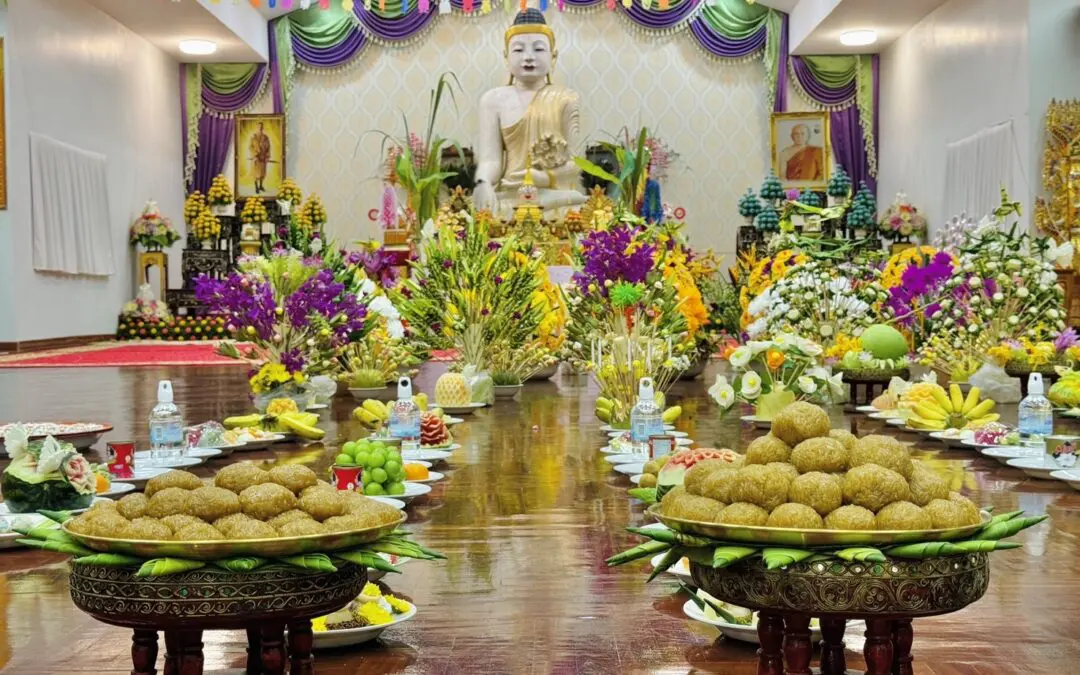
One of the most striking aspects of the Sam Tor Luang ceremony is the elaborate preparation of offerings. Community members arrange ceremonial structures, banners, offering tables, banana shoots, sugarcane shoots, flowers, incense, candles, and beautifully carved fruits such as watermelon, pomelo, apple, and papaya. These details are not decorative extras. They represent the Shan aesthetic of devotion, where beauty itself becomes part of the act of worship. The careful arrangement of offerings expresses respect, merit, and cultural identity all at once.
On the day before the main ceremony, the atmosphere gradually becomes more active as devotees gather to prepare the ritual space. They decorate the site, organize offerings, prepare ingredients, carve fruit, and arrange the ceremonial setting for the pre-dawn rite. This preparatory phase is important because it reveals the social dimension of the tradition. The event depends on cooperation. Elders transmit knowledge, working adults provide labor, and younger generations observe and participate. In this way, Sam Tor Luang functions as cultural inheritance in action.
The ritual center of the event is the cooking and stirring of madhupayasa during the deep night or just before dawn. Published schedules from recent Mae Hong Son observances show that the sacred rice is typically stirred at around 03:00 AM and formally offered at around 05:00 AM. These early hours are part of the meaning of the event. The quiet darkness, the focused atmosphere, the rhythm of ritual work, and the anticipation of the offering all create a solemn mood unlike ordinary daytime festivals.
Madhupayasa in the Mae Hong Son tradition is described as a rich sweet rice preparation made with sticky rice and ingredients such as honey, milk, sweetened milk, condensed dairy, sesame oil, coconut milk, butter-like fats, and sugar, depending on the version used by the local community. The user-provided account emphasizes rice, milk, butter, and honey, which aligns with the central sacred meaning of the dish. Once the mixture is properly cooked and thickened, it is shaped into portions for the offering ritual.
In local belief, the shaping of the rice into multiple portions carries symbolic significance. Community accounts connected with the tradition often refer to a set number of rice portions, reflecting the remembered narrative of the Bodhisattva’s consumption of madhupayasa after part of it had been dedicated first. What matters most in the ceremony is not culinary exactness but devotional intent. The rice is prepared as an offering, not as an ordinary dessert. It is treated as sacred food within a ritual sequence.
After the sacred rice is offered to the Buddha, portions may be placed into prepared containers together with fruit and offerings, then ceremonially taken to important areas within the temple grounds. These may include the sermon hall, ordination hall, meditation space, and chedi area. This ritual movement through the temple grounds expands the meaning of the offering. It links the sacred food not only to the Buddha image but to the wider ritual landscape of the temple.
From a cultural perspective, the Sam Tor Luang tradition is a clear expression of Shan identity in Mae Hong Son. The ritual vocabulary, the arrangement of offerings, the decorative forms, and the style of communal participation all reflect Tai Yai tradition in a specifically local northern Thai setting. This makes the ceremony especially valuable for understanding northern Thai culture beyond general Lanna references. It highlights the ethnic and cultural richness of Mae Hong Son as a borderland province with a deeply rooted Shan heritage.
The ceremony also strengthens intergenerational bonds. Older community members preserve the ritual knowledge and symbolic understanding, while younger participants learn through direct involvement. This is one reason the continued revival and organization of Sam Tor Luang in Mae Hong Son has been treated as a form of cultural safeguarding. It preserves both the ritual itself and the social fabric that allows the tradition to survive.
Recent public announcements confirm that the tradition is still being organized at Wat Phra That Doi Kong Mu, with a clearly published 2025 program in Mae Hong Son. That makes it one of the northern Thai traditions that remains visible and active in contemporary public religious life. For cultural travelers, it offers a rare chance to witness a local Buddhist tradition that is still meaningful to the community and still grounded in lived practice.
Visitors interested in attending should approach the event with respect. This is not a performance staged for tourism. It is a sacred community ceremony. Modest dress, quiet behavior, and sensitivity to ritual space are essential. Anyone hoping to photograph the event should avoid obstructing local participants or interfering with devotional activities. The deeper value of the experience comes from observing how faith, memory, and community effort are woven together in a single ceremonial act.
Getting There is easiest via Wat Phra That Doi Kong Mu, which is the main venue associated with recent public schedules for the ceremony. The temple stands on Doi Kong Mu west of central Mae Hong Son town. From the Nong Chong Kham area and the main town center, the drive uphill is short and straightforward. Visitors staying in town should leave early if they want to witness the key ritual moments, since the most important stages begin between 03:00 AM and 05:00 AM. Early morning temperatures can also be cool, especially during the rainy-to-cool season transition in Mae Hong Son.
Overall, the Sam Tor Luang Tradition of Mae Hong Son is a northern Thai cultural tradition of exceptional religious and community value. It preserves a Buddhist narrative through Shan ritual form, and it continues to serve as a shared expression of faith and identity. For anyone studying Thai traditions, Shan culture, or meaningful local observances in northern Thailand, Sam Tor Luang deserves close attention as one of Mae Hong Son’s living cultural traditions.
| Name | Sam Tor Luang Tradition / Tang Sam Tor Luang / Madhupayasa Rice Offering Tradition |
| Province | Mae Hong Son |
| Main Venue Found in Recent Records | Wat Phra That Doi Kong Mu, Chong Kham, Mueang Mae Hong Son, Mae Hong Son |
| Highlights | Pre-dawn stirring of madhupayasa, Shan-style ceremonial offerings, carved fruit decorations, and dawn Buddhist offering rites |
| History | Derived from the Buddhist account of Sujata offering madhupayasa to the Bodhisattva before enlightenment, later preserved as a Shan community tradition in Mae Hong Son |
| Cultural Group | Shan / Tai Yai Culture, Northern Thai Cultural Heritage |
| Distinctive Features | A sacred offering tradition combining Buddhist devotion, local ritual craftsmanship, and strong communal participation |
| Festival Period | Annually before Ok Phansa, on a sacred observance day in the 10th lunar month |
| Main Rituals | Preparation of ceremonial offerings, fruit carving, cooking and stirring madhupayasa, shaping the sacred rice, and offering it before dawn |
| Current Status | Still actively observed, with confirmed public announcements and activities found for 2025 at Wat Phra That Doi Kong Mu |
| Caretaker of Main Venue | Phra Sumonthasanakitti, Abbot of Wat Phra That Doi Kong Mu |
| Main Contact Number | Wat Phra That Doi Kong Mu: 081 026 4544 |
| Official Website / Official Page | Wat Phra That Doi Kong Mu Official Facebook Page / Mae Hong Son Provincial Office of Buddhism |
| Travel Information | A short drive uphill from central Mae Hong Son town and the Nong Chong Kham area; visitors should leave early to attend the 03:00–05:00 AM ritual period |
| Nearby Tourist Attractions | 1) Nong Chong Kham 2 km 2) Wat Chong Kham 2 km 3) Wat Chong Klang 2 km 4) Phraya Singhanatracha Monument 3 km 5) Mae Hong Son Walking Street 2 km |
| Nearby Restaurants | 1) Bai Fern 2 km Tel. 053 611 374 2) Salween Home Restaurant 4 km Tel. 084 687 8891 3) Little Good Things Vegan Cafe 2 km Tel. 062 274 3805 4) Kaimook Restaurant 2 km Tel. 053 612 092 5) Khao Soi Pa Noon 2 km Tel. 053 812 384 |
| Nearby Accommodations | 1) Panorama Hotel 2 km Tel. 053 611 757 2) Piya Guesthouse 2 km Tel. 053 611 260 3) Baiyoke Chalet Hotel 2 km Tel. 053 613 132 4) B2 Mae Hong Son Premier Hotel 3 km 5) Boondee House 3 km |
Frequently Asked Questions (FAQ)
Q: What is the Sam Tor Luang Tradition?
A: It is a Shan Buddhist tradition in Mae Hong Son centered on offering madhupayasa rice to the Buddha in remembrance of Sujata’s offering before enlightenment.
Q: When is the Sam Tor Luang Tradition held?
A: It is generally held shortly before Ok Phansa, on a sacred observance day in the 10th lunar month, so the exact date changes each year.
Q: What are the main rituals in the ceremony?
A: The key rituals include preparing ceremonial offerings, carving fruits, cooking and stirring madhupayasa, shaping the sacred rice, and offering it before dawn.
Q: Why is madhupayasa important in this tradition?
A: It recalls the Buddhist story of Sujata’s offering and is understood as a sacred food linked to the Bodhisattva’s final preparation before enlightenment.
Q: Where can visitors observe the tradition in Mae Hong Son?
A: Recent confirmed public programs place the ceremony at Wat Phra That Doi Kong Mu in Mueang Mae Hong Son District.
Q: Can travelers attend respectfully?
A: Yes. Visitors are welcome to observe respectfully, but should dress modestly, remain quiet during rituals, and avoid disturbing devotees or ritual preparations.
 Category: ●Art, Culture and Heritage
 Group: ●Art, Craft Centres, Tradition
Last Update : 4 MonthAgo
 Last Update : 4 MonthAgo
 Click to Access the Navigation Map GPS
Som Tor Luang Tradition Map
Recommend

 Historical Sites and Monuments(1)
 Landmarks and Memorials(1)
Art, Craft Centres, Tradition(10)
Landmarks and Memorials(1)
Art, Craft Centres, Tradition(10)
 Museums(3)
 Educational Places
 Educational Gardens, Farm(1)
 Places of Worship
 Temple(81)
 Other Sacred Sites(1)
 Research and Development
 Royal Project(4)
 Suburban Living
 Village, Community(19)
 Local Market(4)
 Nature and Wildlife
 National Parks and Marine Reserves(5)
 Mountain (Doi)(5)
 Dam, Reservoir, Lake(2)
 Waterfalls(12)
 Hot Springs(6)
 Caves(13)
 Flower Field(2)
 River, Canal(3)
 Other natural attractions(1)
 Entertainment and Agricultural
 Farms, Parks and Ecotourism(2)
 Shopping
 Shopping and Night Market(1)
 Travel Articles, Recipes
 Travel Review, Food Review(1)


