
lovethailand home >North Travel Attractions >Mae Hong Son Travel Attractions >Muang Mae Hong Son >Mok Cham Pae > Wat Mok Champae
TL;DR: Wat Mok Champae is located at 94 Moo 1, Mok Champae, Mueang Mae Hong Son, Mae Hong Son, open Daily, hours 08.00 - 17.00.
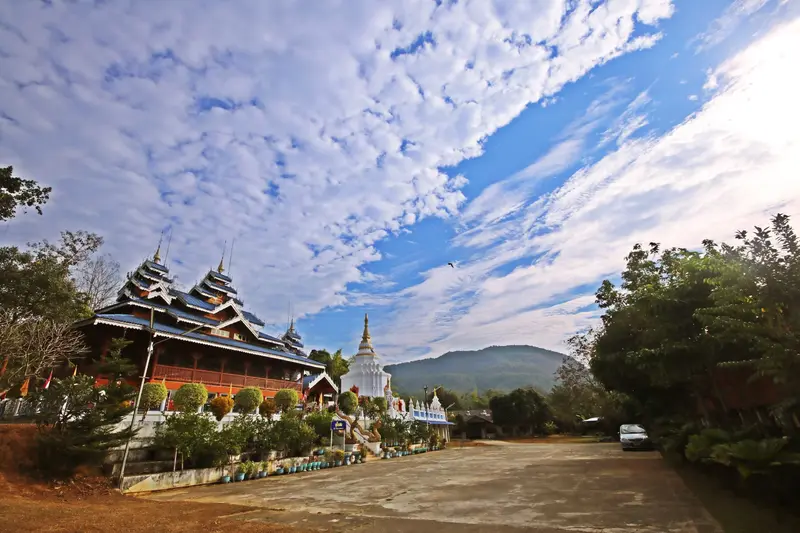
Wat Mok Champae
Open Days: Daily
Opening Hours: 08.00 - 17.00
Wat Mok Champae is one of the most culturally meaningful temples in Mok Champae Subdistrict, Mueang Mae Hong Son District, Mae Hong Son Province. It stands not only as a religious center for the local community, but also as a place that reflects the history, language, architecture, and long-standing faith of the people who live in this part of Mae Hong Son. Travelers heading toward Ban Rak Thai, Pang Ung, or Tham Pla often pass through this area, and a stop at Wat Mok Champae adds a valuable cultural dimension to the journey.
The temple is located at 94 Moo 1, Mok Champae Subdistrict, Mueang Mae Hong Son District, Mae Hong Son Province. It belongs to the Mahanikaya sect and occupies approximately 10 rai of land. Historical records state that the temple was established in 1851, making it one of the old temples in the area. This long history matters because it shows that the temple has grown together with the local community over many generations.
The name “Mok Champae” itself carries cultural meaning. In Tai Yai language, “mok” means flower, while “champae” means frangipani or plumeria. The full meaning therefore becomes “frangipani flower.” This detail gives the temple an added cultural layer because the name is rooted in local language and regional identity rather than being just a geographic label. For visitors interested in the heritage of Mae Hong Son, even the temple’s name tells part of the story.
In its earliest period, Wat Mok Champae was very simple. Local residents recognized the importance of building a temple to serve as a spiritual center for the Buddhist community, so they first constructed a small wooden structure. The floor and walls were lined with bamboo, and the roof was covered with tong tueng leaves, a traditional local material. Even though the building was modest, it was sufficient for religious ceremonies and already fulfilled the temple’s most important role as a place of faith.
As the village became stronger and more established, the temple also developed. Local residents later rebuilt parts of the temple, replacing bamboo with hardwood and changing the roof to corrugated metal for greater durability. Over time, more permanent structures were added within the grounds, including an ordination hall, a chedi, monks’ quarters, and other supporting buildings. This gradual development is one of the clearest signs of the temple’s importance to the community. The temple was not created all at once in finished form. It grew step by step through the sustained faith and effort of the people around it.
A major milestone in the temple’s institutional history was the granting of Wisungkhamasima, the royal boundary designation for ordination halls. Wat Mok Champae received this designation for the first time on 23 June 1971, and again for the current boundary on 12 November 2010. These dates are important because they show that the temple was formally recognized and continued to develop in line with the administrative system of Thai Buddhism.
Architecturally, Wat Mok Champae is especially appealing because of its Tai Yai artistic identity. In 1997, the temple began construction of a new preaching hall, which was completed in 2000. The building was made from hardwood and designed in Tai Yai style. This gives the temple a strong regional character, since Tai Yai architecture is one of the visual signatures of Mae Hong Son. The forms, proportions, and decorative details create a sense of calm elegance that is quite different from central Thai temple architecture.
Another important stage came in 2005, when the temple began constructing a new ordination hall. This hall was built in wood and designed in an applied Tai Yai style. The ordination hall is considered one of the temple’s most beautiful features today. For travelers who appreciate wooden architecture, local craftsmanship, and northern Buddhist art, this is one of the strongest reasons to visit Wat Mok Champae. It is not simply an old village temple. It is a place where local artistic identity is clearly visible in the sacred architecture itself.
The temple’s beauty, however, is not only visual. Much of its appeal comes from the fact that it remains a real community temple rather than a purely touristic site. Visitors can still sense the rhythm of local religious life here. The grounds, the wooden buildings, and the atmosphere all suggest continuity rather than reconstruction for display. This is one of the reasons Wat Mok Champae feels meaningful to people who enjoy cultural travel. It offers a living setting, not a staged one.
Wat Mok Champae is currently under the care of Phra Khru Anusonthammakit, who also serves as the ecclesiastical head of Mok Champae Subdistrict. This detail reinforces the temple’s present-day importance. It is not just historically significant. It also remains active and relevant within the local religious administration. For current travel writing, this kind of verified present-day leadership matters because it confirms that the temple is still functioning and cared for as an active religious institution.
For travelers, one of the temple’s main strengths is its location. Mok Champae is already a well-known route for people traveling from Mae Hong Son town toward Ban Rak Thai, Pang Ung, Phu Klon, and Tham Pla. That makes Wat Mok Champae easy to include in a one-day route. Instead of visiting only scenic destinations, travelers can add a temple stop that provides historical and cultural context for the surrounding area. This helps make the trip feel more complete and rooted in place.
The atmosphere of Wat Mok Champae is especially suited to those who enjoy quiet temple visits. It is best experienced slowly. Rather than rushing in for a quick photo, visitors benefit most when they take time to observe the wooden architecture, appreciate the Tai Yai design elements, pay respects, and absorb the peaceful character of the temple. Because the temple remains a living religious site, respectful behavior is essential. Modest clothing, quiet speech, and sensitivity toward monks and local worshippers are all part of visiting appropriately.
Another reason Wat Mok Champae stands out is the way it represents the broader story of Mae Hong Son. Many travelers know the province for mountain scenery, misty lakes, pine forests, and lakeside villages. But places like Wat Mok Champae remind visitors that Mae Hong Son is also deeply shaped by temple culture, local language, and community-based religious life. The temple helps reveal the province beyond scenic viewpoints and popular photo spots.
For those interested in cultural heritage, the temple also offers a valuable example of how local communities preserve identity through architecture. The preaching hall and ordination hall are not only functional structures. They are expressions of local aesthetics, materials, and beliefs. Hardwood, wooden construction, and Tai Yai stylistic influence together form a strong regional signature. In this way, Wat Mok Champae serves as a meaningful point of reference for understanding temple heritage in Mae Hong Son.
Wat Mok Champae also fits well into slower travel itineraries. A traveler could begin in Mae Hong Son town, stop at the temple in the morning, then continue to Phu Klon Country Club, Ban Rak Thai, Pang Ung, or Tham Pla. This kind of route combines religion, architecture, landscape, and local food in a balanced way. It is especially suitable for travelers who want more than a scenic drive and prefer a journey with cultural depth.
In summary, Wat Mok Champae is a historic village temple with artistic, linguistic, and communal significance. Founded in 1851, developed over time by local residents, enriched with Tai Yai-style wooden architecture, and still led by an active abbot today, it offers a rich and grounded experience for anyone interested in Mae Hong Son beyond its most famous postcard views. It is a temple worth visiting not because it is grand in scale, but because it preserves a strong sense of place, continuity, and local identity.
Getting There from Mae Hong Son town is convenient. Take Highway 1095 toward Mok Champae, which is the same general route used for travel to Ban Rak Thai, Pang Ung, and Tham Pla. From there, continue into the village area of Mok Champae to reach the temple. Travelers driving their own car can easily include Wat Mok Champae as a cultural stop along the route. Because Mae Hong Son roads include curves and mountain sections, daylight travel and careful driving are recommended.
| Name | Wat Mok Champae |
| Summary | A historic temple of Mok Champae, founded in 1851, featuring Tai Yai-style wooden architecture and serving as a long-standing spiritual center for the local community. |
| Location | 94 Moo 1, Mok Champae, Mueang Mae Hong Son, Mae Hong Son |
| Address | 94 Moo 1, Mok Champae Subdistrict, Mueang Mae Hong Son District, Mae Hong Son 58000, Thailand |
| Highlights | Tai Yai-style wooden ordination hall, hardwood preaching hall, historic village temple, and the cultural meaning of the name “Mok Champae.” |
| History | Founded in 1851. Began as a small bamboo-and-wood structure with a roof of tong tueng leaves, later rebuilt with hardwood and more permanent sacred structures. Received Wisungkhamasima on 23 June 1971 and again for the current boundary on 12 November 2010. |
| Name Origin | In Tai Yai language, “mok” means flower and “champae” means frangipani or plumeria, so the name means “frangipani flower.” |
| Distinctive Features | A community temple with strong Tai Yai architectural character, especially the preaching hall completed in 2000 and the wooden applied Tai Yai ordination hall begun in 2005. |
| Current Status | An active temple with a resident abbot and continuing religious use. |
| Latest Abbot | Phra Khru Anusonthammakit |
| Facilities | Ordination hall, preaching hall, chedi, monks’ quarters, and other temple buildings. |
| Main Areas / Zones | Wooden ordination hall, preaching hall, chedi, monks’ quarters, and temple grounds. |
| Nearby Tourist Attractions | 1. Phu Klon Country Club about 3 km, Tel. 053-282579 2. Wat Mae Sanga about 4 km 3. Ban Rak Thai about 12 km 4. Pang Ung about 16 km, Tel. 084-3650776 5. Tham Pla about 13 km |
| Nearby Restaurants | 1. MIWO SLOW BAR about 5 km, Tel. 096-774-7722 2. Rim Na Story about 6 km, Tel. 088-236-8733 3. Pa Wha Restaurant, Ban Rak Thai about 12 km, Tel. 064-253-3336 4. Leewine Rukthai about 12 km, Tel. 089-262-1335, 089-552-9650 5. Ta Lao Sue Rukthai Resort Restaurant about 12 km, Tel. 089-557-2258 |
| Nearby Accommodations | 1. Chenfong Rakthai Resort about 12 km, Tel. 081-764-1376 2. Pa Nuay Guesthouse, Ban Rak Thai about 12 km, Tel. 065-445-7911 3. 168 Ban Rak Thai Resort about 12 km, Tel. 082-965-5137 4. Baan Din Homestay, Pang Ung about 16 km, Tel. 085-416-4869 5. Nihao Rakthai Resort about 12 km, Tel. 062-312-1009, 097-210-5584 |
Frequently Asked Questions (FAQ)
Q: Where is Wat Mok Champae located?
A: Wat Mok Champae is located at 94 Moo 1, Mok Champae Subdistrict, Mueang Mae Hong Son District, Mae Hong Son Province.
Q: When was Wat Mok Champae founded?
A: The temple was founded in 1851 and is one of the old community temples of the area.
Q: What does the name “Mok Champae” mean?
A: In Tai Yai language, the name means “frangipani flower.”
Q: What is special about Wat Mok Champae?
A: Its main highlights are the Tai Yai-style wooden ordination hall, the hardwood preaching hall, and its long-standing role as a cultural and spiritual center of Mok Champae.
Q: Is Wat Mok Champae still active today?
A: Yes. It remains an active temple with Phra Khru Anusonthammakit as the abbot.
Q: Can I visit Wat Mok Champae on the way to Ban Rak Thai or Pang Ung?
A: Yes. The temple is on the travel route through Mok Champae and can be included conveniently in a trip to Ban Rak Thai, Pang Ung, or Tham Pla.
Q: Why is Wat Mok Champae worth visiting?
A: It offers a peaceful village-temple atmosphere, local Tai Yai architectural beauty, and a deeper cultural perspective on Mae Hong Son beyond the province’s scenic attractions.
 Category: ●Places of Worship
 Group: ●Temple
Last Update : 2 MonthAgo
 Last Update : 2 MonthAgo
 Click to Access the Navigation Map GPS
Wat Mok Champae Map
Recommend

 Art, Culture and Heritage
 Historical Sites and Monuments(1)
 Landmarks and Memorials(1)
 Art, Craft Centres, Tradition(10)
 Museums(3)
 Educational Places
 Educational Gardens, Farm(1)
Temple(81)
Educational Gardens, Farm(1)
Temple(81)
 Other Sacred Sites(1)
 Research and Development
 Royal Project(4)
 Suburban Living
 Village, Community(19)
 Local Market(4)
 Nature and Wildlife
 National Parks and Marine Reserves(5)
 Mountain (Doi)(5)
 Dam, Reservoir, Lake(2)
 Waterfalls(12)
 Hot Springs(6)
 Caves(13)
 Flower Field(2)
 River, Canal(3)
 Other natural attractions(1)
 Entertainment and Agricultural
 Farms, Parks and Ecotourism(2)
 Shopping
 Shopping and Night Market(1)
 Travel Articles, Recipes
 Travel Review, Food Review(1)


