
lovethailand home >North Travel Attractions >Mae Hong Son Travel Attractions >Muang Mae Hong Son >Pang Mu > Wat Soppong (Pang Mu)
TL;DR: Wat Soppong (Pang Mu) is located at Ban Soppong, Moo 6, Pang Mu, Mueang Mae Hong Son, Mae Hong Son, open Daily, hours 08:00 – 17:00. Highlights include Tai Yai sermon hall, Burmese-Tai Yai chedi, community rice bank, sports ground, sacred Buddha images.
Wat Soppong (Pang Mu)
Open Days: Daily
Opening Hours: 08:00 – 17:00
Wat Soppong (Pang Mu) is a long-established community temple in Pang Mu Subdistrict, Mueang Mae Hong Son District, Mae Hong Son Province. Located at No. 30, Ban Soppong, Moo 6, this temple may not be the most famous landmark in the province, but it offers something equally valuable: a close look at how a northern Thai temple continues to function as a true community center. For travelers interested in Mae Hong Son beyond the usual viewpoints and postcard stops, this temple provides a meaningful cultural experience rooted in local life, Tai Yai artistic heritage, and living Buddhist tradition.
The temple belongs to the Mahanikaya sect and covers 5 rai, 2 ngan, and 93 square wah, with an additional 1 rai of monastic land. Its setting reflects the practical structure of a village temple rather than a monument built only for tourism. Public roads border the site, reinforcing its connection to daily community life. Wat Soppong is not separated from the village; it is part of it.
Wat Soppong was originally established in 1919. The first temple site was later affected by flooding, which led to the relocation of the temple to its present location in 1981. Local residents commonly call it “Wat Soppong Tai,” a name that reflects community memory and local identity. This history is important because it shows the resilience of the temple and the determination of villagers to preserve their religious center despite environmental challenges.
What makes this temple especially interesting is its role in community life. In addition to serving as a religious site, the temple also supports local social functions. A village rice bank is located within the temple grounds, and the temple offers space for community meetings, official training sessions, seminars, and other public gatherings. In this sense, Wat Soppong is not only a sacred site but also a practical social institution that continues to support village life in multiple ways.
The overall atmosphere inside the temple is open and spacious. There is a sports ground for local youth, adding a strong community dimension to the place. This is one of the reasons the temple feels authentic and lived-in. Visitors do not simply encounter architecture and religious objects here; they encounter a place that continues to serve local people on a daily basis.
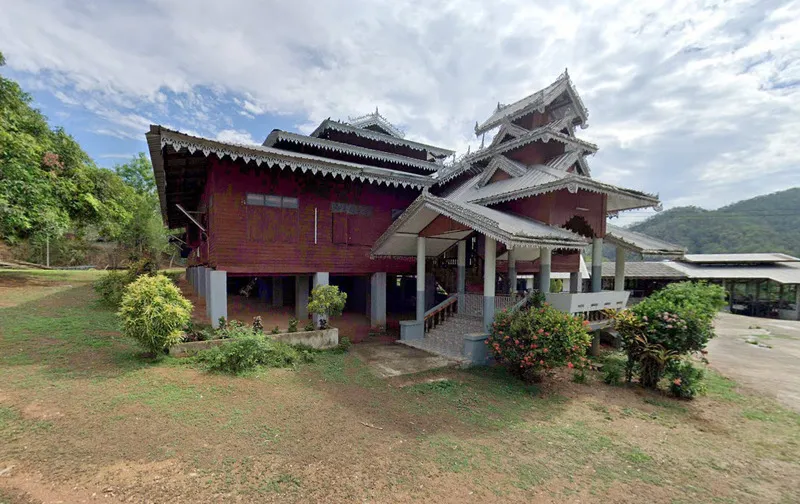
The sermon hall is one of the most distinctive structures inside the temple. Built in Tai Yai style, it reflects the visual identity that defines much of Mae Hong Son’s religious architecture. The proportions, roofline, and aesthetic sensibility are tied closely to the heritage of the Tai Yai people, who have long influenced the culture of this region. Facing the sermon hall is the precept hall, and together they form the central ritual and functional core of the temple grounds.
Behind the temple stands a newly built chedi designed in a beautiful blend of Burmese and Tai Yai artistic styles. This chedi adds visual depth and cultural richness to the temple, connecting the site to the broader historical and ethnic character of Mae Hong Son. The province’s temple architecture often reflects cross-border influences, and Wat Soppong is a clear example of that layered cultural landscape.
Important sacred objects inside the temple include the sermon hall, the precept hall, the kitchen building, and several revered Buddha images. Among the most notable are Buddha images made from “phong kludrad” or “salo” material in Tai Yai artistic style, along with metal Buddha images. These details matter because they place the temple within the broader artistic history of local Buddhism in northern Thailand.
The temple’s administrative history is also well documented. A list of abbots from the past to the present has been preserved, showing the continuity of religious leadership over time. The latest abbot named in the temple record is Phra Sagn Samajaro, who has served from 1997 to the present according to the available temple information. This continuity strengthens the temple’s role as a stable spiritual institution for the village.
For visitors, one of the main appeals of Wat Soppong is that it represents a different side of Mae Hong Son travel. This is not a temple defined mainly by panoramic views or mass tourism. Instead, it is a place where architecture, religion, local governance, and everyday community life meet in one shared space. Travelers who appreciate cultural depth, local context, and authentic places will find this temple especially rewarding.
Wat Soppong is also well suited to travelers building a cultural route through Mueang Mae Hong Son District. It can be visited together with nearby temples and landmarks such as Wat Pha Ang, Wat Pang Mu, Wat Phra That Doi Kong Mu, Nong Chong Kham, Wat Chong Kham-Wat Chong Klang, and Su Tong Pae Bridge. This makes it a strong addition to a half-day or full-day temple and heritage itinerary.
Getting There is straightforward from Mae Hong Son town. Travel toward Pang Mu Subdistrict and continue to Ban Soppong, Moo 6. The temple is accessible by private car, motorbike, or local transport. Because it lies within a settled community area rather than a remote mountain route, it is easy to combine with other attractions in the Pang Mu and town-center zones.
The best time to visit is in the morning or late afternoon, when the weather is more comfortable and the light is softer for photography. Visitors should dress respectfully, especially since this temple remains an active community and religious site. That is part of its value: this is not a staged attraction, but a living temple with ongoing community use.
In summary, Wat Soppong (Pang Mu) is a meaningful destination for anyone interested in community temples, Tai Yai heritage, local religious life, and the cultural layers of Mae Hong Son. It is modest in scale, but rich in context. Rather than overwhelming visitors with spectacle, it offers a more thoughtful experience grounded in history, village life, and enduring faith.
| Name | Wat Soppong (Pang Mu) |
| Location | Ban Soppong, Moo 6, Pang Mu, Mueang Mae Hong Son, Mae Hong Son |
| Address | No. 30, Ban Soppong, Moo 6, Pang Mu Subdistrict, Mueang Mae Hong Son District, Mae Hong Son 58000 |
| Summary | A long-established community temple known for Tai Yai architecture, local village functions, and a strong connection to daily life in Pang Mu |
| Highlights | Tai Yai sermon hall, Burmese-Tai Yai chedi, community rice bank, sports ground, sacred Buddha images |
| History | Founded in 1919 and relocated to the present site in 1981 after the original site was affected by flooding |
| Name Origin | Named after Ban Soppong village; locally known as “Wat Soppong Tai” |
| Distinctive Features | Open temple grounds, active community use, Tai Yai artistic identity, and a village-oriented atmosphere |
| Travel Information | Accessible from Mae Hong Son town via Pang Mu Subdistrict and Ban Soppong; suitable for car, motorbike, and local transport |
| Current Status | Still active as a community temple and local event venue |
| Open Days | Daily |
| Opening Hours | 08:00 – 17:00 |
| Facilities | Sermon hall, precept hall, kitchen, sports ground, community meeting space |
| Main Areas / Zones | Sermon hall, precept hall, sports ground, rice bank, rear chedi zone |
| Abbot / Caretaker | Phra Sagn Samajaro |
| Main Contact Number | 053-613-073 |
| Nearby Tourist Attractions | 1. Wat Pha Ang approximately 4 km 2. Wat Pang Mu approximately 5 km 3. Wat Phra That Doi Kong Mu approximately 8 km. Tel. 053-611-221 4. Wat Chong Kham-Wat Chong Klang and Nong Chong Kham approximately 9 km. Tel. 053-611-352 5. Su Tong Pae Bridge / Suan Tham Phu Sama approximately 13 km. Tel. 084-372-3446 6. Pang Ung approximately 40 km. Tel. 084-365-0776 7. Ban Rak Thai approximately 34 km. Tel. 082-965-5137 |
| Nearby Restaurants | 1. Little Good Things Cafe Mae Hong Son approximately 6 km. Tel. 094-227-0901 2. Salween River Restaurant approximately 7 km. Tel. 084-687-8891 3. Bai Fern Restaurant approximately 8 km. Tel. 053-611-374 4. Before Sunset Coffee approximately 8 km. Tel. 053-612-234 5. Sri Phrai Restaurant approximately 9 km. Tel. 053-612-951 |
| Nearby Accommodations | 1. The Imperial Mae Hong Son Resort approximately 6 km. Tel. 053-684-444 2. Sib-Lan Buri Resort Mae Hong Son approximately 7 km. Tel. 063-591-9888 3. Gims Resort approximately 8 km. Tel. 053-614-214, 080-133-4593 4. Baan Phuthadol approximately 9 km. Tel. 084-608-0909 5. Fern Resort approximately 15 km. Tel. 053-686-110, 093-314-8222 |
Frequently Asked Questions (FAQ)
Q: Where is Wat Soppong (Pang Mu) located?
A: It is located at No. 30, Ban Soppong, Moo 6, Pang Mu Subdistrict, Mueang Mae Hong Son District, Mae Hong Son Province.
Q: When was Wat Soppong founded?
A: The temple was founded in 1919 and moved to its present location in 1981 after flooding affected the original site.
Q: What makes this temple special?
A: Its Tai Yai architecture, community rice bank, sports ground, village-centered role, and sacred local Buddha images make it especially distinctive.
Q: Who is the latest abbot listed for the temple?
A: The latest abbot named in the temple information is Phra Sagn Samajaro.
Q: Is Wat Soppong suitable for cultural travelers?
A: Yes. It is ideal for travelers who want to understand local religious life, village culture, and Tai Yai heritage in Mae Hong Son.
Q: Can I combine this temple with other nearby attractions?
A: Yes. It can easily be combined with Wat Pha Ang, Wat Pang Mu, Wat Phra That Doi Kong Mu, Nong Chong Kham, Wat Chong Kham-Wat Chong Klang, and Su Tong Pae Bridge.
Tel : 053613073
 Tel : 053613073
 Category: ●Places of Worship
 Group: ●Temple
Last Update : 2 MonthAgo
 Last Update : 2 MonthAgo
 Click to Access the Navigation Map GPS
Wat Soppong (Pang Mu) Map
Recommend

 Art, Culture and Heritage
 Historical Sites and Monuments(1)
 Landmarks and Memorials(1)
 Art, Craft Centres, Tradition(10)
 Museums(3)
 Educational Places
 Educational Gardens, Farm(1)
Temple(81)
Educational Gardens, Farm(1)
Temple(81)
 Other Sacred Sites(1)
 Research and Development
 Royal Project(4)
 Suburban Living
 Village, Community(19)
 Local Market(4)
 Nature and Wildlife
 National Parks and Marine Reserves(5)
 Mountain (Doi)(5)
 Dam, Reservoir, Lake(2)
 Waterfalls(12)
 Hot Springs(6)
 Caves(13)
 Flower Field(2)
 River, Canal(3)
 Other natural attractions(1)
 Entertainment and Agricultural
 Farms, Parks and Ecotourism(2)
 Shopping
 Shopping and Night Market(1)
 Travel Articles, Recipes
 Travel Review, Food Review(1)


