
lovethailand home >Northeastern Travel Attractions >Roi Et Travel Attractions >Phon Thong >Pho Si Sawang > Wat Phra That Upamung
TL;DR: Wat Phra That Upamung is located at Ban Sang Bu, Moo 3, Pho Si Sawang Subdistrict, Phon Thong District, Roi Et Province, open Daily, hours 08.00 – 17.00.
Wat Phra That Upamung
Open Days: Daily
Opening Hours: 08.00 – 17.00
Wat Phra That Upamung in Roi Et Province is a sacred Buddhist temple and a local spiritual landmark in Ban Sang Bu, Pho Si Sawang Subdistrict, Phon Thong District. Its most important feature is Phra That Upamung, an old stupa deeply connected with local beliefs about the Buddha’s sacred ashes and the wider religious memory surrounding Phra That Phanom. According to local tradition, a group led by Phraya Kaeo Phromtha of Si Phum was bringing the Buddha’s ashes to be enshrined at Phra That Phanom, but when they reached this area, they learned that the construction of Phra That Phanom had already been completed and sealed. The ashes were therefore enshrined on this forested mound, which later became a place of devotion for local villagers and Buddhist pilgrims.
Wat Phra That Upamung is also known in some records as Wat That Upamung or Wat That Upmung. It is located in Ban Sang Bu, Moo 3, Pho Si Sawang Subdistrict, Phon Thong District, Roi Et Province. The temple lies west of Ban Sang Bu in an area that was formerly covered by woodland. This setting gives the temple a noticeably calm and rural character. Unlike large urban temples that are designed for mass tourism, Wat Phra That Upamung feels intimate, quiet, and closely tied to the daily life and faith of the surrounding community. Visitors come here to pay respect, learn about local history, and experience a less-commercial side of Roi Et’s Buddhist heritage.
The central importance of Wat Phra That Upamung comes from its connection with the story of Phra That Phanom, one of the most revered stupas in northeastern Thailand. The local legend describes how the sacred ashes of the Buddha were originally intended for enshrinement at Phra That Phanom. When the group arrived in this forested area and learned that the stupa at Phra That Phanom had already been completed, they chose this elevated place to preserve the ashes instead. Because of this narrative, Phra That Upamung is not viewed simply as an old structure. For local people, it is a sacred point in a larger spiritual geography linking Roi Et with the Buddhist heritage of the Mekong region.
The temple’s history is also reflected in its formal religious status and its long relationship with the local community. Wat That Upamung is recorded as a community temple under the Maha Nikaya order, with its founding associated with the year 1817, or B.E. 2360. The temple grounds were originally forested and contained an old stupa and a Tripitaka hall. Later, Luang Pu Sing Thong discovered the stupa and began restoration work, which helped establish the place as a forest temple centered on Phra That Upamung. The sacred objects of the temple include the stupa itself and two Buddha images, making it a site of devotion for residents of Ban Sang Bu and nearby villages.
The restoration history of Phra That Upamung took place over several generations. After the sacred ashes were enshrined according to local tradition, monks practicing meditation and forest wandering came to this site. Luang Pu Sing Thong is remembered as one of the key monks who built a square-based stupa over the older sacred core. The structure was described as having a covered form and an inner passage where devotees could enter to pay respect. The work was not fully completed during his lifetime. Later, Luang Pu Thongma Thawaro continued the construction with the support of villagers from Ban Sang Bu and Ban Pong. Local people helped make fired bricks from clay taken near the temple and used traditional materials to bind the structure. This process shows how religious architecture in rural Isan was often created through a combination of monastic leadership, village labor, and local craftsmanship.
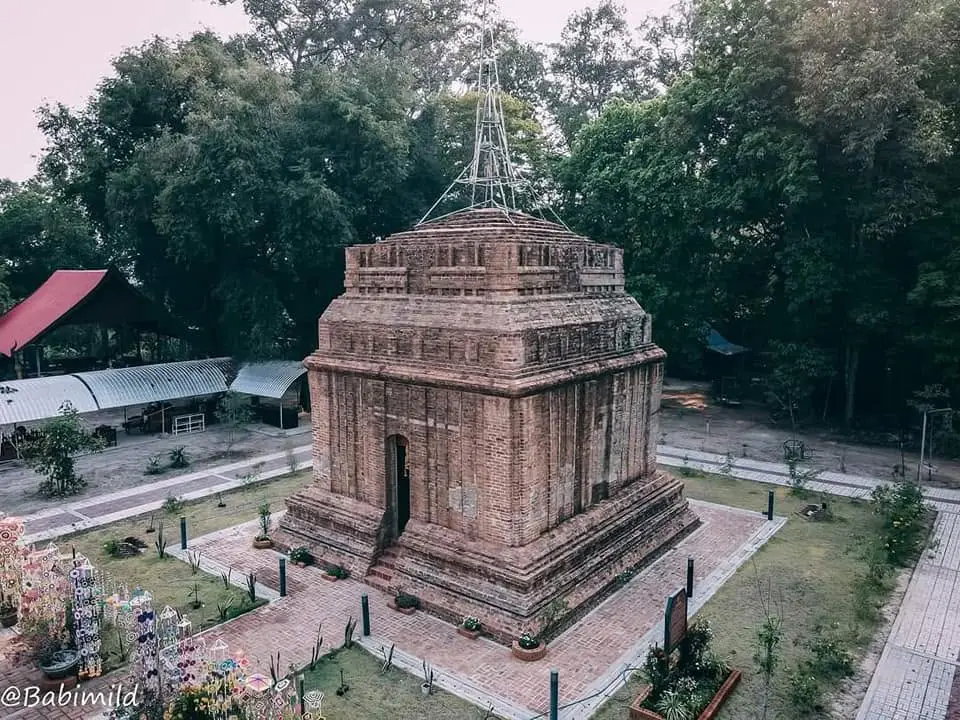
Over time, the stupa developed cracks and construction stopped. Rain, weathering, and age gradually affected the structure. The upper part of the stupa eventually collapsed, and local accounts connect the major damage to the same historical period as the collapse of Phra That Phanom in B.E. 2518, or 1975. Today, the remains of Phra That Upamung still show signs of deterioration. Yet this condition is part of what makes the site so meaningful. The stupa does not impress visitors through perfect restoration or monumental scale. Instead, it reveals the passage of time, the fragility of sacred architecture, and the continuing devotion of a community that still respects the place despite its damaged condition.
The name “Upamung” is associated with the form of the stupa, which functioned as a covered structure protecting the original sacred core. Some local explanations describe the form as resembling a covered tunnel or a structure with an enclosed passage for worship. The name has become closely tied to the identity of Pho Si Sawang Subdistrict, where local slogans and community descriptions continue to refer to Phra That Upamung as a sacred landmark. For travelers, understanding the name helps reveal the relationship between language, architecture, and local memory. It is not merely a label, but a clue to how people have interpreted the shape and function of the stupa over time.
Wat Phra That Upamung has value in several dimensions. Religiously, it is a place for paying respect to the sacred stupa and participating in Buddhist merit-making. Historically, it preserves a local version of the sacred-ashes narrative connected to Phra That Phanom. Culturally, it reflects how villagers from Ban Sang Bu, Ban Pong, and surrounding communities have supported the temple across generations. The temple is therefore more than a tourist stop. It is a living memory space where faith, local history, and community identity remain strongly connected.
The atmosphere of the temple is best appreciated by visitors who prefer quiet cultural travel. Travelers should not expect a heavily developed tourist attraction with extensive commercial facilities. The temple is a functioning religious site with a sermon hall, prayer hall, monks’ residences, a Tripitaka hall, restrooms, and areas for Buddhist activities. Visitors should walk calmly, dress respectfully, and avoid climbing or touching fragile parts of the stupa. The damaged condition of Phra That Upamung makes careful behavior especially important. Respectful travel here means helping preserve a sacred place that still holds deep emotional value for the local community.
The main point of interest is Phra That Upamung itself. The stupa’s structure and its visible traces of collapse allow visitors to observe the history of local construction techniques and village-based restoration. The use of clay, fired bricks, and natural binding materials reveals a form of Isan craftsmanship shaped by available resources and local knowledge. For travelers interested in cultural heritage, the stupa is a valuable case study in how rural communities created and preserved sacred architecture without the resources of large royal or urban temples. When viewed alongside the stories of Luang Pu Sing Thong and Luang Pu Thongma Thawaro, the stupa becomes a material record of faith and collective labor.
Another important aspect of the temple is that it is still active. The presence of monks and the continued use of temple buildings show that Wat Phra That Upamung is not an abandoned ruin. It remains a place where Buddhist practice, merit-making, and local rituals continue. This living dimension is significant for foreign travelers because it changes the way the site should be understood. Wat Phra That Upamung is both a heritage site and a working temple. Visitors are therefore entering a space that belongs to the religious life of the community, not only a historical monument.
One of the stories often associated with Phra That Upamung concerns mysterious lights said to appear near the stupa on certain Buddhist holy nights. Such stories should be understood as part of the oral tradition and spiritual imagination of the community. Their importance lies less in scientific proof and more in what they reveal about the way local people experience the sacredness of the place. For many villagers, Phra That Upamung is not simply old; it is powerful, protective, and spiritually alive. These beliefs form an essential part of the temple’s cultural meaning.
For travelers who want to understand Roi Et beyond its major city landmarks, Wat Phra That Upamung offers a more local and contemplative experience. Roi Et is often associated with places such as Bueng Phalan Chai, the Roi Et Tower, and major temples in the provincial center. Yet the province also contains many smaller community temples, stupas, shrines, and local heritage sites scattered across its districts. Visiting Phon Thong District and Pho Si Sawang Subdistrict gives travelers a deeper view of rural religious life and the cultural landscape of northeastern Thailand.
The best time to visit is in the morning or late afternoon, when the weather is more comfortable and natural light is suitable for walking around the temple grounds. During the rainy season, visitors should wear practical footwear because some areas may become wet or muddy. Travelers looking for a quiet experience should avoid busy merit-making days, while those interested in local culture may find temple events meaningful if they participate respectfully. In either case, the temple should be approached with calmness, modest dress, and awareness of its sacred role.
Foreign visitors should dress respectfully by covering shoulders and knees, speaking softly, and avoiding disruptive behavior. Photography should be done with care, especially around monks, worshippers, and fragile structures. The stupa should not be climbed or touched. If monks or local residents are present, a polite greeting and a respectful distance are appropriate. Temples in rural Thailand often function as community centers as well as sacred sites, so visitors should be mindful that they are entering a place of daily religious life.
Getting There is easiest by private car or rental car. From Roi Et city, travel toward Phon Thong District, then continue into Pho Si Sawang Subdistrict and Ban Sang Bu. The drive from the provincial city to Phon Thong takes a little over 1 hour under normal conditions, and the final section leads into a rural community area. Travelers using public transportation can take a local bus or van to Phon Thong and then arrange local transport to the temple. Because rural transport may not run frequently, return travel should be planned in advance.
A practical travel route can combine Wat Phra That Upamung with other places in Phon Thong District. Visitors may begin with the temple in the morning, then continue to local landmarks such as Laem Phayom, a large water area used for recreation, or Chao Pu Kut Peng Shrine and the Guan Yin image, which are respected by people in the district. Travelers with more time can extend the route toward Nong Phok District or other parts of Roi Et. This type of itinerary allows visitors to experience Buddhist heritage, local shrines, community life, and natural scenery in a single day.
Wat Phra That Upamung is also connected to the wider identity of Pho Si Sawang Subdistrict, whose local character includes the sacred stupa, natural-dye textiles, reed mats, the Bun Bang Fai rocket festival, and local natural resources. This means that a visit to the temple can also serve as an entry point into community-based travel. Visitors who have more time may ask local authorities or residents about local products and events. Supporting community products and respecting local traditions can make the trip more meaningful and beneficial to the area.
The temple’s current abbot is Phra Khru Pariyatithammakon, and the temple remains active with resident monks. This continuity is important because sacred sites maintain their meaning not only through old structures but also through ongoing religious practice. The continued presence of monks, villagers, merit-making, and temple activities ensures that Wat Phra That Upamung is still a living spiritual center rather than a forgotten ruin. For travelers, this is one of the most important reasons to visit with sensitivity and respect.
The value of Wat Phra That Upamung can be understood in multiple layers. The first layer is sacred devotion to the stupa. The second is the historical memory of the monks and villagers who helped build and restore it. The third is the visible survival of an old structure shaped by time and weather. The fourth is the temple’s present role as an active religious site. Together, these layers make Wat Phra That Upamung a meaningful destination for travelers who want to experience the depth of local Buddhist culture in Roi Et.
As a heritage learning site, Wat Phra That Upamung raises important questions about conservation. The stupa’s damaged condition reminds visitors that local heritage requires care, resources, and community involvement. Preserving such a place must balance historical authenticity, safety, religious belief, and the wishes of local people. Visitors who understand this context will see that the temple is not only a place to visit, but also a reminder of how fragile and valuable community heritage can be.
Wat Phra That Upamung is suitable for temple travelers, cultural tourists, researchers of local legends, and anyone interested in the quieter spiritual geography of northeastern Thailand. It is not a destination defined by spectacle. Its strength lies in atmosphere, memory, and devotion. A thoughtful visit allows travelers to see how an old stupa, even in a damaged state, can continue to shape local identity and remain a source of faith for generations.
| Name | Wat Phra That Upamung |
| Alternative Names | Wat That Upamung, Wat That Upmung |
| Location | Ban Sang Bu, Moo 3, Pho Si Sawang Subdistrict, Phon Thong District, Roi Et Province |
| Address | No. 64, Ban Sang Bu, Moo 3, Pho Si Sawang Subdistrict, Phon Thong District, Roi Et 45110, Thailand |
| Place Type | Community Buddhist temple under the Maha Nikaya order and a historical-cultural attraction |
| Highlights | Phra That Upamung, a sacred local stupa connected with traditions about the Buddha’s ashes and Phra That Phanom |
| History | The temple is associated with B.E. 2360, or 1817. It was originally a forested area with an old stupa and a Tripitaka hall. Luang Pu Sing Thong and Luang Pu Thongma Thawaro played important roles in restoring the stupa. |
| Name Origin | The name is associated with the covered form of the stupa, which enclosed the original sacred core and was described in local tradition as having a tunnel-like structure for worship. |
| Distinctive Features | An old sacred stupa with visible traces of collapse and weathering, carrying strong religious and local historical significance |
| Important Sacred Objects | 1 Phra That Upamung stupa and 2 Buddha images |
| Travel Information | From Roi Et city, travel toward Phon Thong District, then continue to Pho Si Sawang Subdistrict and Ban Sang Bu. Private car, rental car, or locally arranged transport from Phon Thong is recommended. |
| Current Status | An active community temple with resident monks and a listed local attraction in Pho Si Sawang Subdistrict |
| Open Days | Daily |
| Opening Hours | 08.00 – 17.00 |
| Facilities | Sermon hall, prayer hall, monks’ residences, Tripitaka hall, restrooms, and Buddhist activity areas |
| Main Areas / Zones | Phra That Upamung Stupa Sermon Hall Prayer Hall Monks’ Residences Tripitaka Hall Forest Temple Area and Worship Space |
| Abbot / Caretaker | Phra Khru Pariyatithammakon |
| Local Information Contact | Pho Si Sawang Subdistrict Municipality, Tel. 0-4303-0242 |
| Official Website / Official Page | Pho Si Sawang Subdistrict Municipality website |
| Nearby Tourist Attractions | 1. Pho Si Sawang Subdistrict Tourist Service Center, 8 km 2. Wat Pa Thep Mongkhon Yan, 6 km 3. Wat Maha Wanotthayan, 7 km 4. Chao Pu Kut Peng Shrine and Guan Yin Image, 15 km 5. Laem Phayom, 16 km |
| Nearby Restaurants | 1. Tam Dood Niew Phon Thong, 14 km, Tel. 082-183-0345 2. Inthanin Coffee Bangchak - Phon Thong, 13 km, Tel. 097-241-6764 3. Sushi Fa Shabu Buffet Phon Thong, 14 km, Tel. 080-727-9784 4. Jungle Cafe Phon Thong Roi Et Branch, 15 km, Tel. 080-327-2139 5. PunThai Coffee Ronnachai Road Phon Thong, 15 km, Tel. 080-071-9223 |
| Nearby Accommodations | 1. Yello Block Hotel, 14 km, Tel. 043-030-426, 098-494-5426 2. Tontan Hotel Phon Thong, 15 km, Tel. 095-669-8875, 085-105-8838, 043-033-458 3. Baan Suan Resort Hotel, 15 km, Tel. 043-572-448 4. Phon Thong Grand Villa Resort, 16 km, Tel. 043-501-893, 043-507-893 5. Rim Nam Resort Phon Thong, 18 km, Tel. 093-104-0159 |
Frequently Asked Questions (FAQ)
Q: Where is Wat Phra That Upamung located?
A: Wat Phra That Upamung is located in Ban Sang Bu, Moo 3, Pho Si Sawang Subdistrict, Phon Thong District, Roi Et Province.
Q: What are the opening days and hours of Wat Phra That Upamung?
A: The temple is open daily from 08.00 to 17.00.
Q: Why is Wat Phra That Upamung important?
A: It is a sacred community temple with Phra That Upamung as its main spiritual landmark, linked to local traditions about the Buddha’s ashes and Phra That Phanom.
Q: Who is the abbot of Wat Phra That Upamung?
A: The abbot is Phra Khru Pariyatithammakon.
Q: What can visitors see inside Wat Phra That Upamung?
A: Visitors can see Phra That Upamung Stupa, Buddha images, the sermon hall, prayer hall, Tripitaka hall, monks’ residences, and the peaceful atmosphere of a rural forest temple.
Q: How can travelers get to Wat Phra That Upamung?
A: Travelers can drive from Roi Et city to Phon Thong District, then continue to Pho Si Sawang Subdistrict and Ban Sang Bu. A private car, rental car, or locally arranged transport is recommended.
Q: How should visitors behave at Wat Phra That Upamung?
A: Visitors should dress respectfully, speak softly, avoid climbing or touching damaged parts of the stupa, and respect monks, worshippers, and local residents.
Q: Which nearby attractions can be visited with Wat Phra That Upamung?
A: Nearby places include Pho Si Sawang Subdistrict Tourist Service Center, Wat Pa Thep Mongkhon Yan, Wat Maha Wanotthayan, Chao Pu Kut Peng Shrine and Guan Yin Image, and Laem Phayom.
 Category: ●Places of Worship
 Group: ●Temple
Last Update : 4 WeekAgo
 Last Update : 4 WeekAgo
 Click to Access the Navigation Map GPS
Wat Phra That Upamung Map
Recommend

 Art, Culture and Heritage
 Historical Sites and Monuments(3)
 Landmarks and Memorials(5)
 Art, Craft Centres, Tradition(2)
 Museums(1)
 Educational Places
 Educational Gardens, Farm(3)
Temple(35)
Educational Gardens, Farm(3)
Temple(35)
 Other Sacred Sites(6)
 Suburban Living
 Village, Community(1)
 Local Market(1)
 Nature and Wildlife
 National Parks and Marine Reserves(1)
 Mountain (Doi)(2)
 Dam, Reservoir, Lake(8)
 Waterfalls(1)
 Flower Field(1)
 River, Canal(4)
 Entertainment and Agricultural
 Zoos and Aquariums(1)
 Stadium(1)
 Farms, Parks and Ecotourism(5)
 Shopping
 Shopping and Night Market(1)


