
lovethailand home >Northeastern Travel Attractions >Roi Et Travel Attractions >Phanom Phrai >Phanom Phrai > Wat Klang Udom Wet
TL;DR: Wat Klang Udom Wet is located at Phanom Phrai Subdistrict, Phanom Phrai District, Roi Et Province, open Daily, hours 08.00 – 17.00.
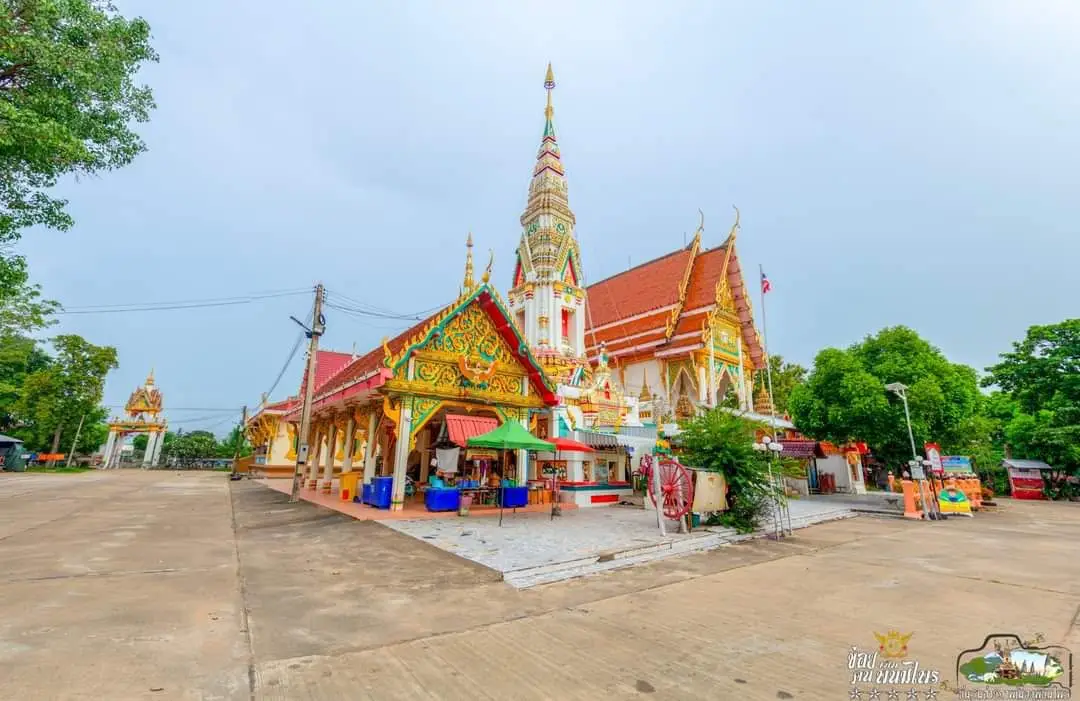
Wat Klang Udom Wet
Open Days: Daily
Opening Hours: 08.00 – 17.00
Wat Klang Udom Wet in Roi Et is located in Phanom Phrai Subdistrict, Phanom Phrai District, Roi Et Province. It is an old and deeply respected Buddhist temple centered on Phra Maha That, the sacred stupa that has long served as the spiritual heart of Phanom Phrai. The temple is important not only as a place of worship, but also as a cultural landmark connected with local legends, sacred relic beliefs, the old community of Saen Lan Chang, the annual third-lunar-month stupa worship festival, and the famous Phanom Phrai Bun Bang Fai rocket festival held in the seventh lunar month. For travelers who want to understand Roi Et beyond the city center, this temple offers a strong view of Isan faith, community ritual, and local Buddhist memory.
Phra Maha That is the most important feature of Wat Klang Udom Wet. Local people respect it as a sacred stupa and a symbol of the Buddha’s presence through relic belief. Devotees come to worship, make merit, ask for success in their wishes, and seek auspiciousness for themselves and their families. The stupa is not only an old religious monument. It is the center of communal faith, annual festivals, vow-making traditions, and the identity of Phanom Phrai.
Local legend connects the temple with an ancient settlement once known as Ban Chae Chae or Ban Kae, inhabited by indigenous people locally remembered as Kha. Two monks, Phra Khru Maha Rattanachaiya and Phra Khru Maha Pasaman, are said to have traveled from the Khmer region of Indapatthanakhon toward Marukkhanakhon to spread Buddhism. When they arrived near Ban Kae, local people developed faith in them and invited them to stay. Phra Khru Maha Pasaman accepted the invitation, taught the villagers, and a temple was built under the name Wat Pasaman. This legend forms one of the deepest layers of the temple’s identity.
Later, Phra Khru Yot Kaeo, also known as Phra Luk Kaeo, a monk from Vientiane, led Lao settlers across the Mekong into the area. The settlement grew and became associated with the name Mueang Saen Lan Chang. Phra Khru Yot Kaeo renamed the temple Wat Pho because of the many Bodhi trees in the temple area. He is also connected in legend with the bringing of a portion of the Buddha’s breastbone relic from Phu Kamphra, associated with Phra That Phanom, to be enshrined at Wat Pho. A stupa was then built to house the relic portion and Buddha images. This stupa is identified in local tradition as the present Phra Maha That of Wat Klang Udom Wet.
These legends make Wat Klang Udom Wet more than a village temple. They show the temple as a place where several cultural layers meet: the older local community, Lao settlement, Buddhist monks, relic devotion, and the formation of Phanom Phrai’s religious landscape. Whether read as sacred history or community memory, the story gives the temple deep cultural meaning and explains why the stupa remains so important to local people.
During the period of Phra Khru Kittimasak, also remembered locally as Phra Khru Mao or Ya Khu Tui, Mueang Saen Lan Chang had become Mueang Mano Phrai. As abbot, he restored Wat Pho and officially renamed it Wat Klang Udom Wet on March 5, 1882. The name reflects the temple’s position in the middle of the community and its role as a place of learning. Klang means central, while Udom Wet suggests richness in knowledge and sacred learning. The name therefore preserves the temple’s role as both a religious and educational center.
Phra Khru Kittimasak also restored the ordination hall and requested the royal granting of the consecrated boundary, which the temple received on January 15, 1907. The consecrated boundary gave the temple a formal sacred area for monastic rites. This was important for ordinations, Sangha ceremonies, and the full religious function of the monastery. It shows that Wat Klang Udom Wet had become an established Buddhist institution in Phanom Phrai.
During the abbacy of Phra Khru Prachot Thammanuyut, or Luang Pho Chari, from 1954 to 1971, Phra Maha That had deteriorated significantly. He invited laypeople to support a major restoration, and the stupa was restored to a dignified form. This restoration was essential because the stupa was the spiritual focus of the town. Without such care, an important sacred monument and the heart of local ritual life would have been weakened. The restoration helped preserve the pride of Phanom Phrai for later generations.
During the period of Phra Palat Narin Subhatto, later known as Phra Khru Suphat Udom Wet, from 1978 to 1996, the temple developed both materially and spiritually. New structures such as an ordination hall, monks’ residences, and a library were built. The temple also supported summer ordination programs for monks and novices, Sunday Buddhist school, and the Wat Klang Udom Wet Foundation for social assistance. These activities show that the temple served as a center for education, morality, and public benefit, not only stupa worship.
Phra Khru Adun Chanthakhun, also known as Luang Pho Pradit Chandaro, became the abbot on September 24, 1996 and has continued the temple’s development. Under his leadership, the temple has supported religious work, social benefit activities, the Chanthakhun Saen Tham Charity Association, the Wat Klang Udom Wet rescue unit, and a community ICT learning center. These activities show how a temple can continue to serve a modern community while preserving sacred tradition.
Besides Phra Maha That, the temple contains many important sacred and cultural objects. These include an old stupa believed to be related to the same period as Phra Maha That, the large Buddha image known locally as Phra Chao Yai, and statues of former abbots who developed the temple, including Phra Khru Kittimasak, Phra Khru Prachot Thammanuyut, and Phra Khru Suphat Udom Wet. These objects help visitors understand the temple’s long line of religious leadership and restoration.
Phra Maha That is also known in local belief as Chao Pho Chum Kham or Chao Pho Jum Kham. People believe that the sacred stupa protects the community and helps those who are suffering. This belief is especially connected with vows and the offering of rockets during the Bun Bang Fai festival. When a wish is fulfilled, devotees may offer rockets as a form of gratitude. This gives the Phanom Phrai rocket festival a special identity: it is not only a rain-seeking festival but also an act of devotion to Phra Maha That.
The annual worship festival of Phra Maha That is held from the 12th waxing moon to the 15th waxing moon of the third lunar month. Many Buddhists and visitors come to pay homage to the stupa. The festival includes merit-making, offerings, alms-giving, and community activities. For local families, this festival is also a time for reunion and renewal of faith. It remains one of the most important religious events at Wat Klang Udom Wet.
The Phanom Phrai Bun Bang Fai festival is another major event connected directly with the temple. It is traditionally held on the 15th waxing moon of the seventh lunar month. Local belief says that the people of Mueang Saen Lan Chang first brought rockets to offer to Chao Pho Phra Maha That. Today the festival includes ritual worship, dance offerings, rocket processions, beautiful parade floats, and rocket launching. The festival unites the municipality, government agencies, temples, schools, community groups, and Phanom Phrai people who return home for the annual event.
The dance offering to Phra Maha That is one of the most memorable parts of the modern festival. Participants dress beautifully and dance in unison to honor the sacred stupa. This ceremony confirms that the faith of Phanom Phrai people is still active today. The festival is not only entertainment. It is a ritual expression of devotion, gratitude, protection, and community unity centered on Wat Klang Udom Wet.
Wat Klang Udom Wet is therefore important in many ways. It preserves sacred legend, relic belief, the memory of Saen Lan Chang, the work of former abbots, community education, social assistance, and seasonal festivals. Visitors should pay attention not only to the stupa but also to Phra Chao Yai, the old stupa, former abbot statues, the ordination hall, and the Maha That pavilion area. These elements together explain why the temple remains the spiritual heart of Phanom Phrai.
The Maha That pavilion area is an important contemporary space. It supports religious ceremonies, meditation practice, community events, rest areas, and social activities. Its development helps the temple welcome large numbers of people during the stupa worship festival, the rocket festival, and other important ceremonies. On ordinary days, it also provides a calm and organized area for visitors to pay respect and walk around the sacred stupa.
A meaningful visit should begin at Phra Maha That. Visitors can then pay respect to Phra Chao Yai, observe the old stupa, view the statues of former abbots, visit the ordination hall, and walk through the Maha That pavilion area. This route helps visitors understand the temple from its sacred center outward: relic devotion, Buddha images, monastic leadership, community service, and annual ritual life.
Getting There from Roi Et city requires traveling toward Phanom Phrai District, about 70 kilometers by road. After entering Phanom Phrai Municipality, continue to Wat Klang Udom Wet in Phanom Phrai Subdistrict. Private car or hired vehicle is the most convenient option. Visitors without private transport can travel to Phanom Phrai town area by local transport and then continue to the temple by local taxi or hired vehicle.
The best time to visit is in the morning or early afternoon, when the weather is more comfortable for paying respect and walking around the temple. The temple is open daily from 08.00 to 17.00. Visitors who want to experience the major festivals should plan for the third-lunar-month Phra Maha That worship festival or the seventh-lunar-month Bun Bang Fai festival. These periods are lively but crowded, so visitors should allow extra time for travel, parking, and participation in ceremonies.
Visitors should dress respectfully, speak quietly, and behave with care around Phra Maha That, the ordination hall, and the Maha That pavilion area. During festivals, they should follow instructions from temple staff, community volunteers, and local authorities. Proper conduct helps maintain the dignity of the temple and allows both worshippers and travelers to experience the place appropriately.
For families and students, Wat Klang Udom Wet is a valuable outdoor classroom. Children can learn what a sacred stupa is, why Buddhist relics are revered, why the third-lunar-month worship festival matters, and how the rocket festival is connected with faith and community. Learning at the actual site helps visitors understand Buddhism, Isan festivals, and local identity more clearly than reading about them alone.
For foreign travelers, Wat Klang Udom Wet is a strong example of an Isan temple where stupa devotion, seasonal festivals, vow-making, dance offerings, and community identity remain closely connected. It shows that Thai temples are not only architectural attractions. They are living social and spiritual centers where people make merit, return home, honor sacred objects, ask for protection, and express belonging through ceremony.
Overall, Wat Klang Udom Wet is one of the most important religious sites in Phanom Phrai District. Its highlights include the sacred Phra Maha That, the legend of relic enshrinement, Phra Chao Yai, the old stupa, former abbot statues, the third-lunar-month stupa worship festival, the seventh-lunar-month Bun Bang Fai festival, the dance offering to Phra Maha That, and the continuing leadership of Phra Khru Adun Chanthakhun or Luang Pho Pradit Chandaro. The temple tells the story of Phanom Phrai through relic faith, community memory, festivals, education, and Buddhist devotion.
| Name | Wat Klang Udom Wet, Roi Et |
| Temple Type | Local Buddhist Temple And Important Sacred Site Of Phanom Phrai District |
| Location | Phanom Phrai Subdistrict, Phanom Phrai District, Roi Et Province |
| Address | Wat Klang Udom Wet, Phanom Phrai Subdistrict, Phanom Phrai District, Roi Et 45140, Thailand |
| Highlights | Sacred Phra Maha That, Phra Chao Yai, old stupa, former abbot statues, Maha That pavilion, third-lunar-month stupa worship festival, and Phanom Phrai Bun Bang Fai festival in the seventh lunar month |
| History | Local legend connects the temple with Ban Chae Chae or Ban Kae, the early community of the area. The temple was once known as Wat Pasaman, later Wat Pho, and was officially renamed Wat Klang Udom Wet on March 5, 1882 during the period of Phra Khru Kittimasak. |
| Name Origin | The name reflects the temple’s location in the middle of the community and its historic role as a place of learning and sacred knowledge. |
| Phra Maha That | The sacred stupa is believed in local tradition to be connected with the enshrinement of Buddhist relics and the Buddha’s breastbone relic. It is the spiritual center of Phanom Phrai. |
| Important Sacred Objects | Phra Maha That, Phra Chao Yai, old stupa, statue of Phra Khru Kittimasak, statue of Phra Khru Prachot Thammanuyut, and statue of Phra Khru Suphat Udom Wet |
| Religious Importance | A spiritual center for Phanom Phrai and nearby districts, used for Buddhist ceremonies, the stupa worship festival, Bun Bang Fai, ritual offerings, Kathin, robe-offering ceremonies, Buddhist holy days, and community activities |
| Phra Maha That Worship Festival | Held annually from the 12th waxing moon to the 15th waxing moon of the third lunar month, attracting many Buddhist devotees and visitors |
| Phanom Phrai Bun Bang Fai Festival | Held around the 15th waxing moon of the seventh lunar month to honor Phra Maha That, with ritual worship, dance offerings, rocket processions, and rocket launching |
| Community Role | A center of religious festivals, education, social welfare, the Wat Klang Udom Wet rescue unit, and the Wat Klang Udom Wet community ICT learning center |
| Travel Information | From Roi Et city, travel toward Phanom Phrai District, about 70 km by road, then continue into Phanom Phrai Municipality to reach Wat Klang Udom Wet. Private car or hired vehicle is the most convenient option. |
| Current Status | Open as a local Buddhist temple, sacred stupa worship site, and important festival center of Phanom Phrai District |
| Open Days | Daily |
| Opening Hours | 08.00 – 17.00 |
| Facilities | Temple courtyard, parking area, Phra Maha That worship area, ubosot, Maha That pavilion, sermon hall, merit-making area, ritual area, and restaurants in Phanom Phrai Municipality |
| Main Areas / Zones | 1. Phra Maha That Of Wat Klang Udom Wet 2. Maha That Pavilion 3. Phra Chao Yai 4. Old Stupa 5. Ubosot And Consecrated Monastic Area 6. Former Abbot Statue Area 7. Sermon Hall And Merit-Making Area 8. Third-Lunar-Month Stupa Worship Festival Area 9. Ritual Offering And Dance Offering Area 10. Seventh-Lunar-Month Bun Bang Fai Festival Area 11. Wat Klang Udom Wet Rescue Unit And Community Service Area |
| Related Traditions / Activities | Third-lunar-month Phra Maha That worship festival, Phanom Phrai Bun Bang Fai festival in the seventh lunar month, dance offering to Phra Maha That, rocket offering as vow fulfillment, Kathin ceremony, robe-offering events, Buddhist holy day merit-making, and community activities |
| Caretaker / Responsible Body | Wat Klang Udom Wet, Phanom Phrai Subdistrict, Phanom Phrai District, Roi Et Province, Maha Nikaya Order, with Phanom Phrai Municipality involved in local festival activities |
| Abbot | Phra Khru Adun Chanthakhun, also known as Luang Pho Pradit Chandaro |
| Resident Monks | About 5 monks |
| Local Information / Municipality | Phanom Phrai Municipality, Tel. 043-591221, 043-590039 |
| Nearby Tourist Attractions | 1. Phanom Phrai District Office / Phanom Phrai Market Area, about 1 km, Tel. 043-591223 2. Phanom Phrai Municipality, about 1 km, Tel. 043-591221, 043-590039 3. Wat Pa Ampawan, Phanom Phrai, about 2 km 4. Ban Don Phra Chan Rocket Launching Area, about 5 km 5. Phanom Phrai Hospital, about 2 km, Tel. 043-591321-2 6. Nong Hi District, about 20 km 7. Thung Kula Rong Hai Area, about 25 km 8. Ku Ka Sing, Kaset Wisai District, about 45 km 9. Bo Phan Khan Rattana Sophon, Nong Hi District, about 50 km 10. Bueng Phlan Chai, Mueang Roi Et District, about 70 km |
| Nearby Restaurants | 1. Aileen Cafe & Bistro Phanom Phrai, about 1 km, Tel. 084-056-0129, 091-017-0371 2. PunThai Coffee, Phinit Nonsarat Road, Phanom Phrai, about 1 km, Tel. 061-025-8770 3. Bai Boon Coffee By Sam Cafe, about 1 km, Tel. 043-591-205 4. Nam Lam Yai Phanom Phrai, about 1 km, Tel. 084-595-8246 5. Popular Pizza & Coffee & Resort, about 3 km, Tel. 065-845-9785 6. L.Kor Hor Shabu Phanom Phrai, about 20 km, Tel. 097-945-4546 7. Thai101, Nong Hi District, about 23 km, Tel. 093-629-6844 |
| Nearby Accommodations | 1. Sanshine Place Phanom Phrai, about 1 km, Tel. 099-545-9938 2. Popular Pizza & Coffee & Resort Phanom Phrai, about 3 km, Tel. 065-845-9785 3. Horseview Resort Phanom Phrai, about 5 km, Tel. 043-030-536 4. Ban Pa Fun, Nong Hi District, about 23 km, Tel. 087-542-7426 5. Phuwana Resort, Nong Hi District, about 25 km 6. Wetsawat Place Hotel, Yasothon, about 35 km 7. PK Garden Hotel, Yasothon, about 40 km, Tel. 045-711-456 |
Frequently Asked Questions (FAQ)
Q: Where is Wat Klang Udom Wet located?
A: Wat Klang Udom Wet is located in Phanom Phrai Subdistrict, Phanom Phrai District, Roi Et Province, about 70 km from Roi Et city by road.
Q: What are the opening days and hours?
A: The temple is open daily from 08.00 to 17.00.
Q: What is the main highlight of Wat Klang Udom Wet?
A: The main highlight is the sacred Phra Maha That, an old stupa revered by Phanom Phrai people and associated with relic belief, vow-making, and major annual festivals.
Q: When is the Phra Maha That worship festival held?
A: The festival is held annually from the 12th waxing moon to the 15th waxing moon of the third lunar month, attracting many Buddhist devotees and visitors.
Q: How is Wat Klang Udom Wet connected with the Phanom Phrai Bun Bang Fai festival?
A: The Bun Bang Fai festival is held to honor Phra Maha That. It includes ritual worship, dance offerings, rocket processions, and rocket launching based on local belief.
Q: Who is the abbot of Wat Klang Udom Wet?
A: The abbot is Phra Khru Adun Chanthakhun, also known as Luang Pho Pradit Chandaro.
Q: What areas should visitors see inside the temple?
A: Important areas include Phra Maha That, the Maha That pavilion, Phra Chao Yai, the old stupa, the ubosot, former abbot statues, the sermon hall, and the ritual area for offerings to Phra Maha That.
Q: What nearby attractions can be combined with a visit?
A: Nearby places include Phanom Phrai market area, Phanom Phrai Municipality, Ban Don Phra Chan rocket launching area, Nong Hi District, Thung Kula Rong Hai, Ku Ka Sing, Bo Phan Khan Rattana Sophon, Bueng Phlan Chai, and Ho Wot 101 Tower.
 Category: ●Places of Worship
 Group: ●Temple
Last Update : 4 WeekAgo
 Last Update : 4 WeekAgo
 Click to Access the Navigation Map GPS
Wat Klang Udom Wet Map
Recommend

 Art, Culture and Heritage
 Historical Sites and Monuments(3)
 Landmarks and Memorials(5)
 Art, Craft Centres, Tradition(2)
 Museums(1)
 Educational Places
 Educational Gardens, Farm(3)
Temple(35)
Educational Gardens, Farm(3)
Temple(35)
 Other Sacred Sites(6)
 Suburban Living
 Village, Community(1)
 Local Market(1)
 Nature and Wildlife
 National Parks and Marine Reserves(1)
 Mountain (Doi)(2)
 Dam, Reservoir, Lake(8)
 Waterfalls(1)
 Flower Field(1)
 River, Canal(4)
 Entertainment and Agricultural
 Zoos and Aquariums(1)
 Stadium(1)
 Farms, Parks and Ecotourism(5)
 Shopping
 Shopping and Night Market(1)


