
lovethailand home >Northeastern Travel Attractions >Roi Et Travel Attractions >Pathum Rat >Nong Khaen > Wat Pa Utthayan
TL;DR: Wat Pa Utthayan is located at Ban Du Fai Yai, Moo 4, Nong Khaen Subdistrict, Pathum Rat District, Roi Et Province, open Daily, hours 08.00 – 17.00.
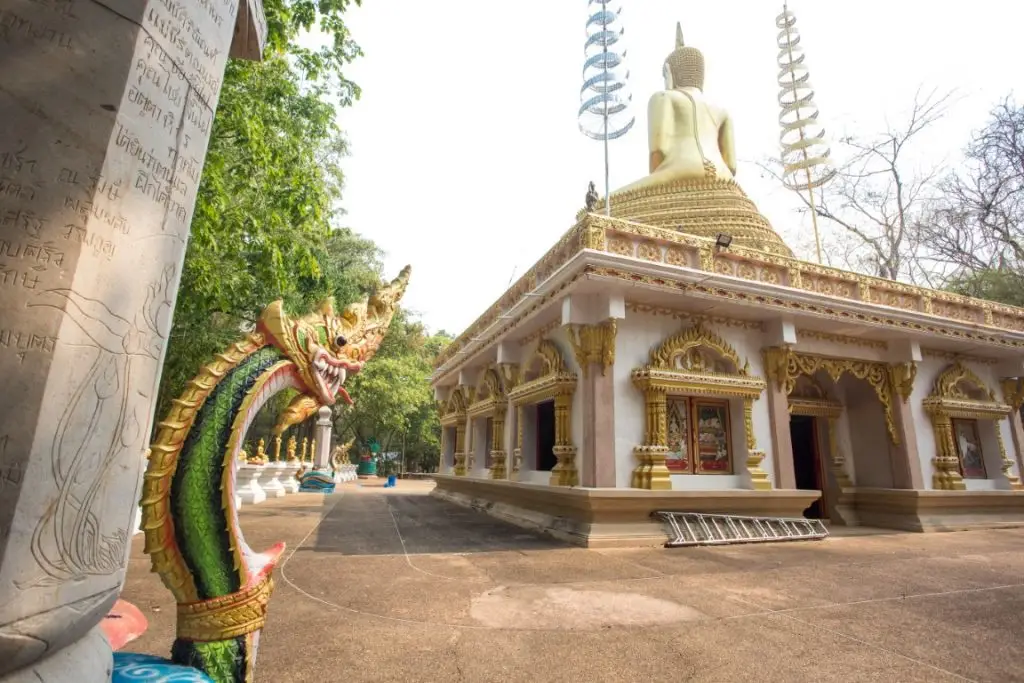
Wat Pa Utthayan
Open Days: Daily
Opening Hours: 08.00 – 17.00
Wat Pa Utthayan in Roi Et is located at 247 Ban Du Fai Yai, Moo 4, Nong Khaen Subdistrict, Pathum Rat District, Roi Et Province. It is a local Buddhist temple under the Maha Nikaya order and an important spiritual site for the Ban Du Fai Yai community. The temple is best known for its large golden Buddha image, inside which sacred relics of the Buddha are enshrined. This makes Wat Pa Utthayan a meaningful destination for Buddhist worship, merit-making, meditation, and cultural travel in the rural area of Pathum Rat District.
The temple has a calm and simple atmosphere associated with forest temples in northeastern Thailand. Although its large Buddha image is the main visual and devotional highlight, the temple is not a crowded urban attraction. Its value lies in quiet faith, open temple grounds, monastic life, and the relationship between monks and the local community. Visitors who come to Wat Pa Utthayan should expect a peaceful religious environment rather than a commercial sightseeing complex.
Temple history records that Wat Pa Utthayan was established in 1930. Its former name was Wat Pa Nong Phueng. This name came from the old landscape of the area, where a small pond was located near the temple site and the surrounding area was once dense forest. Over time, the temple developed from a forested local worship area into a more established Buddhist temple. The later name Wat Pa Utthayan suggests a peaceful spiritual park or forest-like place suitable for Dhamma practice.
The change from Wat Pa Nong Phueng to Wat Pa Utthayan reflects the development of the temple and the community. Many temples in Isan began in forested or semi-rural areas near villages. Through the faith of monks and laypeople, these places gradually became centers of worship, ceremony, meditation, and community identity. Wat Pa Utthayan belongs to this pattern. It grew from a natural landscape into a religious center for Ban Du Fai Yai and nearby villages.
The temple land covers 53 rai, 1 ngan, and 90 square wah, with 2 additional plots of monastic land totaling more than 8 rai. This gives the temple enough space for the ubosot, sermon hall, monks’ residences, vihara, Buddha-image courtyard, meditation areas, and community activity spaces. The access road is located on the northern side of the temple area. The large compound allows visitors to walk calmly through the temple and experience a sense of openness not often found in dense urban temples.
The most important feature of Wat Pa Utthayan is the large Buddha image that enshrines sacred relics of the Buddha. The image stands prominently on a raised base and forms the central focus of worship. Visitors usually begin by paying respect to this Buddha image, offering flowers or incense, and making a wish for auspiciousness. The presence of sacred relics inside the image gives the site deeper religious meaning and makes the Buddha image more than a visual landmark.
In Buddhist belief, relics of the Buddha are among the most revered sacred objects. They remind devotees of the historical Buddha and the continuing presence of the Dhamma. When sacred relics are enshrined inside a Buddha image, worshippers are invited to remember both the image and the relics as symbols of faith, wisdom, compassion, and liberation. At Wat Pa Utthayan, this makes the act of worship especially meaningful.
In 2006, sacred relics bestowed by Somdet Phra Nyanasamvara, the former Supreme Patriarch of Thailand, were enshrined at the temple as an auspicious blessing. This event strengthened the temple’s spiritual importance. For local people, the relics became a powerful center of faith. For visitors, they explain why the temple is respected beyond its immediate village setting and why the large Buddha image is treated with special reverence.
Wat Pa Utthayan also includes other worship and activity areas, such as the ubosot, vihara, sermon hall, monks’ residences, merit-making area, and meditation spaces. These areas show that the temple is an active Buddhist monastery. It is not only a place built around one statue. Monks live here, ceremonies are performed, laypeople make merit, and the temple continues to support Buddhist life in the surrounding community.
The ubosot is the sacred monastic ceremony hall of the temple. It is used for formal Buddhist rites according to monastic discipline. The sermon hall supports Dhamma listening, merit-making, community gatherings, and temple ceremonies. Monks’ residences support daily monastic life. The vihara and Buddha-image areas provide places for laypeople to worship. Together, these zones make Wat Pa Utthayan a complete religious compound rather than a single shrine.
The current abbot of Wat Pa Utthayan is Phra Khru Sunthon Wanaphirom. The temple has about 6 resident monks. This is important because it means Wat Pa Utthayan remains a living temple. Visitors are not entering an abandoned heritage site or a purely symbolic attraction. They are entering a working Buddhist monastery where monks maintain daily practice and local people continue to support the temple through food offerings, merit-making, and Buddhist ceremonies.
The presence of resident monks gives the temple its living character. In Thai rural communities, a temple survives through the cooperation between monks and villagers. Laypeople bring offerings, join ceremonies, help maintain the temple, and support religious activities. Monks chant, teach, perform rites, and serve as spiritual guides. Wat Pa Utthayan continues this local Buddhist relationship in Ban Du Fai Yai.
Wat Pa Utthayan is also connected with Kathin and other communal merit-making activities. Kathin is one of the most important Buddhist ceremonies after the end of the Buddhist Lent. Devotees gather to offer robes and donations to the monks, and the funds are often used to maintain temple buildings and religious activities. At a community temple such as Wat Pa Utthayan, Kathin is also a way for families, villagers, and returning residents to renew their connection with the temple.
The role of the temple in Ban Du Fai Yai is wide. It is a place for Buddhist holy days, alms-giving, robe offerings, Dhamma listening, meditation, funerals, local ceremonies, and community gatherings. For elderly residents, the temple offers peace and spiritual support. For children and young people, it is a place to learn Buddhist values and community manners. For visitors, it is a window into how Buddhism works in everyday rural life.
Wat Pa Utthayan is also valuable as a rural pilgrimage stop outside Roi Et city. Many visitors know Roi Et through central landmarks such as Bueng Phlan Chai, Ho Wot 101 Tower, Wat Buraphaphiram, and Roi Et National Museum. Wat Pa Utthayan offers a different experience. It takes visitors into Pathum Rat District, where the landscape, communities, and temple life are quieter and more rural. This contrast helps travelers understand Roi Et beyond the city center.
Pathum Rat District lies in the broader cultural landscape of the Thung Kula Rong Hai area. The district name is connected with the lotus: pathum means lotus, while rat is linked with red. This meaning relates to Bua Daeng, an important local name in the district. A visit to Wat Pa Utthayan therefore connects Buddhist faith with the rural identity of Pathum Rat, where temple life, agriculture, community craft, and local routes are closely connected.
The area around Nong Khaen and Ban Du Fai Yai is suitable for slow travel. It is not a place for hurried sightseeing. Visitors should come to pay respect, sit quietly, observe the temple layout, and experience the atmosphere of a rural Buddhist community. Private car travel is the most convenient way to reach the temple because local public transport may be limited. A hired vehicle also allows visitors to combine the temple with nearby villages, OTOP craft groups, or other attractions in the district.
The large Buddha image is the visual heart of the temple. The image rises above its decorated base and creates a strong sense of sacred presence. Visitors should approach it respectfully, remove shoes where appropriate, and avoid climbing or touching sacred elements improperly. The best way to experience the site is to spend time quietly in front of the image and reflect on the meaning of the relics enshrined within.
Wat Pa Utthayan is suitable for elderly visitors, families, local pilgrims, and travelers interested in Buddhist culture. Elderly visitors can make merit and pay respect in a calm environment. Families can teach children about Buddha images and sacred relics. Cultural travelers can observe the relationship between a forest-style temple and a rural Isan community. The temple offers a slower and more contemplative experience than many city attractions.
The sacred relics inside the Buddha image also make the temple useful for learning about relic worship in Buddhism. Relics are not viewed simply as objects. They are reminders of the Buddha, his teachings, and the continuing power of faith. Worshippers often approach relics with humility, gratitude, and a wish to live more wisely. At Wat Pa Utthayan, the relics help connect personal devotion with the broader Buddhist tradition.
Group visitors can include Wat Pa Utthayan in a wider Pathum Rat cultural route. Possible related stops include Ban Samran in Nong Khaen Subdistrict, local OTOP craft groups in Non Sawan Subdistrict, the silk-weaving group of Ban Bak Tu, the bamboo sticky-rice basket group of Ban Som Hong, and wider Roi Et sites such as Thung Kula Rong Hai, Ku Ka Sing, Wat Prachakhom Wanaram, Bueng Phlan Chai, and Ho Wot 101 Tower. This creates a route that combines faith, community craft, rural landscape, and city landmarks.
During important Buddhist days such as Magha Puja, Visakha Puja, Asalha Puja, Buddhist Lent, the end of Lent, Kathin season, and robe-offering events, the temple may have more worshippers than usual. These times allow visitors to see the temple’s community role clearly. However, visitors should allow extra time, remain quiet during ceremonies, and respect areas reserved for monks and local participants.
Getting There from Roi Et city requires traveling toward Pathum Rat District, then continuing to Nong Khaen Subdistrict and Ban Du Fai Yai. The distance from Roi Et city to Pathum Rat District is about 66 kilometers, and visitors then continue on local roads to the temple. Private car travel is the most convenient option. Visitors without a car can travel to Pathum Rat town area and then use hired local transport to reach the temple.
Because the temple is in a rural area, visitors should plan transportation carefully. Local transport may not run frequently, especially for return trips. Families and small groups should consider arranging a vehicle from Roi Et city or from Pathum Rat District. This allows better control of time and makes it easier to visit nearby sites or stop for meals and accommodation in Bua Daeng or other parts of Pathum Rat.
The temple is open daily from 08.00 to 17.00. Morning and early afternoon are the best times to visit because the weather is usually more comfortable and the temple atmosphere is calm. A basic visit may take 45 minutes to 1 hour. Visitors who want to sit quietly, meditate, or take more time around the Buddha-image area should allow longer and avoid disturbing monks or worshippers.
There is no confirmed ticketed admission system for Wat Pa Utthayan. Visitors can enter during opening hours, pay respect, walk around the main areas, and make donations according to personal faith. Visitors should dress respectfully, speak quietly, avoid inappropriate contact with sacred structures, keep the temple clean, and avoid entering monks’ residence areas without permission.
For families, Wat Pa Utthayan can serve as a meaningful outdoor classroom. Children can learn what sacred relics are, why Buddha images are respected, how a forest-style temple differs from an urban temple, and why villagers support temples through merit-making. Learning in the actual temple environment helps children understand Buddhism as a living practice rather than only as an idea in books.
For foreign travelers, Wat Pa Utthayan is a strong example of a rural Thai Buddhist temple centered on relic worship and community faith. The temple shows that Buddhism in Thailand is not only represented by famous royal temples or city landmarks. It also lives in local monasteries, where monks, villagers, Buddha images, sacred relics, and merit-making traditions continue to shape daily life.
Overall, Wat Pa Utthayan in Roi Et is an important Buddhist site in Pathum Rat District. Its main highlights are the large golden Buddha image, the sacred relics enshrined within the image, its former name Wat Pa Nong Phueng, its establishment in 1930, its spacious temple grounds of more than 53 rai, its peaceful forest-temple atmosphere, and the leadership of Phra Khru Sunthon Wanaphirom as abbot. The temple tells the story of Roi Et through faith, relic worship, rural temple life, and the devotion of the Ban Du Fai Yai community.
| Name | Wat Pa Utthayan, Roi Et |
| Former Name | Wat Pa Nong Phueng |
| Temple Type | Local Buddhist Temple, Maha Nikaya Order, And Worship Site For A Large Buddha Image Enshrining Sacred Relics |
| Location | Ban Du Fai Yai, Moo 4, Nong Khaen Subdistrict, Pathum Rat District, Roi Et Province |
| Address | 247 Ban Du Fai Yai, Moo 4, Nong Khaen Subdistrict, Pathum Rat District, Roi Et 45190, Thailand |
| Highlights | Large golden Buddha image enshrining sacred relics of the Buddha, peaceful forest-temple atmosphere, meditation areas, and the temple’s role as a spiritual center of Ban Du Fai Yai community |
| History | Established in 1930. The temple was formerly known as Wat Pa Nong Phueng because the original area had a small pond nearby and was surrounded by dense forest. It later developed into Wat Pa Utthayan, an important Buddhist site in Nong Khaen Subdistrict. |
| Temple Area | 53 rai, 1 ngan, and 90 square wah, with 2 additional monastic land plots totaling more than 8 rai |
| Important Buddha Image | Large Buddha image enshrining sacred relics of the Buddha, revered by Buddhist devotees |
| Sacred Relics | Sacred relics were enshrined in 2006. They were bestowed by Somdet Phra Nyanasamvara, the former Supreme Patriarch of Thailand, as an auspicious blessing for the temple. |
| Religious Importance | A worship site for the large Buddha image and sacred relics, used for Buddhist ceremonies, Kathin, robe offerings, alms-giving, merit-making, meditation, and community religious activities |
| Travel Information | From Roi Et city, travel toward Pathum Rat District, then continue to Nong Khaen Subdistrict and Ban Du Fai Yai. The distance from Roi Et city to the Pathum Rat area is about 66 km, followed by local roads to the temple. |
| Current Status | Open as a local Buddhist temple, worship site for the large Buddha image, meditation place, and spiritual center of Ban Du Fai Yai, Nong Khaen Subdistrict |
| Open Days | Daily |
| Opening Hours | 08.00 – 17.00 |
| Facilities | Temple courtyard, parking area, large Buddha-image worship area, ubosot, sermon hall, vihara, monks’ residences, merit-making area, meditation area, and northern access road |
| Main Areas / Zones | 1. Large Buddha Image Courtyard 2. Worship Base For The Buddha Image And Sacred Relics 3. Ubosot And Monastic Ceremony Area 4. Sermon Hall 5. Vihara And Worship Area 6. Monks’ Residence Area 7. Merit-Making And Offering Area 8. Meditation And Dhamma Practice Area 9. Northern Entrance Route 10. Ban Du Fai Yai Community Area Around The Temple |
| Related Traditions / Activities | Kathin ceremony, robe-offering events, Buddhist holy day merit-making, alms-giving, offerings to monks, meditation, and community Buddhist activities |
| Caretaker / Responsible Body | Wat Pa Utthayan, Nong Khaen Subdistrict, Pathum Rat District, Roi Et Province, Maha Nikaya Order |
| Abbot | Phra Khru Sunthon Wanaphirom |
| Resident Monks | About 6 monks |
| Nearby Tourist Attractions | 1. Ban Du Fai Yai Community Around The Temple, about 0 km 2. Ban Samran, Nong Khaen Subdistrict, about 6 km 3. Ban Bak Tu Silk-Weaving Group, Non Sawan Subdistrict, about 13 km 4. Ban Som Hong Bamboo Sticky-Rice Basket Group, Non Sawan Subdistrict, about 15 km, Tel. 043-030495 5. Pathum Rat District Office / Bua Daeng Area, about 12 km, Tel. 043-587353 6. Thung Kula Rong Hai, Pathum Rat Area, about 25 km 7. Ku Ka Sing, Kaset Wisai District, about 45 km 8. Wat Prachakhom Wanaram / Wat Pa Kung, Si Somdet District, about 55 km 9. Bueng Phlan Chai, Mueang Roi Et District, about 70 km 10. Ho Wot 101 Tower, about 70 km, Tel. 043-514100, 095-2244101 |
| Nearby Restaurants | 1. Jungle Cafe Pathum Rat Branch, Bua Daeng Subdistrict, about 12 km, Tel. 099-032-2633 2. Im Oun Na Cup, Pathum Rat District, about 12 km, Tel. 081-827-5592 3. Lamphu Nuea Yang Pathum Rat Branch, Bua Daeng Subdistrict, about 12 km, Tel. 087-433-0597 4. Khita Cafe Pathum Rat, opposite Bangchak Station in the district area, about 13 km 5. Restaurants And Cafes In Bua Daeng, Pathum Rat District, about 12 km 6. Restaurants In Kaset Wisai District Area, about 35 km |
| Nearby Accommodations | 1. Dan Sawan Park View / Dan Sawan Resort, Nong Khaen Subdistrict, about 8 km, Tel. 085-747-7639, 090-519-0079 2. Dara 2 Hotel, Bua Daeng Subdistrict, about 12 km, Tel. 063-047-3221 3. Ruean Champa Garden Resort, Bua Daeng Subdistrict, about 13 km, Tel. 087-944-8819, 093-537-9755 4. Parichat Luck Resort, Khi Lek Subdistrict, about 18 km, Tel. 043-030-362 5. Khao Thip Resort, Non Sawan Subdistrict, about 16 km, Tel. 089-863-5982 6. Fa Sai Resort, Non Sawan Subdistrict, about 16 km, Tel. 086-252-6286 7. Phra Chan Resort, Bua Daeng Subdistrict, about 12 km, Tel. 080-816-7155 |
Frequently Asked Questions (FAQ)
Q: Where is Wat Pa Utthayan located?
A: Wat Pa Utthayan is located at 247 Ban Du Fai Yai, Moo 4, Nong Khaen Subdistrict, Pathum Rat District, Roi Et 45190, Thailand, about 66–70 km from Roi Et city by road.
Q: What are the opening days and hours?
A: The temple is open daily from 08.00 to 17.00.
Q: Is there an admission fee?
A: There is no confirmed ticketed admission system. Visitors can enter the temple, worship, and walk around the main areas during opening hours. Merit-making can be done according to personal faith.
Q: What is the main highlight of Wat Pa Utthayan?
A: The main highlight is the large golden Buddha image that enshrines sacred relics of the Buddha inside the image. It is widely respected by Buddhist devotees.
Q: What was the former name of Wat Pa Utthayan?
A: The temple was formerly known as Wat Pa Nong Phueng because the original area had a small pond nearby and was once surrounded by dense forest.
Q: Who is the abbot of Wat Pa Utthayan?
A: The abbot of Wat Pa Utthayan is Phra Khru Sunthon Wanaphirom.
Q: What areas should visitors see inside the temple?
A: Important areas include the large Buddha image courtyard, worship base for the sacred relics, ubosot, sermon hall, vihara, merit-making area, monks’ residence area, and meditation area.
Q: What nearby attractions can be combined with a visit?
A: Nearby places include Ban Samran in Nong Khaen Subdistrict, Ban Bak Tu silk-weaving group, Ban Som Hong bamboo craft group, Thung Kula Rong Hai, Ku Ka Sing, Wat Prachakhom Wanaram, Bueng Phlan Chai, and Ho Wot 101 Tower.
 Category: ●Places of Worship
 Group: ●Temple
Last Update : 4 WeekAgo
 Last Update : 4 WeekAgo
 Click to Access the Navigation Map GPS
 Art, Culture and Heritage
 Historical Sites and Monuments(3)
 Landmarks and Memorials(5)
 Art, Craft Centres, Tradition(2)
 Museums(1)
 Educational Places
 Educational Gardens, Farm(3)
Temple(35)
Educational Gardens, Farm(3)
Temple(35)
 Other Sacred Sites(6)
 Suburban Living
 Village, Community(1)
 Local Market(1)
 Nature and Wildlife
 National Parks and Marine Reserves(1)
 Mountain (Doi)(2)
 Dam, Reservoir, Lake(8)
 Waterfalls(1)
 Flower Field(1)
 River, Canal(4)
 Entertainment and Agricultural
 Zoos and Aquariums(1)
 Stadium(1)
 Farms, Parks and Ecotourism(5)
 Shopping
 Shopping and Night Market(1)


