
lovethailand home >Northeastern Travel Attractions >Roi Et Travel Attractions >Muang Roi Et >Nai Muang > Wat Bueng Phra Lan Chai
TL;DR: Wat Bueng Phra Lan Chai is located at Pracha Tham Rak Road, Nai Mueang Subdistrict, Mueang Roi Et District, Roi Et Province, open Daily, hours 08.00 – 17.00.
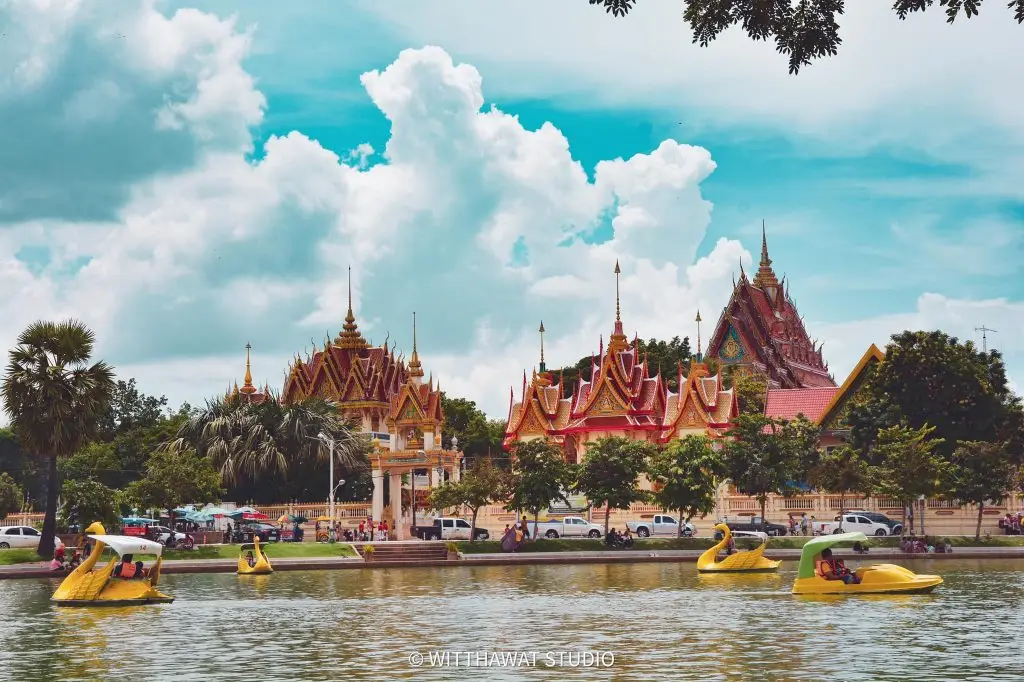
Wat Bueng Phra Lan Chai
Open Days: Daily
Opening Hours: 08.00 – 17.00
Wat Bueng Phra Lan Chai in Roi Et is an old royal Buddhist temple located at 116 Pracha Tham Rak Road in Nai Mueang Subdistrict, Mueang Roi Et District, Roi Et Province. It stands in the historic heart of Roi Et city, close to Bueng Phlan Chai, Ho Wot 101 Tower, Roi Et National Museum, Wat Klang Ming Mueang, Wat Buraphaphiram, and Wat Sra Thong. For foreign travelers, this temple is one of the most meaningful places to understand Roi Et because it connects Buddhism, sacred water, ancient boundary stones, royal ceremonies, civic rituals, monastic education, and the memory of the old city in one compact urban temple landscape.
The temple is locally known as Wat Bueng, meaning the temple by the pond or lake. This short local name reflects its relationship with Bueng Phlan Chai and with Sra Chai Mongkhon, the sacred pond inside the temple. Wat Bueng Phra Lan Chai is not a temple whose importance comes mainly from a giant Buddha image or a highly decorative building. Its deepest value comes from its ceremonial history, sacred water, ancient remains, and continuing role as a religious and educational center for Roi Et.
Wat Bueng Phra Lan Chai is a third-class royal temple of ordinary type under the Dhammayut order. It was re-established as a temple in 1775 and received its consecrated boundary in 1921. The temple’s long history places it among the important Buddhist sites of Roi Et. It is a living monastery, not a museum. Monks reside here, Buddhist ceremonies are performed, visitors come to pay respect, and the temple continues to serve as a spiritual and civic space in the city.
The temple’s modern historical story begins in 1775, when Phraya Khattiya Wongsa (Thon), the ruler of Roi Et, invited officials, merchants, and local people to clear an overgrown area filled with ruins and restore it as a Buddhist temple. The restored temple was named Wat Bueng Phra Lan Chai. This act of restoration was more than a religious project. It symbolized the recovery of a sacred space, the organization of community life, and the rebuilding of civic identity in Roi Et.
In 1887, Luang Songkran Wisit, with the support of Phraya Khattiya Wongsa (Phao Thon Silangkun), led officials, soldiers, police, merchants, residents, and prisoners to restore the ancient temple area again. This second major restoration helped revive the temple as a functioning religious site and reinforced its role as a sacred place of the city. The long support from local rulers, governors, and provincial authorities shows that the temple has always been connected with the civic structure of Roi Et.
The name Wat Bueng Phra Lan Chai carries several layers of meaning. Bueng refers to the lake or water landscape near the temple. Phra Lan suggests a sacred ceremonial ground. Chai means victory or auspicious success. The name therefore reflects the temple’s relationship with water, ritual space, and victory. Local tradition connects the area with ceremonies performed after victory in warfare, making the temple a place where Buddhism, civic memory, and old royal or provincial ceremonies overlap.
The most important feature of the temple is Sra Chai Mongkhon, the sacred pond inside the temple grounds. It is a natural square pond about 25 meters wide, 25 meters long, and about 5 meters deep. Local people have long regarded this pond as a sacred water source of Roi Et. Water from Sra Chai Mongkhon has been used in auspicious ceremonies, official rites, and sacred water ceremonies. This makes the pond one of the most important symbolic features of the temple.
Sra Chai Mongkhon is important because it connects water with faith, loyalty, and civic duty. In the past, the pond was associated with the Ceremony of Drinking the Water of Allegiance, a ritual in which rulers, officials, and people in positions of responsibility swore loyalty and honesty. In that context, water was not merely water. It became a sacred medium of truth, public duty, moral conduct, and loyalty to the city.
The sacred role of Sra Chai Mongkhon continues in the present. The water source has been used in provincial sacred water ceremonies for important national occasions. The Ho Phra Trai Ming Mueang, located in the middle of the pond, stands at the point where local belief holds that water rises from underground. This central position makes the pond and the tower the ritual heart of the temple. Visitors should understand this area as one of Roi Et’s most important sacred water landscapes.
Ho Phra Trai Ming Mueang is another major feature of the temple. It stands in the middle of Sra Chai Mongkhon and connects the sacred pond with Buddhist learning, sacred objects, and ceremonial practice. Inside the tower, a sacred Buddhist water vessel is enshrined on the first level, while an Emerald Buddha image is enshrined on the third level. The building therefore functions as a symbolic bridge between water, scripture, sacred images, and the spiritual identity of Roi Et.
The temple also preserves ancient evidence, including Dvaravati-period boundary stones and laterite remains associated with ancient cultural networks in northeastern Thailand. These objects show that the area has religious and cultural importance reaching back before the modern city. Boundary stones are especially meaningful in Buddhist culture because they mark sacred space. Their presence at Wat Bueng Phra Lan Chai suggests deep historical continuity and helps connect present-day Roi Et with ancient Buddhist communities in the region.
The Dvaravati boundary stones are particularly important because they show that Buddhist sacred space existed in the area long before the temple’s documented restoration in 1775. These stones are not simply old objects. They are evidence of ritual practice, early Buddhist culture, and the marking of sacred ground. For travelers interested in archaeology, they provide a rare local connection between Roi Et and the wider history of Buddhism in northeastern Thailand.
The ubosot, or ordination hall, is the main monastic ceremony building of the temple. The older ubosot was damaged by a severe storm and could not be restored in its original condition, so a new ordination hall was built on the same sacred ground. The new building was completed in 2005 after a long period of construction. It continues to serve as the temple’s main site for monastic rites and Buddhist ceremonies. Inside is a Buddha image in the posture of subduing Mara as the principal image.
The present ubosot reflects continuity rather than replacement. Although the earlier structure was lost, the sacred function of the space continues. The building has Thai architectural features such as tiered roofs and traditional decorative elements, appropriate for a royal temple. It is used for monastic ceremonies and for important Buddhist occasions of the community. Visitors should see it as a living religious building, not only as architecture.
Inside and around the ubosot, the temple’s Buddhist storytelling connects with the wider Isan tradition of the Vessantara Jataka and Bun Phawet. The story of Prince Vessantara is central to the Mahachat tradition, which remains strongly associated with Roi Et and Isan culture. This connection between Buddhist narrative and local tradition shows that Wat Bueng Phra Lan Chai is not only a ceremonial temple, but also a place where religious teaching and local culture meet.
Wat Bueng Phra Lan Chai has long been a center of education. It is associated with the origin of Buddhist scriptural education in both Dhamma and Pali studies in Roi Et. The temple has served monks, novices, and students who study Buddhist doctrine, monastic discipline, language, and religious knowledge. This educational role is essential to understanding Thai temples. A temple is not only a place of worship; it has historically been a school, a library, a training center, and a moral institution.
The temple is also connected with early Thai-language education, vocational learning, and traditional medicine in Roi Et. Before modern schools became widespread, temples often served as community learning spaces where people gained literacy, moral instruction, professional skills, and medical knowledge. Wat Bueng Phra Lan Chai is part of that history. Its educational role helps explain why the temple is important not only to monks, but also to the wider society of the province.
The temple also served as a regional center for training Buddhist preachers in northeastern Thailand and as a youth training center for Roi Et. These roles show the temple’s importance in spreading Buddhist knowledge and strengthening moral education. A Buddhist preacher must be able to explain Dhamma clearly to ordinary people, while youth training helps transmit discipline, ethics, and cultural awareness to younger generations. This makes the temple a living center of religious communication.
Wat Bueng Phra Lan Chai is also a mental and spiritual development center for Roi Et. People come here to make merit, listen to Dhamma, join ceremonies, practice calmness, and find emotional refuge in the city. This living spiritual role is important. Although the temple is historically old, it is not frozen in the past. It continues to support daily religious life, community identity, and the spiritual needs of local people.
The temple has been used for official provincial ceremonies across many periods. Its connection with sacred water, the Water of Allegiance ceremony, and public rites shows the close relationship between Buddhism and civic life in Thailand. Wat Bueng Phra Lan Chai is therefore a meeting point between monastery and state, between religious belief and civic duty, and between local faith and formal ceremony.
Visitors can understand the temple by walking through its main areas in sequence. The ubosot represents monastic and Buddhist ceremony. Sra Chai Mongkhon represents sacred water and civic ritual. Ho Phra Trai Ming Mueang represents Buddhist learning and sacred objects. The Dvaravati boundary stones and laterite remains represent archaeological memory. The educational areas represent the temple’s role as a learning center. Together, these parts make the temple one of the most layered cultural sites in central Roi Et.
A meaningful visit can begin at the ubosot, where visitors can pay respect to the principal Buddha image. From there, they can continue to Sra Chai Mongkhon and Ho Phra Trai Ming Mueang to understand the sacred water tradition. Visitors should then observe the ancient boundary stones and laterite evidence with care, recognizing their value as fragile historical objects. Finally, walking through the temple courtyard and education areas helps reveal the temple’s continuing life as a monastery.
What makes Wat Bueng Phra Lan Chai different from other temples in Roi Et city is its sacred water identity. Wat Klang Ming Mueang is known for its old ubosot and murals. Wat Buraphaphiram is known for Luang Pho Yai. Wat Sra Thong is known for Luang Pho Phra Sangkachai. Wat Bueng Phra Lan Chai is known for Sra Chai Mongkhon, the Water of Allegiance tradition, ancient boundary stones, and Buddhist education. Together, these temples form a strong cultural route through Roi Et city.
For travelers who want to understand Roi Et deeply, Wat Bueng Phra Lan Chai should be included in a city itinerary with Bueng Phlan Chai, Ho Wot 101 Tower, Roi Et National Museum, Wat Klang Ming Mueang, Wat Buraphaphiram, and Wat Sra Thong. These places are close to one another and tell different parts of the city’s story. Visiting Wat Bueng Phra Lan Chai first helps visitors understand the sacred water and ritual foundation of Roi Et before continuing to other historic and modern landmarks.
The best time to visit is in the morning or early afternoon, when the weather is more comfortable for walking around the temple grounds and viewing Sra Chai Mongkhon. The temple is open daily from 08.00 to 17.00. Morning visits are especially suitable for combining the temple with Bueng Phlan Chai and Roi Et National Museum, while afternoon visits can be combined with Ho Wot 101 Tower or Wat Buraphaphiram.
There is no admission fee to visit Wat Bueng Phra Lan Chai. Visitors can enter the temple, pay respect to the principal Buddha image, view Sra Chai Mongkhon, and walk around the main temple areas during opening hours. Donations and merit-making can be made according to personal faith at the areas arranged by the temple. This keeps the temple accessible to both local residents and visitors.
Getting There is easy because the temple is located in Roi Et city on Pracha Tham Rak Road, close to Bueng Phlan Chai and Ho Wot 101 Tower. Visitors with private cars can navigate directly to Wat Bueng Phra Lan Chai or use Bueng Phlan Chai as a nearby reference point. Travelers arriving at Roi Et Bus Terminal can continue by tuk-tuk, local taxi, songthaew, or other local city transport.
The area around the temple has restaurants, cafés, hotels, and several city attractions. Visitors can worship at the temple in the morning, have a meal near Bueng Phlan Chai, then continue to Roi Et National Museum, Wat Klang Ming Mueang, Wat Buraphaphiram, or Ho Wot 101 Tower. Staying near Bueng Phlan Chai, Charoen Phanit Road, Hai Sok Road, or the bus terminal area is convenient for travelers who want to explore Roi Et city temples and landmarks.
Visitors should dress respectfully and behave quietly because the temple is an active Buddhist monastery and a place of sacred water. They should not touch boundary stones, laterite remains, sacred objects, or old structures unnecessarily. The area around Sra Chai Mongkhon should be treated with care because it is deeply meaningful to Roi Et people and remains connected with important ceremonies.
For families and students, Wat Bueng Phra Lan Chai is a valuable outdoor classroom. Children can learn what sacred water means, why boundary stones are important, how Buddhist education developed in temples, and how religious ceremonies were connected with civic loyalty. Learning at the actual site makes these topics easier to understand because history, water, architecture, and ritual can be seen in one place.
For foreign travelers, the temple explains a central idea about Thai and Isan culture: a temple can be a monastery, school, sacred water source, civic ceremony site, archaeological site, and community center at the same time. Wat Bueng Phra Lan Chai demonstrates all of these roles clearly. It allows visitors to understand Roi Et not only through attractions, but through the deeper cultural systems that shaped the city.
Overall, Wat Bueng Phra Lan Chai is one of the most important historic temples in Roi Et city. Its value comes from its royal temple status, Sra Chai Mongkhon sacred pond, Ho Phra Trai Ming Mueang, Water of Allegiance tradition, ancient Dvaravati boundary stones, laterite remains, ubosot, and long role in Buddhist education. For travelers who want to understand Roi Et through Buddhism, sacred water, civic ceremony, education, and local memory, this temple is an essential stop in the city center.
| Name | Wat Bueng Phra Lan Chai, Roi Et |
| Local Name | Wat Bueng |
| Temple Type | Third-Class Royal Temple, Ordinary Type, Dhammayut Order |
| Location | Pracha Tham Rak Road, Nai Mueang Subdistrict, Mueang Roi Et District, Roi Et Province |
| Address | 116 Pracha Tham Rak Road, Nai Mueang Subdistrict, Mueang Roi Et District, Roi Et 45000, Thailand |
| Highlights | Sra Chai Mongkhon sacred pond, Ho Phra Trai Ming Mueang, ubosot, Dvaravati boundary stones, ancient laterite remains, Water of Allegiance ceremony tradition, and the temple’s role as a Buddhist education center in Roi Et |
| History | Restored as a temple in 1775 by Phraya Khattiya Wongsa (Thon), the ruler of Roi Et. In 1887, Luang Songkran Wisit, supported by Phraya Khattiya Wongsa (Phao Thon Silangkun), restored the old temple again. The temple received its consecrated boundary in 1921. |
| Name Origin | The name is connected with a lake or pond landscape, a sacred ceremonial ground, and the idea of victory. Local people commonly call it Wat Bueng because of its close relationship with Bueng Phlan Chai and Sra Chai Mongkhon. |
| Important Sacred Objects | The principal Buddha image in the posture of subduing Mara, the Emerald Buddha image in Ho Phra Trai Ming Mueang, and the sacred Buddhist water vessel inside Ho Phra Trai Ming Mueang |
| Historical Importance | The temple is associated with official ceremonies across many periods, the Water of Allegiance ceremony, and the use of water from Sra Chai Mongkhon in sacred royal and provincial rites. |
| Archaeological Evidence | Ancient Dvaravati-period boundary stones, laterite remains, and traces of earlier Buddhist sacred space connected with ancient cultural networks in northeastern Thailand |
| Educational Role | A historic center of Buddhist scriptural education in Dhamma and Pali studies in Roi Et, connected with Thai-language learning, vocational learning, traditional medicine, preacher training, youth training, and mental development for the province |
| Travel Information | Located in Roi Et city on Pracha Tham Rak Road near Bueng Phlan Chai and Ho Wot 101 Tower. Visitors can travel by private car, tuk-tuk, local taxi, songthaew, or city transport from Roi Et Bus Terminal. |
| Current Status | Open as a royal temple, sacred water site, historic Buddhist learning center, and important ceremonial temple of Roi Et city |
| Open Days | Daily |
| Opening Hours | 08.00 – 17.00 |
| Admission Fee | Free Admission |
| Facilities | Ubosot, temple courtyard, Sra Chai Mongkhon sacred pond, Ho Phra Trai Ming Mueang, worship areas, merit-making areas, monks’ residences, Buddhist education areas, parking space, and nearby restaurants in central Roi Et |
| Main Areas / Zones | 1. Ubosot 2. Principal Buddha Image In The Posture Of Subduing Mara 3. Sra Chai Mongkhon Sacred Pond 4. Ho Phra Trai Ming Mueang 5. Sacred Buddhist Water Vessel 6. Emerald Buddha Image Inside Ho Phra Trai Ming Mueang 7. Dvaravati Boundary Stone Area 8. Ancient Laterite Remains Area 9. Buddhist Scriptural Education Area 10. Temple Courtyard And Religious Activity Area |
| Related Traditions / Activities | Water of Allegiance ceremony tradition, sacred water drawing from Sra Chai Mongkhon, provincial religious ceremonies, Buddhist merit-making, Buddhist scriptural education, youth training, preacher training, and community mental-development activities |
| Caretaker / Responsible Body | Wat Bueng Phra Lan Chai Royal Temple, Dhammayut Order |
| Abbot | Phra Phrom Wachira Sophon (Srichan Punnarat) |
| Main Contact Number | 043-511190 |
| Online Channel | Facebook: Wat Bueng Phra Lan Chai Royal Temple, Roi Et |
| Nearby Tourist Attractions | 1. Bueng Phlan Chai, about 0.1 km 2. Ho Wot 101 Tower, about 0.8 km, Tel. 043-511222 3. Somdet Phra Srinagarindra Park Roi Et, about 0.8 km 4. Roi Et City Pillar Shrine, about 1 km 5. Roi Et National Museum, about 1 km, Tel. 043-514456 Ext. 101 6. Wat Klang Ming Mueang, about 1 km, Tel. 043-512400 7. Wat Buraphaphiram, about 1.5 km, Tel. 043-511374 8. Wat Sra Thong, about 1.5 km |
| Nearby Restaurants | 1. Cozy Cafe’ & Bistro, about 0.2 km, Tel. 094-310-0504 2. Lakeview Restaurant, about 0.5 km, Tel. 093-320-8126 3. Sit Rim, about 0.8 km, Tel. 098-278-4482 4. Her Studio Roi Et, about 1 km, Tel. 083-871-0824 5. 4U For You, Phloen Chit Road, about 1 km, Tel. 065-649-1999 6. Nai Chui Vintage Pork Noodle, about 1 km |
| Nearby Accommodations | 1. Saket Nakhon Hotel, about 0.8 km, Tel. 043-511-741 2. Rueanrimnam Hotel, about 1 km, Tel. 043-518-967 3. The Premium Residence, about 1.5 km, Tel. 043-518-655 4. 101 Hotel, about 1.5 km, Tel. 043-513-999, 065-119-6999 5. HOP INN Roi Et, about 2 km, Tel. 02-080-2222 6. The Rice Hotel, about 3 km, Tel. 043-519-999 7. Le Park 23 Boutique Resort, about 3 km, Tel. 043-513-444 |
Frequently Asked Questions (FAQ)
Q: Where is Wat Bueng Phra Lan Chai located?
A: Wat Bueng Phra Lan Chai is located at 116 Pracha Tham Rak Road, Nai Mueang Subdistrict, Mueang Roi Et District, Roi Et 45000, Thailand. It is near Bueng Phlan Chai, Ho Wot 101 Tower, and the central Roi Et tourist area.
Q: What are the opening days and hours?
A: The temple is open daily from 08.00 to 17.00.
Q: Is there an admission fee?
A: There is no admission fee. Visitors can enter the temple, worship the principal Buddha image, view Sra Chai Mongkhon, Ho Phra Trai Ming Mueang, and the main temple areas during opening hours.
Q: Why is Wat Bueng Phra Lan Chai important?
A: It is an old royal temple of Roi Et with Sra Chai Mongkhon sacred pond, a connection to the Water of Allegiance ceremony, ancient Dvaravati boundary stones, laterite remains, and a major role in Buddhist scriptural education in the province.
Q: What is Sra Chai Mongkhon?
A: Sra Chai Mongkhon is the sacred pond inside Wat Bueng Phra Lan Chai. It is a natural square pond and an important sacred water source used in auspicious, official, and Buddhist water ceremonies of Roi Et.
Q: Who is the abbot of Wat Bueng Phra Lan Chai?
A: The abbot is Phra Phrom Wachira Sophon (Srichan Punnarat).
Q: What should visitors see inside the temple?
A: Important areas include the ubosot, principal Buddha image, Sra Chai Mongkhon sacred pond, Ho Phra Trai Ming Mueang, sacred Buddhist water vessel, Emerald Buddha image, ancient boundary stones, laterite remains, and Buddhist education areas.
Q: What nearby attractions can be combined with a visit?
A: Nearby places include Bueng Phlan Chai, Ho Wot 101 Tower, Somdet Phra Srinagarindra Park Roi Et, Roi Et City Pillar Shrine, Roi Et National Museum, Wat Klang Ming Mueang, Wat Buraphaphiram, and Wat Sra Thong.
Tel : 043511190
 Tel : 043511190
 Category: ●Places of Worship
 Group: ●Temple
Last Update : 4 WeekAgo
 Last Update : 4 WeekAgo
 Click to Access the Navigation Map GPS
Wat Bueng Phra Lan Chai Map
Recommend

 Art, Culture and Heritage
 Historical Sites and Monuments(3)
 Landmarks and Memorials(5)
 Art, Craft Centres, Tradition(2)
 Museums(1)
 Educational Places
 Educational Gardens, Farm(3)
Temple(35)
Educational Gardens, Farm(3)
Temple(35)
 Other Sacred Sites(6)
 Suburban Living
 Village, Community(1)
 Local Market(1)
 Nature and Wildlife
 National Parks and Marine Reserves(1)
 Mountain (Doi)(2)
 Dam, Reservoir, Lake(8)
 Waterfalls(1)
 Flower Field(1)
 River, Canal(4)
 Entertainment and Agricultural
 Zoos and Aquariums(1)
 Stadium(1)
 Farms, Parks and Ecotourism(5)
 Shopping
 Shopping and Night Market(1)


