
lovethailand home >Northeastern Travel Attractions >Nakhon Ratchasima Travel Attractions >Phi Mai >Samrit > Luang Por Dam Shrine
TL;DR: Luang Por Dam Shrine is located at Moo 2, Ban Samrit, Samrit Subdistrict, Phimai District, Nakhon Ratchasima Province 30110, open Daily, hours 08.00 – 17.00.
Luang Por Dam Shrine
Open Days: Daily
Opening Hours: 08.00 – 17.00
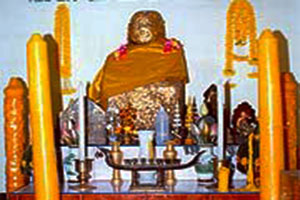
Luang Pho Kham Shrine in Nakhon Ratchasima is located in Moo 2, Ban Samrit, Samrit Subdistrict, Phimai District, Nakhon Ratchasima Province 30110. It is a small but meaningful local shrine connected with faith, village memory, and the cultural landscape of Phimai. The shrine is associated with a sandstone Buddha-image rough form discovered by villagers in a pond area. Local people originally called it Luang Pho It, but as worshippers covered the image with gold leaf over time, it became widely known as Luang Pho Thong Kham, or Luang Pho Kham. Today, the shrine remains a sacred place for people in Ban Samrit and for visitors who want to understand the quieter community-based side of Phimai.
The significance of Luang Pho Kham Shrine lies in the connection between a sacred object, local discovery, and continuing village devotion. The shrine once housed a Naga-protected Buddha image, a form of Buddha image deeply associated with protection, calmness, and sacred guardianship in Buddhist belief. Today, the surviving object is the sandstone rough form of a Buddha image found by villagers. Although the original Naga-protected Buddha image is no longer seen in complete form, the remaining sandstone image has become an important object of worship for the community.
What makes Luang Pho Kham Shrine different from larger temples or major historical parks is its direct connection with local people. The sandstone image was not brought from elsewhere as a display object. It was found in the village landscape itself, in the area of a pond. After its discovery, villagers recognized its sacred character and began to worship it. Over time, people applied gold leaf to the image as an act of devotion. This local practice transformed the image into the sacred Luang Pho Thong Kham remembered and respected today.
The name Luang Pho Kham is closely related to the idea of gold. In Thai Buddhist practice, applying gold leaf to a sacred image is an act of respect and merit-making. Each small sheet of gold leaf represents faith, gratitude, and a personal wish offered with a calm mind. As layers of gold leaf accumulated on the image, the visual identity of the Buddha image changed, and the name Luang Pho Thong Kham, meaning the golden venerable Buddha image, became part of the community’s shared memory.
Ban Samrit is an important community within the historical and cultural landscape of Nakhon Ratchasima. It is associated with Thung Samrit, local heroism, and the memory of Thao Suranari and Nang Sao Boonlua, also known as Ya Luea. Because Luang Pho Kham Shrine stands within this same community, it should not be seen only as a small local shrine. It belongs to a wider landscape of faith and history in Samrit Subdistrict, where village memory, sacred places, historical monuments, and community identity exist close together.
Phimai District is one of the most historically important districts of Nakhon Ratchasima. It is best known for Phimai Historical Park, a major ancient site connected with Khmer architecture and the cultural networks of the Mun River basin. The discovery of a sandstone Buddha-image rough form in Ban Samrit fits naturally within this broader context. The area around Phimai contains many historical layers, from major ancient monuments to smaller sacred objects cared for by local communities. Luang Pho Kham Shrine adds an intimate village-level dimension to this history.
A rough form of a Buddha image is an unfinished or partly formed image, often suggesting a stage in the process of creating a sacred object. A sandstone rough form can be meaningful both as a devotional object and as a cultural clue. It invites reflection on local artisanship, material, religious practice, and the possible movement of sacred objects in earlier periods. Although villagers called the image Luang Pho It, meaning the brick venerable image, local data identifies it as sandstone. The local name itself remains important because it reflects how villagers remembered and related to the sacred object.
Luang Pho It or Luang Pho Thong Kham therefore carries two kinds of value at once. First, it is a sacred object worshipped by villagers and visitors. Second, it is a cultural object that suggests a long relationship between Buddhism, stone sculpture, and the local landscape of Phimai. For visitors interested in local history, the shrine shows that Phimai’s past is not represented only by the famous stone sanctuary. It also survives in smaller community shrines and sacred objects protected by local devotion.
The shrine is best visited quietly and respectfully. Visitors can pay respect, apply gold leaf, pray, or spend a short period of time observing the atmosphere. It is not a large tourist attraction, and this is part of its value. The shrine preserves the feeling of a community sacred place rather than a commercial destination. Its modest setting allows visitors to experience local faith directly and see how a small shrine can hold deep meaning for the people who live nearby.
Worship at Luang Pho Kham Shrine is simple. Visitors may bring flowers, incense, candles, gold leaf, or other suitable offerings. Inside the shrine area, they should speak softly, move carefully, and avoid disturbing local worshippers. Gold leaf should be applied respectfully. Visitors should not touch the sacred image or other people’s offerings unnecessarily. Because Luang Pho Kham is strongly connected with local faith, polite behavior is an important part of the visit.
It is important to understand Luang Pho Kham Shrine as a community shrine, not a large commercial attraction. Visitors should observe the surrounding village landscape with respect, including the pond area, local houses, paths, and the worship space used by villagers. Entering with this attitude allows the visit to become more meaningful. It preserves the dignity of the shrine and shows respect for the community that has cared for Luang Pho Kham over time.
When connected with Samrit Subdistrict, Luang Pho Kham Shrine becomes part of a wider route of local history. Nearby places such as Thung Samrit Memorial and the Tambon Samrit Local Museum help visitors understand the historical memory of the community. Thung Samrit Memorial honors Nang Sao Boonlua, or Ya Luea, and the Korat heroes connected with the events of Thung Samrit. The museum presents local stories, tools, objects, and community memory. Together, these places make Samrit a meaningful cultural route.
The Tambon Samrit Local Museum is located in the same area as Thung Samrit Memorial. It collects and presents information about local life, historical memory, community objects, and the heritage of Samrit. A route beginning with Luang Pho Kham Shrine and continuing to the museum and memorial creates a good balance between faith and history. Visitors can first pay respect to Luang Pho Kham, then learn about Ya Luea, the heroes of Thung Samrit, and the way of life of the local community.
Visiting Luang Pho Kham Shrine is suitable for travelers who want to experience Phimai beyond its famous historical park. If Phimai Historical Park represents the grand scale of ancient civilization, Luang Pho Kham Shrine represents the intimate scale of village faith. Seeing both gives travelers a fuller understanding of Phimai as a district of ancient art, Buddhism, local memory, and living community traditions.
Getting There is easiest by private car. Visitors can search for Moo 2, Ban Samrit, Samrit Subdistrict, Phimai District, Nakhon Ratchasima 30110. From Nakhon Ratchasima city, take Mittraphap Road toward Khon Kaen, then turn into the local road leading to Ban Samrit. From Phimai town, travelers can drive toward Samrit Subdistrict and Ban Samrit. A private car is the most convenient option because it allows visitors to combine the shrine with Thung Samrit Memorial, Phimai Historical Park, Sai Ngam, and Phimai National Museum in the same day.
Travelers without a private car can first go to Phimai town or Nakhon Ratchasima city, then continue by local hired vehicle to Ban Samrit. Public transport in village areas may not run as frequently as in the city, so planning in advance is useful. For groups or cultural study trips, hiring a vehicle is the most practical choice because it allows several local sites to be visited efficiently.
The best time to visit is in the morning or late afternoon during the general opening hours of 08.00 to 17.00. Morning is suitable for worship before the weather becomes hot. Late afternoon is convenient for those continuing from Phimai or nearby attractions. During the hot season, visitors should prepare drinking water, a hat, or an umbrella because some village roads and open areas can be sunny.
A general visit to Luang Pho Kham Shrine usually takes about 20 to 40 minutes for worship, gold-leaf offering, and quiet observation. If the visit is combined with Thung Samrit Memorial and the Tambon Samrit Local Museum, visitors should allow at least 2 to 3 hours. A fuller route including Phimai Historical Park, Phimai National Museum, and Sai Ngam can take half a day to a full day.
For families, the shrine is a good place for children and young visitors to learn about local faith. The story of Luang Pho It and Luang Pho Thong Kham begins with the discovery of a sacred object in a village pond. This makes history and belief easier to understand because they are connected with a real place, a real community, and a story passed down by local people. Children can learn that history exists not only in museums or major archaeological parks, but also in small shrines protected by communities.
For visitors interested in art history or archaeology, the shrine invites attention to the material and form of the sandstone Buddha image. Although the image has been covered with gold leaf over time, it still reflects the importance of stone sacred images in the Phimai region. Small community objects like this help expand the picture of Buddhism and sacred art in northeastern Thailand beyond the most famous monuments.
If visitors continue to Phimai Historical Park, they will see a strong contrast between a major ancient monument and a village shrine. Phimai Historical Park contains large stone architecture, an ancient town plan, and formally restored structures. Luang Pho Kham Shrine is modest and community-based. Both are valuable in different ways. Together, they help visitors understand how the past remains present in both monumental heritage and everyday local devotion.
Food options around Phimai include local Thai restaurants, Isan food, noodle shops, cafés, bakeries, and well-known local dishes such as Phimai-style noodles. Visitors can stop for food in Phimai town after paying respect at the shrine or before continuing to the historical park. Many restaurants are located within a manageable driving distance from Ban Samrit and are suitable for a relaxed half-day or full-day route.
Accommodation for visitors to Luang Pho Kham Shrine is most convenient in Phimai town. The town has hotels, guest houses, and small local accommodations suitable for travelers who want to explore Phimai in depth. Staying in Phimai makes it easier to visit the historical park, Phimai National Museum, Sai Ngam, Thung Samrit Memorial, the Tambon Samrit Local Museum, and Luang Pho Kham Shrine without rushing.
Visitors should dress modestly, speak quietly, avoid climbing or touching sacred areas unnecessarily, and respect the shrine as a local place of worship. Photography should be done carefully. If local people are praying, visitors should keep distance and avoid taking close photographs without permission. The best visit is one that respects both the sacred image and the community that maintains the shrine.
Photography at the shrine should focus on the overall atmosphere, the worship space, and the relationship between the shrine and the village. Images should preserve the calm and modest character of the place. The most meaningful photographs are not dramatic tourist images, but quiet images that show how faith, memory, and everyday community life exist together in Ban Samrit.
Overall, Luang Pho Kham Shrine helps visitors understand Phimai and Samrit Subdistrict more deeply. Its highlights include Luang Pho It or Luang Pho Thong Kham, the sandstone Buddha-image rough form found in the local pond, the villagers’ devotion expressed through gold leaf, and its role as a sacred community shrine. The shrine is suitable for worship, local history learning, cultural travel, and a route connecting Samrit and Phimai’s wider historical attractions.
A visit to Luang Pho Kham Shrine is therefore more than a short stop at a village shrine. It is an encounter with the memory of Ban Samrit, where a sacred object, a pond, village houses, local devotion, and the history of Thung Samrit come together. The shrine’s beauty lies not in size or grandeur, but in the story, faith, and care that local people have preserved over time.
| Name | Luang Pho Kham Shrine, Nakhon Ratchasima |
| Location | Moo 2, Ban Samrit, Samrit Subdistrict, Phimai District, Nakhon Ratchasima Province 30110 |
| Address | Ban Samrit, Moo 2, Samrit Subdistrict, Phimai District, Nakhon Ratchasima Province 30110 |
| Highlights | Luang Pho It or Luang Pho Thong Kham, a sandstone Buddha-image rough form found by villagers in a pond and revered as a sacred object of Ban Samrit |
| History / Local Story | The shrine once housed a Naga-protected Buddha image. Today, the main sacred object is a sandstone Buddha-image rough form found by villagers in a pond. It was locally called Luang Pho It, then became known as Luang Pho Thong Kham or Luang Pho Kham after worshippers covered it with gold leaf |
| Name Origin | The name Luang Pho Kham is connected with the gold leaf applied to the sacred image, creating the local name Luang Pho Thong Kham |
| Distinctive Features | A compact community shrine with a sacred worship area for Luang Pho Kham and a local story connected with a sandstone Buddha image found in Ban Samrit |
| Important Sacred Object | Luang Pho Kham, also known as Luang Pho Thong Kham, the revered sandstone Buddha-image rough form of Ban Samrit |
| Travel Information | Private car is the most convenient option. Search for Moo 2, Ban Samrit, Samrit Subdistrict, Phimai District. From Nakhon Ratchasima city, travel along Mittraphap Road toward Khon Kaen and enter Samrit Subdistrict by local roads |
| Current Status | Open for worship and respectful visits as a sacred community shrine in Ban Samrit |
| Open Days | Daily |
| Opening Hours | 08.00 – 17.00 |
| Facilities | Worship area, offering area, front shrine space, community surroundings, and local routes connecting nearby cultural attractions in Samrit Subdistrict |
| Main Areas / Zones | Luang Pho Kham worship area, gold-leaf offering point, offering area, front shrine area, pond-related local story area, and Ban Samrit community surroundings |
| Caretaker | Ban Samrit community and local authorities in Samrit Subdistrict |
| Nearby Tourist Attractions | 1. Thung Samrit Memorial – about 3 km – Tel. 044-482900-1 2. Tambon Samrit Local Museum – about 3 km – Tel. 044-482900-1 3. Phimai Historical Park – about 16 km 4. Phimai National Museum – about 16 km – Tel. 044-471167 5. Sai Ngam, Phimai – about 18 km 6. Meru Phrommathat, Phimai – about 16 km |
| Nearby Restaurants | 1. Noi Som Tam Phimai – about 16 km – Tel. 083-365-7490 2. Krua Khun Pim By Chef Watch Phimai – about 16 km – Tel. 091-776-6198 3. Rakkan Bakery 1 – about 16 km – Tel. 065-584-8675 4. Burger Ban Ban Phimai – about 16 km – Tel. 085-258-1793 5. Riverside Restaurant Phimai – about 17 km |
| Nearby Accommodations | 1. Phimai Paradise Hotel – about 16 km – Tel. 044-287-565, 044-471-575 2. Rabbit Hotel Phimai – about 16 km – Tel. 081-202-2250 3. Benya Guest House – about 16 km – Tel. 081-976-2471 4. Phimai Inn Hotel – about 17 km 5. Phimai Hotel – about 16 km |
Frequently Asked Questions (FAQ)
Q: Where is Luang Pho Kham Shrine located?
A: Luang Pho Kham Shrine is located in Moo 2, Ban Samrit, Samrit Subdistrict, Phimai District, Nakhon Ratchasima Province 30110.
Q: What are the opening days and hours of Luang Pho Kham Shrine?
A: The shrine is open daily from 08.00 to 17.00.
Q: What is the main highlight of Luang Pho Kham Shrine?
A: The main highlight is Luang Pho Kham, also known as Luang Pho Thong Kham, a sandstone Buddha-image rough form found by villagers in a pond and later covered with gold leaf by worshippers.
Q: How are Luang Pho Kham and Luang Pho It connected?
A: Luang Pho It was the local name for the sandstone Buddha-image rough form found in the pond. After people applied gold leaf over the image, it became known as Luang Pho Thong Kham or Luang Pho Kham.
Q: How can travelers get to Luang Pho Kham Shrine?
A: The most convenient way is by private car. Travelers can search for Moo 2, Ban Samrit, Samrit Subdistrict, Phimai District. From Nakhon Ratchasima city, take Mittraphap Road toward Khon Kaen and enter Samrit Subdistrict by local roads.
Q: What nearby attractions can be combined with Luang Pho Kham Shrine?
A: Nearby attractions include Thung Samrit Memorial, Tambon Samrit Local Museum, Phimai Historical Park, Phimai National Museum, Sai Ngam, and Meru Phrommathat.
Q: How long should visitors spend at Luang Pho Kham Shrine?
A: A general visit for worship, gold-leaf offering, and quiet observation takes about 20 to 40 minutes. A route including Samrit and Phimai attractions can take half a day to a full day.
 Category: ●Places of Worship
 Group: ●Other Sacred Sites
Last Update : 1 MonthAgo
 Last Update : 1 MonthAgo
 Click to Access the Navigation Map GPS
Luang Por Dam Shrine Map
Recommend

 Art, Culture and Heritage
 Historical Sites and Monuments(20)
 Landmarks and Memorials(5)
 Art, Craft Centres, Tradition(7)
 Museums(6)
 Art Gallery(1)
 Educational Places
 Educational Gardens, Farm(4)
 Temple(29)
 Mosque(1)
Other Sacred Sites(6)
Mosque(1)
Other Sacred Sites(6)
 Research and Development
 Royal Project(3)
 Suburban Living
 Village, Community(6)
 Local Market(4)
 Floating Market(1)
 Nature and Wildlife
 National Parks and Marine Reserves(3)
 Mountain (Doi)(5)
 Dam, Reservoir, Lake(8)
 Waterfalls(9)
 Hot Springs(1)
 Caves(2)
 Flower Field(1)
 River, Canal(8)
 Bays and Beaches(2)
 Other natural attractions(3)
 Entertainment and Agricultural
 Zoos and Aquariums(1)
 Animal camps and shows(1)
 Farms, Parks and Ecotourism(21)
 Waterpark(2)
 Outdoor and Adventure Activities(6)
 Shopping
 Shopping and Night Market(2)
 Travel Articles, Recipes
 Travel Review, Food Review(5)


