
lovethailand home >Northeastern Travel Attractions >Kalasin Travel Attractions >Muang Kalasin >Kalasin > Wat Tai Pho Kham
TL;DR: Wat Tai Pho Kham is located at Kalasin Subdistrict, Mueang Kalasin District, Kalasin Province, open Daily, hours 08.00 – 17.00.
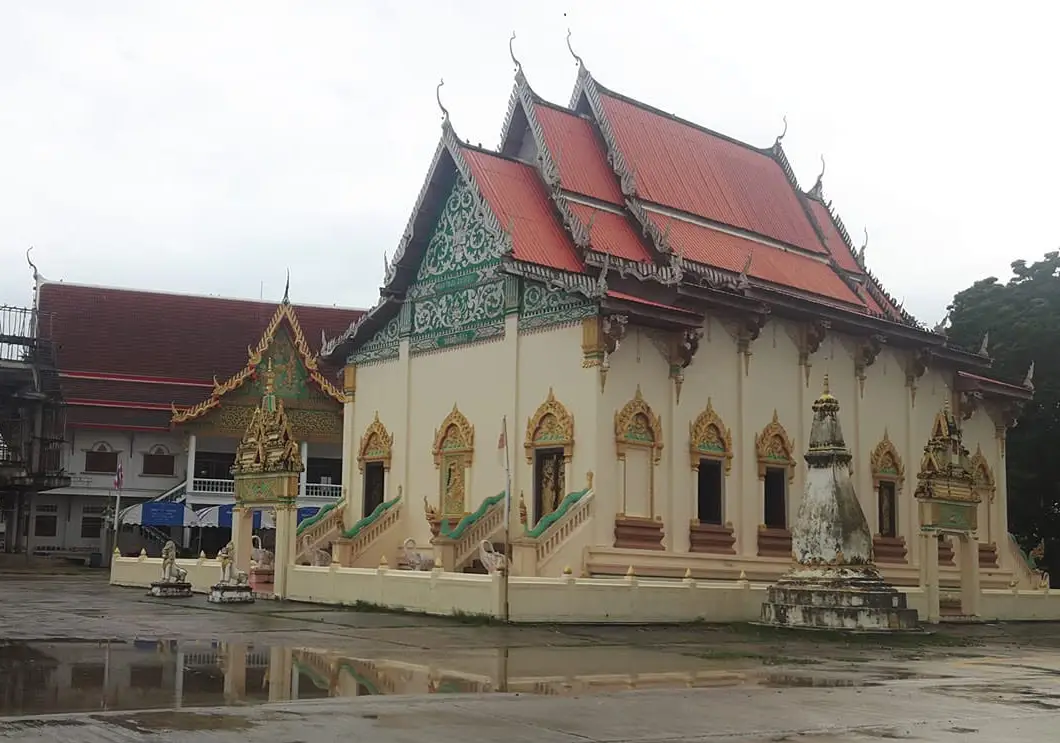
Wat Tai Pho Kham
Open Days: Daily
Opening Hours: 08.00 – 17.00
Wat Tai Pho Kham in Kalasin Province is an old Buddhist temple in the heart of Mueang Kalasin. Located at No. 2 Phanna Road, Kalasin Subdistrict, Mueang Kalasin District, the temple is an important place for understanding the early layout of Kalasin town and the relationship between temples and traditional communities. Wat Tai Pho Kham was established in 1798, around the same period as Wat Klang and Wat Nuea, also known as Wat Si Bun Rueang. These 3 temples reflect the old settlement pattern in which the community was divided into northern, central, and southern neighbourhoods, each with its own temple as a spiritual and social centre.
The importance of Wat Tai Pho Kham is not limited to its age. The temple is especially meaningful because of its old ordination hall, or ubosot, which represents local Buddhist architecture in Kalasin. The building is a Thai-style brick-and-plaster structure standing on a moulded base. Its roof has 3 overlapping gabled tiers, with side eaves extending outward like wings. The column capitals are decorated with stucco forms resembling offering trays, while the supporting brackets are shaped as garudas. The front pediment is decorated with stucco images of worshipping deities and curling vine motifs. Inside the ubosot is a large principal Buddha image in the subduing Mara posture, created in the local Isan artistic style.
When Wat Tai Pho Kham is viewed together with Wat Klang and Wat Nuea, visitors can clearly see how the old town of Kalasin was organised. In many older Thai communities, temples were not only places of worship. They served as schools, meeting places, ritual centres, and landmarks within the settlement. Wat Klang represented the central area, Wat Nuea represented the northern area, and Wat Tai represented the southern area. This way of naming temples according to direction is a valuable clue to the spatial memory of the old town.
The temple was probably first known simply as Wat Tai, meaning the southern temple, because of its position south of Wat Klang and Wat Nuea. The words Pho Kham were later added because of a sacred bodhi tree inside the temple. In Buddhist culture, the bodhi tree is deeply associated with enlightenment, because the Buddha attained enlightenment beneath a bodhi tree. For this reason, Thai Buddhist communities often plant bodhi trees in temple grounds. The tree gives shade, creates a peaceful atmosphere, and acts as a living symbol of wisdom, merit, and religious continuity.
As the bodhi tree at Wat Tai grew larger, it became the temple’s most memorable symbol. People who came to make merit, extend their lifespan, or pray for recovery from illness often brought forked wooden supports to place beneath the tree. This act is based on the belief that supporting the bodhi tree symbolically supports the life of the devotee. The tree becomes stronger and does not fall, just as the sick person is hoped to regain strength, health, and a longer life. Over time, many wooden supports were placed around the tree, and local people began to describe the temple as the southern temple with the supported bodhi tree. The name eventually became shortened to Wat Tai Pho Kham.
The bodhi tree connected with the temple name remains spiritually important to local people. It stands in the western part of the temple area, near the buildings of Tessaban 4 Wat Tai Pho Kham School. Many local residents believe that a tree spirit, or bodhi guardian deity, resides there. This belief gives the tree a special role. It is not merely a large tree in a temple compound, but a sacred presence linking nature, Buddhism, community memory, and personal hope.
The name Wat Tai Pho Kham also carries a beautiful symbolic meaning. The word pho refers to the bodhi tree and to enlightenment, the highest goal in Buddhism. The word kham means to support, prop up, or sustain. Together, the name can be understood as a place that supports the bodhi tree, supports Buddhist faith, and supports the lives and minds of the people who come to pray. This layered meaning helps explain why the temple remains emotionally significant for local devotees.
The old ubosot is the main architectural feature of Wat Tai Pho Kham. It is built of brick and plaster on a moulded base, in a Thai style interpreted through local Isan craftsmanship. Its 3-tiered gabled roof gives the building a dignified profile, while the side eaves provide shade and help protect the walls from rain. The design is both beautiful and practical. It responds to the climate of Northeastern Thailand while maintaining the sacred appearance expected of a Buddhist ordination hall.
The moulded base raises the ubosot above the temple courtyard and gives the building a sense of stability. Such a base is not simply structural; it also creates a visual separation between ordinary ground and sacred space. The brick-and-plaster construction shows the development of temple architecture in Kalasin after the early foundation of the town. It reflects the faith of the community and the intention to create a permanent building for important Buddhist rituals.
The column capitals are decorated with stucco forms that resemble offering trays. In Thai religious culture, a tray is associated with respect, worship, and the offering of something valuable. When this form appears on the columns of an ordination hall, it transforms a structural element into a symbolic one. The columns do not merely hold the roof; they help express the sacred dignity of the building.
The garuda-shaped brackets are among the most distinctive elements of the ubosot. In Thai and Buddhist visual culture, the garuda represents strength, protection, authority, and a connection with the celestial realm. As brackets, the garudas serve a structural function by supporting the roof eaves. At the same time, they act as symbolic guardians of the sacred building. Their form gives movement and energy to the exterior of the ubosot.
The pediment is decorated with stucco figures of worshipping deities surrounded by curling vine motifs. The worshipping deity, or thep phanom, is a familiar symbol of reverence in Thai Buddhist art. Its presence on the pediment marks the building as a place of worship. The curling vine design adds a sense of movement, growth, and abundance. Together, these elements create a visual language of devotion, fertility, and sacred beauty.
Inside the ubosot, the principal Buddha image is a large image in the subduing Mara posture. This posture represents the moment before enlightenment when the Buddha overcame Mara and called the Earth to witness his accumulated merit. The gesture communicates mental strength, stillness, and the victory of wisdom over defilement. For worshippers, the image offers a powerful reminder of patience, inner discipline, and moral courage.
The local Isan style of the principal Buddha image gives it a special charm. It may not follow royal artistic conventions in every detail, but it carries the sincere faith of the community. Local Buddha images often feel close to the people who made and worshipped them. Their value lies not only in artistic form but in the relationship between image, temple, and community devotion. At Wat Tai Pho Kham, the principal image is therefore both a sacred object and a reflection of local Buddhist identity.
Wat Tai Pho Kham remains active as a living temple. It hosts Buddhist activities, merit-making, alms-giving ceremonies, meditation practice, and community religious events. The celebration of the temple’s 225th anniversary included a consecration ceremony for a replica of Luang Pho Pho Kham, Bun Duean Si tradition, and meditation activities. These events show that the temple is not an abandoned historical site. It is still a centre of faith and community life in Kalasin.
The practice of supporting the bodhi tree is one of the most meaningful traditions associated with the temple. The forked wooden supports placed beneath the tree are not random objects. They are physical expressions of prayer. A devotee who supports the tree symbolically asks for life to be supported, illness to be eased, and strength to return. The practice links body, mind, nature, and religion in a simple but profound way.
From a cultural point of view, the supported bodhi tree shows how Isan communities understand temples as places that care for life in every stage. People come to temples not only on major Buddhist holy days but also when they are sick, anxious, grieving, or seeking encouragement. The tree at Wat Tai Pho Kham becomes a living focus of these hopes. It gives the temple a distinct identity that is different from other city temples in Kalasin.
A meaningful visit should include a slow walk around the ubosot. Visitors can begin by observing the base, the steps, the 3-tiered roof, the wing-like eaves, the garuda brackets, and the pediment decoration. After that, they can enter the interior respectfully to pay homage to the principal Buddha image. This sequence helps visitors understand how the architecture moves from the ordinary space of the courtyard into the sacred space of the ordination hall.
Wat Tai Pho Kham is especially suitable for travelers interested in local history, temple architecture, Buddhist belief, and the old town layout of Kalasin. When visited together with Wat Klang and Wat Nuea, the temple helps complete the story of Kalasin’s early community structure. Wat Klang is known for its royal temple status and Luang Pho Ong Dam. Wat Nuea is known for Dvaravati sema stones from Fa Daet Song Yang. Wat Tai Pho Kham is known for its old ubosot, supported bodhi tree tradition, and its role as the southern temple of the old community.
The temple is located in the city and is close to Tessaban 4 Wat Tai Pho Kham School. This relationship between temple, school, and neighbourhood is typical of many Thai towns. Temples often played an educational role before modern schools became widespread. Even today, the presence of a school beside the temple shows how religious, educational, and community spaces continue to coexist in Thai urban life.
For photographers, the temple offers several attractive subjects: the old ubosot, the 3-tiered roof, the stucco pediment, the garuda brackets, the shaded temple courtyard, and the sacred bodhi tree. Morning and late afternoon are the best times for photography because the light is softer and reveals the depth of stucco details more clearly. Visitors should take photographs respectfully, especially inside the ubosot or near worshippers.
Proper behavior is important because Wat Tai Pho Kham is an active Buddhist temple. Visitors should dress politely, cover shoulders and knees, remove shoes where required, speak softly, and avoid touching old architectural surfaces. The bodhi tree and its supports should also be treated respectfully. Cultural travel should help preserve the site rather than disturb it.
The best time to visit is in the morning, when the atmosphere is calm and the heat is not too strong. Late afternoon is also suitable because the warm light makes the building details more visible. Visitors planning a short city route can visit Wat Tai Pho Kham together with Wat Klang, Wat Si Bun Rueang, Kalasin Museum, Kut Nam Kin Public Park, and Rongsi Market.
Getting There is easy because Wat Tai Pho Kham is located within Mueang Kalasin. Visitors can travel by private car, rental car, motorcycle, or local hired transport. On map navigation, search for Wat Tai Pho Kham Kalasin. From Wat Klang or Wat Si Bun Rueang, the temple is only a short distance away, making it convenient for a compact cultural route through the old city temple network.
Travelers arriving from other provinces such as Khon Kaen, Maha Sarakham, Roi Et, or Sakon Nakhon can first enter Kalasin city and then continue to the temple. The site is close to hotels, restaurants, and other central attractions. Staying in Mueang Kalasin is convenient for visitors who want to explore the 3 old city temples, the local museum, Rongsi Market, and nearby parks.
Historically, Wat Tai Pho Kham is a readable piece of Kalasin’s old urban landscape. Its name, location, ubosot, bodhi tree, and life-supporting ritual all work together as cultural evidence. A visit to the temple should therefore be understood not simply as a visit to a single temple, but as a way to read the old town through Buddhist space, community belief, and living tradition.
The beauty of Wat Tai Pho Kham lies in its quiet depth. The ubosot may not be the largest temple building in Kalasin, but it contains meaningful architectural details. The supported bodhi tree may look simple at first, but once visitors understand the belief behind it, the wooden supports become visible traces of many people’s hopes and prayers. This is what gives the temple its distinctive emotional character.
Overall, Wat Tai Pho Kham is one of the most meaningful old temples in Kalasin city. Founded in 1798, it represents the southern community of the old town, preserves a graceful brick-and-plaster ubosot, houses a large principal Buddha image in the subduing Mara posture, and carries the unique tradition of the supported bodhi tree. For travelers who want to understand Kalasin through history, Buddhism, architecture, and local belief, Wat Tai Pho Kham should be visited together with Wat Klang and Wat Nuea.
| Name | Wat Tai Pho Kham, Kalasin Province |
| Location | Kalasin Subdistrict, Mueang Kalasin District, Kalasin Province |
| Address | No. 2 Phanna Road, Kalasin Subdistrict, Mueang Kalasin District, Kalasin 46000, Thailand |
| Coordinates | 16.43277, 103.50160 |
| Highlights | Old Kalasin city temple, Thai-style brick-and-plaster ubosot, 3-tiered gabled roof, garuda-shaped brackets, thep phanom pediment, large principal Buddha image in the subduing Mara posture, and the supported bodhi tree tradition |
| History | Established in 1798 during the early period of Kalasin town; the temple served the southern neighbourhood in the traditional community layout of northern, central, and southern settlements |
| Name Origin | Originally known as Wat Tai, meaning the southern temple, because it stood south of Wat Klang and Wat Nuea. The name Pho Kham was added from the bodhi tree supported by wooden forks used in life-extension merit-making rituals |
| Distinctive Features | Thai-style ubosot built of brick and plaster on a moulded base, 3-tiered gabled roof, side wing eaves, stucco tray-like column capitals, garuda brackets, and stucco pediment with worshipping deities and curling vine motifs |
| Important Objects / Features | Old ubosot, large Isan-style principal Buddha image in the subduing Mara posture, supported bodhi tree, life-extension merit-making area, temple courtyard, and religious activity area of the Kalasin city community |
| Related Traditions / Rituals | Life-extension merit-making with wooden supports for the bodhi tree, Bun Duean Si tradition, consecration ceremony for Luang Pho Pho Kham replica, alms-giving, and community meditation activities |
| Travel Information | Located in central Mueang Kalasin and easily reached by private car, rental car, motorcycle, or local hired transport. Search for Wat Tai Pho Kham Kalasin on map navigation |
| Current Status | Open to visitors and functioning as an active Buddhist temple in Mueang Kalasin |
| Open Days | Daily |
| Opening Hours | 08.00 – 17.00 |
| Facilities | Temple courtyard, worship area, old ubosot viewing area, supported bodhi tree area, and parking space within or near the temple depending on current conditions |
| Main Areas / Zones | Old ubosot, principal Buddha image area, garuda bracket and pediment area, temple courtyard, supported bodhi tree area, nearby Tessaban 4 Wat Tai Pho Kham School area, and community religious activity area |
| Abbot / Caretaker | Phra Khru Pariyat Phutthikhun, Dr., abbot of Wat Tai Pho Kham and deputy ecclesiastical district chief of Mueang Kalasin |
| Nearby Tourist Attractions | 1. Wat Klang Royal Monastery Kalasin, about 0.8 km 2. Wat Si Bun Rueang or Wat Nuea, about 1 km 3. Phraya Chai Sunthon Monument, about 1 km 4. Kalasin Museum, about 1 km 5. Kut Nam Kin Public Park, about 1 km 6. Rongsi Market Kalasin, about 3 km 7. Phutthasathan Phu Po, about 28 km |
| Nearby Restaurants | 1. NICE TIME CAFE KALASIN, about 0.4 km, Tel. 088-562-4518 2. Cafe De’ Supak, about 0.8 km, Tel. 043-811-051, 088-552-6796 3. Khwan Oey Restaurant, about 1 km, Tel. 089-863-6332 4. Tam Yua Yeh Kalasin, about 2 km, Tel. 063-968-3937 5. Ban Tan Fa Kalasin, about 2 km, Tel. 086-717-0774 |
| Nearby Accommodations | 1. Supak Hotel, about 0.8 km, Tel. 043-811-595 2. A.P. Garden Hotel, about 1 km, Tel. 086-354-6193 3. Phaiboonplace Hotel, about 1 km, Tel. 043-811-661 4. Rimpao Hotel, about 2 km, Tel. 043-813-631 5. TK Residence Hotel, about 3 km, Tel. 095-338-0515 6. Nub Thong Residence, about 3 km, Tel. 095-520-7290 |
Frequently Asked Questions (FAQ)
Q: Where is Wat Tai Pho Kham located?
A: Wat Tai Pho Kham is located at No. 2 Phanna Road, Kalasin Subdistrict, Mueang Kalasin District, Kalasin Province. It is in the city area and close to Wat Klang and Wat Si Bun Rueang.
Q: When was Wat Tai Pho Kham established?
A: Wat Tai Pho Kham was established in 1798, during the early period of Kalasin town, as the temple of the southern community in the old settlement layout.
Q: Why is it called Wat Tai Pho Kham?
A: The temple was originally known as Wat Tai because it stood south of Wat Klang and Wat Nuea. The name Pho Kham comes from the bodhi tree in the temple, where local people placed wooden supports as part of life-extension merit-making.
Q: What is the main architectural highlight of Wat Tai Pho Kham?
A: The main highlight is the old Thai-style brick-and-plaster ubosot with a 3-tiered gabled roof, wing-like side eaves, garuda-shaped brackets, a thep phanom pediment, and a large Isan-style Buddha image in the subduing Mara posture.
Q: What does the supported bodhi tree mean?
A: The supported bodhi tree is connected with life-extension merit-making. Local people believe that placing forked wooden supports under the bodhi tree symbolically supports life, health, and longevity.
Q: What nearby places should be visited with Wat Tai Pho Kham?
A: Recommended nearby places include Wat Klang Royal Monastery, Wat Si Bun Rueang, Phraya Chai Sunthon Monument, Kalasin Museum, Kut Nam Kin Public Park, and Rongsi Market.
Q: How long should visitors spend at Wat Tai Pho Kham?
A: A simple visit may take about 30–45 minutes. Visitors who want to study the ubosot architecture, the supported bodhi tree, and take photographs should allow around 1 hour.
Q: How should visitors behave at Wat Tai Pho Kham?
A: Visitors should dress politely, speak softly, remove shoes where required, avoid touching old architectural surfaces, respect the bodhi tree and worship areas, and be mindful of monks and local worshippers.
 Category: ●Places of Worship
 Group: ●Temple
Last Update : 3 MonthAgo
 Last Update : 3 MonthAgo
 Click to Access the Navigation Map GPS
 Art, Culture and Heritage
 Historical Sites and Monuments(2)
 Landmarks and Memorials(3)
 Art, Craft Centres, Tradition(4)
 Museums(3)
 Art Gallery(1)
 Educational Places
 Educational Gardens, Farm(1)
Temple(21)
Educational Gardens, Farm(1)
Temple(21)
 Other Sacred Sites(6)
 Suburban Living
 Village, Community(3)
 Nature and Wildlife
 National Parks and Marine Reserves(3)
 Mountain (Doi)(2)
 Dam, Reservoir, Lake(5)
 Waterfalls(4)
 Caves(2)
 River, Canal(3)
 Bays and Beaches(1)
 Other natural attractions(2)
 Entertainment and Agricultural
 Animal camps and shows(1)
 Farms, Parks and Ecotourism(2)


