
lovethailand home >Northeastern Travel Attractions >Kalasin Travel Attractions >Na Ku >Phu Laen Chang > Phu Faek Forest Park (Dinosaur Footprints)
TL;DR: Phu Faek Forest Park (Dinosaur Footprints), Kalasin attractions : Nature and Wildlife, National Parks and Marine Reserves.

Phu Faek Forest Park (Dinosaur Footprints)
Open Days: Contact the responsible authority before visiting
Opening Hours: Contact the responsible authority before entering the area
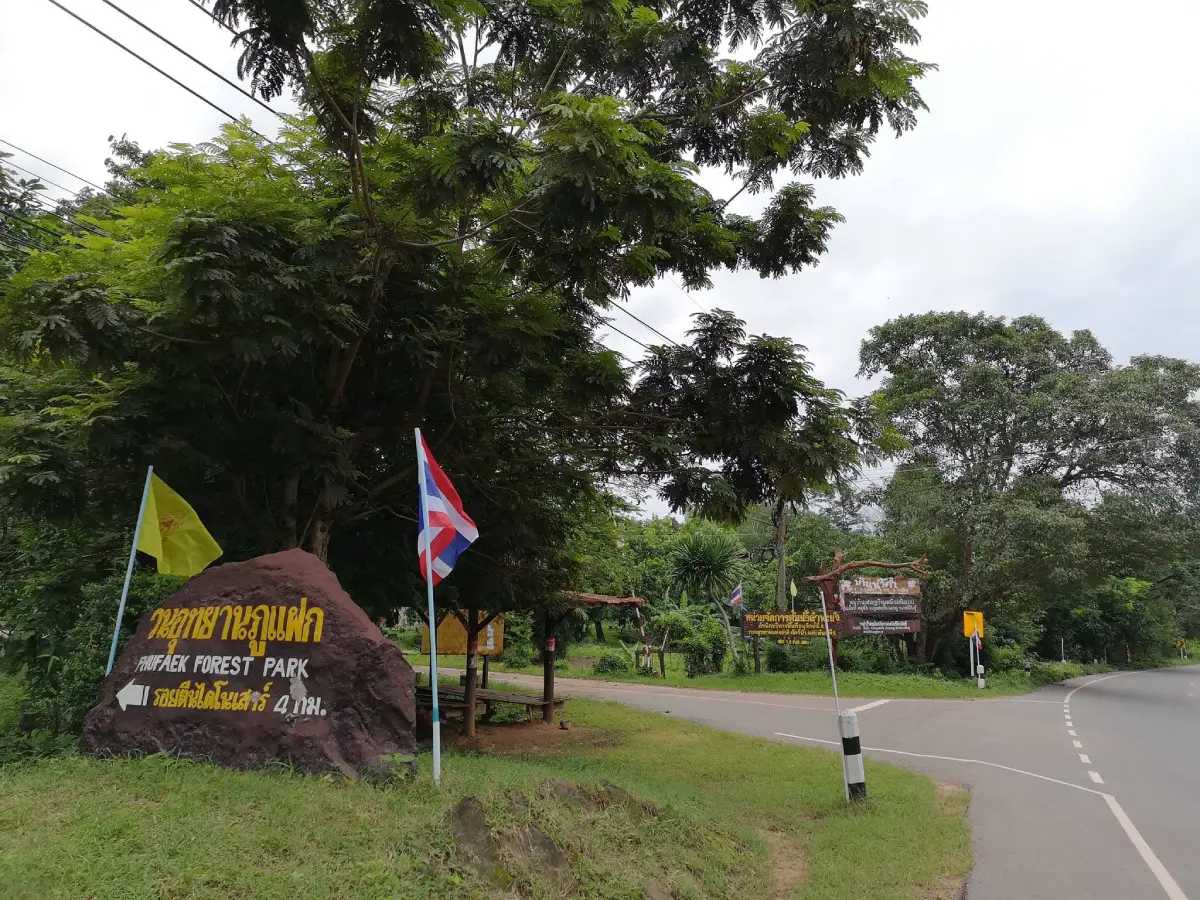
Phu Faek Forest Park, also known as the Dinosaur Footprints Site of Kalasin, is one of northeastern Thailand’s most important natural and geological attractions. Located at Moo 6, Ban Nam Kham, Phu Laen Chang Subdistrict, Na Khu District, Kalasin Province, the site is famous for dinosaur footprints preserved on a sandstone rock platform along a stream at the foot of Phu Faek. These footprints are believed to be about 140 million years old and belong to carnivorous theropod dinosaurs, often described in local and scientific sources as carnosaur-type meat-eating dinosaurs. For foreign travelers, Phu Faek is not just a forest park. It is an outdoor geological classroom where forest ecology, sandstone, stream erosion, fossil traces, and the deep prehistoric past of Thailand can be experienced in one place.
The charm of Phu Faek lies in its quiet natural setting and the scientific value hidden within an apparently simple forest landscape. The terrain consists of low hills and alternating upland slopes. The forest type is dry dipterocarp forest, a common but ecologically important forest type in northeastern Thailand. Local trees include makha mong, teng, rang, pradu, and other hardy species that can survive in relatively dry soil and distinct seasonal conditions. Although this forest may look open and dry during part of the year, it provides habitat for small wildlife such as squirrels, tree shrews, civets, wild rabbits, and birds. It also helps protect soil, slow water runoff, and preserve the natural character of the Phu Phan landscape.
The most important feature of Phu Faek Forest Park is the dinosaur footprint site. The discovery story has become part of Kalasin’s local heritage. In November 1996, two girls, Kanyamat Singnakhrong and Phatchari Waisen, visited the area with their guardians during a holiday outing. While they were near the rock platform in the stream at the foot of Phu Faek, they noticed unusual large marks on the stone surface. After the discovery was reported, geologists, government officials, and local agencies inspected the area and confirmed that the marks were dinosaur footprints. The discovery became an important moment in Kalasin’s identity as one of Thailand’s dinosaur provinces.
The Phu Faek footprints are particularly valuable because footprints tell a different story from dinosaur bones. Bones reveal anatomy, but footprints reveal movement, direction, stride, posture, and the environment in which the animal walked. According to geological descriptions, the footprints at Phu Faek appear in several trackways on sandstone. They are three-toed footprints, with average dimensions of about 45 cm long and 40 cm wide, and stride distances of about 110 – 120 cm. These features indicate a two-legged carnivorous dinosaur with a hip height of more than 2 metres, walking slowly across wet sandy ground near an ancient water body about 140 million years ago.
Some tourism descriptions mention 7 theropod footprints, with about 4 still clearly visible today, while geological surveys describe several trackways and a larger total number of traces. This difference usually comes from whether the count refers only to clearly visible tourist-area prints or to the broader scientific survey of all trackways. For visitors, the most important point is that the site is fragile and irreplaceable. The footprints that can still be seen today are the result of natural erosion removing the rock layers that once covered them. They must be viewed carefully, without stepping on, scratching, touching, or altering the rock surface.
Geologically, the dinosaur footprints are preserved on a sandstone surface along a stream channel. They are associated with the Phra Wihan Formation, which lies below the Sao Khua Formation, one of the best-known dinosaur-bearing rock units in Thailand. The likely ancient environment was a moist sandy riverbank or lakeside area. A dinosaur walked across wet sand, leaving deep impressions. Later, sediment covered the footprints, preserving them beneath new layers. Over millions of years, the sediment hardened into rock. Natural erosion eventually removed the overlying rock and exposed the ancient footprints again, allowing modern people to see evidence of movement from the Early Cretaceous world.
Conservation is essential at Phu Faek because fossil footprints cannot be recreated once damaged. Stream water, seasonal flooding, pebbles, and moving sediment can slowly wear down the prints. Human behaviour can accelerate that damage. Visitors should not pour water on the footprints, rub the surface, place objects in the tracks, use powder to make the marks clearer, or stand on the prints for photographs. Even small actions can reduce scientific detail over time. Good visitors help protect the site by observing from safe areas and leaving the rock surface untouched.
Phu Faek is also a forest ecology site. The dry dipterocarp forest around the footprint area offers a useful introduction to the natural ecosystems of northeastern Thailand. Teng, rang, pradu, and other local trees adapt to dry-season conditions through thick bark, deep roots, and seasonal leaf fall. Small mammals such as squirrels, tree shrews, civets, and wild rabbits use the forest for food and shelter. Travelers who come only for the dinosaur footprints may miss this ecological dimension. The best way to appreciate Phu Faek is to see the forest, rocks, stream, and footprints as one connected natural system.
Because the site is a natural and protected area, visitors should prepare properly. Closed-toe shoes or hiking shoes are recommended, especially because the rock and stream area can be slippery after rain. Drinking water, a hat, insect repellent, and a personal trash bag are useful. Loud noise, littering, food waste, and careless walking can disturb wildlife and damage the visitor experience. Families should keep children close, particularly near rocks and water. Group visits should contact the responsible authority in advance.
Travelers should also check current access before visiting. Some public information indicates that Phu Faek has been closed to tourism during certain periods or has been under development as a geological tourism route. For this reason, visitors should contact the local authority, the forest park authority, or the relevant tourism office before traveling. This is especially important for those planning to see the footprints, walk nature trails, camp, or bring student groups. Confirming the current status helps avoid wasted travel and helps protect the site while management or conservation work is underway.
When visiting the footprint area, take time to understand the landscape before focusing on the footprints themselves. The rock platform, stream channel, surrounding forest, and hillside all contribute to the story. What may look like an ordinary streambed is actually a preserved surface from a very ancient environment. If signs or staff explanations are available, visitors should read and listen carefully. Understanding the scientific background will make the footprints more meaningful than simply seeing a shape in stone.
Season affects the experience at Phu Faek. During the rainy season and just after the rains, the forest is greener and the stream environment looks more alive, but the rock surface may be slippery and water levels may affect visibility. The early cool season is often the most comfortable time for nature travel because the weather is milder and walking is easier. The dry season may make the rock structure clearer, but heat and forest-fire risk should be considered. In every season, safety and conservation rules should come before convenience.
The standard route from Kalasin city follows Highway No. 213 toward Somdet District. At Somdet, turn right onto Highway No. 2042 toward Kuchinarai for about 20 km until reaching Huai Phueng District. From there, turn left onto Highway No. 2101 toward Na Khu for about 10 km, then turn left into Phu Faek Forest Park for about 4.7 km. A private car or rental car is the most practical option because the final access road is local and allows more flexible travel to nearby attractions.
Travelers coming from Kalasin city should allow more time than the map distance alone suggests. The last section into the forest park area may require careful driving, especially after rain. Families should bring drinking water and snacks, but all waste must be taken back out. Student groups, study tours, and large visitor groups should contact the responsible authority before departure and provide information about the group size, purpose of visit, and expected activity. This allows staff to advise on access, safety, and any current restrictions.
Phu Faek is highly suitable for educational travel. It can support lessons on dinosaurs, fossil traces, sandstone geology, stream erosion, dry dipterocarp forest, local wildlife, and conservation ethics. It is valuable for schools, universities, family learning trips, nature clubs, and foreign visitors interested in geological tourism. Seeing dinosaur footprints in the actual landscape helps learners understand that scientific evidence is not limited to museums. It can also appear in a forest stream in rural Thailand, preserved for millions of years in rock.
For international travelers, Phu Faek offers a different side of Thailand. The country is often associated with beaches, temples, markets, and food, but Kalasin shows another dimension: prehistoric life and geological heritage. A broader dinosaur route in Kalasin can include Phu Faek Forest Park, Phu Noi Dinosaur Site, and Sirindhorn Museum in Sahatsakhan District. Together, these places help visitors understand why Kalasin is often associated with dinosaurs and why northeastern Thailand is so important for palaeontology.
Nearby attractions can make the trip more complete. Wat Phra That Muen Hin in Na Khu District is a religious site associated with Luang Pu Sila Sirichanto. Pha Sawoei Viewpoint in Somdet District gives a scenic view of the Phu Phan landscape. Kaeng Ka-am Waterfall provides a different natural setting with rock and water. Ban Phon Phu Thai Phrae Wa Silk Cultural Centre adds a cultural textile dimension. Wat Phutthawat on Phu Sing and Sirindhorn Museum can extend the trip into Buddhist heritage and dinosaur education. Travelers with 1 full day or 2 days can combine several of these places depending on route and season.
Food options are available in Na Khu, Huai Phueng, Kuchinarai, and nearby districts, though visitors should not assume that every rural restaurant will be open at all times. Local restaurants, cafés, and grilled-meat shops can serve as rest stops before or after visiting the forest park. Travelers with children or older adults should plan meal stops in advance. If traveling in a group, it is better to contact restaurants ahead of time, especially in rural areas where capacity may be limited.
Accommodation near Phu Faek is more limited than in Kalasin city. Practical options include small local stays in Na Khu, resorts in Huai Phueng or Kham Muang, and larger choices in Sahatsakhan or Kalasin city depending on the wider route. If the trip focuses on multiple dinosaur-related sites, staying closer to Sahatsakhan may help connect with Sirindhorn Museum. If the focus is Phu Faek and Na Khu, local accommodation should be contacted directly before travel.
Photography should be done without disturbing the footprint surface. Morning or late-afternoon light can help reveal shadows and texture on the rock. If water is present in some prints, visitors should photograph the site as it is. They should not remove water, add water, scrape mud, or place objects inside the footprints. Conservation photography means recording the site without changing it. A good photograph should preserve memory, not damage evidence.
Phu Faek has several layers of importance for Kalasin. It strengthens the province’s identity as a dinosaur destination. It provides a learning site for dry dipterocarp forest ecology and Phu Phan terrain. It also requires cooperation among local communities, government agencies, scientists, and visitors. If managed carefully, the forest park can become a strong example of geological tourism that balances public access with fossil conservation.
In the future, if geological tourism routes and visitor facilities are further developed, Phu Faek has strong potential as a family learning destination, a school field-trip site, and an international niche attraction for travelers interested in dinosaurs. The most important elements to preserve are the natural setting, the accuracy of scientific interpretation, visitor safety, and the fragile rock surface of the footprints. Development should help people understand the site more deeply without making it crowded or damaged.
In summary, Phu Faek Forest Park should be visited with curiosity and respect. It is not only a place to take a quick photo of dinosaur footprints. It is a place to read the forest, observe sandstone, understand dry dipterocarp ecology, and imagine a carnivorous dinosaur walking across wet sand 140 million years ago. With careful planning, current-status checking, and strict respect for conservation rules, Phu Faek can be one of the most meaningful nature and geology experiences in Kalasin Province.
Getting There from Kalasin city, take Highway No. 213 to Somdet District. At Somdet, turn right onto Highway No. 2042 toward Kuchinarai for about 20 km until reaching Huai Phueng District. Then turn left onto Highway No. 2101 toward Na Khu for about 10 km, and turn left into Phu Faek Forest Park for about 4.7 km. A private car or rental car is recommended. Visitors should contact the responsible authority before traveling, especially if they want to see the dinosaur footprints, walk nature trails, or visit as a group.
| Name | Phu Faek Forest Park (Dinosaur Footprints Site) |
| Location | Moo 6, Ban Nam Kham, Phu Laen Chang Subdistrict, Na Khu District, Kalasin Province, Thailand |
| Address | Phu Faek Forest Park, Ban Nam Kham, Moo 6, Phu Laen Chang Subdistrict, Na Khu District, Kalasin 46160, Thailand |
| Highlights | A 140-million-year-old carnivorous theropod/carnosaur dinosaur footprint site preserved on sandstone along a stream at the foot of Phu Faek |
| History | The footprints were discovered in November 1996 by Kanyamat Singnakhrong and Phatchari Waisen with their guardians. Geologists and related agencies later confirmed them as dinosaur footprints from about 140 million years ago. |
| Distinctive Features | Three-toed dinosaur footprints on sandstone, interpreted as traces of two-legged carnivorous dinosaurs walking through an ancient moist sandy environment near water |
| Terrain And Ecosystem | Low hills and dry dipterocarp forest with tree species such as makha mong, teng, rang, and pradu; small wildlife includes squirrels, tree shrews, civets, and wild rabbits |
| Travel Information | From Kalasin city, take Highway No. 213 to Somdet District, then Highway No. 2042 toward Kuchinarai for about 20 km to Huai Phueng District. Turn left onto Highway No. 2101 toward Na Khu for about 10 km, then turn left into Phu Faek Forest Park for about 4.7 km. |
| Current Status | A natural and fossil footprint site where visitors should contact the responsible authority before traveling, as closure or development notices have appeared during some periods. |
| Open Days | Contact the responsible authority before visiting |
| Opening Hours | Contact the responsible authority before entering the area |
| Facilities | Forest area, access route to dinosaur footprints, natural sandstone platform, geological learning point, and nearby Ban Nam Kham community area |
| Main Areas / Zones | 1. Forest park entrance area 2. Dry dipterocarp forest nature route 3. Sandstone stream platform at the dinosaur footprint site 4. Carnivorous dinosaur footprint viewing area 5. Geological and fossil learning area 6. Ban Nam Kham community area in Phu Laen Chang Subdistrict |
| Caretaker | Phu Faek Forest Park under relevant forest and protected-area authorities, with geological information from the Department of Mineral Resources and local information from Phu Laen Chang Municipality |
| Main Contact Number | Phu Laen Chang Municipality Tel. 0-4384-0648, TAT Khon Kaen Office Tel. 043-227714, Department of National Parks Hotline 1362 |
| Nearby Tourist Attractions | 1. Wat Phra That Muen Hin, Luang Pu Sila Sirichanto, 16 km 2. Pha Sawoei Viewpoint, Kalasin, 28 km 3. Kaeng Ka-am Waterfall, Somdet District, 33 km 4. Ban Phon Phu Thai Phrae Wa Silk Cultural Centre, 40 km 5. Wat Phutthawat, Phu Sing, 55 km 6. Sirindhorn Museum and Phu Kum Khao Dinosaur Excavation Site, 60 km |
| Nearby Restaurants | 1. Chill Bar @ Na Khu, 16 km, Tel. 084-652-5033 2. Jungle Cafe Na Khu Kalasin Branch, 17 km, Tel. 098-632-6965 3. Anucha Korean Barbecue, 17 km, Tel. 085-756-8034 4. Bua Rin Restaurant, 18 km 5. Local Restaurants In Na Khu Town, 16 km 6. Coffee BAR Kham Muang, 40 km, Tel. 065-296-9851 |
| Nearby Accommodations | 1. Local Stays And Homestays In Na Khu District, 16 km 2. Naparat Resort, Huai Phueng District, 22 km, Tel. 088-516-5778 3. Leelawadee Resort Kham Muang, 42 km, Tel. 088-330-0595 4. Sabai Dee Resort Kham Muang, 43 km, Tel. 063-354-3886 5. Phu Aom Resort, Khao Wong District, 45 km, Tel. 094-826-9356 |
Frequently Asked Questions (FAQ)
Q: Where is Phu Faek Forest Park located?
A: Phu Faek Forest Park is located at Moo 6, Ban Nam Kham, Phu Laen Chang Subdistrict, Na Khu District, Kalasin Province. It is a natural site and an important dinosaur footprint location in Kalasin.
Q: How old are the dinosaur footprints at Phu Faek?
A: The dinosaur footprints at Phu Faek are about 140 million years old and belong to carnivorous theropod or carnosaur-type dinosaurs.
Q: Who discovered the Phu Faek dinosaur footprints?
A: The footprints were discovered in November 1996 by Kanyamat Singnakhrong and Phatchari Waisen with their guardians. Geologists and relevant agencies later confirmed them as dinosaur footprints.
Q: Is Phu Faek Forest Park open to visitors?
A: Visitors should contact the responsible authority before traveling because closure or development notices have appeared during some periods, and access conditions may change.
Q: How do I get from Kalasin city to Phu Faek Forest Park?
A: Take Highway No. 213 to Somdet District, continue on Highway No. 2042 toward Kuchinarai for about 20 km to Huai Phueng District, turn left onto Highway No. 2101 toward Na Khu for about 10 km, then turn left into Phu Faek Forest Park for about 4.7 km.
Q: Who is Phu Faek Forest Park suitable for?
A: It is suitable for families, students, geology learners, dinosaur enthusiasts, nature travelers, and visitors interested in dry dipterocarp forest ecosystems in Kalasin.
Q: What should visitors prepare before going to Phu Faek?
A: Visitors should wear closed-toe shoes, bring drinking water, a hat, insect repellent, a personal trash bag, and contact the authority before traveling. They must not step on, touch, scratch, or alter the dinosaur footprints.
Q: What nearby attractions can be combined with Phu Faek Forest Park?
A: Nearby attractions include Wat Phra That Muen Hin, Pha Sawoei Viewpoint, Kaeng Ka-am Waterfall, Ban Phon Phu Thai Phrae Wa Silk Cultural Centre, Wat Phutthawat on Phu Sing, and Sirindhorn Museum.
 Category: ●Nature and Wildlife
 Group: ●National Parks and Marine Reserves
Last Update : 3 MonthAgo
 Last Update : 3 MonthAgo
 Click to Access the Navigation Map GPS
Phu Faek Forest Park (Dinosaur Footprints) Map

 Art, Culture and Heritage
 Historical Sites and Monuments(2)
 Landmarks and Memorials(3)
 Art, Craft Centres, Tradition(4)
 Museums(3)
 Art Gallery(1)
 Educational Places
 Educational Gardens, Farm(1)
 Places of Worship
 Temple(21)
 Other Sacred Sites(6)
 Suburban Living
 Village, Community(3)
National Parks and Marine Reserves(3)
Village, Community(3)
National Parks and Marine Reserves(3)
 Mountain (Doi)(2)
 Dam, Reservoir, Lake(5)
 Waterfalls(4)
 Caves(2)
 River, Canal(3)
 Bays and Beaches(1)
 Other natural attractions(2)
 Entertainment and Agricultural
 Animal camps and shows(1)
 Farms, Parks and Ecotourism(2)


