
lovethailand home >Northeastern Travel Attractions >Kalasin Travel Attractions >Muang Kalasin >Kalasin > Pong Lang Circle
TL;DR: Pong Lang Circle is located at At the intersection of Kalasin Road and Chai Sunthon Road, Tambon Kalasin, Mueang Kalasin District, Kalasin Province, open Daily, hours 24 Hours.
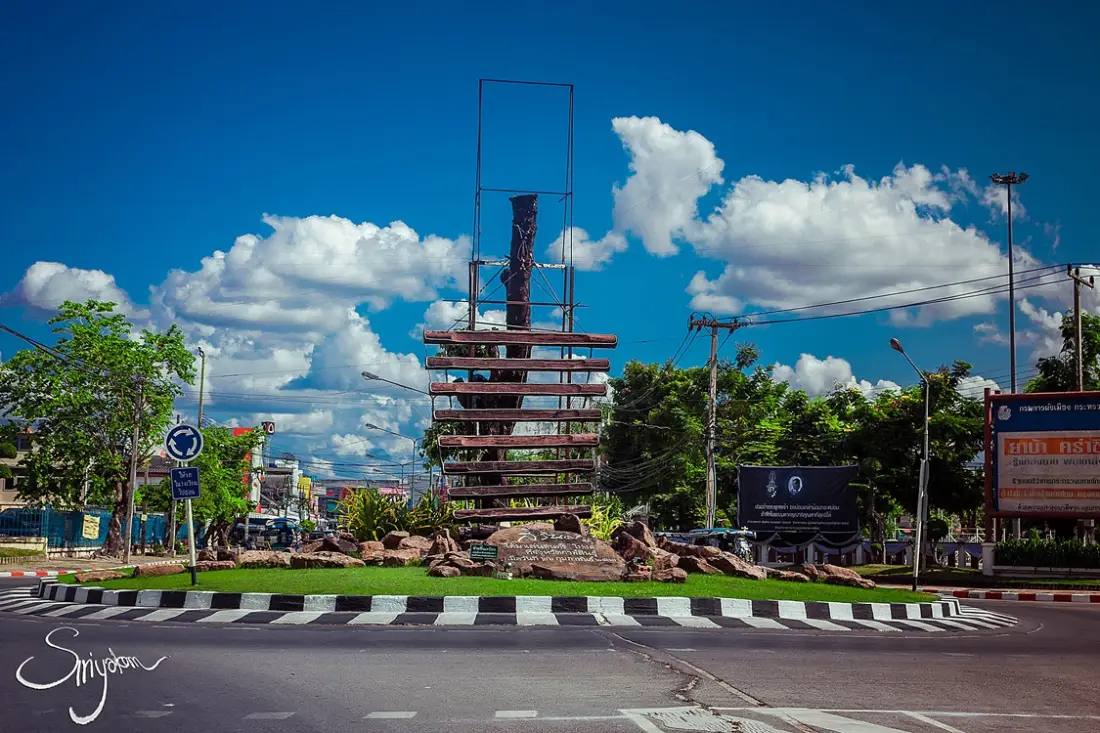
Pong Lang Circle
Open Days: Daily
Opening Hours: 24 Hours
Pong Lang Circle in Kalasin Province is one of the most recognizable cultural landmarks in the heart of Kalasin city. Located at the intersection of Kalasin Road and Chai Sunthon Road in Tambon Kalasin, Mueang Kalasin District, this traffic circle is more than an urban roundabout. It is a public cultural monument that represents Kalasin as the birthplace of the pong lang, a traditional Isan wooden percussion instrument that has become one of the province’s strongest cultural symbols.
For travelers arriving in Kalasin for the first time, Pong Lang Circle gives an immediate visual introduction to the identity of the province. At the center of the roundabout stands a large sculptural representation of the pong lang, with wooden bars arranged in descending order like the real instrument. Its shape, scale, and location make it easy to notice while passing through the city. More importantly, it communicates a clear message: Kalasin is a city of folk music, local wisdom, performance, and cultural pride.
The pong lang is a traditional northeastern Thai percussion instrument. It is often compared to a xylophone, but unlike a horizontal xylophone, the pong lang is normally hung vertically. The instrument is made from selected wood, traditionally including mahat wood or other stable hardwoods that produce a firm and resonant tone. Each wooden piece is carved and shaped to create a different pitch, then strung together with rope. During performance, one end is hung from a pole or frame, while the lower end may be tied to a post or attached near the player’s waist, allowing the musician to control the instrument while striking it rhythmically.
The cultural story of the pong lang is closely connected with local wisdom. Earlier forms of wooden sound instruments, such as kro, kalor, or kro lor, were used in rural communities before being developed into the musical instrument known today as the pong lang. In the past, the instrument used a smaller pitch system. Later, Kru Plueang Chaiyaratsami, a National Artist in Performing Arts for folk music, developed and standardized the pong lang into a more complete musical instrument. The modern form is widely associated with 13 wooden bars and a richer pitch system suitable for performance in northeastern Thai folk ensembles.
Kru Plueang Chaiyaratsami is central to the meaning of Pong Lang Circle. He was the key figure who transformed local wooden sound wisdom into a recognized folk instrument. His work helped move the pong lang from a local sound object into a structured musical instrument that could be taught, performed, and passed down through generations. Through schools, folk music groups, cultural events, and performing arts institutions, the pong lang became widely known across Thailand and among Thai communities overseas.
Pong Lang Circle was built as a memorial to an important royal visit on 26 February 1990, when Her Royal Highness Princess Maha Chakri Sirindhorn performed pong lang music at Kalasin College of Dramatic Arts. The pieces performed included Lai Toei Khong and Lai Lom Phat Phrao. This moment deeply impressed the people of Kalasin because a local folk instrument of the province was honored in a highly meaningful setting. The event strengthened the status of the pong lang as a symbol of provincial identity and inspired the creation of a public landmark that would preserve this shared memory in the center of the city.
The roundabout therefore has a deeper meaning than its physical size. It is a place where music, memory, and city life meet. Every person passing through the intersection sees a reminder that Kalasin is not only known for ancient sites, Praewa silk, dinosaur fossils, and local traditions, but also for folk music that carries the rhythm of the Isan way of life. The monument turns a musical instrument into a visible urban symbol, allowing culture to appear in everyday public space rather than only on stage or inside a museum.
The design of the monument is effective because the pong lang itself has a strong visual identity. The descending wooden bars suggest pitch, rhythm, and motion even when no sound is heard. For visitors unfamiliar with the instrument, the sculpture invites curiosity: What is this instrument? Why is it important to Kalasin? Who developed it? Why was it built as a major city landmark? These questions lead naturally into the cultural history of Isan music, folk performance, local craftsmanship, and the work of Kru Plueang Chaiyaratsami.
In actual performance, the pong lang is often played with other northeastern Thai instruments such as khaen, phin, wot, drums, cymbals, and rhythm clappers. It is also closely associated with folk dance, molam singing, colorful costumes, and Praewa silk. The sound of the pong lang is lively, bright, and rhythmically exciting. It creates a festive atmosphere and is often used in cultural performances, school bands, provincial festivals, and stage shows that present the beauty of Isan identity.
For Kalasin, the pong lang is not just an instrument. It is a cultural language. It represents community gatherings, youth training, local pride, and the continuity of traditional knowledge. Many schools and performance groups in the province continue to train young musicians and dancers in pong lang performance. This educational role is important because it allows the instrument to remain alive in modern society, not merely as a preserved object, but as an active performance tradition.
Pong Lang Circle is a public roadside landmark, not a ticketed attraction. Visitors can pass by and view it every day, 24 hours a day, with no admission fee. However, because it is located within an active traffic circle, visitors should always prioritize safety. The best way to take photographs is from a safe roadside area, sidewalk, or nearby viewpoint. Visitors should not stop vehicles in unsafe positions, stand in the traffic lane, or walk into the central island of the roundabout while traffic is moving.
The best times to visit are early morning, late afternoon, and evening. In the morning, the area is usually calmer and the light is suitable for clear photographs. In the late afternoon, the softer light gives the monument a warmer appearance. In the evening, city lights and seasonal decorations can create a more atmospheric urban scene. During festive periods, the area around the roundabout may be decorated, making it an interesting point for photography and city sightseeing.
Travelers who enjoy cultural photography should use Pong Lang Circle as an opening image for a Kalasin travel route. A photograph of the monument communicates the province’s identity quickly and clearly. It is especially useful for visitors who want a meaningful check-in point rather than a generic city snapshot. The monument represents sound, music, local craftsmanship, royal memory, and community pride in a single frame.
The surrounding area is part of central Kalasin, with access to restaurants, accommodation, shops, local roads, government offices, and other attractions. Because of its convenient location, Pong Lang Circle is best visited as a short stop within a broader city route. It can be combined with the Phraya Chai Sunthon Monument, Kalasin Museum or Kalasin Art Gallery, Wat Klang Royal Temple, Wat Tai Pho Kham, Kut Nam Kin Public Park, and Kalasin College of Dramatic Arts.
A half-day cultural route in Kalasin city can begin at Pong Lang Circle, where visitors learn about the province’s musical identity. From there, travelers can continue to the Phraya Chai Sunthon Monument to learn about the founder of Kalasin, then visit Kalasin Museum to understand the province’s cultural, historical, and ethnic background. The route can continue to Wat Klang Royal Temple, which is associated with Luang Pho Ong Dam, or to Wat Tai Pho Kham, an old temple in the city. This route provides a compact but meaningful introduction to Kalasin’s history, music, faith, and local culture.
For a full-day itinerary, Pong Lang Circle can be used as the starting point before traveling further to major provincial attractions. Visitors may continue to Sirindhorn Museum and Phu Kum Khao Dinosaur Excavation Site in Sahatsakhan District, Phra That Yakhu in the ancient city area of Fa Daet Song Yang in Kamalasai District, or Lam Pao Dam in Yang Talat District. Beginning the trip at Pong Lang Circle helps travelers understand Kalasin as a province with multiple layers: folk music, ancient history, Praewa silk, Buddhist culture, and prehistoric dinosaur heritage.
Getting There is simple. Travelers can reach Pong Lang Circle by private car, rental car, local taxi, or city transport in Kalasin. From the Kalasin provincial administrative area or the government center, follow the main city roads toward the intersection of Kalasin Road and Chai Sunthon Road. From Kalasin Bus Terminal, the distance is short and local transport can easily take visitors to the roundabout. For travelers staying in the city center, the circle can be included as a quick stop between hotels, restaurants, temples, and local attractions.
Although the site does not require a long visit, understanding its background makes the experience much more meaningful. Without context, it may appear to be only a decorative roundabout. With context, it becomes a cultural marker that tells the story of a province through music. It connects Kru Plueang Chaiyaratsami, the development of the pong lang, the royal performance in 1990, and the continuing life of Isan folk music in schools, communities, and festivals.
For families, Pong Lang Circle can also become an easy learning stop. Children can be introduced to questions such as: Why are the wooden bars different sizes? How does wood create high and low sounds? Why did a folk instrument become a provincial symbol? Who was Kru Plueang Chaiyaratsami? These simple questions can lead to discussions about music, sound, craftsmanship, local identity, and Thai cultural heritage.
For international travelers, the site provides an accessible entry point into northeastern Thai culture. Many visitors are familiar with Thai temples, markets, and food, but fewer know about the diversity of regional music. Pong Lang Circle introduces one of Isan’s most distinctive instruments in a way that is easy to understand visually. It helps foreign travelers see that Thai culture is not uniform, but made up of strong local identities, each with its own sounds, performances, materials, and community stories.
The monument is also linked with Kalasin’s festival identity. Cultural events such as pong lang performances, Praewa silk presentations, and provincial fairs help keep the instrument visible in modern public life. During major cultural periods, Kalasin’s streets, public spaces, and performance venues often reflect the energy of local music and traditional arts. Pong Lang Circle remains one of the symbols that connects these events to the city’s everyday landscape.
What makes Pong Lang Circle especially valuable is that it places folk culture in the middle of ordinary urban movement. People do not need to enter a museum to encounter it. They see it while going to work, traveling through town, visiting restaurants, staying in hotels, or attending events. This is the strength of a meaningful local landmark: it keeps culture close to daily life and allows memory to remain visible across generations.
For Kalasin residents, the roundabout is more than a photo point. It is a familiar sign of home, a cultural reminder, and a city marker that has become part of local memory. For visitors, it is an introduction to the city’s personality. For students and cultural learners, it is a starting point for exploring the relationship between music, community, performance, and regional identity. For photographers, it is a compact but powerful image of Kalasin.
Travelers should remember that the value of Pong Lang Circle lies not in the amount of time spent there, but in the story it carries. A short visit can be highly meaningful when connected with the history of the pong lang, the work of Kru Plueang Chaiyaratsami, the royal performance on 26 February 1990, and the living tradition of Isan folk music. For this reason, the roundabout is one of the most important cultural check-in points in Kalasin city.
Pong Lang Circle is therefore an ideal first stop for anyone who wants to understand Kalasin beyond surface-level sightseeing. It is free to visit, open all day, easy to reach, and close to other attractions, restaurants, and accommodation. More importantly, it summarizes the spirit of the province in one powerful symbol: the sound of wood, the rhythm of Isan, the pride of local people, and the cultural memory of Kalasin as the city of pong lang.
| Name | Pong Lang Circle, Kalasin Province |
| Location | At the intersection of Kalasin Road and Chai Sunthon Road, Tambon Kalasin, Mueang Kalasin District, Kalasin Province |
| Address | Tambon Kalasin, Mueang Kalasin District, Kalasin Province 46000, Thailand |
| Highlights | A major city landmark featuring a large pong lang sculpture, representing Kalasin as the birthplace of the pong lang and the province’s musical identity |
| History | Built as a memorial to the occasion when Her Royal Highness Princess Maha Chakri Sirindhorn performed pong lang music, including Lai Toei Khong and Lai Lom Phat Phrao, at Kalasin College of Dramatic Arts on 26 February 1990 |
| Important Associated Figure | Kru Plueang Chaiyaratsami, National Artist in Performing Arts for folk music, who developed earlier wooden sound instruments into the pong lang widely used today |
| Name Origin | Named after the pong lang, a traditional Isan wooden percussion instrument and a key cultural symbol of Kalasin Province |
| Distinctive Features | A large pong lang monument in the center of the roundabout, inspired by the 13 wooden bars of the instrument developed from earlier folk percussion forms |
| Travel Information | Accessible by private car, rental car, local taxi, or city transport. It is a useful reference point on Kalasin Road and Chai Sunthon Road in central Kalasin. |
| Current Status | A public roadside landmark in central Kalasin, open for viewing and photography from safe roadside areas |
| Open Days | Daily |
| Opening Hours | 24 Hours |
| Fees | No Admission Fee |
| Facilities | Located in the city center near restaurants, shops, accommodation, main roads, and cultural attractions in Mueang Kalasin District |
| Main Areas / Zones | Central Pong Lang Sculpture Area Surrounding Roadway Area Safe Roadside Viewpoints For Photography Kalasin Road And Chai Sunthon Road Connection Seasonal City Decoration Area During Major Festivals |
| Caretaker | Kalasin Municipality |
| Main Contact Number | Kalasin Municipality Tel. 043-811671; Additional Tourism Information: TAT Khon Kaen Office Tel. 043-227714 |
| Official Website / Official Page | Kalasin Municipality And Amazing Thailand, Tourism Authority Of Thailand |
| Nearby Tourist Attractions | 1. Phraya Chai Sunthon Monument, about 1 km 2. Kalasin Museum / Kalasin Art Gallery, about 1 km 3. Wat Klang Royal Temple, about 1 km 4. Wat Tai Pho Kham, about 2 km 5. Kut Nam Kin Public Park, about 2 km 6. Kalasin College Of Dramatic Arts, about 2 km |
| Nearby Restaurants | 1. Nong Moyon Coffee&MilkTea Chai Sunthon Road, about 1 km, Tel. 064-6643244 2. Pong Lang Lab & Koi Kalasin, about 2 km, Tel. 063-9187688 3. Kin Sen Kalasin, about 2 km, Tel. 061-4242295 4. Tam Krathei Kalasin, about 3 km, Tel. 081-7295116 5. Baan Ped Kalasin, about 3 km, Tel. 098-3425545, 086-1300716 |
| Nearby Accommodations | 1. Dino Studio Kalasin Hotel, about 1 km, Tel. 043-822295 2. Supak Hotel, about 1 km, Tel. 043-811051 3. The Moon Kalasin, about 2 km, Tel. 099-4624655 4. QBiZ Hotel Kalasin, about 2 km, Tel. 080-4545929 5. Bunganakorn Village, about 3 km, Tel. 043-815929 6. Chada View Kalasin, about 3 km, Tel. 082-3449777 |
Frequently Asked Questions (FAQ)
Q: Where is Pong Lang Circle located?
A: Pong Lang Circle is located at the intersection of Kalasin Road and Chai Sunthon Road in Tambon Kalasin, Mueang Kalasin District, Kalasin Province.
Q: Why is Pong Lang Circle important?
A: It is a major cultural symbol of Kalasin, representing the province as the birthplace of the pong lang, a traditional Isan folk percussion instrument. It also commemorates the royal pong lang performance by Her Royal Highness Princess Maha Chakri Sirindhorn on 26 February 1990.
Q: Is Pong Lang Circle open all day?
A: Yes. It is a public roadside landmark that can be viewed daily, 24 hours a day.
Q: Is there an admission fee?
A: No. There is no admission fee because the landmark is located in a public traffic circle.
Q: Who developed the pong lang into the instrument known today?
A: Kru Plueang Chaiyaratsami, a National Artist in Performing Arts for folk music, played a key role in developing earlier wooden sound instruments into the modern pong lang.
Q: When is the best time to take photos at Pong Lang Circle?
A: Morning, late afternoon, and evening are good times for photography. Visitors should take photos only from safe roadside areas or sidewalks.
Q: What attractions can be visited near Pong Lang Circle?
A: Nearby attractions include Phraya Chai Sunthon Monument, Kalasin Museum, Wat Klang Royal Temple, Wat Tai Pho Kham, Kut Nam Kin Public Park, and Kalasin College of Dramatic Arts.
Q: Is Pong Lang Circle suitable for first-time visitors to Kalasin?
A: Yes. It is an easy, meaningful, and free check-in point that introduces travelers to Kalasin’s identity as the city of pong lang folk music.
 Category: ●Art, Culture and Heritage
 Group: ●Landmarks and Memorials
Last Update : 3 MonthAgo
 Last Update : 3 MonthAgo
 Click to Access the Navigation Map GPS
 Historical Sites and Monuments(2)
Landmarks and Memorials(3)
Historical Sites and Monuments(2)
Landmarks and Memorials(3)
 Art, Craft Centres, Tradition(4)
 Museums(3)
 Art Gallery(1)
 Educational Places
 Educational Gardens, Farm(1)
 Places of Worship
 Temple(21)
 Other Sacred Sites(6)
 Suburban Living
 Village, Community(3)
 Nature and Wildlife
 National Parks and Marine Reserves(3)
 Mountain (Doi)(2)
 Dam, Reservoir, Lake(5)
 Waterfalls(4)
 Caves(2)
 River, Canal(3)
 Bays and Beaches(1)
 Other natural attractions(2)
 Entertainment and Agricultural
 Animal camps and shows(1)
 Farms, Parks and Ecotourism(2)
 Travel Articles, Recipes
 Travel Review, Food Review(1)


