
lovethailand home >North Travel Attractions >Lamphun Travel Attractions >Ban Thi >Ban Thi > Wat Phra That Doi Wiang
TL;DR: Wat Phra That Doi Wiang is located at Village No. 9, Ban Doi Wiang, Ban Thi Subdistrict, Ban Thi District, Lamphun Province, open Open Daily, hours 06:00 – 18:00.
Wat Phra That Doi Wiang
Open Days: Open Daily
Opening Hours: 06:00 – 18:00
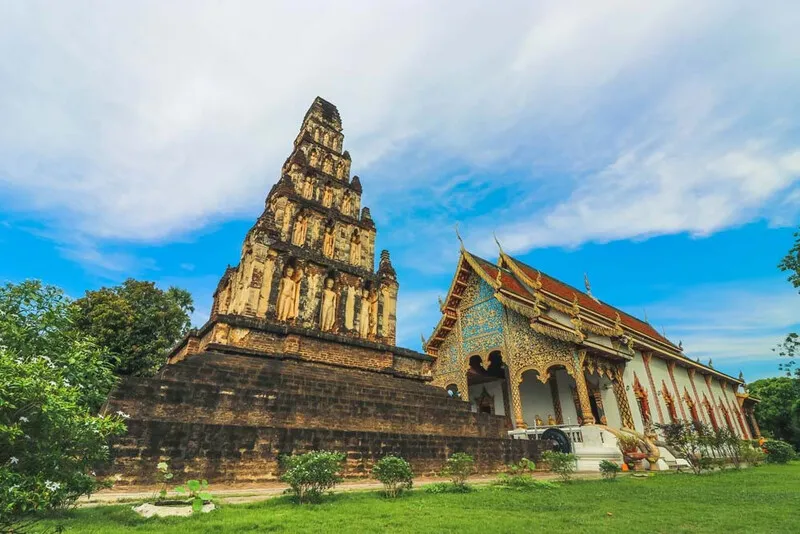
Wat Phra That Doi Wiang is located in Village No. 9, Ban Doi Wiang, Ban Thi Subdistrict, Ban Thi District, Lamphun Province. This ancient hilltop temple is one of Ban Thi’s meaningful religious and cultural sites, known for its old chedi enshrining sacred relics of the Buddha, its connection to local Lanna legends, and its peaceful setting on Doi Wiang hill. The temple is especially suitable for travelers who want to visit a quiet Buddhist site, pay respect to a historic relic chedi, and explore a lesser-known cultural attraction in Lamphun.
The temple stands about 7 km from Ban Thi District and occupies around 15 rai at the lower area of the hill. At the uppermost part of the hill is the sacred Phra That Doi Wiang chedi, which enshrines relics of the Buddha. The location gives the temple a distinctive atmosphere: visitors gradually leave the village area and move toward a calmer hill setting, where the landscape, forested surroundings, and religious structures create a sense of spiritual retreat.
According to local tradition, Wat Phra That Doi Wiang is believed to have been established around 677 CE, corresponding to B.E. 1220, during the era of Queen Chamadevi. A palm-leaf manuscript legend tells of Khun Luang Pala Wicha, who founded a frontier town in this area and built a temple on the hill. This background gives Wat Phra That Doi Wiang historical importance beyond its role as a place of worship. It reflects the settlement pattern, defensive frontier communities, and Buddhist faith of ancient Lamphun.
The temple’s association with Queen Chamadevi places it within the broader historical landscape of Hariphunchai and early Buddhism in northern Thailand. Lamphun has long been regarded as one of the oldest cultural centers in the North, and Doi Wiang’s legend helps connect the temple to the region’s ancient religious and political history. For visitors interested in Lanna heritage, this makes the temple a valuable stop that reveals another layer of Lamphun beyond its better-known monuments in the city center.
In a later period, wildfire spread through the temple grounds and damaged many of the original structures. What remained were the chedi and a small pavilion. This history gives the temple a strong sense of endurance. The surviving chedi is not only an ancient religious monument but also a symbol of local faith that has passed through destruction, abandonment, restoration, and continuous community devotion.
The heart of the temple is the hilltop relic chedi. In Lanna Buddhist culture, a relic chedi is more than an architectural object; it is a sacred center that links the Buddha, the community, ancestral memory, and the surrounding landscape. Climbing or traveling up to pay respect to the chedi carries the feeling of moving from ordinary daily life into a more sacred space. This is one reason hilltop temples in northern Thailand often leave a strong impression on visitors.
Wat Phra That Doi Wiang also preserves 3 important old Buddha images. The first is a bronze Buddha image in the Mara-Vijaya posture, with a lap width of 29 inches. Local people call this image “Phra Chao Sai Fon,” or the Rain Buddha. The name comes from a well-known local story: during a severe drought, villagers invited the image in a rain-seeking procession, and rain later fell. Since then, the community has revered the image as Phra Chao Sai Fon, a sacred symbol of mercy, hope, and agricultural abundance.
The story of Phra Chao Sai Fon reveals how Buddhist faith and farming life are deeply connected in local communities. In many rural areas, rain determines livelihood, rice fields, orchards, and seasonal well-being. A sacred Buddha image associated with rain is therefore not only an object of worship but also a cultural memory of how people faced hardship together through faith and communal ritual.
The second Buddha image has a lap width of 99 inches and is enshrined in the sermon hall. The third has a lap width of 89 inches and is enshrined at the foot of the hill. Both images have laterite cores covered with plaster. When they were discovered, they were incomplete, with their heads partly buried in the ground. Local villagers therefore called them “Phra Chao Dam Din,” meaning the Buddha images that emerged from the earth.
Phra Chao Dam Din gives the temple another compelling layer of history. Buddha images found in a damaged or earth-buried state often suggest periods of abandonment, fire, decay, or disruption in a temple’s past. When the community restored and re-enshrined these sacred images, it was not simply the preservation of old objects; it was the recovery of faith, memory, and identity.
The highest level of the hill is the site of Phra That Doi Wiang chedi. This is the most important point for worshippers and visitors. The peaceful setting, the old chedi, and the hilltop atmosphere create a direct and contemplative experience. The temple is not designed as a busy tourist attraction; its value lies in quiet faith, local legend, and the feeling of an old sacred site still cared for by its community.
Every year, on the 8th waning day of the 7th lunar month, the temple holds the annual relic bathing ceremony. This tradition is one of the most important religious events associated with Wat Phra That Doi Wiang. Local residents and devotees gather to make merit, bathe the relic chedi, and take part in Lanna-style Buddhist rituals. The ceremony represents purification, gratitude, and the continuation of communal faith from generation to generation.
For cultural travelers, the annual relic bathing ceremony is a meaningful time to visit because it shows that Wat Phra That Doi Wiang is still a living temple, not merely an old monument. The event brings together merit-making, offerings, local participation, and reverence for the Buddha’s relics. It demonstrates the temple’s role as a spiritual center for Ban Doi Wiang and the wider Ban Thi community.
The general atmosphere of Wat Phra That Doi Wiang is calm and natural. The temple’s hill setting, its old chedi, and its sacred Buddha images make it an ideal place for quiet merit-making and reflective travel. Visitors should dress respectfully, keep noise low, and move carefully around any sloped or elevated areas. Comfortable footwear is recommended, especially for those who plan to walk around the hilltop and temple grounds.
Getting There is most convenient by private car. From Ban Thi District, travel toward Ban Doi Wiang in Ban Thi Subdistrict for about 7 km. From Lamphun city, head toward Ban Thi District and continue to Ban Doi Wiang. From Chiang Mai, visitors can connect via routes toward Ban Thi, including roads from the San Kamphaeng side, depending on the starting point. Using an online map is helpful, but local directions from villagers can also be useful because the temple is located in a rural hill area.
A good travel plan is to visit Wat Phra That Doi Wiang in the morning, then continue to nearby attractions or cafés in Ban Thi District. Places such as Mae Thi Reservoir, Wat Si Don Chai, and Alpine Golf Resort Chiang Mai can be combined into a half-day or full-day itinerary. This route is suitable for travelers who prefer quiet cultural sites, green scenery, and local community experiences rather than crowded sightseeing routes.
Wat Phra That Doi Wiang is especially suitable for visitors interested in ancient temples in Lamphun, hilltop relic chedis, Queen Chamadevi legends, sacred Buddha images, and traditional Lanna rituals. Its charm does not come from grand decoration but from age, silence, local devotion, and stories that continue to live in the community. A visit here offers a deeper understanding of Ban Thi’s spiritual landscape and the enduring Buddhist heritage of Lamphun Province.
| Name | Wat Phra That Doi Wiang |
| Location | Village No. 9, Ban Doi Wiang, Ban Thi Subdistrict, Ban Thi District, Lamphun Province |
| Address | Ban Doi Wiang, Village No. 9, Ban Thi Subdistrict, Ban Thi District, Lamphun Province |
| Highlights | Hilltop relic chedi, Buddha relics, Phra Chao Sai Fon, Phra Chao Dam Din, annual relic bathing ceremony |
| History | Believed to have been built around B.E. 1220 during the era of Queen Chamadevi; local palm-leaf legend mentions Khun Luang Pala Wicha establishing a frontier town and building a temple on the hill |
| Distinctive Features | Ancient hilltop temple with a relic chedi and 3 old Buddha images, closely connected to Ban Thi’s local legends and community faith |
| Area | Approximately 15 rai at the lower hill area |
| Important Sacred Objects | Phra That Doi Wiang chedi, Phra Chao Sai Fon bronze Buddha image with a 29-inch lap width, Phra Chao Dam Din Buddha images with 99-inch and 89-inch lap widths |
| Annual Tradition | Relic bathing ceremony held every year on the 8th waning day of the 7th lunar month |
| Travel Information | About 7 km from Ban Thi District to Ban Doi Wiang; private car is the most convenient option |
| Current Status | Open to visitors and worshippers |
| Open Days | Open Daily |
| Opening Hours | 06:00 – 18:00 |
| Nearby Tourist Attractions | 1. Mae Thi Reservoir – 3 km 2. Wat Si Don Chai Phra Yuen – 8 km 3. Alpine Golf Resort Chiang Mai – 13 km 4. Wat Phra That Hariphunchai Woramahawihan – 28 km 5. Queen Chamadevi Monument – 29 km |
| Nearby Restaurants | 1. 108 At Loft Coffee – 8 km, Tel. 097 232 9441 2. Chaona Cafe – 13 km, Tel. 095 674 2919 3. Rabiang Doi Khad Fa – 13 km 4. Amfer'cafe – 14 km 5. Imm Farm – 15 km |
| Nearby Accommodations | 1. Baan Suan Homestay By Lamyai Khun Mae – 10 km, Tel. 083 325 0036 2. Alpine Golf Resort Chiang Mai – 13 km, Tel. 053 880 888 3. Baan Suan Punnapat – 14 km, Tel. 084 885 8051 4. The Grand Jamjuree Resort – 31 km 5. Huandalha Resort – 33 km |
Frequently Asked Questions (FAQ)
Q: Where is Wat Phra That Doi Wiang located?
A: Wat Phra That Doi Wiang is located in Village No. 9, Ban Doi Wiang, Ban Thi Subdistrict, Ban Thi District, Lamphun Province, about 7 km from Ban Thi District.
Q: Why is Wat Phra That Doi Wiang important?
A: It is an ancient hilltop temple with a chedi enshrining Buddha relics, connected to the era of Queen Chamadevi and local legends of an old frontier town.
Q: What is Phra Chao Sai Fon?
A: Phra Chao Sai Fon is a 29-inch bronze Buddha image in the Mara-Vijaya posture. According to local belief, villagers once carried it in a rain-seeking procession during drought, after which rain fell.
Q: What are Phra Chao Dam Din Buddha images?
A: They are 2 old Buddha images with lap widths of 99 inches and 89 inches. Their cores are made of laterite and covered with plaster. When discovered, their heads were partly buried in the ground, leading villagers to call them Phra Chao Dam Din.
Q: Does the temple have an annual tradition?
A: Yes. The annual relic bathing ceremony is held every year on the 8th waning day of the 7th lunar month.
Q: How do visitors get to Wat Phra That Doi Wiang?
A: The temple is about 7 km from Ban Thi District toward Ban Doi Wiang. Traveling by private car is the most convenient option because the temple is located in a rural hill area.
Q: Who should visit Wat Phra That Doi Wiang?
A: It is suitable for travelers interested in ancient temples, hilltop relic chedis, Queen Chamadevi legends, local Lanna faith, and quiet cultural tourism in Lamphun.
 Category: ●Places of Worship
 Group: ●Temple
Last Update : 4 MonthAgo
 Last Update : 4 MonthAgo
 Click to Access the Navigation Map GPS
Wat Phra That Doi Wiang Map
Recommend

 Art, Culture and Heritage
 Historical Sites and Monuments(2)
 Landmarks and Memorials(8)
 Art, Craft Centres, Tradition(9)
 Museums(3)
 Historic Homes and Cities(1)
Temple(91)
Historic Homes and Cities(1)
Temple(91)
 Mosque(1)
 Other Sacred Sites(7)
 Research and Development
 Royal Project(1)
 Suburban Living
 Village, Community(13)
 Local Market(3)
 Nature and Wildlife
 National Parks and Marine Reserves(2)
 Mountain (Doi)(1)
 Dam, Reservoir, Lake(13)
 Waterfalls(3)
 Caves(4)
 River, Canal(1)
 Other natural attractions(1)
 Entertainment and Agricultural
 Farms, Parks and Ecotourism(2)


