
lovethailand home >Northeastern Travel Attractions >Buri Ram Travel Attractions >Phutthaisong >Ban Yang > Ban Hua Saphan
TL;DR: Ban Hua Saphan is located at Ban Yang Subdistrict, Phutthaisong District, Buri Ram Province, open Daily, with advance contact recommended for group visits, hours Please contact the weaving group or community coordinator in advance to arrange.

Ban Hua Saphan
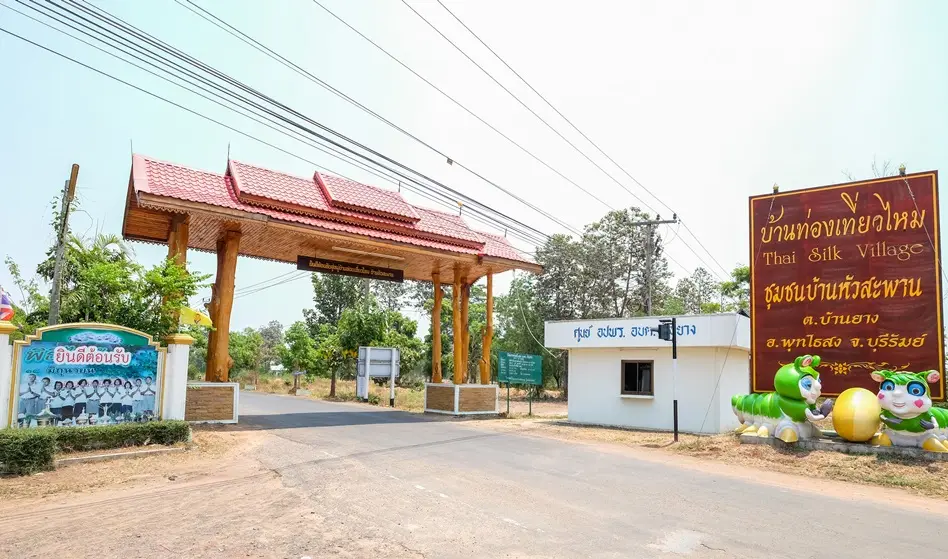
Open Days: Daily, with advance contact recommended for group visits
Opening Hours: Please contact the weaving group or community coordinator in advance to arrange activity sessions
Ban Hua Saphan in Buri Ram Province is a silk tourism community in Ban Yang Subdistrict, Phutthaisong District. The village is known for mulberry cultivation, silkworm raising, silk reeling, dyeing, mudmee tying, hand-weaving, and silk product development. The community organizes its learning activities into several practical bases, including mulberry and silkworm cultivation, silk reeling, silk weaving, silk dyeing, and product processing. Its best-known products include mudmee silk, red-hemmed silk skirts, silk thread, plain silk, shawls, scarves, bags, and handmade silk products. For international travelers, Ban Hua Saphan is one of the most meaningful places in northern Buri Ram to understand living Isan silk heritage directly from local craftspeople.
Ban Hua Saphan is one of the most distinctive silk-weaving communities in Phutthaisong District, Buri Ram Province. Located in Ban Yang Subdistrict, the village is easily reached from Phutthaisong town by Highway 202 toward Phayakkhaphum Phisai. Although it may appear at first to be a quiet rural community, Ban Hua Saphan is in fact an important center of mulberry cultivation, silkworm raising, silk thread production, hand-weaving, and community-based cultural tourism. It is a place where visitors can see Thai silk not only as a finished product, but as a long process of knowledge, labor, patience, and local identity.
The appeal of Ban Hua Saphan lies in its living character. Visitors do not come here only to buy silk from a display shelf. They can learn how a piece of silk begins with mulberry leaves, how silkworms are raised, how cocoons are collected, how silk threads are reeled from cocoons, how threads are washed and dyed, how mudmee patterns are prepared, and how the final cloth slowly appears on a handloom. This complete process gives the community strong educational value for travelers, students, designers, and anyone interested in traditional Thai textiles.
Silk has been part of Ban Hua Saphan’s way of life for generations. Local people have long practiced rice farming as a main occupation while also growing mulberry, raising silkworms, and weaving silk, especially after the harvest season. Over time, what began as household knowledge became an important source of income and identity for the village. In 2010, local producers formally organized the Ban Hua Saphan Mulberry-Growing and Silkworm-Raising Cooperative to strengthen production, improve silk quality, manage products more effectively, and pass the knowledge to younger generations.
The community has gained recognition as a model silk village. Ban Hua Saphan was selected as a nationally outstanding mulberry-growing and silkworm-raising village in 2014. This recognition reflects not only the beauty of its silk, but also the strength of its community system. Many households participate in different stages of production, from mulberry farms and silkworm houses to silk reeling, dyeing, weaving, product development, sales, and tourism reception. This shared structure makes the village a strong example of community-based craft economy in northeastern Thailand.
The learning route of Ban Hua Saphan is organized into several practical bases. Ban Noi, Moo 3, serves as the mulberry and silkworm-raising base. Ban Hua Saphan, Moo 5, is known as the silk-reeling base. Ban Hua Saphan, Moo 13, is the silk-weaving base. Ban Hua Saphan Klang, Moo 14, is the washing and dyeing base. Ban Hua Saphan Mai, Moo 18, is the product-processing base. This structure allows visitors to understand the full silk supply chain rather than seeing only one isolated activity.
The mulberry and silkworm-raising base is the beginning of the story. Mulberry leaves are the essential food of silkworms, and their quality directly affects the health of the worms and the quality of the cocoons. Villagers grow mulberry and use accumulated experience to select leaves at the right stage. Silkworm raising requires cleanliness, ventilation, temperature awareness, protection from insects, and careful feeding according to each growth stage. It is both agricultural work and delicate care.
The life cycle of the silkworm helps visitors understand why silk production requires time. The process begins with eggs, then larvae, cocoons, pupae, and moths. During the larval stage, silkworms feed heavily on mulberry leaves. When they become mature and ready to spin cocoons, villagers move them into special cocooning frames. Timing is important. If mature silkworms are not handled properly, the quality of the cocoon and the silk thread can be affected. This is why silk farming demands close attention every day.
The silk-reeling base is one of the most fascinating parts of the visit. Reeling silk means drawing silk filaments from the cocoons. The cocoons are placed in hot water to soften the natural gum that holds the filaments together. Several fine filaments are then drawn together to form a single usable silk thread. The process may look simple, but it requires trained eyes, steady hands, and careful control of temperature and thread tension. A good silk thread must be strong, smooth, and suitable for later weaving.
After reeling, silk threads must be dried, wound, washed, dyed, and prepared for weaving. Each step affects the final quality of the textile. Some silk threads are suitable for plain weaving, some for mudmee, some for decorative details, and some for processed products. Local knowledge is needed to understand how each type of silk should be handled. This is one reason Ban Hua Saphan remains valuable: it preserves not just weaving skills, but the entire technical knowledge behind silk production.
The dyeing and mudmee stages reveal the artistic heart of Isan silk. Mudmee is an ikat technique in which sections of the silk thread are tied before dyeing so that patterns appear when woven. The pattern is planned before the fabric exists. A weaver or craftsperson must know where to tie, how tightly to tie, how color will settle, and how the pattern will align on the loom. This means that the design of a mudmee cloth begins in the mind and hands of the craftsperson long before the first line of cloth is woven.
The hand-weaving base is where visitors see silk become cloth. The sound of the loom, the movement of the shuttle, the rhythm of hands and feet, and the gradual formation of a textile show the patience required in traditional weaving. A single piece of cloth may take many days or weeks to complete depending on its size and complexity. The value of handmade silk therefore reflects far more than material cost. It includes time, concentration, inherited skill, and the personal rhythm of the weaver.
Ban Hua Saphan is especially known for mudmee silk and red-hemmed silk skirts, known in Thai as pha sin tin daeng. This textile form is strongly associated with Buri Ram and southern Isan culture. The red hem gives the skirt a dignified and auspicious character, making it suitable for ceremonies, festivals, and important family occasions. Traditional and local patterns, including heavenly stairway motifs, rattan fruit motifs, peacock motifs, and applied designs, help connect the cloth with community memory and regional identity.
Alongside traditional patterns, the community also develops applied designs for modern use. Some textiles include metallic thread, adjusted color palettes, or pattern combinations that make the cloth suitable for contemporary clothing and accessories. This does not erase tradition when done carefully. Instead, it helps the craft remain relevant to younger buyers, designers, and travelers who want textiles that can be used in daily life while still carrying a strong cultural story.
Products available from the community include silk thread, mudmee silk, red-hemmed silk skirts, red-bordered mudmee cloth, plain silk, shawls, scarves, pillows, herbal pillows, triangular pillows, bone-shaped pillows, bags, and other handmade silk products. These items are suitable both as meaningful souvenirs and as functional products. Buying directly from the village supports local weavers and helps keep the silk economy within the community.
Ban Hua Saphan is also an excellent educational destination. Families can bring children to learn where silk comes from. Students can study local economy, agricultural craft, textile production, and community organization. Textile designers can observe color use, pattern structures, handloom rhythm, and the relationship between old motifs and contemporary design. Cultural travelers can experience a quieter and deeper side of Buri Ram beyond major temples, stone sanctuaries, or sports tourism.
Visitors should plan enough time for the experience. A short visit may be enough for buying silk, but those who want to understand the complete process should allow at least 1 to 2 hours or more. Some activities, such as silk reeling, dyeing, or mudmee tying, may not take place at every moment of every day. Advance contact is therefore important, especially for groups, study tours, or travelers who want guided demonstrations through multiple bases.
Respectful behavior is essential in a community-based tourism village. Visitors should ask permission before taking photographs of weavers, homes, looms, silk threads, or private working areas. They should not touch cocoons, threads, tools, or finished products without permission. Bargaining should be polite and reasonable because handwoven silk represents many hours of work. Respect for the weaver is part of the value of responsible cultural travel.
The village can be combined with nearby attractions in Phutthaisong and Na Pho districts. Travelers may visit Phra Chao Yai at Wat Hong, Phutthaisong Market, Khlong Phang Chu, Na Pho Handicraft Center, and Prang Ku Suan Taeng. This route gives visitors a broader view of northern Buri Ram, where silk, local temples, ancient monuments, canals, and community life are closely connected. It is a quieter alternative to the more famous southern Buri Ram route around Phanom Rung.
Getting There is easiest by private car. From Phutthaisong town, take Highway 202 toward Phayakkhaphum Phisai for about 3 km to reach the Ban Hua Saphan area. Travelers coming from Buri Ram Airport or the Phayakkhaphum Phisai side can follow Highway 202 toward Phutthaisong; the community is located before reaching Phutthaisong town. The entrance is near local landmarks such as Wat Thep Rangsan School and a highway service point. Online navigation can be set to Ban Hua Saphan Silk Tourism Village, Ban Yang Subdistrict, Phutthaisong District, Buri Ram Province.
Travelers coming from Buri Ram city can drive toward Phutthaisong District and continue onto Highway 202. Because this is a community destination rather than a large formal attraction, advance coordination helps make the visit smoother. It allows the local group to prepare demonstrations, arrange speakers, and guide visitors through the appropriate learning bases.
The best time to visit is in the morning or early afternoon. This gives enough time to observe silk activities and continue to nearby attractions. During the hot season, visitors should bring drinking water, a hat, or an umbrella. During the rainy season, local roads should be checked and travel time should be flexible. Comfortable clothing and shoes are recommended because visitors may walk between community learning points.
In summary, Ban Hua Saphan is more than a silk-selling village. It is a living cultural landscape where mulberry fields, silkworm houses, silk threads, looms, patterns, and family knowledge remain connected. A visit here helps travelers understand that Thai silk is not only beautiful fabric, but also the result of agriculture, patience, design, community cooperation, and intergenerational transmission. For anyone visiting Phutthaisong or northern Buri Ram, Ban Hua Saphan is a meaningful stop for understanding Isan silk heritage at its source.
| Name | Ban Hua Saphan / Ban Hua Saphan Silk Tourism Village / Ban Hua Saphan Weaving Group |
| Location | Ban Yang Subdistrict, Phutthaisong District, Buri Ram Province |
| Address | Ban Hua Saphan, Ban Yang Subdistrict, Phutthaisong District, Buri Ram Province 31120, Thailand |
| Highlights | A silk tourism village and complete mulberry-silk learning center covering mulberry cultivation, silkworm raising, silk reeling, dyeing, mudmee tying, hand-weaving, and silk product processing |
| History / Development | The community has preserved mulberry growing, silkworm raising, and silk weaving for generations. In 2010, local producers established the Ban Hua Saphan Mulberry-Growing And Silkworm-Raising Cooperative to strengthen production and preserve local wisdom. |
| Name Origin | The name Ban Hua Saphan is associated with the local settlement landscape of Ban Yang Subdistrict and is now widely recognized as the name of an important silk tourism community in Buri Ram. |
| Distinctive Features | A community that produces silk from upstream to downstream processes, with clear learning bases and distinctive products such as mudmee silk, red-hemmed silk skirts, and red-bordered mudmee cloth |
| Main Products | Silk Thread, Mudmee Silk, Red-Hemmed Silk Skirts, Red-Bordered Mudmee Cloth, Plain Silk, Shawls, Scarves, Herbal Pillows, Triangular Pillows, Bone-Shaped Pillows, Bags, And Processed Silk Products |
| Main Areas / Learning Bases | 1. Ban Noi, Moo 3, Mulberry And Silkworm-Raising Base 2. Ban Hua Saphan, Moo 5, Silk-Reeling Base 3. Ban Hua Saphan, Moo 13, Silk-Weaving Base 4. Ban Hua Saphan Klang, Moo 14, Silk Washing And Dyeing Base 5. Ban Hua Saphan Mai, Moo 18, Product-Processing Base 6. OTOP Product Building And Community Learning Point 7. Silk Product Display And Sales Area |
| Caretaker / Coordinator | Ban Hua Saphan Weaving Group, Ban Hua Saphan Mulberry-Growing And Silkworm-Raising Cooperative, Community Leaders, And Ban Yang Subdistrict Administrative Organization |
| Contact Numbers | Khun Wanthana Thai Silk Tel. 089-579-8083 Community Learning Center / Cooperative Tel. 087-961-1261 |
| Important Activities | Silk study visits, mulberry cultivation learning, silkworm raising, cocoon selection, silk reeling, silk dyeing, mudmee tying, hand-weaving, product shopping, and community lifestyle learning |
| Current Status | Active silk tourism village, local wisdom learning center, and important silk production community in Phutthaisong District, Buri Ram Province |
| Open Days | Daily, with advance contact recommended for group visits |
| Opening Hours | Please contact the weaving group or community coordinator in advance to arrange activity sessions and demonstrations |
| Fees | General community visits have no admission fee. Group demonstrations, study visits, and arranged activities should be coordinated with the community in advance. |
| Facilities | Community learning center, OTOP product building, silk-weaving demonstration area, silk product sales area, community parking, and group reception area by advance arrangement |
| Travel Information | From Phutthaisong town, take Highway 202 toward Phayakkhaphum Phisai for about 3 km. Travelers coming from the Phayakkhaphum Phisai side will reach Ban Hua Saphan before arriving in Phutthaisong town. |
| Nearby Tourist Attractions | 1. Phutthaisong Market, about 5 km 2. Phra Chao Yai At Wat Hong / Wat Sisa Raet, about 7 km 3. Wat Pa Nong Bua Rong, about 10 km 4. Khlong Phang Chu, Na Pho District, about 12 km 5. Na Pho District Handicraft Center, about 20 km 6. Prang Ku Suan Taeng, Ban Mai Chaiyaphot District, about 30 km |
| Nearby Restaurants | 1. PunThai Coffee Beside Thai Food Phutthaisong, about 5 km, Tel. 092-282-7118 2. Hom Laeng Isan Food And Jim Jum Phutthaisong, about 6 km, Tel. 099-413-5396 3. Bobby Bang Cafe Phutthaisong, about 6 km, Tel. 091-870-0587 4. Lucas Egg Tart Phutthaisong, about 7 km, Tel. 090-952-7817, 085-634-2451 5. Bypass Pub&Restaurant Phutthaisong, about 7 km, Tel. 081-877-8347, 098-127-3748 |
| Nearby Accommodations | 1. Phufa Resort, Ban Yang Subdistrict, about 2 km, Tel. 091-659-2466 2. Rachata Resort, Phutthaisong, about 5 km, Tel. 081-049-2045 3. Pho Fah Rung Resort, Phutthaisong, about 5 km, Tel. 089-424-0367 4. Baan Suan Samran Hotel, Phutthaisong, about 6 km, Tel. 086-871-3301 5. Pran Kamon Resort, Hai Sok Subdistrict, about 7 km, Tel. 080-760-8833 6. Boonmanee Resort, Phutthaisong, about 7 km, Tel. 081-725-7249 |
Frequently Asked Questions (FAQ)
Q: Where is Ban Hua Saphan located?
A: Ban Hua Saphan is located in Ban Yang Subdistrict, Phutthaisong District, Buri Ram Province, Thailand. It is a silk tourism village and an important community-based silk learning center.
Q: What is Ban Hua Saphan famous for?
A: The village is famous for its complete silk production process, including mulberry cultivation, silkworm raising, silk reeling, dyeing, mudmee tying, hand-weaving, and processed silk products.
Q: What learning bases are available in Ban Hua Saphan?
A: The community has learning bases for mulberry and silkworm raising, silk reeling, silk weaving, silk washing and dyeing, and silk product processing, spread across different village areas.
Q: What are the main silk products from Ban Hua Saphan?
A: Main products include silk thread, mudmee silk, red-hemmed silk skirts, red-bordered mudmee cloth, plain silk, shawls, scarves, bags, pillows, and other processed silk products.
Q: Should visitors contact the community before visiting?
A: Yes. Advance contact is recommended, especially for group visits or travelers who want to see several learning bases and live demonstrations.
Q: How can travelers get to Ban Hua Saphan?
A: From Phutthaisong town, take Highway 202 toward Phayakkhaphum Phisai for about 3 km. Travelers coming from the Phayakkhaphum Phisai side will reach Ban Hua Saphan before entering Phutthaisong town.
Q: What nearby places can travelers visit after Ban Hua Saphan?
A: Nearby places include Phra Chao Yai at Wat Hong, Phutthaisong Market, Wat Pa Nong Bua Rong, Khlong Phang Chu, Na Pho District Handicraft Center, and Prang Ku Suan Taeng.
Q: Who should visit Ban Hua Saphan?
A: Ban Hua Saphan is suitable for families, students, study groups, textile designers, Thai craft lovers, cultural travelers, and visitors who want to learn about living Isan silk heritage from local craftspeople.
 Category: ●Suburban Living
 Group: ●Village, Community
Last Update : 3 MonthAgo
 Last Update : 3 MonthAgo
 Click to Access the Navigation Map GPS
 Art, Culture and Heritage
 Historical Sites and Monuments(14)
 Landmarks and Memorials(2)
 Art, Craft Centres, Tradition(6)
 Museums(3)
 Educational Places
 Museum for Study(1)
 Places of Worship
 Temple(74)
 Other Sacred Sites(5)
Village, Community(3)
Other Sacred Sites(5)
Village, Community(3)
 Nature and Wildlife
 National Parks and Marine Reserves(2)
 Mountain (Doi)(1)
 Dam, Reservoir, Lake(14)
 River, Canal(1)
 Bays and Beaches(1)
 Other natural attractions(2)
 Entertainment and Agricultural
 Animal camps and shows(1)
 Stadium(2)
 Farms, Parks and Ecotourism(2)
 Waterpark(1)


