
lovethailand home >Northeastern Travel Attractions >Buri Ram Travel Attractions >Phutthaisong >Mafueang > Wat Manee Chan
TL;DR: Wat Manee Chan is located at Ban Mafueng, Mafueng Subdistrict, Phutthaisong District, Buri Ram Province, Thailand, open Daily, hours 08.00 – 17.00.
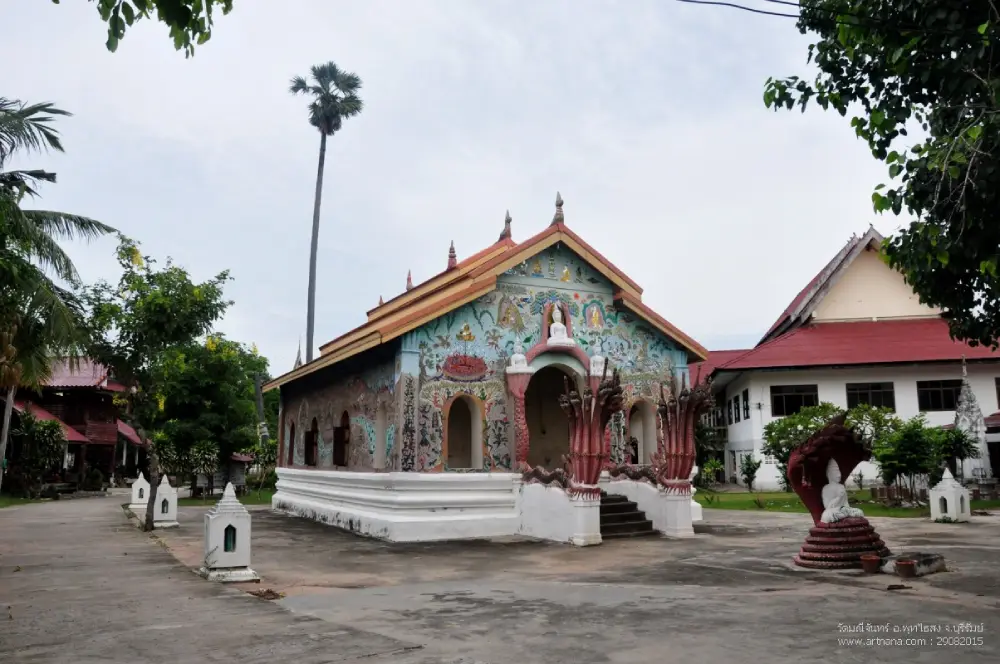
Wat Manee Chan
Open Days: Daily
Opening Hours: 08.00 – 17.00
Wat Manee Chan in Buri Ram Province is an important temple in Ban Mafueng, Mafueng Subdistrict, Phutthaisong District. It is best known for its extraordinary ordination hall decorated on all four exterior sides with colored-glass mosaic art. The temple was founded in 1913 and has long been part of the spiritual and cultural life of the local community. Over time, the ordination hall deteriorated because of age and the area’s saline soil, which damaged the plaster walls. Local abbots and villagers repaired the building as much as they could until a major restoration in 2007 transformed the old ordination hall into one of the most distinctive Buddhist art sites in northeastern Thailand.
The ordination hall of Wat Manee Chan is widely known as a Maha Ut ordination hall, a traditional type of sacred building with only one entrance at the front. In local belief, such a hall carries a special sense of sacred power and ritual importance. What makes this ordination hall exceptional is the colored-glass artwork covering its exterior walls on all four sides. The images tell stories from Buddhist literature, Buddhist history, local culture, community life, social values, and an important national historical event connected with the 60th anniversary of King Rama IX’s accession to the throne.
The major restoration in 2007 was led by Mr. Setthaphan Sernthaisong. The work included replacing the tiled roof, removing the plaster damaged by salt from the soil, and replastering the walls. After the structure was restored, the project continued with the creation of colored-glass murals around the ordination hall. This turned a deteriorating local temple building into a remarkable work of public Buddhist art and a cultural landmark for Ban Mafueng and Phutthaisong District.
The colored-glass art was designed and created by Assistant Professor Asvinee Wanjing, a lecturer in Thai Painting at Chiang Mai University, and Ajarn Udom Wanjing. Their work combined knowledge of Thai painting, local storytelling, Buddhist symbolism, and the demanding technique of cutting and arranging colored glass. Every piece of glass had to be cut and placed carefully to form human figures, animals, objects, architecture, landscape details, and narrative scenes. The result is both a devotional artwork and a visual record of local life.
The artwork at Wat Manee Chan was inspired by the colored-glass art of Wat Xieng Thong in Luang Prabang, Laos, but it has its own distinctive identity. Instead of copying an older style directly, the artists adapted the technique to the life and culture of Phutthaisong. The murals include Buddhist themes, local events, and modern details such as motorcycles and mobile phones. These contemporary images make the temple especially interesting because they show how Buddhist art can include the living world of the present community.
The front wall of the ordination hall presents the story of Phra Malai visiting the three worlds. Phra Malai is one of the most beloved Buddhist literary figures in northeastern Thai religious culture. The story deals with journeys through hell, heaven, and the human world, teaching about karma, impermanence, moral action, and the importance of making merit. By placing this story at the front of the hall, the temple introduces visitors to Buddhist moral reflection before they enter or walk around the sacred space.
The Phra Malai scene is powerful because it is familiar to many Isan communities through sermons, literature, and temple storytelling. Images of suffering remind viewers of the consequences of unwholesome actions, while heavenly scenes express the fruits of merit. The human world represents the place where choices are made. The mural therefore functions not only as decoration but also as a visual teaching tool that communicates Buddhist ideas to people of all ages.
The two side walls of the ordination hall depict important events, cultural practices, social conditions, values, and beliefs of people in Phutthaisong. These scenes are especially valuable because they preserve local life from a particular period in time. Everyday activities, local customs, travel, technology, dress, and community events are all transformed into sacred public art. In this way, Wat Manee Chan becomes a visual archive of the community, not merely a place for worship.
The rear wall of the ordination hall is one of the most important sections. It depicts the historic royal appearance at the balcony of Ananta Samakhom Throne Hall during the celebration of the 60th anniversary of King Rama IX’s reign. This image reflects loyalty, collective memory, and a major moment in modern Thai history. Its placement on the temple wall gives the ordination hall a national historical dimension in addition to its Buddhist and local cultural meanings.
The colored-glass murals change with natural light. In soft sunlight, the images appear gentle and calm. Under stronger light, the glass reflects brighter colors and gives the figures more vivid energy. Visitors who see the ordination hall in the morning and again in the afternoon may feel that the artwork has changed. This is one of the special qualities of colored-glass art: light, time, weather, and the viewer’s position all become part of the experience.
The use of colored glass gives Wat Manee Chan a different character from ordinary painted murals. Glass reflects light and creates its own brightness. The technique requires careful planning because each piece must be cut and placed precisely. Unlike brush painting, mistakes cannot be corrected easily. The artists had to consider composition, color, scale, distance, and the physical shape of the ordination hall before creating each section of the mural.
The ordination hall is therefore a combination of architecture, sacred space, and large-scale community art. Elderly villagers may see the murals as memories of local life. Young people may see them as lessons in local history. Travelers may admire the visual beauty. Buddhist practitioners may reflect on the moral teachings. This ability to speak to many types of viewers is one of the reasons Wat Manee Chan is so meaningful.
The temple also preserves the cultural identity of Phutthaisong. The murals show that local history does not exist only in written records. It can also be preserved in images, colors, stories, and shared memory. When local people see motorcycles, mobile phones, community events, and daily life represented on the ordination hall walls, they see their own time and place recorded as part of a sacred visual narrative.
Wat Manee Chan is a strong example of how temple art can preserve community memory. The murals do not present only distant sacred stories. They also present local people, local customs, and modern life. By placing these images around the ordination hall, the temple gives dignity to the everyday life of the community and connects it with Buddhist values. This makes the temple both a religious place and a cultural learning site.
For visitors interested in Buddhist art, Wat Manee Chan should be explored slowly. The best way to view the site is to begin by paying respect inside the temple area, then walk around the ordination hall from the front to the side walls and finally to the rear. Each wall has a different theme, and all four sides together form a complete visual narrative. Visitors who rush through the site will miss many small details in the colored glass.
The temple is also suitable for students, teachers, artists, and cultural travelers. It can be used as an outdoor classroom for studying Buddhist literature, the Phra Malai story, colored-glass technique, local culture, modern Thai history, and community-based art. Seeing the actual scale of the murals, the reflection of light, and the atmosphere of the temple gives learners a deeper understanding than reading about the artwork alone.
Wat Manee Chan is not a place to visit in a hurry. Visitors should allow at least 45 minutes to one hour to walk around the ordination hall, observe the details, take respectful photographs, and understand the stories on each wall. Morning and late afternoon are especially good times for visiting because the natural light softens the colors and makes the glass reflections more beautiful. Midday light gives a stronger and sharper view of the glass pieces.
Visitors should behave respectfully because Wat Manee Chan remains an active Buddhist temple. Shoulders and knees should be covered, shoes should be removed before entering sacred areas, and voices should be kept low. Visitors should not touch the colored-glass walls because the artwork is delicate and important to the community. Photography should be done without disturbing monks or local worshippers.
Getting There is convenient from Phutthaisong Market. Travel east from the market toward the traffic-light intersection, then continue straight for about 1 kilometer to Ban Mafueng, where the temple is located. Travelers coming from Buri Ram city can drive toward Phutthaisong District and continue to Mafueng Subdistrict. The temple is close enough to the district center to be included in a half-day cultural route.
A practical Phutthaisong cultural route can begin at Wat Manee Chan, then continue to Phra Chao Yai at Wat Hong, Bueng Sa Bua, Wat Pa Nong Bua Rong, Loeng Bo Water Park, and nearby community attractions. Travelers with more time can continue to nearby districts such as Khu Mueang or Ban Mai Chaiyaphot to explore more temples and local learning sites in northern Buri Ram.
Restaurants and cafés are available in Phutthaisong town, including local Thai restaurants, Isan food restaurants, cafés, coffee shops, and casual dining places. Several small resorts and local accommodations are also available in and around Phutthaisong. This makes it possible to stay overnight and explore Wat Manee Chan, Wat Hong, Bueng Sa Bua, and other nearby attractions without rushing.
For foreign visitors, Wat Manee Chan offers a different perspective on Thai Buddhist art. It is not an ancient Khmer monument or a large royal temple. Instead, it is a local community temple where Buddhist faith, glass art, local memory, and modern life come together. The colored-glass murals show that Thai temple art can continue to evolve while still serving Buddhist devotion and community identity.
In summary, Wat Manee Chan is one of the most distinctive temples in Phutthaisong District, Buri Ram Province. Its Maha Ut ordination hall, colored-glass murals on all four sides, Phra Malai story, local cultural scenes, and historical image of King Rama IX’s 60th reign anniversary make it an important site for visitors interested in Buddhist art, Isan culture, community history, and meaningful temple travel in Thailand.
| Name | Wat Manee Chan |
| Location | Ban Mafueng, Mafueng Subdistrict, Phutthaisong District, Buri Ram Province, Thailand |
| Address | Ban Mafueng, Moo 1, Mafueng Subdistrict, Phutthaisong District, Buri Ram 31120, Thailand |
| Highlights | A Maha Ut ordination hall decorated with colored-glass murals on all four exterior sides, telling stories of Phra Malai, Buddhist history, local life, community culture, and modern Thai history |
| History | The temple was founded in 1913. The important local-style ordination hall was built around 1939 – 1941 and was extensively restored in 2007 after deterioration caused by age and saline soil conditions |
| Distinctive Features | A Maha Ut ordination hall with a single front entrance and distinctive colored-glass mosaic art around the building |
| Major Restoration | Mr. Setthaphan Sernthaisong led the major 2007 restoration, including roof replacement, removal of damaged plaster, replastering, and the creation of colored-glass murals |
| Artists And Designers | Assistant Professor Asvinee Wanjing of the Thai Painting Department, Chiang Mai University, and Ajarn Udom Wanjing |
| Artistic Inspiration | Inspired by the colored-glass art of Wat Xieng Thong in Luang Prabang, while creating a unique local identity through Phutthaisong community life, modern technology, and local cultural scenes |
| Important Elements | Maha Ut ordination hall, colored-glass murals on four sides, principal Buddha image worship area, temple courtyard, and local cultural learning space |
| Mural Stories | The front wall shows Phra Malai visiting the three worlds. The two side walls show local events, community life, social conditions, values, and beliefs of Phutthaisong people. The rear wall shows the historic royal appearance at Ananta Samakhom Throne Hall during King Rama IX’s 60th reign anniversary |
| Artistic Value | A colored-glass mosaic artwork combining Buddhist literature, Buddhist art, national history, and contemporary Isan community life within a single sacred building |
| Resident Monks | 1 monk |
| Travel Information | From Phutthaisong Market, travel east to the traffic-light intersection and continue straight for about 1 kilometer to Ban Mafueng, where the temple is located |
| Current Status | Open as a local Buddhist temple and cultural learning site of Phutthaisong District |
| Open Days | Daily |
| Opening Hours | 08.00 – 17.00 |
| Facilities | Worship area, ordination hall, temple courtyard, walking area for viewing colored-glass murals, and local cultural learning space |
| Main Areas / Zones | Maha Ut Ordination Hall Zone Front Phra Malai Mural Zone Side Local Life And Culture Mural Zones Rear Historical Mural Zone Principal Buddha Image Worship Zone Temple Courtyard And Respectful Photography Zone |
| Nearby Tourist Attractions | 1. Phra Chao Yai At Wat Hong / Wat Hong Buri Ram, about 3 km 2. Bueng Sa Bua, about 3 km 3. Wat Pa Nong Bua Rong, about 13 km 4. Loeng Bo Water Park, Hai Sok Subdistrict, about 14 km 5. Khlong Phang Chu, Na Pho District, about 15 km 6. Dictionary Park, about 25 km 7. Play La Ploen, Khu Mueang District, about 35 km |
| Nearby Restaurants | 1. Bobby Bang Cafe Phutthaisong, about 3 km, Tel. 091-870-0587 2. Growth Cafe’ Bistro & Bar, about 3 km, Tel. 096-168-7699 3. Bypass Pub & Restaurant Phutthaisong, about 4 km, Tel. 081-877-8347 4. Hom Laeng Isan Food And Jim Jum Phutthaisong, about 4 km, Tel. 099-413-5396 5. Krua Baifern Phutthaisong, about 3 km, Tel. 062-170-8994 6. Baifern / Baifern Food And Mart, about 3 km, Tel. 044-655-434 |
| Nearby Accommodations | 1. Rachata Resort, about 3 km, Tel. 081-049-2045 2. Phufa Resort, about 8 km, Tel. 091-659-2466, 091-662-2646, 092-879-2694 3. Prankamon Resort, about 10 km, Tel. 080-760-8833 4. Suan Palm Resort, about 11 km, Tel. 081-113-9806 5. Pho Fa Rung Resort, about 4 km, Tel. 089-424-0367 |
Frequently Asked Questions (FAQ)
Q: Where is Wat Manee Chan located?
A: Wat Manee Chan is located in Ban Mafueng, Mafueng Subdistrict, Phutthaisong District, Buri Ram Province, not far from Phutthaisong Market.
Q: What is the main highlight of Wat Manee Chan?
A: The main highlight is the Maha Ut ordination hall decorated with colored-glass murals on all four exterior sides, telling stories of Phra Malai, Buddhist history, local life, and national history.
Q: When was Wat Manee Chan established?
A: Wat Manee Chan was founded in 1913. The important local-style ordination hall was built around 1939 – 1941 and was extensively restored in 2007.
Q: Who designed the colored-glass murals at Wat Manee Chan?
A: The colored-glass murals were designed and created by Assistant Professor Asvinee Wanjing and Ajarn Udom Wanjing.
Q: What stories are shown on the four walls of the ordination hall?
A: The front wall shows Phra Malai visiting the three worlds. The side walls show local life, culture, and important events in Phutthaisong. The rear wall shows the historic royal appearance during King Rama IX’s 60th reign anniversary.
Q: What type of travelers should visit Wat Manee Chan?
A: Wat Manee Chan is suitable for travelers interested in beautiful temples in Buri Ram, Isan Buddhist art, colored-glass murals, local culture, community history, and respectful temple photography.
Q: What attractions can be visited together with Wat Manee Chan?
A: Nearby attractions include Phra Chao Yai at Wat Hong, Bueng Sa Bua, Wat Pa Nong Bua Rong, Loeng Bo Water Park, Khlong Phang Chu, Dictionary Park, and Play La Ploen.
Q: How should visitors behave at Wat Manee Chan?
A: Visitors should dress respectfully, keep quiet, avoid touching the colored-glass walls, take photos respectfully, and treat the temple as an active sacred place of the local community.
 Category: ●Places of Worship
 Group: ●Temple
Last Update : 1 MonthAgo
 Last Update : 1 MonthAgo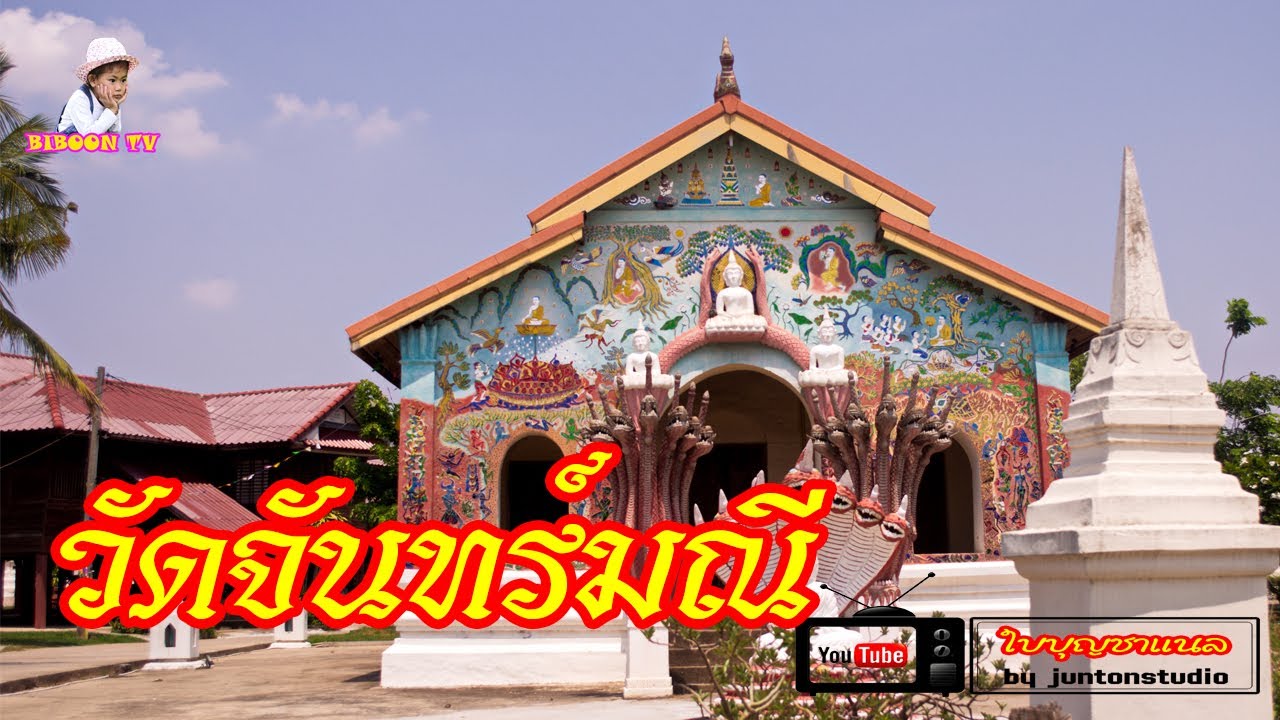
 Click to Access the Navigation Map GPS
Wat Manee Chan Map
Recommend

 Art, Culture and Heritage
 Historical Sites and Monuments(14)
 Landmarks and Memorials(2)
 Art, Craft Centres, Tradition(6)
 Museums(3)
 Educational Places
 Museum for Study(1)
Temple(74)
Museum for Study(1)
Temple(74)
 Other Sacred Sites(5)
 Suburban Living
 Village, Community(3)
 Nature and Wildlife
 National Parks and Marine Reserves(2)
 Mountain (Doi)(1)
 Dam, Reservoir, Lake(14)
 River, Canal(1)
 Bays and Beaches(1)
 Other natural attractions(2)
 Entertainment and Agricultural
 Animal camps and shows(1)
 Stadium(2)
 Farms, Parks and Ecotourism(2)
 Waterpark(1)


