
lovethailand home >Northeastern Travel Attractions >Buri Ram Travel Attractions >Prakhon Chai >Chorakhe Mak > Kuti Ruesi Ban Khok Mueang
TL;DR: Kuti Ruesi Ban Khok Mueang is located at Moo 6, Ban Khok Mueang, Chorakhe Mak Subdistrict, Prakhon Chai District, Buriram Province, open Daily, hours 06.00 – 18.00.
Kuti Ruesi Ban Khok Mueang
Open Days: Daily
Opening Hours: 06.00 – 18.00
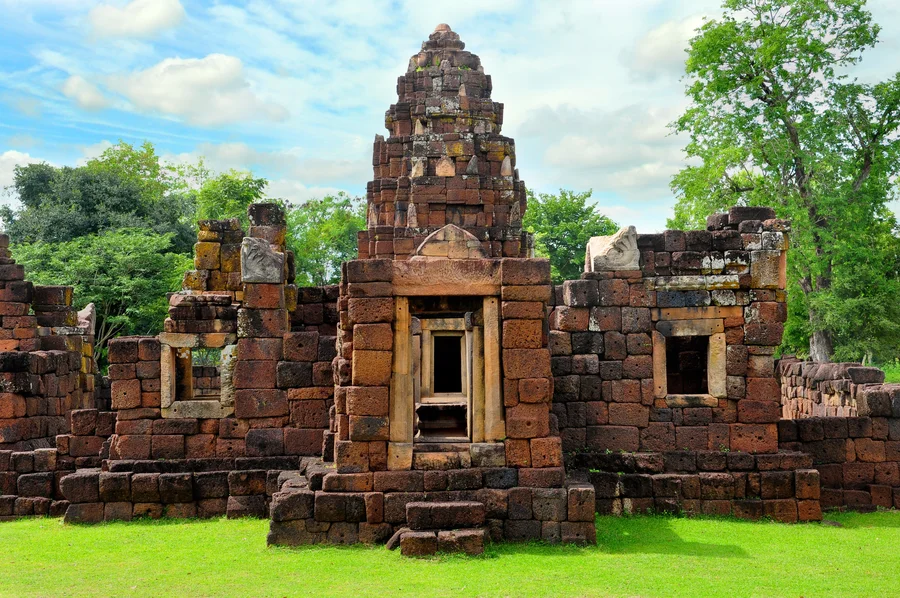
Kuti Ruesi Ban Khok Mueang, also known as Kuti Ruesi Khok Mueang or Kuti Ruesi Mueang Tam, is a small but important Khmer Arokayasala, or ancient healing sanctuary, in Ban Khok Mueang, Chorakhe Mak Subdistrict, Prakhon Chai District, Buriram Province. Located about 1 km south of Prasat Mueang Tam, the site features a laterite main sanctuary tower, a library-like building, an enclosure wall, an eastern gateway, a sacred pond, and decorative fragments such as lintels, Naga forms, makara spitting Naga motifs, and lotus elements. It is one of the key sites for understanding the Mahayana Buddhist medical and religious network around Prasat Mueang Tam and Phanom Rung.
Kuti Ruesi Ban Khok Mueang is a compact yet highly meaningful Khmer archaeological site in Ban Khok Mueang, Chorakhe Mak Subdistrict, Prakhon Chai District, Buriram Province. Because it stands close to Prasat Mueang Tam, it is sometimes called Kuti Ruesi Mueang Tam, a name that helps distinguish it from Kuti Ruesi Nong Bua Rai near the foot of Phanom Rung. Although the monument is smaller than the famous Khmer sanctuaries nearby, it plays an important role in explaining the ancient cultural landscape of Ban Khok Mueang, where temples, reservoirs, healing sanctuaries, communities, and travel routes formed one connected system.
The location of Kuti Ruesi Ban Khok Mueang is especially important. It stands in the ancient community zone around Prasat Mueang Tam and Baray Mueang Tam, within the broader cultural landscape connected to Phanom Rung. This area should not be viewed as a single attraction but as a network of related places. Prasat Mueang Tam represents a major lowland Khmer sanctuary. Baray Mueang Tam represents the ancient water system and community reservoir. Kuti Ruesi Ban Khok Mueang represents the healing and religious infrastructure that supported people living and traveling within this landscape.
The monument consists of a laterite sanctuary tower with sandstone elements. Sandstone appears especially around the doorway, door frame, and architectural details that required strength or fine finishing. The eastern entrance projects outward as a porch, while the other 3 sides are false doors, a common feature in Khmer sacred architecture. The east-facing entrance is significant because the east is associated with sunrise, beginning, purification, and ritual entry. The false doors help balance the architectural form and give the tower a complete sacred presence on all 4 sides.
The main sanctuary tower is made of laterite and sandstone. Its base has a square plan with 12 recessed corners and measures about 7 x 7 meters. On the east side, the projecting porch forms the entrance and measures about 2.20 x 3.20 meters. The recessed-corner plan gives rhythm to the structure and prevents the building from appearing as a simple block. Laterite provides strength and mass, while sandstone allows for better detailing around important architectural elements.
Inside the same sacred compound is a library-like building, or bannalai, made of laterite and sandstone. It stands in the southeast part of the enclosure and measures about 4 x 7.50 meters. The building has double doorways and no windows. In Khmer sanctuary plans, a bannalai is usually associated with sacred texts, ritual objects, or auxiliary religious functions. Its presence at Kuti Ruesi Ban Khok Mueang shows that the site was not just a single shrine but a structured religious compound with several functional zones.
The main tower and the bannalai are enclosed by a laterite wall, or kamphaeng kaeo. The enclosure measures about 26.70 x 35.40 meters and has its main gateway on the east. The eastern gateway is built of laterite with sandstone door frames and is divided into 3 chambers. The side chambers have window openings, while the central chamber includes front and rear projecting porches. This gateway was not merely an entrance. It created a formal transition from the outer world into the sacred medical and religious compound.
The decorative fragments at Kuti Ruesi Ban Khok Mueang are particularly interesting. They include lintels, Naga forms, makara spitting Naga motifs, lotus elements, and other carved architectural pieces. Some of these fragments do not appear fully consistent with the main tower and enclosure, suggesting that older architectural elements may have been reused in a later construction phase. This gives the site an important layered character: an earlier sacred structure may have existed here around the 11th to 12th centuries, before the site was later adapted or rebuilt as a Mahayana Buddhist Arokayasala during the 13th century.
As an Arokayasala, Kuti Ruesi Ban Khok Mueang differs in meaning from Prasat Mueang Tam. An Arokayasala in the reign of King Jayavarman VII was not a hospital in the modern clinical sense. It was a religious healing sanctuary where medical care, worship, water, ritual, and royal merit were connected. Such sites commonly included a main shrine, a library-like building, an enclosure wall, an entrance gateway, and a sacred pond. These elements are clearly present at Kuti Ruesi Ban Khok Mueang, making it one of the important examples of Khmer healing sanctuaries in Buriram.
In Mahayana Buddhist belief, Arokayasala sites are often associated with Bhaisajyaguru, the Medicine Buddha. Healing in the ancient world was not separated from religion in the way it is today. Patients or travelers may have come to such a site to rest, use water, pray, perform rituals, and seek both physical and spiritual well-being. Kuti Ruesi Ban Khok Mueang therefore preserves evidence of how ancient Khmer society understood care, illness, merit, and sacred protection.
The sacred pond of the monument is located at the northeastern corner of the site. To the east, along the central axis, lies a much larger reservoir known as Baray Mueang Tam or Thale Mueang Tam, measuring about 500 x 800 meters. These water features are essential for understanding the site. Water was important for practical use, ritual purification, healing, agriculture, and sacred landscape design. The relationship between the small pond, the large baray, the healing sanctuary, and the nearby temple shows how water shaped the ancient community around Ban Khok Mueang.
When viewed together with Prasat Mueang Tam, Kuti Ruesi Ban Khok Mueang becomes even more meaningful. Prasat Mueang Tam is a large Hindu sanctuary with a refined plan, 4 symbolic ponds, and elegant sandstone carvings. Kuti Ruesi Ban Khok Mueang is smaller, but it represents healing, care, and Mahayana Buddhist practice. The 2 sites are very close to each other and both belong to the same ancient community landscape. Visiting them together gives travelers a fuller understanding of how Khmer religious life was organized on the lowland around Phanom Rung.
The site was officially registered as an archaeological monument in the Royal Gazette, Volume 52, Section 75, on March 8, 1935. Its protected boundary was later defined in the Royal Gazette, Volume 99, Section 155, on October 21, 1982, covering 3 rai, 2 ngan, and 70 square wah. This official protection confirms its national cultural value. Visitors should therefore treat the site carefully: do not climb on the ruins, move stones, scratch laterite or sandstone surfaces, or disturb architectural fragments.
Another important aspect of Kuti Ruesi Ban Khok Mueang is its connection with the living community. Ban Khok Mueang is an active community tourism destination with stories around Prasat Mueang Tam, Baray Mueang Tam, silk weaving, baray-mud tie-dye products, local crafts, cycling routes, and seasonal food culture such as phat kung chom. A visit to the healing sanctuary can therefore be combined with community-based travel, allowing visitors to connect ancient heritage with present-day local life.
For general visitors, 30 to 45 minutes is usually enough to explore Kuti Ruesi Ban Khok Mueang. Begin at the eastern gateway, then walk into the enclosure to observe the main tower, bannalai, enclosure wall, decorative fragments, and sacred pond. Visitors interested in art history should spend more time studying the sandstone and laterite elements, especially lintels, Naga forms, makara motifs, and lotus decorations. These details reveal the layered history of the site.
The best time to visit is in the morning or late afternoon, when the light is softer and the laterite surfaces are more photogenic. The site can also be combined easily with Prasat Mueang Tam and Baray Mueang Tam on the same walk or short drive. During the midday heat, visitors should bring drinking water, a hat, and comfortable shoes. Some ground surfaces are uneven, so walking carefully around the architectural bases and stone fragments is important.
Getting There is easiest by private car, rental car, or hired local vehicle. From Prasat Mueang Tam, travel about 1 km south to reach Kuti Ruesi Ban Khok Mueang. From Buriram city, drive toward Prakhon Chai District, continue to Chorakhe Mak Subdistrict, and enter the Ban Khok Mueang community area. This route can be combined with Prasat Mueang Tam, Baray Mueang Tam, Prasat Ban Bu, Phanom Rung Historical Park, and Wat Khao Angkhan in one day.
For deeper cultural travel, visitors may begin at Kuti Ruesi Ban Khok Mueang to understand the Arokayasala healing tradition, continue to Prasat Mueang Tam to explore a major Khmer sanctuary, then walk or drive to Baray Mueang Tam to understand the ancient water system. The route can then extend to Prasat Ban Bu, a Khmer travelers’ rest house, and Phanom Rung, the great mountain sanctuary. This sequence clearly shows that Ban Khok Mueang was not an isolated temple area but a complete cultural system of religion, healing, travel, water, and settlement.
Kuti Ruesi Ban Khok Mueang is therefore a small site that should not be overlooked. Its value lies in the way it opens another side of Khmer civilization: the care of people, the relationship between healing and religion, and the integration of sacred architecture with water and community life. A visit here before or after Prasat Mueang Tam makes the journey through Ban Khok Mueang more meaningful and gives travelers a deeper understanding of Buriram as a land of Khmer stone monuments and layered cultural memory.
| Name | Kuti Ruesi Ban Khok Mueang |
| Alternative Names | Kuti Ruesi Khok Mueang, Kuti Ruesi Mueang Tam |
| Location | Moo 6, Ban Khok Mueang, Chorakhe Mak Subdistrict, Prakhon Chai District, Buriram Province |
| Address | Ban Khok Mueang, Chorakhe Mak Subdistrict, Prakhon Chai District, Buriram 31140, Thailand |
| Highlights | A Khmer Arokayasala Near Prasat Mueang Tam, With A Laterite Main Tower, Bannalai, Enclosure Wall, Eastern Gateway, Sacred Pond, And Decorative Fragments Including Naga, Makara Spitting Naga, And Lotus Motifs |
| History | Architectural Fragments Relate To The 11th To 12th Centuries, While The Overall Arokayasala Plan Reflects Mahayana Buddhist Healing Sanctuaries Popular In The 13th Century During The Reign Of King Jayavarman VII |
| Name Origin | Named After Ban Khok Mueang, The Local Community Where The Site Is Located. The Name Kuti Ruesi Mueang Tam Is Also Used Because The Site Stands Close To Prasat Mueang Tam. |
| Distinctive Features | The Main Tower Is Built Of Laterite And Sandstone, With A Square Base Of About 7 x 7 Meters And 12 Recessed Corners. The Eastern Side Has A Projecting Entrance Porch, While The Other 3 Sides Are False Doors. |
| Main Areas / Zones | 1. Main Laterite And Sandstone Sanctuary Tower 2. Eastern Entrance Porch 3. Three False Doors Of The Main Tower 4. Bannalai In The Southeast Part Of The Enclosure 5. Laterite Enclosure Wall 6. Three-Chamber Eastern Gateway 7. Sacred Pond At The Northeastern Corner 8. Baray Mueang Tam Or Thale Mueang Tam To The East |
| Key Evidence | Laterite Sanctuary Tower, Bannalai, Lintels, Naga Forms, Makara Spitting Naga Motifs, Lotus Elements, Sandstone Door Frames, Enclosure Wall, Gateway, And Sacred Pond Of The Arokayasala |
| Registration | Registered In The Royal Gazette, Volume 52, Section 75, On March 8, 1935, With Protected Boundary Defined On October 21, 1982, Covering 3 Rai, 2 Ngan, And 70 Square Wah |
| Travel Information | Located About 1 Km South Of Prasat Mueang Tam. Best Reached By Private Car, Rental Car, Or Hired Local Vehicle From Prakhon Chai, Nang Rong, Or Buriram City. |
| Current Status | Important Archaeological Site In Ban Khok Mueang Community, Near Prasat Mueang Tam And Baray Mueang Tam |
| Open Days | Daily |
| Opening Hours | 06.00 – 18.00 |
| Facilities | Community Parking Area, Walking Access To The Monument, Outdoor Learning Area, Community Cycling Route, Local Shops, And Ban Khok Mueang Community Tourism Activities |
| Caretaker | The Fine Arts Department Through Phanom Rung Historical Park, Together With Ban Khok Mueang Community In The Local Area |
| Main Contact Number | Phanom Rung Historical Park, Tel. 044-666-251 Ban Khok Mueang Community Tourism And Homestay Coordinator, Tel. 088-193-8840 |
| Nearby Tourist Attractions | 1. Prasat Mueang Tam, About 1 Km 2. Baray Mueang Tam Or Thale Mueang Tam, About 1 Km 3. Prasat Ban Bu, About 3 Km 4. Prasat Khao Plai Bat, About 3 Km 5. Phanom Rung Historical Park, About 8 Km 6. Kuti Ruesi Ban Nong Bua Lai, About 8 Km 7. Wat Khao Angkhan, About 22 Km |
| Nearby Restaurants | 1. NATEE Cafe’ Buriram, About 12 Km, Tel. 098-197-8004 2. Ran Laang Wang Prakhon Chai, About 16 Km, Tel. 084-605-4324 3. Sobhlasta Restaurant At Eireann Boutique Hotel, About 17 Km, Tel. 087-493-9919, 044-666-199 4. Le Loft Bar & Restaurant, About 26 Km, Tel. 094-310-9913 5. Steve & Lek Restaurant, About 26 Km |
| Nearby Accommodations | 1. Ban Khok Mueang Community Homestay, About 1 Km, Tel. 088-193-8840 2. Hotel De L’amour Buriram, About 16 Km, Tel. 098-102-7809, 044-651-555 3. Eireann Boutique Hotel, About 17 Km, Tel. 087-493-9919, 044-666-199 4. Sohground Boutique Resort, About 18 Km, Tel. 080-488-3183 5. Phanomrungpuri Hotel, About 28 Km, Tel. 044-632-222, 086-336-6618 6. Alvarez Hotel Buriram, About 58 Km, Tel. 044-611-555 |
Frequently Asked Questions (FAQ)
Q: Where Is Kuti Ruesi Ban Khok Mueang Located?
A: It is located at Moo 6, Ban Khok Mueang, Chorakhe Mak Subdistrict, Prakhon Chai District, Buriram Province, about 1 km south of Prasat Mueang Tam.
Q: Are Kuti Ruesi Ban Khok Mueang And Kuti Ruesi Mueang Tam The Same Place?
A: Yes. They refer to the same site. The name Kuti Ruesi Mueang Tam is used because the monument stands close to Prasat Mueang Tam and helps distinguish it from Kuti Ruesi Nong Bua Rai near Phanom Rung.
Q: Why Is Kuti Ruesi Ban Khok Mueang Important?
A: It is a Khmer Arokayasala, or healing sanctuary, showing the connection between Mahayana Buddhism, healing practice, water, and the ancient religious network around Prasat Mueang Tam.
Q: What Are The Main Highlights Of The Site?
A: The highlights include the laterite main tower, bannalai, enclosure wall, eastern gateway, sacred pond, and decorative fragments such as lintels, Naga forms, makara spitting Naga motifs, and lotus elements.
Q: When Was Kuti Ruesi Ban Khok Mueang Built?
A: Some decorative elements relate to the 11th to 12th centuries, while the Arokayasala plan reflects Mahayana Buddhist healing sanctuaries popular in the 13th century during the reign of King Jayavarman VII.
Q: What Nearby Places Should Be Visited Together With This Site?
A: Nearby places include Prasat Mueang Tam, Baray Mueang Tam, Prasat Ban Bu, Prasat Khao Plai Bat, Phanom Rung Historical Park, Kuti Ruesi Ban Nong Bua Lai, and Wat Khao Angkhan.
Q: How Can Travelers Get There?
A: From Prasat Mueang Tam, travel about 1 km south. The site is best reached by private car, rental car, or hired local vehicle from Prakhon Chai, Nang Rong, or Buriram city.
Q: What Should Visitors Be Careful About?
A: Visitors should dress respectfully, avoid climbing on the ruins, not move laterite or sandstone fragments, avoid scratching the monument, and keep the community area clean.
 Category: ●Art, Culture and Heritage
 Group: ●Historical Sites and Monuments
Last Update : 3 MonthAgo
 Last Update : 3 MonthAgo
 Click to Access the Navigation Map GPS
Kuti Ruesi Ban Khok Mueang Map
Recommend
 Historical Sites and Monuments(14)
 Landmarks and Memorials(2)
 Art, Craft Centres, Tradition(6)
 Museums(3)
 Educational Places
 Museum for Study(1)
 Places of Worship
 Temple(74)
 Other Sacred Sites(5)
 Suburban Living
 Village, Community(3)
 Nature and Wildlife
 National Parks and Marine Reserves(2)
 Mountain (Doi)(1)
 Dam, Reservoir, Lake(14)
 River, Canal(1)
 Bays and Beaches(1)
 Other natural attractions(2)
 Entertainment and Agricultural
 Animal camps and shows(1)
 Stadium(2)
 Farms, Parks and Ecotourism(2)
 Waterpark(1)


