
lovethailand home >Northeastern Travel Attractions >Buri Ram Travel Attractions >Muang Buri Ram >Samet > Huai Chorakhe Mak Reservoir
TL;DR: Huai Chorakhe Mak Reservoir is located at Ban Bua, Samet, And Sakae Phrong Subdistricts, Mueang Buriram District, Buriram Province, open Daily.

Huai Chorakhe Mak Reservoir
Open Days: Daily
Recommended Visiting Time: Morning To Late Afternoon
Huai Chorakhe Mak Reservoir in Buriram Province is a large freshwater reservoir located in Mueang Buriram District, covering areas of Ban Bua, Samet, and Sakae Phrong subdistricts. It lies along the Buriram–Prakhon Chai route, about 10–13 km from Buriram city. Today, the reservoir area is closely connected with Buriram Irrigation Project and the city’s water-supply system, making it important not only as a public recreation site but also as a working water-management landscape for irrigation, water storage, and daily urban use.
The most immediate appeal of Huai Chorakhe Mak Reservoir is its wide, lake-like freshwater surface. The area is shaded by trees and has a calm atmosphere that makes it popular with local residents for walking, relaxing, exercising, photography, and spending quiet time near the water. It is not a heavily commercialized tourist attraction. Its value comes from the open landscape, the breeze over the reservoir, the shade of mature trees, and the simple feeling of being close to nature just outside the city.
Huai Chorakhe Mak Reservoir was built in 1962 for irrigation and water-supply purposes. Covering approximately 3,876 rai, it is one of the important reservoirs serving Buriram. Its role in water management is significant because it stores water, supports agricultural use, and contributes to the broader water system of the city. The presence of Buriram Irrigation Project at the reservoir also shows how the site functions as both a public landscape and a government-managed water infrastructure area.
The reservoir sits in a lowland catchment that receives water from surrounding areas. During the rainy season, the water level rises and the reservoir becomes broad and full. During the dry season, the water level drops, creating shallow zones and exposed edges that are useful for waterbirds and other wetland wildlife. The surrounding area is relatively flat, with communities and agricultural land nearby. This makes the reservoir closely connected to everyday local life, including water use, farming, recreation, and public space.
Beyond its irrigation and water-supply role, Huai Chorakhe Mak Reservoir is also important for biodiversity. It is part of Huai Chorakhe Mak Reservoir Non-Hunting Area, a protected wetland landscape that provides habitat for waterbirds, migratory birds, fish, aquatic plants, and other forms of wildlife. The reservoir is therefore not only a water body for people, but also a living wetland ecosystem. Visitors should approach the area with respect because people, water infrastructure, and wildlife all share the same space.
One of the most important conservation stories connected with Huai Chorakhe Mak Reservoir is the reintroduction of the Eastern Sarus Crane in Thailand. The area is recognized as the first experimental release site for Thai Sarus Cranes, a species that had once nearly disappeared from the wild in the country. The presence of this conservation program reflects the quality of the surrounding wetland environment, which provides open space, water, feeding areas, and habitat conditions suitable for large wetland birds.
For birdwatchers, Huai Chorakhe Mak Reservoir is a meaningful destination. Bird species associated with the area include the Eastern Sarus Crane, Baer’s pochard, purple heron, intermediate egret, red-throated pipit, sand martin, Australasian pipit, eastern marsh harrier, pied harrier, Pacific golden plover, and yellow-breasted bunting. These species reflect the ecological importance of the reservoir as a wetland habitat. Casual visitors may come for scenery, but those who look more carefully will see that the reservoir supports a much richer natural system.
The reservoir ecosystem also includes fish and aquatic vegetation. Fish species recorded from the area include several members of the carp family, such as Hampala barb, Cyclocheilichthys, rohu, and Siamese mud carp. Around the reservoir, wetland plants such as sedges, reeds, lotus, hornwort, floating water plants, morning glory, and water hyacinth help create shelter, feeding grounds, and breeding areas for wildlife. This makes Huai Chorakhe Mak more than a scenic lake. It is a functioning freshwater wetland.
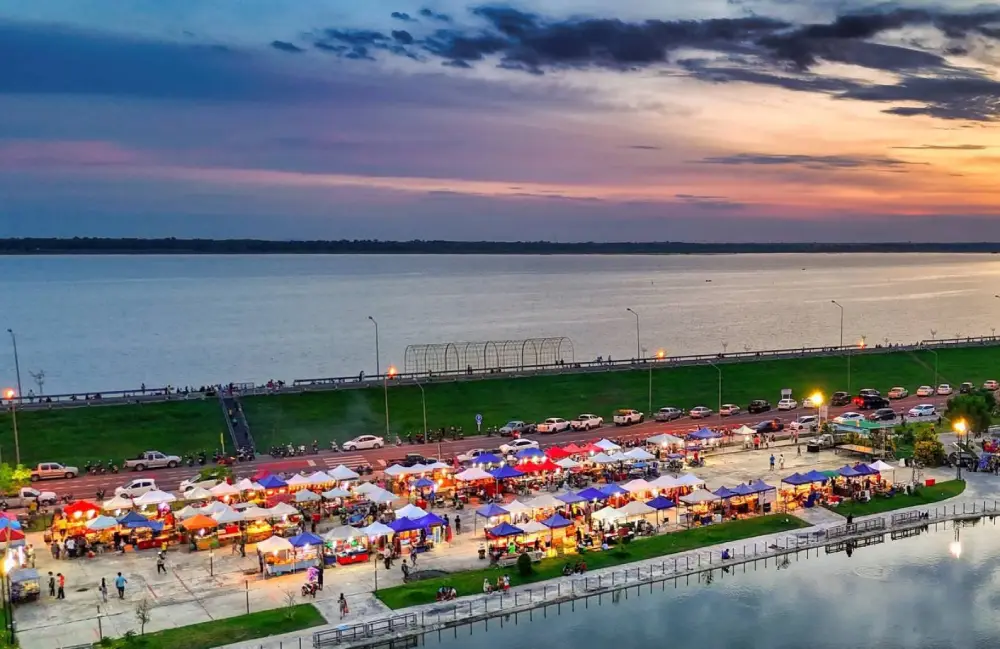
The atmosphere around the reservoir is best enjoyed in the morning and late afternoon. Morning visits are comfortable for walking, light exercise, and quiet photography. Late afternoon is better for relaxing, catching cooler air, and watching local life around the water. On Fridays, Saturdays, and Sundays, the lakeside area becomes livelier with the Huai Chorakhe Mak walking street market, locally known as Sro Ang. This weekend market adds food, community products, and local color to the reservoir experience.
The Sro Ang Walking Street Market is held at the Buriram Irrigation Project area near Huai Chorakhe Mak Reservoir, Moo 17, Ban Bua Subdistrict. It operates on Fridays, Saturdays, and Sundays from 15.00 to 21.00. For travelers, this makes the reservoir especially appealing in the late afternoon and evening. Visitors can enjoy the water view, walk through the market, try local food, and experience a more community-based side of Buriram tourism.
The reservoir is also connected with the Wetland and Eastern Sarus Crane Conservation Center in Buriram, located near the Huai Chorakhe Mak area. This connection strengthens the site’s value as a nature-learning destination. Travelers interested in cranes, wetlands, bird conservation, and environmental education can combine the reservoir, lakeside scenery, and nearby learning center in the same visit. This makes the area suitable for families, students, birdwatchers, photographers, and nature-focused travelers.
In terms of travel planning, Huai Chorakhe Mak Reservoir is easy to combine with several nearby attractions. Huai Talat Reservoir and Buriram Bird Park are about 1 km away. Khao Kradong Volcano Forest Park, Chang Arena, Buriram Castle, Chang International Circuit, and Wat Pa Khao Noi are also within convenient driving distance. This location makes the reservoir a useful stop for travelers who want a mixed itinerary of nature, wetlands, Buddhism, sports, and local food.
Because Huai Chorakhe Mak Reservoir is connected with government water-management facilities, water-supply functions, public recreation, and wildlife protection, visitors should use the area respectfully. Littering, disturbing birds, feeding wildlife, entering restricted government zones, fishing where it is not allowed, or ignoring signs should be avoided. The reservoir is both a place for people and a habitat for wildlife, so responsible behavior is part of the travel experience.
Visitors do not need special equipment to enjoy the reservoir. A simple visit can include a walk along the water, a rest under the trees, photographs of the lake, and an evening visit to the walking street market. Those interested in birds and nature should bring binoculars, a camera, a hat, drinking water, mosquito repellent, and comfortable shoes. Since the area is close to water, insects may be present in some seasons, especially around dusk.
Getting There from Buriram city is straightforward. Travel along the Buriram–Prakhon Chai route toward Samet and Ban Bua subdistricts. The distance is about 10–13 km from the city. Private car, rental car, motorcycle, or hired local transport are the most convenient options. Travelers visiting on market days should allow extra time for parking and walking around the area, especially in the late afternoon.
A practical half-day itinerary can begin at Khao Kradong Volcano Forest Park in the morning, where visitors can pay respect to Phra Suphattharabophit and see the extinct volcanic crater. In the afternoon, continue to Huai Chorakhe Mak Reservoir for lakeside relaxation, nature observation, and photography. On Fridays to Sundays, stay into the evening for the Sro Ang Walking Street Market. Travelers interested in nature conservation can also include the nearby Wetland and Eastern Sarus Crane Conservation Center.
Huai Chorakhe Mak Reservoir is therefore much more than a roadside reservoir. It brings together water management, public recreation, wetland ecology, bird conservation, and community life in one landscape. Its broad freshwater surface supports the city and surrounding farmland, while its quiet edges provide space for people to rest and wildlife to live. For travelers who want to see Buriram beyond temples, stadiums, and historical sites, Huai Chorakhe Mak Reservoir offers a calm and meaningful view of the province’s relationship with water and nature.
| Name | Huai Chorakhe Mak Reservoir |
| Location | Ban Bua, Samet, And Sakae Phrong Subdistricts, Mueang Buriram District, Buriram Province |
| Address | Buriram Irrigation Project, Ban Bua Subdistrict, Mueang Buriram District, Buriram 31000, Thailand |
| Coordinates | Approximately 14.9122, 103.0487 |
| Highlights | Large Freshwater Lake, Shaded Lakeside Recreation, Irrigation And Water-Supply Landscape, Birdwatching, Wetland Habitat, And Sro Ang Weekend Walking Street Market |
| History / Importance | Built In 1962 For Irrigation And Water Supply, The Reservoir Covers Approximately 3,876 rai And Is One Of Buriram’s Important Water-Management Sites |
| Landscape Character | A Large Freshwater Reservoir With Open Water, Lowland Catchment, Shoreline Trees, Wetland Edges, Aquatic Plants, And Government Irrigation Facilities |
| Travel Information | From Buriram City, Use The Buriram–Prakhon Chai Route Toward Samet And Ban Bua Subdistricts. The Distance Is About 10–13 km |
| Current Status | A Government Irrigation Area, Water-Supply Related Site, Public Recreation Area, And Huai Chorakhe Mak Reservoir Non-Hunting Area |
| Open Days | Daily In Public Recreation Areas |
| Recommended Visiting Time | Morning And Late Afternoon; Friday–Sunday Evenings Are Suitable For The Sro Ang Walking Street Market |
| Fees | Free Admission In Public Recreation Areas |
| Facilities | Access Roads, Lakeside Rest Areas, Viewpoints, Walking Areas, Parking In Designated Areas, And Weekend Walking Street Market |
| Main Areas / Zones | Reservoir Surface, Buriram Irrigation Project Headworks, Water-Supply Related Area, Lakeside Recreation Zone, Tree-Lined Shoreline, Birdwatching Area, Wetland Zone, Sro Ang Walking Street Market, And Access Route To The Wetland And Eastern Sarus Crane Conservation Center |
| Caretaker | Buriram Irrigation Project, Regional Irrigation Office 8, Royal Irrigation Department, With Conservation Areas Under Huai Chorakhe Mak Reservoir Non-Hunting Area |
| Main Contact Number | Buriram Irrigation Project, Tel. 044-637-205 |
| Recommended Activities | Lakeside Relaxation, Walking, Exercise, Photography, Birdwatching, Wetland Learning, Weekend Walking Street Visit, And A Stop At The Nearby Sarus Crane Conservation Area |
| Visitor Guidelines | Do Not Litter, Disturb Wildlife, Feed Birds, Enter Restricted Government Areas Without Permission, Or Ignore Officer Instructions And Warning Signs |
| Nearby Tourist Attractions | 1. Huai Talat Reservoir And Buriram Bird Park, About 1 km, Tel. 088-703-9364 2. Wetland And Eastern Sarus Crane Conservation Center, About 2 km 3. Khao Kradong Volcano Forest Park, About 6 km, Tel. 044-637-349 4. Phra Suphattharabophit, Khao Kradong, About 7 km 5. Chang Arena, About 9 km, Tel. 044-666-445, 098-103-8888 6. Buriram Castle, About 9 km 7. Chang International Circuit, About 10 km, Tel. 044-604-200 8. Wat Pa Khao Noi, About 12 km |
| Nearby Restaurants | 1. Idea Moo Kratha, About 4 km, Tel. 093-536-4463, 082-123-3346 2. Pa Yim Duck Noodles, Buriram–Prakhon Chai Road, About 5 km, Tel. 083-777-9225 3. MehaiMena, About 6 km, Tel. 083-038-6219, 063-952-6195 4. Phakha Restaurant By Ratree Resort, About 6 km, Tel. 064-158-8222, 081-877-2644 5. Khrua Phu Kong Add, About 7 km, Tel. 084-383-8416 6. The Library Cafe Buriram, About 9 km, Tel. 098-103-5331 |
| Nearby Accommodations | 1. At Pream & Chan Resort, About 3 km 2. Judy Park & Resort, About 4 km 3. Blooming Resort, About 5 km, Tel. 082-371-9999, 044-110-636 4. T-Rex Buriram Boutique Hotel, About 7 km, Tel. 081-821-8882 5. The Crystal Hotel Buriram, About 9 km, Tel. 044-634-678 6. Modena By Fraser Buriram, About 10 km, Tel. 044-118-188 7. Fortune Hotel Buriram, About 10 km, Tel. 044-163-800 To 805 |
Frequently Asked Questions (FAQ)
Q: Where is Huai Chorakhe Mak Reservoir located?
A: It is located in Ban Bua, Samet, and Sakae Phrong subdistricts of Mueang Buriram District, Buriram Province, about 10–13 km from Buriram city on the Buriram–Prakhon Chai route.
Q: Why is Huai Chorakhe Mak Reservoir important?
A: It is a large reservoir built for irrigation and water supply, covering about 3,876 rai, and it also serves as a public recreation area and wetland habitat near Buriram city.
Q: What kind of travel is Huai Chorakhe Mak Reservoir suitable for?
A: It is suitable for lakeside relaxation, walking, exercise, photography, birdwatching, wetland learning, and visiting the weekend Sro Ang Walking Street Market.
Q: Is there an admission fee?
A: Public recreation areas around the reservoir can be visited free of charge. Visitors should follow signs and officer instructions, especially near government or restricted areas.
Q: What birds are associated with this area?
A: The area is associated with the Eastern Sarus Crane and several wetland bird species, including Baer’s pochard, purple heron, intermediate egret, harriers, and migratory birds.
Q: When is the Sro Ang Walking Street Market open?
A: The market operates on Fridays, Saturdays, and Sundays from 15.00 to 21.00 at the Buriram Irrigation Project area near Huai Chorakhe Mak Reservoir.
Q: What is the best time to visit?
A: Morning is suitable for walking and quiet scenery, while late afternoon is best for relaxation, photography, cooler weather, and the weekend walking street market.
Q: What should visitors be careful about?
A: Visitors should avoid littering, disturbing birds, entering restricted government areas, feeding wildlife, or ignoring warning signs and officer instructions.
 Category: ●Nature and Wildlife
 Group: ●Dam, Reservoir, Lake
Last Update : 3 MonthAgo
 Last Update : 3 MonthAgo
 Click to Access the Navigation Map GPS
Huai Chorakhe Mak Reservoir Map
Recommend

 Art, Culture and Heritage
 Historical Sites and Monuments(14)
 Landmarks and Memorials(2)
 Art, Craft Centres, Tradition(6)
 Museums(3)
 Educational Places
 Museum for Study(1)
 Places of Worship
 Temple(74)
 Other Sacred Sites(5)
 Suburban Living
 Village, Community(3)
 National Parks and Marine Reserves(2)
 Mountain (Doi)(1)
Dam, Reservoir, Lake(14)
Mountain (Doi)(1)
Dam, Reservoir, Lake(14)
 River, Canal(1)
 Bays and Beaches(1)
 Other natural attractions(2)
 Entertainment and Agricultural
 Animal camps and shows(1)
 Stadium(2)
 Farms, Parks and Ecotourism(2)
 Waterpark(1)


