
lovethailand home >Northeastern Travel Attractions >Buri Ram Travel Attractions >Chaloem Phrakiat >Ta Pek > Phanom Rung Historical Park
TL;DR: Phanom Rung Historical Park is located at Ban Ta Pek, Ta Pek Subdistrict, Chaloem Phra Kiat District, Buriram Province 31110, Thailand, open Daily, hours 06.00 – 18.00.
Phanom Rung Historical Park
Open Days: Daily
Opening Hours: 06.00 – 18.00
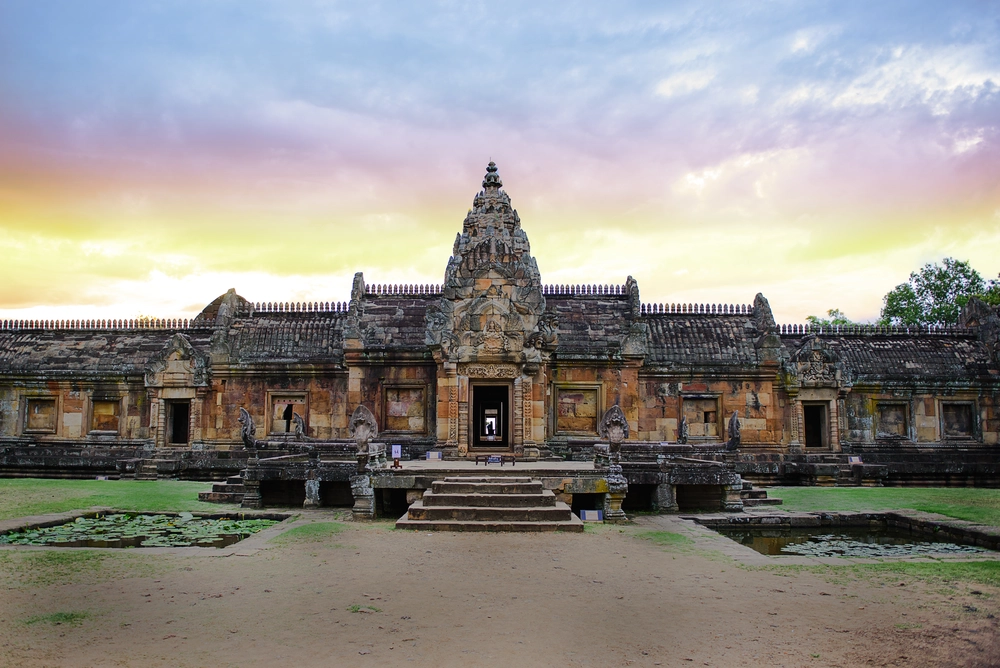
Phanom Rung Historical Park in Buriram Province is one of the most beautiful and complete Khmer stone sanctuaries in Thailand. Located at Ban Ta Pek, Ta Pek Subdistrict, Chaloem Phra Kiat District, the park’s central monument, Prasat Hin Phanom Rung, stands on the summit of an extinct volcano rising about 200 meters above the surrounding plain, or around 350 meters above sea level. The name “Phanom Rung” or “Vnam Rung” comes from Khmer and means “large mountain.” The sanctuary was originally built as a Hindu temple dedicated to Shiva in the Shaivite tradition, and later reflected changing religious currents in the Khmer Empire, especially during the period when Mahayana Buddhism became influential under King Jayavarman VII.
Phanom Rung brings together many layers of meaning in one place: a sacred mountain setting, Khmer stone architecture, Hindu cosmology, refined sandstone carving, a long history of construction from the 10th to 13th centuries CE, modern restoration through anastylosis, and living cultural traditions that continue to draw visitors from across Thailand and abroad. Its most striking feature is the carefully planned axial layout, leading from the lower approach up to the central sanctuary. The entire route symbolically represents the ascent from the human world toward the heavenly realm of Mount Kailasa, the mythical abode of Shiva.
The choice of an extinct volcano as the site of the sanctuary was deeply meaningful. In Hindu thought, mountains are sacred places associated with divine presence, cosmic power, and the connection between earth and heaven. Mount Kailasa is considered the dwelling place of Shiva, and by building a temple on the summit of Phanom Rung, the ancient Khmer builders recreated Shiva’s celestial residence on earth. A visit to Phanom Rung is therefore not only a walk up a hill, but a gradual movement through sacred space, from the ordinary world toward the spiritual center of the temple.
The construction history of Phanom Rung spans several centuries. The earliest religious structures were established around the 15th Buddhist century, while later buildings were added and transformed through the 16th, 17th, and 18th Buddhist centuries. Some remains are older than the main sanctuary, including the brick shrine foundation northeast of the principal tower and the small sanctuary in the southwest area of the inner court. The central sanctuary, the grand stairway, and the naga bridges are generally associated with the 17th Buddhist century, while laterite buildings such as the so-called White Elephant House and rectangular structures in the inner court belong to a later phase around the 18th Buddhist century.
The sanctuary was originally a Hindu temple dedicated to Shiva. Inscriptions and artistic evidence clearly reflect the worship of Shiva as the supreme deity, including the presence of Shiva lingam worship, images of Shiva Nataraja, directional deities, ascetics, and other Hindu motifs. In later Khmer history, especially during the reign of King Jayavarman VII, Mahayana Buddhism gained great influence across the empire. Like many Khmer religious sites, Phanom Rung reflects a long and layered religious history in which Hindu and Buddhist ideas interacted with changing political and cultural contexts.
The visitor route begins at the lower approach, where the landscape and architecture are arranged with symbolic intention. The first part of the ascent includes 3 stepped ponds before reaching the first pavilion. From there, a long processional walkway leads forward, lined on both sides with lotus-bud-shaped boundary posts known in Thai as sao nang riang. These posts do more than decorate the path. They define the ceremonial axis and guide the visitor’s eyes toward the sanctuary above. Each step along this stone path gradually separates the visitor from the ordinary world and prepares the mind for entry into sacred space.
The processional walkway leads to the first naga bridge, one of the most iconic elements of Phanom Rung. In Khmer and broader Southeast Asian belief, the naga is associated with water, fertility, protection, and passage between worlds. At Phanom Rung, the naga bridge symbolically connects the human realm with the divine realm. Crossing it is a ritual movement, marking the transition from the world below toward the heavenly domain represented by the sanctuary on the summit.
On the northern side of the processional route stands a laterite pavilion known locally as the White Elephant House. This building is an important part of the approach to the sanctuary. Built of laterite, it belongs to the later phase of construction and shares a similar period with other laterite structures in the inner court. The local name makes the building easy to remember, though its original function may have been connected to ritual preparation or activities associated with entering the sacred compound. Its presence helps complete the ceremonial sequence of the ascent.
After crossing the naga bridge, visitors climb a long stairway divided into 5 levels with resting platforms. This stairway emphasizes the height of the mountain and the spiritual importance of the sanctuary. As one climbs higher, the lower world gradually recedes from view, creating the sensation of rising toward a sacred realm. At the top of the stairs is a broad platform leading to another naga bridge in front of the central doorway of the gallery, the main passage into the inner court.
The gallery encloses the inner sacred area and forms a crucial architectural boundary. Its central doorway aligns with the processional path, the rows of boundary posts, the naga bridges, and the central sanctuary. After passing through this doorway, visitors encounter yet another naga bridge before reaching the principal tower. The repeated use of naga bridges reinforces the concept of transition between levels of sacred space, from the outer approach to the inner court and finally to the heart of the temple.
The principal sanctuary stands at the center of the inner court. It has a square plan with indented corners and a mandapa, or rectangular antechamber, attached to the front. The tower is built largely of sandstone, including warm-toned pink sandstone that appears especially beautiful in morning and late afternoon light. Every part of the structure, from the base and walls to the doorframes, attached columns, lintels, pediments, superstructure tiers, and corner elements, is decorated with fine carving. The craftsmanship reveals the high artistic achievement of ancient Khmer artisans.
The decorative program of the main sanctuary includes floral motifs, foliage patterns, ascetic figures, directional deities, and the famous Shiva Nataraja imagery. The lintels and pediments at the front of the principal tower are especially important. Shiva Nataraja represents Shiva as the cosmic dancer. His dance embodies creation, preservation, destruction, and the continuous rhythm of the universe. In a temple dedicated to Shiva, this image carries profound religious meaning and strengthens the identity of Phanom Rung as a mountain sanctuary of Shiva.
Inside the inner court, southwest of the main sanctuary, stands a smaller sanctuary that has lost its roof. Artistic evidence such as carvings on its pediment and lintel indicates that this small sanctuary predates the main tower and belongs to around the 16th Buddhist century. Its presence shows that Phanom Rung was not built all at once. Instead, it developed over several generations. Each structure represents a different layer of sacred activity, patronage, and architectural transformation.
To the northeast of the principal tower are the remains of an older brick shrine foundation dating to around the 15th Buddhist century. This early foundation is important because it shows that the summit of Phanom Rung had already served as a religious center before the construction of the grand sandstone sanctuary. These earlier remains allow visitors to understand Phanom Rung as a sacred landscape that evolved over time, beginning with smaller religious structures and eventually becoming one of the most impressive Khmer monuments in Thailand.
At the northeastern and southeastern corners of the inner court are rectangular laterite buildings dating to around the 18th Buddhist century. These structures are contemporary with the laterite pavilion along the processional route. The use of laterite in some buildings and sandstone in others shows how ancient builders selected materials according to function, strength, and artistic requirements. Sandstone was ideal for detailed carving and sacred imagery, while laterite provided durable structural support.
Phanom Rung is also famous for the solar alignment phenomenon in which sunlight passes through all 15 doorways of the sanctuary along the main axis. This occurs during specific periods of the year and demonstrates the precision of the temple’s orientation. The event is visually striking and culturally significant, combining architecture, astronomy, belief, and seasonal ritual. It has become one of the most celebrated highlights of the site and draws large numbers of visitors when viewing dates are announced.
The annual Phanom Rung Festival, known in Thai as the tradition of ascending Phanom Rung, keeps the ancient sanctuary connected with contemporary cultural life. Usually held in early April, the festival features ceremonial processions, the Phanom Rung Naruprakarn parade, the invitation of Shiva, light-and-sound performances, Buriram Apsara dance, cultural markets, and activities related to the solar alignment. This festival transforms the monument from a static ancient site into a living cultural stage where history, art, belief, and community identity are brought together.
The restoration of Phanom Rung by the Fine Arts Department is an important chapter in the history of heritage conservation in Thailand. The restoration used the anastylosis method, in which original stone components were carefully dismantled, numbered, studied, and then reassembled in their original positions after strengthening the foundation. This method requires archaeological knowledge, architectural expertise, engineering skill, and precise documentation. The goal is not to create a new monument, but to return the original material to its proper place as accurately as possible.
The restoration project took many years and became one of Thailand’s major conservation achievements. On 21 May 1988, Phanom Rung Historical Park was officially opened by Her Royal Highness Princess Maha Chakri Sirindhorn. The opening marked the transformation of the site into a formally managed historical park, a center for education, and a major cultural tourism destination. Since then, Phanom Rung has become one of the strongest symbols of Buriram Province and Khmer heritage in Thailand.
Phanom Rung is also widely remembered for the return of the Narai Bantomsin lintel, which had been removed from Thailand and later returned. This lintel is one of the most important sculptural elements associated with the sanctuary. Its repatriation became a powerful symbol of cultural heritage protection. The story reminds visitors that carved stones are not isolated art objects; they belong to specific places, histories, religious meanings, and collective memory. Seeing the lintel in its original context helps restore the relationship between the artwork and the monument.
Visitors should allow at least 2 to 3 hours to experience the park properly. A meaningful visit begins at the lower approach, continues along the processional path, crosses the naga bridge, passes the White Elephant House, climbs the 5 levels of stairs, enters the gallery, crosses the inner naga bridge, and finally reaches the principal sanctuary. Following this sequence allows travelers to understand the intended movement of the temple layout rather than treating the site as a collection of separate structures.
Key points that deserve close attention include the boundary-post walkway, the naga bridges, the White Elephant House, the stairways, the gallery, the pediments and lintels of the main sanctuary, the Shiva Nataraja carving, the floral and foliage motifs, the small sanctuary in the southwest of the inner court, the older brick shrine foundation, and the laterite buildings in the inner area. Each element carries historical, artistic, or symbolic meaning. Together they form one of the most complete Khmer sacred landscapes in Thailand.
The best time to visit Phanom Rung is in the morning or late afternoon. The weather is cooler, the light is more suitable for photography, and the color of the sandstone becomes warmer and more dramatic. Visitors who want to see the solar alignment through the 15 doorways should check the official annual schedule before traveling, as the exact dates and times depend on the movement of the sun. During the Phanom Rung Festival, the park is lively and crowded, while ordinary weekdays offer a quieter atmosphere for careful observation.
Phanom Rung Historical Park is open daily from 06.00 to 18.00. The admission fee is 20 baht for Thai visitors and 200 baht for foreign visitors. The main contact number for the park is 044-666-251. Because the park includes long walkways, steps, and exposed outdoor areas, visitors should wear comfortable shoes, bring water, and plan rest stops if traveling with elderly visitors or anyone with mobility limitations.
Respectful behavior is essential when visiting the sanctuary. Visitors should dress politely, avoid climbing on ancient structures, avoid touching carvings unnecessarily, never write on stone surfaces, never move any objects, and help keep the area clean. Sandstone and laterite may appear strong, but they have endured centuries of weathering. Careless contact and repeated climbing can damage the monument. Responsible travel is part of preserving Phanom Rung for future generations.
Getting There from Buriram city can be done by 2 main routes. The first route follows Highway 218 from Buriram to Nang Rong for about 50 km, then turns left onto Highway 24 for about 14 km to Ban Tako. From there, continue via Highways 2117 and 2221 through Ban Ta Pek for about 12 km to reach Phanom Rung. The second route follows Highway 219 from Buriram to Prakhon Chai for about 44 km, then takes the road from Prakhon Chai toward Phanom Rung for about 21 km. This second route is convenient for combining the trip with Prasat Muang Tam.
Travelers using public transport can take the Buriram-Chanthaburi bus from Buriram Bus Terminal and get off at Ban Tako. From there, a local songthaew or motorcycle taxi can be taken to Phanom Rung. The fare should be agreed upon before departure. For groups or travelers who want to visit several nearby sites, hiring a car with a driver or using a private vehicle is more convenient, especially when combining Phanom Rung with Prasat Muang Tam, Wat Khao Phra Angkhan, and other attractions in Chaloem Phra Kiat District.
The area around Phanom Rung includes several attractions that can be planned into the same route. Prasat Muang Tam is a large Khmer sanctuary with beautiful ponds and decorative carving. Prasat Ban Bu is linked to ancient routes at the foot of Phanom Rung. Wat Khao Phra Angkhan stands on another extinct volcano. Lam Nang Rong Dam offers a scenic water landscape. Exploring these places together helps travelers understand the historical geography of Buriram more completely.
Phanom Rung Historical Park is therefore much more than a famous tourist attraction in Buriram. It is a place where history, religion, art, astronomy, landscape, restoration, and living tradition come together. From the volcanic mountain and boundary-post walkway to the naga bridges, gallery, central sanctuary, Narai Bantomsin lintel, and annual Phanom Rung Festival, every element contributes to the significance of this extraordinary cultural heritage site. Travelers who take the time to walk slowly and observe carefully will find that Phanom Rung is one of the most meaningful Khmer monuments in Southeast Asia.
| Name | Phanom Rung Historical Park / Prasat Hin Phanom Rung |
| Location | Ban Ta Pek, Ta Pek Subdistrict, Chaloem Phra Kiat District, Buriram Province 31110, Thailand |
| Address | 114 Ta Pek Subdistrict, Chaloem Phra Kiat District, Buriram Province 31110, Thailand |
| Coordinates | Chaloem Phra Kiat District, Buriram Province, on the summit of the extinct Phanom Rung volcano |
| Highlights | Khmer stone sanctuary on an extinct volcano, boundary-post walkway, naga bridges, central sanctuary, Narai Bantomsin lintel, and the solar alignment through 15 doorways |
| History / Period | Hindu Shaivite sanctuary built and expanded from around the 15th to 18th Buddhist centuries; officially opened as Phanom Rung Historical Park on 21 May 1988 |
| Name Origin | The name “Phanom Rung” or “Vnam Rung” comes from Khmer and means “large mountain” |
| Distinctive Features | The sanctuary faces east and is arranged along a ceremonial axis from the lower approach, naga bridges, gallery, and inner court to the central tower representing Shiva’s celestial abode |
| Main Areas / Zones | 1. Lower Approach And Three Stepped Ponds 2. First Pavilion 3. Boundary-Post Walkway 4. First Naga Bridge 5. White Elephant House 6. Five-Level Stairway 7. Upper Platform And Naga Bridge Before The Gallery 8. Gallery 9. Inner Naga Bridge 10. Principal Sanctuary 11. Small Sanctuary In The Southwest Inner Court 12. Brick Shrine Foundation In The Northeast 13. Laterite Buildings In The Inner Court |
| Traditions / Key Events | Annual Phanom Rung Festival, Phanom Rung Naruprakarn procession, light-and-sound performances, Buriram Apsara dance, and the solar alignment through 15 doorways |
| Travel Information | From Buriram, take Highway 218 toward Nang Rong, continue via Highway 24 to Ban Tako, then follow Highways 2117 and 2221 through Ban Ta Pek. Another route uses Highway 219 toward Prakhon Chai and continues to Phanom Rung, which is convenient for visiting Prasat Muang Tam. |
| Current Status | Open daily as a historical park under the Fine Arts Department, Ministry of Culture |
| Open Days | Daily |
| Opening Hours | 06.00 – 18.00 |
| Fees | Thai Visitors 20 Baht, Foreign Visitors 200 Baht; vehicle service fees apply for entry through Gate 3 according to the park’s regulations |
| Facilities | Parking Area, Visitor Center, Restrooms, Walking Paths, Heritage Viewing Areas, And Rest Points Along The Ascent To The Sanctuary |
| Caretaker / Related Authority | The Fine Arts Department, Ministry Of Culture, Through Phanom Rung Historical Park |
| Main Contact Number | 044-666-251 Phanom Rung Historical Park |
| Official Website / Official Page | finearts.go.th/phanomrunghistoricalpark |
| Nearby Tourist Attractions | 1. Prasat Muang Tam, About 8 km, Tel. 044-666-251 2. Prasat Ban Bu, About 7 km 3. Prasat Khao Plai Bat 2, About 16 km, Tel. 044-666-251 4. Wat Khao Phra Angkhan, About 20 km, Tel. 093-529-5671 5. Lam Nang Rong Dam, About 43 km, Tel. 044-606-336 |
| Nearby Restaurants | 1. Krua Khun Nong Restaurant, About 2 km, Tel. 065-303-1688 2. Cafe de Phanomrung, About 4 km, Tel. 093-565-9954 3. Suan Hom Khanun, About 8 km, Tel. 081-074-8996 4. Phu Lava Café And Farm, About 12 km, Tel. 093-914-6265 5. Krua Baan Euy, About 18 km, Tel. 082-551-0417 |
| Nearby Accommodations | 1. Smart Resort, About 8 km, Tel. 081-660-0968 2. Phanomrung Hostel & Linn Chan Café, About 10 km, Tel. 061-539-4965 3. Hotel de l'amour Buriram, About 22 km, Tel. 044-651-555 4. Eireann Boutique Hotel, About 23 km, Tel. 044-666-199 5. Phanomrungpuri Hotel, About 32 km, Tel. 044-632-222 |
Frequently Asked Questions (FAQ)
Q: Where is Phanom Rung Historical Park located?
A: Phanom Rung Historical Park is located at Ban Ta Pek, Ta Pek Subdistrict, Chaloem Phra Kiat District, Buriram Province, on the summit of an extinct volcano.
Q: What does the name Phanom Rung mean?
A: The name “Phanom Rung” or “Vnam Rung” comes from Khmer and means “large mountain,” referring to the sanctuary’s mountain-top setting.
Q: What religion was Prasat Hin Phanom Rung originally built for?
A: It was originally built as a Hindu Shaivite sanctuary dedicated to Shiva, and later reflected Mahayana Buddhist influence during some periods of Khmer history.
Q: What are the opening hours and entrance fees at Phanom Rung Historical Park?
A: The park is open daily from 06.00 to 18.00. Admission is 20 baht for Thai visitors and 200 baht for foreign visitors.
Q: What should visitors not miss at Phanom Rung?
A: Key highlights include the boundary-post walkway, naga bridges, White Elephant House, five-level stairway, gallery, central sanctuary, Shiva Nataraja carving, and Narai Bantomsin lintel.
Q: What is the solar alignment through 15 doorways?
A: It is a phenomenon in which sunlight passes through all 15 doorways of the sanctuary along the same axis during specific periods of the year.
Q: When is the Phanom Rung Festival held?
A: The Phanom Rung Festival is usually held in early April and features ceremonial processions, light-and-sound performances, Buriram Apsara dance, cultural activities, and the solar alignment event.
Q: What nearby places can be visited together with Phanom Rung?
A: Nearby attractions include Prasat Muang Tam, Prasat Ban Bu, Prasat Khao Plai Bat 2, Wat Khao Phra Angkhan, and Lam Nang Rong Dam.
Tel : 044782715
 Tel : 044782715
 Category: ●Art, Culture and Heritage
 Group: ●Historical Sites and Monuments
Last Update : 4 MonthAgo
 Last Update : 4 MonthAgo
 Click to Access the Navigation Map GPS
Phanom Rung Historical Park Map
Gellery
Recommend
 Historical Sites and Monuments(14)
 Landmarks and Memorials(2)
 Art, Craft Centres, Tradition(6)
 Museums(3)
 Educational Places
 Museum for Study(1)
 Places of Worship
 Temple(74)
 Other Sacred Sites(5)
 Suburban Living
 Village, Community(3)
 Nature and Wildlife
 National Parks and Marine Reserves(2)
 Mountain (Doi)(1)
 Dam, Reservoir, Lake(14)
 River, Canal(1)
 Bays and Beaches(1)
 Other natural attractions(2)
 Entertainment and Agricultural
 Animal camps and shows(1)
 Stadium(2)
 Farms, Parks and Ecotourism(2)
 Waterpark(1)
 Travel Articles, Recipes
 Travel Review, Food Review(1)


