
lovethailand home >Northeastern Travel Attractions >Buri Ram Travel Attractions >Satuek >Satuek > Wat Nong Bua Chao Pa
TL;DR: Wat Nong Bua Chao Pa is located at Village No. 5, Satuek Subdistrict, Satuek District, Buriram Province, open Daily, hours 08.00 – 17.00.
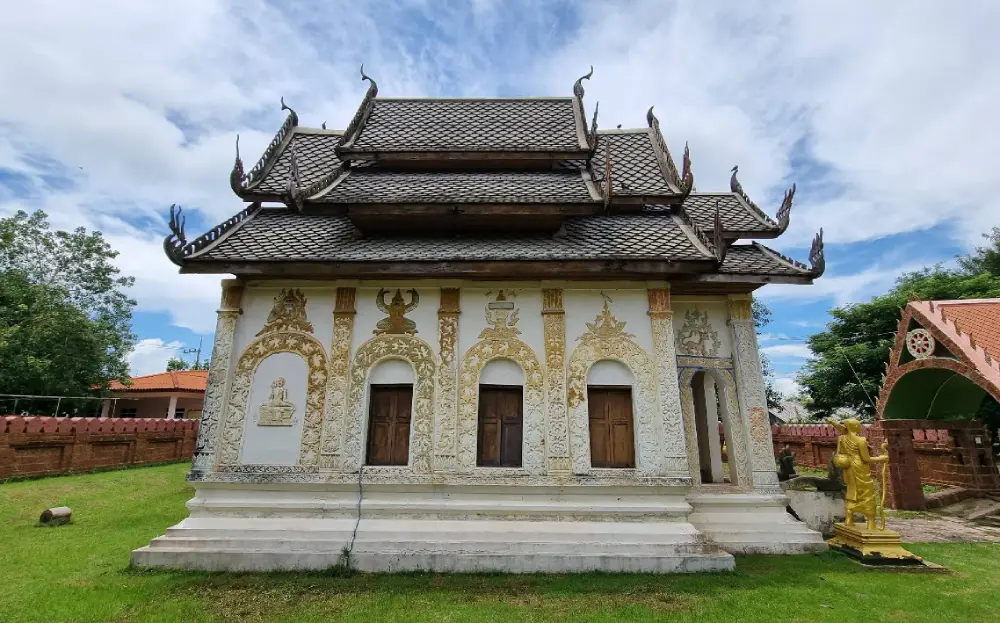
Wat Nong Bua Chao Pa
Open Days: Daily
Opening Hours: 08.00 – 17.00
Wat Nong Bua Chao Pa, located in Village No. 5, Satuek Subdistrict, Satuek District, Buriram Province, is an old community temple associated with the Mun River, the Thai-Kuay people, local Buddhist life, and vernacular Isan architecture. Its most important feature is the old ordination hall built in 1945 by skilled Vietnamese craftsmen. Although modest in size, the building is highly valuable as a local sim, or northeastern Thai ordination hall, created through the faith, labor, and donations of villagers from several nearby communities.
The temple stands in an area closely connected with the history of Thai-Kuay settlement along the Mun River. In the past, Thai-Kuay people migrated from Surin Province and settled in this riverside area. They were well known for their expertise in capturing and handling elephants, a way of life deeply connected with forests, rivers, and natural landscapes. After wild elephant herds moved away toward the Khao Yai region and more families began to settle permanently, the community gradually expanded into a village. As in many Buddhist communities in northeastern Thailand, the need for a religious site soon became an important part of village life.
In 1907, local villagers established a monks’ residence under the leadership of Nai Nuan Kana, who served as the village headman at that time. The religious site was built near a lotus pond, or nong bua in Thai, and this became the origin of the name “Wat Nong Bua Chao Pa.” The name reflects both the natural landscape and the memory of the community. The lotus pond referred to the physical setting, while the term chao pa evokes the old forest environment and the lives of people who once lived closely with elephants and woodland areas.
In its earliest period, the temple was not defined by permanent buildings or elaborate architecture. It served first as a simple religious shelter for monks, a place where villagers could make merit, receive teachings, and gather for Buddhist activities. As the community became more stable, the need for a proper ordination hall grew stronger. An ordination hall would allow the temple to perform important monastic ceremonies and become a complete religious center for the village and surrounding settlements.
The construction of the ordination hall began in 1945 under the leadership of Phra Khru Suchit Thammaprahat, also known as Luang Pho Hao. He served as abbot between 1943 and 1953 and held important ecclesiastical roles in the district and province at that time. The construction did not rely only on the people of Ban Nong Bua Chao Pa. It also received support from nearby villages, including Ban Kham, Ban Khu Khat, Ban Nong Phai, and Ban Sakrachai. Villagers donated money, labor, and materials to help create a permanent ordination hall for the temple.
The construction process reveals the character of rural temple building in the past. Villagers first prepared the ground, cleared bamboo forest, and filled the land with soil. According to local memory, the ordination hall was built over the stump of a bodhi tree. People carried soil from the bank of the Mun River and used bamboo tools to compact the ground. These efforts show that the building was not simply the work of craftsmen or donors. It was the result of shared physical labor and collective faith from the local community.
The temple hired Vietnamese craftsmen because the local community did not have enough skilled builders for this type of masonry work. The craftsmen began by producing bricks, using an area slightly away from the village, around what later became the crematorium area, as the firing site. After the bricks were fired, villagers carried them to the construction area to help the craftsmen work more efficiently. The ordination hall therefore represents a meeting point between specialist craftsmanship and community devotion.
The construction materials and techniques are especially interesting. The exterior wall color was made using burnt shells, which were ground into fine powder and mixed with pigment. This method helped the color become more durable. It also shows the use of local knowledge and natural materials in temple construction before modern building materials became widely available. The total construction budget was about 8,000 baht, a significant amount for a rural community at that time.
After the ordination hall was completed, a celebration was held in 1947 for 2 days and 2 nights. This was a major community event because the ordination hall made the temple complete as a place for important Buddhist ceremonies. From that time onward, the hall became the main sacred building for the village and surrounding communities. It has served as a place for monastic rites, ordinations, and important Buddhist activities for generations.
The value of Wat Nong Bua Chao Pa’s ordination hall lies in its vernacular architecture and its connection with Vietnamese craftsmanship. It is a solid-walled local ordination hall with a front porch. The building is a single-storey structure with 4 bays. Its rectangular plan measures approximately 4.84 meters in width and 8.36 meters in length. The front porch measures about 1.64 meters wide and 2.53 meters long. The raised lotus-style base stands above the ground, and a 3-step staircase leads up to the front entrance. Although compact, the building has a dignified and carefully proportioned appearance.
The structure uses a post-and-beam system with brick walls covered in plaster. Both the interior and exterior plaster cover the timber posts. The exterior was painted, while the roof is an open gable form with 2 superimposed tiers, each tier having 2 roof layers. A lower roof covers the front porch. The gable decoration includes traditional elements such as chofa, lamyong, bai raka, nak sadung, and hang hong. These details give the building a clear Thai vernacular identity while preserving a local Isan character.
Compared with many other Isan sim structures, Wat Nong Bua Chao Pa’s ordination hall has several unusual features. Its form is not broad and low, but rather slender and elongated. The roof composition is distinctive, and the stucco ornamentation gives the walls and gable a strong visual identity. This makes the temple particularly interesting for travelers and researchers who are interested in Isan Buddhist architecture, local craftsmanship, stucco art, and the exchange of building skills between Thai-Kuay villagers and Vietnamese craftsmen.
The interior usable space measures approximately 3.70 meters wide and 7.20 meters long, or about 26.64 square meters. Although the interior is small, the ordination hall has continued to serve religious purposes. Over time, the building developed cracks along wall lines and suffered from roof leakage. Because of its age and condition, the number of people entering the building should be limited. Visitors should treat the structure as a valuable old religious building and avoid crowding, leaning on the walls, or touching damaged areas.
In 1980, Phra Khru Anurak Chalachai, also known as Luang Pho Mo, who was abbot at that time, repaired the damaged roof by replacing the original cement kite-shaped tiles with galvanized metal sheets. The main structure was largely preserved, apart from soil filling around the building up to the height of one stair step. This repair helped the ordination hall continue to function while retaining much of its original character.
The ordination hall later gained attention as an old building worthy of conservation. Conservation-related work involved agencies responsible for building preservation and surveys by officials connected with the Fine Arts Department. This recognition shows that the ordination hall is not only important to the local community but also valuable as part of Buriram’s vernacular architectural heritage and the broader cultural landscape of northeastern Thailand.
Wat Nong Bua Chao Pa also preserves the memory of the Thai-Kuay people along the Mun River. This community has long been associated with forests, elephants, and riverine settlement. Although the elephant-catching way of life has changed greatly over time, the temple name, migration story, and riverside setting continue to preserve traces of the earlier generations. The temple therefore connects local history, ethnic memory, Buddhist practice, and natural geography in one meaningful place.
Culturally, the ordination hall is more than an architectural object. It is a ritual center and a shared memory space for the community. Since the celebration of the hall in 1947, local people have used it for monastic ceremonies and Buddhist activities. Many generations have known this building through ordinations, merit-making events, community gatherings, and temple ceremonies. The hall is therefore both a sacred structure and a vessel of community memory.
The atmosphere of Wat Nong Bua Chao Pa is peaceful and suitable for travelers who want to explore a deeper side of Buriram. It is different from large historical parks or famous tourist landmarks. Here, visitors encounter a real village temple, learn about Thai-Kuay settlement history, see a local ordination hall with surviving original features, and experience a quiet religious site connected with the Mun River landscape.
Travelers interested in architecture should take time to observe the old ordination hall from the outside. Start with the raised base, the 3-step front staircase, the front porch, the rectangular plan, the layered gable roof, and the gable ornaments. Then look at the plaster walls and remaining traces of craftsmanship. Because the building is old, visitors should observe respectfully, avoid climbing or leaning on the structure, and avoid entering in large groups.
Wat Nong Bua Chao Pa can be included in a cultural route around Satuek District. Nearby places include Wat Pa Yang Nam Sai, the Big Buddha of Satuek, Wat Pa Satuek Pattana, Chao Por Wang Krut Shrine, and Wat Satuek Burapha Wanaram. A route like this helps travelers understand Satuek through religion, local beliefs, community life, and the landscape of the Mun River.
For travelers coming from Buriram city, the easiest way is by private car or rental car. Drive toward Satuek District, then continue along local roads to Village No. 5 in Satuek Subdistrict. The temple can be visited as part of a half-day or full-day trip. A good plan is to visit Wat Nong Bua Chao Pa in the morning, then continue to the Big Buddha of Satuek, Chao Por Wang Krut Shrine, or restaurants and cafés in Satuek town. Morning and late afternoon are the most comfortable times to visit because the weather is cooler and natural light is suitable for viewing the old ordination hall.
Getting There is most convenient by private car. From Buriram city, head to Satuek District and continue to Village No. 5, Satuek Subdistrict. Since the temple is located in a local community rather than a major tourist zone, travelers should check the map before departure. Those arriving via Buriram Airport can continue by road to Satuek District and then to the temple.
Visitors should dress politely because the temple remains an active Buddhist site for the local community. They should avoid loud noise, avoid disturbing monks or villagers who come to make merit, and respect the old ordination hall. Photography is appropriate from a respectful distance, but visitors should not touch decorative elements or damaged walls. A visit to this temple should focus on learning, respect, and appreciation of local heritage.
What makes Wat Nong Bua Chao Pa remarkable is the way it brings together many layers of meaning. It contains the history of Thai-Kuay settlement, the Mun River landscape, the founding of a monks’ residence in 1907, the construction of the ordination hall in 1945, the celebration of the hall in 1947, the roof repair in 1980, and later conservation awareness. Each period adds to the temple’s identity as a living record of a community that grew together with Buddhism.
As a travel destination, Wat Nong Bua Chao Pa is best suited for visitors who value authentic places, real local stories, and cultural depth. The old ordination hall built by Vietnamese craftsmen, its compact form, and its surviving plaster details allow visitors to see a kind of local craftsmanship that is increasingly rare today. At the same time, the story of villagers carrying soil, preparing bamboo tools, firing bricks, and helping the craftsmen gives the building a human dimension beyond its physical form.
Wat Nong Bua Chao Pa deserves wider recognition as one of Satuek District’s important community temples. It is valuable as a temple with an old vernacular ordination hall, a learning site for Thai-Kuay community history along the Mun River, and a meaningful destination for travelers who want to understand Buriram at the community level. It may not be a large tourist attraction, but it offers depth, identity, craftsmanship, and a quiet sense of local faith that can still be felt on site.
| Name | Wat Nong Bua Chao Pa |
| Location | Village No. 5, Satuek Subdistrict, Satuek District, Buriram Province |
| Address | Ban Nong Bua Chao Pa, Village No. 5, Satuek Subdistrict, Satuek District, Buriram Province 31150, Thailand |
| Place Type | Community Buddhist Temple, Mahanikaya Order |
| Highlights | Old Isan vernacular ordination hall built by Vietnamese craftsmen in 1945, Thai-Kuay community history along the Mun River, and strong local architectural value |
| History | The monks’ residence was established in 1907 under the leadership of village headman Nai Nuan Kana. The ordination hall was built in 1945 and celebrated in 1947. |
| Name Origin | The temple was built near a lotus pond, or nong bua, which became the origin of the name Wat Nong Bua Chao Pa. |
| Distinctive Features | Solid-walled vernacular ordination hall with a front porch, rectangular plan, layered gable roof, and traditional decorative elements including chofa, bai raka, nak sadung, and hang hong |
| Ordination Hall Size | The building measures about 4.84 meters wide and 8.36 meters long. The front porch measures about 1.64 meters wide and 2.53 meters long. Interior usable space is about 26.64 square meters. |
| Key Evidence | Old ordination hall built by Vietnamese craftsmen, plasterwork, burnt-shell-based exterior color technique, and local oral history about community participation in construction |
| Important Religious Use | The ordination hall has been used for Buddhist monastic ceremonies since the hall celebration in 1947, with limited entry recommended because of the old building condition. |
| Restoration | In 1980, the damaged roof was repaired by replacing cement kite-shaped tiles with galvanized metal sheets. The building later received conservation attention from relevant agencies. |
| Main Areas / Zones | Old vernacular ordination hall Front porch of the ordination hall Temple courtyard Community area around the temple Mun River cultural landscape in the temple’s historical context |
| Facilities | Temple courtyard, religious activity area, and parking space within or near the temple depending on local conditions |
| Abbot / Caretaker | Phra Wisan Jakkathawaro |
| Travel Information | Travel by private car to Satuek District, Buriram Province, then continue to Village No. 5, Satuek Subdistrict. The temple fits well into a half-day or full-day cultural route around Satuek. |
| Current Status | Open as a community Buddhist temple and valuable vernacular architectural site. Visitors should view the old ordination hall with care. |
| Open Days | Daily |
| Opening Hours | 08.00 – 17.00 |
| Nearby Tourist Attractions | 1. Wat Pa Yang Nam Sai, about 5 km 2. Big Buddha of Satuek, about 8 km 3. Wat Pa Satuek Pattana, about 8 km 4. Chao Por Wang Krut Shrine, about 9 km 5. Wat Satuek Burapha Wanaram, about 9 km |
| Nearby Restaurants | 1. Kinsen Boat Noodles, Branch 228 Satuek, about 7 km 2. Pizza By Nicole Restaurant, about 8 km, Tel. 063-7652408 3. CHER FE' Satuek Buriram, about 8 km, Tel. 082-4399209 4. Just Moment Cafe, about 8 km, Tel. 083-9545662 5. Story Cafe, about 8 km |
| Nearby Accommodations | 1. Seda Resort, about 6 km, Tel. 089-7229089 2. Ban Makham Wan, about 6 km, Tel. 087-9002233 3. J.P. Resort, about 7 km, Tel. 081-2656410 4. Pa Son Resort, about 8 km, Tel. 081-5484670 5. Sahapattana Grand Hotel, about 9 km, Tel. 044-681777, 044-681555 |
Frequently Asked Questions (FAQ)
Q: Where is Wat Nong Bua Chao Pa located?
A: Wat Nong Bua Chao Pa is located in Village No. 5, Satuek Subdistrict, Satuek District, Buriram Province, Thailand.
Q: Why is Wat Nong Bua Chao Pa important?
A: The temple is important as a community Buddhist site connected with Thai-Kuay settlement along the Mun River and as the home of an old vernacular ordination hall built in 1945.
Q: What is special about the old ordination hall?
A: The ordination hall is a solid-walled local Isan structure with a front porch, rectangular plan, layered gable roof, traditional ornaments, and masonry work by Vietnamese craftsmen.
Q: When was Wat Nong Bua Chao Pa founded?
A: The monks’ residence was established in 1907, the ordination hall was built in 1945, and the hall celebration was held in 1947.
Q: Who is the abbot of Wat Nong Bua Chao Pa?
A: The current abbot listed in recent temple information is Phra Wisan Jakkathawaro.
Q: Can visitors enter the old ordination hall?
A: Visitors may view the temple and the old ordination hall, but entry should be limited and careful because the building is old and has signs of deterioration.
Q: What nearby places can be visited with Wat Nong Bua Chao Pa?
A: Nearby places include Wat Pa Yang Nam Sai, the Big Buddha of Satuek, Wat Pa Satuek Pattana, Chao Por Wang Krut Shrine, and Wat Satuek Burapha Wanaram.
Q: How can travelers get to Wat Nong Bua Chao Pa?
A: The easiest way is by private car. Travel to Satuek District in Buriram Province, then continue to Village No. 5, Satuek Subdistrict. Checking a map before departure is recommended.
 Category: ●Places of Worship
 Group: ●Temple
Last Update : 1 WeekAgo
 Last Update : 1 WeekAgo
 Click to Access the Navigation Map GPS
Wat Nong Bua Chao Pa Map
Recommend

 Art, Culture and Heritage
 Historical Sites and Monuments(14)
 Landmarks and Memorials(2)
 Art, Craft Centres, Tradition(6)
 Museums(3)
 Educational Places
 Museum for Study(1)
Temple(74)
Museum for Study(1)
Temple(74)
 Other Sacred Sites(5)
 Suburban Living
 Village, Community(3)
 Nature and Wildlife
 National Parks and Marine Reserves(2)
 Mountain (Doi)(1)
 Dam, Reservoir, Lake(14)
 River, Canal(1)
 Bays and Beaches(1)
 Other natural attractions(2)
 Entertainment and Agricultural
 Animal camps and shows(1)
 Stadium(2)
 Farms, Parks and Ecotourism(2)
 Waterpark(1)


