
lovethailand home >Northeastern Travel Attractions >Buri Ram Travel Attractions >Ban Kruat >Ban Kruat > Wat Ban Kruat
TL;DR: Wat Ban Kruat is located at Ban Kruat Subdistrict, Ban Kruat District, Buri Ram Province, Thailand, open Daily, hours 08.00 – 17.00.
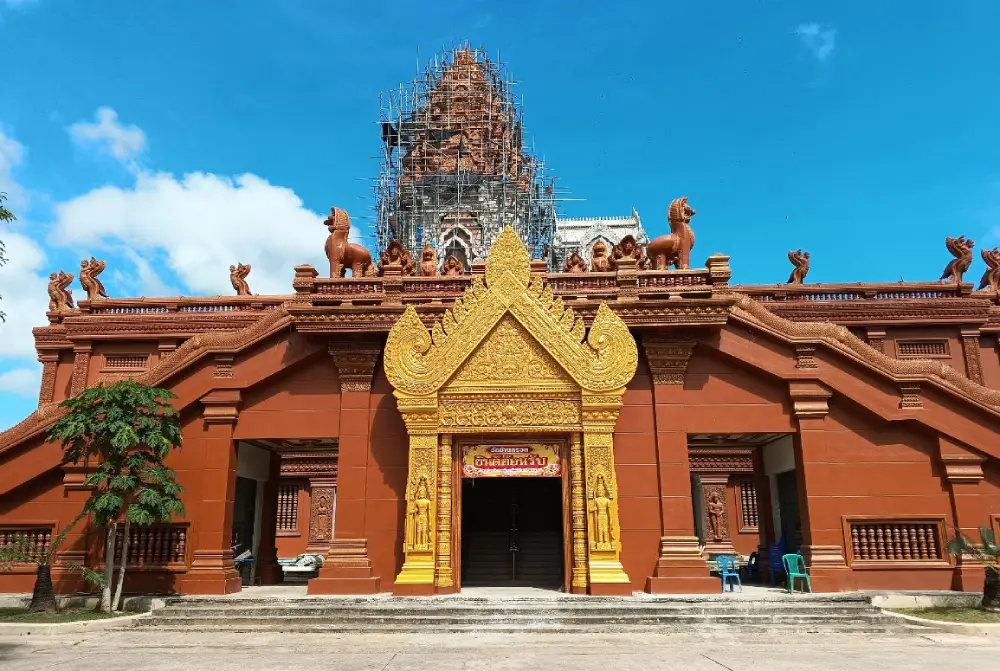
Wat Ban Kruat
Open Days: Daily
Opening Hours: 08.00 – 17.00
Wat Ban Kruat in Ban Kruat Subdistrict, Ban Kruat District, Buri Ram Province, is one of the old and meaningful Buddhist temples of Ban Kruat. The temple was originally known as Wat Ta Leo, named after Ta Leo, the local person who donated the land for the temple. Phra Duang was the monk who first established the temple on that donated land. Later, the temple name was changed to Wat Ban Kruat to match the name of the local community. The temple was officially established in 1898 and received its consecrated boundary on 10 April 1926.
Wat Ban Kruat is important not only because of its age, but also because of its connection with local identity, community memory, Buddhist faith, and Khmer-speaking Thai cultural traditions in southern Isan. Ban Kruat District is culturally rich, with ancient kiln sites, local ceramics, archaeological evidence, borderland communities, and traditions shaped by both Thai Buddhism and Khmer-influenced local culture. Wat Ban Kruat stands at the center of this living cultural landscape.
The original name, Wat Ta Leo, reflects the way many rural Thai temples were founded. A temple often began with the faith of a local donor who offered land, a monk who led the first development, and villagers who gradually helped build religious structures. In the case of Wat Ban Kruat, Ta Leo’s land donation and Phra Duang’s role in establishing the temple show how community devotion became the foundation of a lasting Buddhist institution.
The temple’s official establishment in 1898 marks the beginning of its recognized role in Ban Kruat community life. When Wat Ban Kruat received its consecrated boundary in 1926, it became a temple with a formal sacred boundary for important monastic acts. In Thai Buddhism, this boundary is essential for ceremonies such as ordination and other Sangha activities. This makes the temple not only a place of worship but also a formal religious institution for the community.
Inside the ordination hall, Wat Ban Kruat houses a sacred stone Buddha image as the principal Buddha image. This stone Buddha image is one of the most important sacred objects of the temple. Stone carries a sense of permanence, strength, and timelessness. As the principal image inside the ordination hall, it serves as the spiritual focus for monks, laypeople, worshippers, and visitors who come to make merit and pay respect.
The principal stone Buddha image is especially meaningful because it has witnessed generations of community life. It has been present through ordinations, robe-offering ceremonies, merit-making events, local traditions, family rituals, and the quiet daily practice of villagers. For many people in Ban Kruat, the Buddha image is not only an object of worship. It is a symbol of continuity between ancestors, the present community, and future generations.
Wat Ban Kruat has been led by several important abbots. The early recorded abbots include Phra Athikan Ring Suwannachot, who served from 1898 to 1939; Phra Athikan Dun Yanamuni, who served from 1939 to 1941; Phra Athikan Riek, who served from 1948 to 1949; and Phra Khru Wibun Panyawat, also known as Luang Pu Phad Thitipanyo, who served from 1949 and became one of the most respected monks in the history of the temple. The current abbot is Phra Khru Phinit Kitjaphirom.
Luang Pu Phad, or Phra Khru Wibun Panyawat, remains one of the most important figures associated with Wat Ban Kruat. He was deeply respected by the people of Ban Kruat and became a spiritual center for the community. His role was not limited to temple administration. He was a moral guide, a religious leader, a protector of local traditions, and a monk whose presence strengthened the faith of villagers over many decades.
The memory of Luang Pu Phad continues to shape the identity of Wat Ban Kruat. In many Thai communities, a respected elder monk becomes part of the emotional and spiritual history of a temple. People remember his teachings, kindness, discipline, and role in guiding the community. For this reason, visitors who come to Wat Ban Kruat often see the temple not only as an old religious site, but also as a place connected with the life and legacy of Luang Pu Phad.
Wat Ban Kruat is also important for preserving local religious traditions, especially the San Don Ta tradition. San Don Ta is an ancestral offering tradition practiced by Khmer-speaking Thai communities in southern Isan. It is especially important in areas such as Buri Ram, Surin, and Si Sa Ket. The tradition expresses gratitude to ancestors, respect for family lineage, and the belief that the living remain connected with those who have passed away.
At Wat Ban Kruat, the continuation of San Don Ta shows how Buddhism and local ancestral traditions can coexist naturally. Villagers may make offerings, dedicate merit, gather with family members, and remember their ancestors while also participating in Buddhist rituals. The temple therefore acts as a cultural bridge between family memory, local Khmer-language traditions, and Buddhist teachings on gratitude, merit, and compassion.
The preservation of San Don Ta and other local ceremonies gives Wat Ban Kruat a strong cultural identity. This is not a temple that only preserves buildings and sacred objects. It also preserves living traditions. Through annual ceremonies, merit-making days, Buddhist festivals, ordinations, Kathin ceremonies, and local community gatherings, the temple keeps the cultural rhythm of Ban Kruat alive.
Ban Kruat District lies in the southern part of Buri Ram Province and has cultural connections with borderland communities and Khmer-speaking local populations. The district is also known for ancient kiln sites and ceramics. Wat Ban Kruat adds the Buddhist and community dimension to this wider cultural landscape. A visit to the temple helps travelers understand that Ban Kruat is not only a place of archaeological and ceramic heritage, but also a living community with deep religious traditions.
For cultural travelers, Wat Ban Kruat is suitable for those interested in old temples, sacred Buddha images, respected monks, ancestral traditions, Khmer-speaking Thai culture, and local Buddhist life in southern Isan. The temple is especially meaningful when visited together with other nearby cultural sites, including Wat Pa Ban Kruat, Ban Kruat District Museum, Ban Kruat Cultural Center, Prasat Thong, Ban Kruat stone-cutting site, ancient kiln sites, and Wat Pa Phra Sabai.
Visitors should take time to see the ordination hall, pay respect to the principal stone Buddha image, and learn about the temple’s history from Wat Ta Leo to Wat Ban Kruat. The change of name is important because it shows how the temple moved from being associated with an individual donor to becoming the central temple identity of the wider Ban Kruat community. The name therefore carries both personal memory and community history.
The temple remains active today as a local Buddhist temple with resident monks and regular religious activities. Current information identifies Phra Khru Phinit Kitjaphirom as the abbot and notes a significant number of resident monks. This confirms that Wat Ban Kruat continues to function as a living temple, not merely as a historical place. It remains an active center for ceremonies, merit-making, community gatherings, and the spiritual life of local people.
A visit to Wat Ban Kruat usually takes around 30 minutes to one hour. Visitors can begin by paying respect to the principal Buddha image, then walk around the temple grounds and learn about Luang Pu Phad, the temple’s history, and its role in preserving local traditions. If visiting during a major ceremony or San Don Ta period, travelers may see a deeper expression of local culture and family-based Buddhist devotion.
Visitors should dress respectfully. Shoulders and knees should be covered, shoes should be removed before entering sacred spaces, and voices should be kept low. Photography should be done politely and without disturbing monks, worshippers, or ceremonies. Since the temple is active and meaningful to local people, respectful conduct is essential.
Getting There is convenient by private car, rental car, or local transport. From Buri Ram city, travel toward Ban Kruat District and enter Ban Kruat Subdistrict. The temple is located within the community area of Ban Kruat. Travelers without a private car can take public transport to Ban Kruat town and then hire local transport to the temple. Because the temple is near other local cultural attractions, it can be included easily in a Ban Kruat cultural itinerary.
A practical cultural route can begin at Wat Ban Kruat to pay respect to the sacred stone Buddha image and learn about Luang Pu Phad. Travelers can then continue to Wat Pa Ban Kruat, Ban Kruat District Museum, Ban Kruat Cultural Center, Prasat Thong, Ban Kruat stone-cutting site, Wat Pa Phra Sabai, and the ancient kiln sites of Nai Chian and Sawai. This route offers a complete view of Ban Kruat through Buddhism, local tradition, archaeology, ceramics, and community memory.
Food and accommodation are available in Ban Kruat town. Visitors can find cafés, Thai restaurants, noodle shops, coffee shops, resorts, and bungalows within a practical driving distance from the temple. Staying overnight in Ban Kruat is useful for travelers who want to explore ancient kiln sites, museums, local temples, and nearby cultural destinations without rushing.
For foreign visitors, Wat Ban Kruat is a useful place to understand how Thai temples function in a Khmer-influenced southern Isan community. The temple brings together Buddhism, a sacred stone Buddha image, a story of land donation, local language, ancestral ceremonies, and the legacy of a respected monk. It shows that religion in Thailand is closely tied to family, ancestors, local identity, and the social life of the community.
Wat Ban Kruat is therefore more than an old temple. It is a living record of Ban Kruat’s spiritual history. Its story begins with Ta Leo’s land donation and Phra Duang’s first construction, continues through its official establishment in 1898 and consecrated boundary in 1926, and remains alive today through resident monks, local ceremonies, San Don Ta, and the memory of Luang Pu Phad. For travelers interested in Buri Ram’s deeper cultural heritage, this temple is an important stop.
| Name | Wat Ban Kruat |
| Former Name | Wat Ta Leo |
| Location | Ban Kruat Subdistrict, Ban Kruat District, Buri Ram Province, Thailand |
| Address | Moo 4, Ban Kruat Subdistrict, Ban Kruat District, Buri Ram 31180, Thailand |
| Highlights | An old temple of Ban Kruat, formerly named Wat Ta Leo, with a sacred stone Buddha image as the principal Buddha image in the ordination hall and a strong connection with Luang Pu Phad |
| History | Phra Duang first established the temple on land donated by Ta Leo. The temple was originally called Wat Ta Leo and was later renamed Wat Ban Kruat to match the community name. It was established in 1898 and received its consecrated boundary on 10 April 1926 |
| Distinctive Features | An old community temple preserving Buddhism, Khmer-speaking Thai local traditions, San Don Ta ancestral rites, and the spiritual memory of Ban Kruat people |
| Important Elements | Sacred stone Buddha image as the principal image in the ordination hall, worship area, ordination hall, temple courtyard, and community religious activity areas |
| Important Monk | Phra Khru Wibun Panyawat, also known as Luang Pu Phad Thitipanyo, former abbot of Wat Ban Kruat and a respected spiritual figure of the community |
| Important Tradition | San Don Ta, the ancestral offering tradition of Khmer-speaking Thai communities, along with other traditional local Buddhist merit-making ceremonies |
| Line Of Important Abbots | 1. Phra Athikan Ring Suwannachot, 1898 – 1939 2. Phra Athikan Dun Yanamuni, 1939 – 1941 3. Phra Athikan Riek, 1948 – 1949 4. Phra Khru Wibun Panyawat / Luang Pu Phad Thitipanyo, 1949 – 2015 5. Phra Khru Phinit Kitjaphirom, Current Abbot |
| Abbot / Current Caretaker | Phra Khru Phinit Kitjaphirom |
| Resident Monks | 34 monks |
| Travel Information | Accessible by private car, rental car, or local transport from Buri Ram city to Ban Kruat District. Travelers without a private car can reach Ban Kruat town first and then hire local transport to the temple |
| Current Status | Open as an active local Buddhist temple |
| Open Days | Daily |
| Opening Hours | 08.00 – 17.00 |
| Facilities | Ordination hall, principal Buddha image worship area, merit-making space, temple courtyard, and community religious activity areas |
| Main Areas / Zones | Ordination Hall And Sacred Stone Buddha Image Zone Luang Pu Phad Worship And Memorial Zone Merit-Making And Temple Courtyard Zone Buddhist Ceremony Zone Local Tradition And Community Festival Zone |
| Nearby Tourist Attractions | 1. Wat Pa Ban Kruat, about 1 km 2. Ban Kruat District Museum, about 1 km 3. Ban Kruat Cultural Center, about 1 km 4. Prasat Thong, about 2 km 5. Ban Kruat Stone-Cutting Site / Wat Pa Lan Hin Tat, about 10 km 6. Mekha Reservoir, about 10 km 7. Wat Pa Phra Sabai / 3,000-Year Prehistoric Museum, about 12 km 8. Nai Chian Ancient Kiln Site, about 13 km 9. Sawai Ancient Kiln Site, about 15 km |
| Nearby Restaurants | 1. Coco Cool Cafe’, about 1 km, Tel. 064-778-7799 2. RINTR Plus Cafe Bar Restaurant, about 2 km, Tel. 081-966-1766 3. Jungle Cafe Ban Kruat, about 2 km, Tel. 096-798-1138 4. PunThai Coffee 2445 Road Ban Kruat, about 2 km, Tel. 098-282-1651 5. Tieow Yok Sod by Khon-La-Yum PTT Ban Kruat, about 3 km, Tel. 061-267-1998 6. Pen Tor Ban Kruat, about 5 km, Tel. 098-119-9064, 096-389-2911 |
| Nearby Accommodations | 1. Ban Kruat Garden Resort, about 2 km, Tel. 044-679-263, 086-250-4186 2. Wanasin Resort, about 3 km, Tel. 044-679-295, 080-354-6956 3. Muang Sut Bungalow, about 4 km, Tel. 089-832-1875 4. Mekha Resort, about 6 km, Tel. 084-828-9224 5. I Din Resort Ban Kruat, about 8 km, Tel. 080-004-0870, 089-925-5453 6. Fresh Garden Resort, about 12 km, Tel. 061-038-4295 |
Frequently Asked Questions (FAQ)
Q: Where is Wat Ban Kruat located?
A: Wat Ban Kruat is located in Ban Kruat Subdistrict, Ban Kruat District, Buri Ram Province, Thailand.
Q: What was the former name of Wat Ban Kruat?
A: The temple was formerly called Wat Ta Leo because Ta Leo donated the land for the temple. It was later renamed Wat Ban Kruat to match the community name.
Q: When was Wat Ban Kruat established?
A: Wat Ban Kruat was established in 1898 and received its consecrated boundary on 10 April 1926.
Q: What is the most important sacred object at Wat Ban Kruat?
A: The most important sacred object is the stone Buddha image enshrined as the principal Buddha image in the ordination hall.
Q: Who is the current abbot of Wat Ban Kruat?
A: The current abbot is Phra Khru Phinit Kitjaphirom.
Q: Who was Luang Pu Phad?
A: Luang Pu Phad, or Phra Khru Wibun Panyawat, was a former abbot of Wat Ban Kruat and a highly respected spiritual figure of the Ban Kruat community.
Q: How is Wat Ban Kruat connected with San Don Ta?
A: Wat Ban Kruat plays an important role in preserving San Don Ta, the ancestral offering tradition of Khmer-speaking Thai communities, along with other local Buddhist traditions.
Q: What attractions can be visited together with Wat Ban Kruat?
A: Nearby attractions include Wat Pa Ban Kruat, Ban Kruat District Museum, Ban Kruat Cultural Center, Prasat Thong, Ban Kruat Stone-Cutting Site, Wat Pa Phra Sabai, Nai Chian Ancient Kiln Site, and Sawai Ancient Kiln Site.
 Category: ●Places of Worship
 Group: ●Temple
Last Update : 3 MonthAgo
 Last Update : 3 MonthAgo
 Click to Access the Navigation Map GPS
 Art, Culture and Heritage
 Historical Sites and Monuments(14)
 Landmarks and Memorials(2)
 Art, Craft Centres, Tradition(6)
 Museums(3)
 Educational Places
 Museum for Study(1)
Temple(74)
Museum for Study(1)
Temple(74)
 Other Sacred Sites(5)
 Suburban Living
 Village, Community(3)
 Nature and Wildlife
 National Parks and Marine Reserves(2)
 Mountain (Doi)(1)
 Dam, Reservoir, Lake(14)
 River, Canal(1)
 Bays and Beaches(1)
 Other natural attractions(2)
 Entertainment and Agricultural
 Animal camps and shows(1)
 Stadium(2)
 Farms, Parks and Ecotourism(2)
 Waterpark(1)


