
lovethailand home >Northeastern Travel Attractions >Buri Ram Travel Attractions >Na Pho >Na Pho > Wat Tha Riab
TL;DR: Wat Tha Riab is located at Ban Nong Wa, Village No. 10, Na Pho Subdistrict, Na Pho District, Buriram Province, open Daily, hours Daytime visits are recommended.

Wat Tha Riab
Open Days: Daily
Opening Hours: Daytime visits are recommended
Wat Tha Riab, located at No. 2, Ban Nong Wa, Village No. 10, Na Pho Subdistrict, Na Pho District, Buriram Province, is an old community Buddhist temple under the Mahanikaya order. The temple covers 17 rai, 1 ngan, and 8 square wah. It was established in 1883, received its Wisungkhamasima consecrated boundary in 1892, and is home to an old ordination hall registered as a historic site by the Fine Arts Department in 1977. Its most important features are the historic ordination hall, mural paintings, and the local story behind the temple name, which is linked to a flat path leading down to a riverside landing used by villagers in the past.
Wat Tha Riab is one of the culturally important temples of Na Pho District. It has served the community since the reign of King Rama V and continues to function as a spiritual center for Ban Nong Wa and nearby villages. While Na Pho is widely associated with silk weaving, local handicrafts, and community-based cultural travel, Wat Tha Riab stands out because it preserves an officially registered historic ordination hall within an active village temple. The temple is therefore both a living Buddhist site and a heritage destination for travelers interested in local art, architecture, and community history.
The name Wat Tha Riab comes directly from the landscape and everyday life of the community. The temple site and its surroundings are located on flat land near a path that led down to a water landing. In the past, villagers used this route to move between the village and the riverside landing for travel, water use, trade, communication, and daily activities. Because the path to the landing was flat and easy to use, the community agreed to call the temple “Wat Tha Riab,” meaning a temple by the flat landing. The name preserves a memory of the original landscape and the way local people once moved through the area.
The temple was established in 1883, during a period when many rural communities in northeastern Thailand were developing stable village temples as centers of Buddhist and social life. In an Isan village, a temple has never been only a place for ceremonies. It also functions as a learning space, a meeting place, a moral center, and a spiritual refuge for the community. The founding of Wat Tha Riab reflects the growth of Ban Nong Wa and Na Pho as a settled community that needed a permanent Buddhist institution to support local religious life.
Wat Tha Riab received its Wisungkhamasima in 1892. The consecrated boundary measures 12 meters in width and 24 meters in length. In Thai Buddhism, Wisungkhamasima is essential because it defines the sacred boundary required for important monastic acts such as ordination. For Wat Tha Riab, this boundary gave the ordination hall a complete religious function and allowed the temple to support important Buddhist ceremonies for monks and laypeople in the community.
The temple’s current monastic administration is associated with Phra Athikan Supharit Thanangkaro, identified in temple history as the abbot. The temple has 7 resident monks during the Buddhist rains retreat. This means Wat Tha Riab remains an active temple, not merely a preserved monument. It continues to support Buddhist practice, merit-making, religious ceremonies, and community life in Na Pho District.
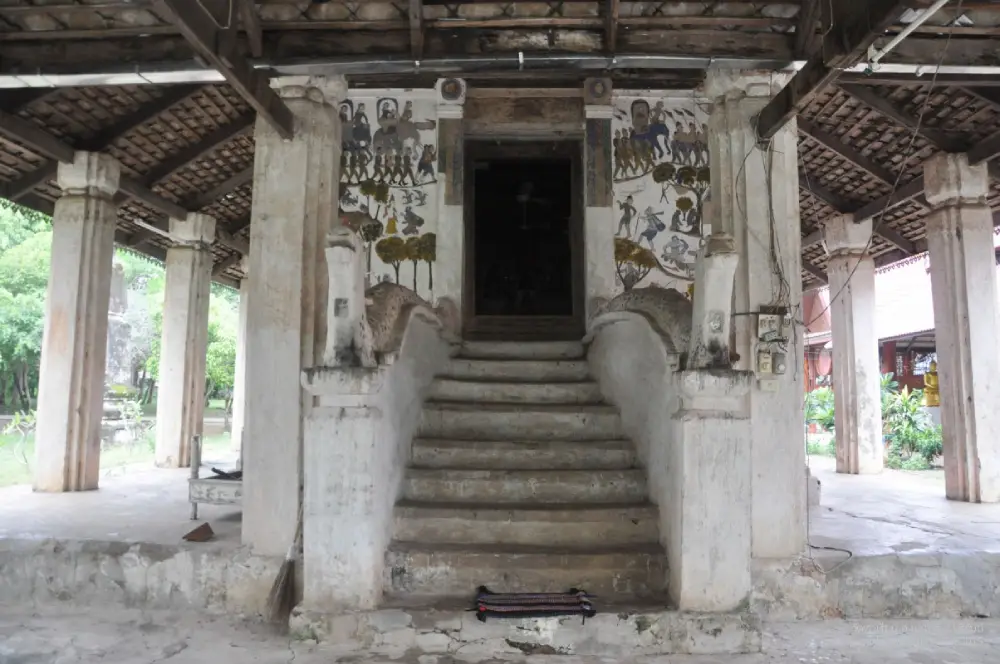
The old ordination hall is the heart of Wat Tha Riab and the main reason the temple is important for cultural travelers. Historical information about the building indicates that the old hall was constructed around 1889, under the leadership of Luang Pho Chun and with the faith and labor of local people. The building reflects vernacular Isan craftsmanship and the influence of skilled Kaew or Vietnamese craftsmen, who were known for masonry, plasterwork, and temple construction. This combination gives the hall a distinctive local character.
The old ordination hall is a solid-walled 3-room structure with a surrounding veranda and a front porch. It is modest in scale compared with modern ordination halls, but it carries strong architectural value because of its proportions, layout, and traditional craftsmanship. Its form represents the local sim, or Isan ordination hall, which was built for religious function, community use, and spiritual meaning rather than monumental grandeur. This quiet and compact form is part of the hall’s charm.
One of the most remarkable features of the ordination hall is its mural painting, found both inside and outside the building. These murals are a form of local artistic heritage that reflects Buddhist stories, community imagination, and vernacular worldviews. Unlike royal-style murals that often follow strict aesthetic conventions, village temple murals tend to be lively, direct, and close to local people. The lines, colors, figures, and narrative details allow visitors to sense the voice of local craftsmen and the beliefs of the community that created them.
The Fine Arts Department registered the old ordination hall of Wat Tha Riab as a historic site in 1977. This recognition confirms the building’s historical, artistic, and architectural value. Registration does not separate the building from the community. Instead, it acknowledges that the ordination hall is both a sacred Buddhist space and a cultural heritage site of Buriram Province. Visitors should therefore view it with respect, understanding that it remains part of an active temple.
In 2025, the Fine Arts Department carried out conservation-related work and public outreach concerning the mural paintings inside and outside the ordination hall. The project involved specialists in mural and monument conservation who provided information to the temple and local community about the significance of the murals, conservation procedures, and appropriate care for historic structures. This recent conservation attention shows that Wat Tha Riab remains highly valued as a local heritage site.
The conservation of the murals is especially important because old wall paintings are vulnerable to moisture, heat, dust, wall cracks, and inappropriate repairs. Without proper care, paintings that have preserved local memory for more than a century can deteriorate in ways that cannot be fully reversed. By involving the temple and community in conservation awareness, the project helps ensure that Wat Tha Riab can remain a learning site for future generations.
Architecturally, the old ordination hall shows how local Isan craftsmanship interacted with outside craft traditions. Kaew or Vietnamese craftsmen who worked in the region were often skilled in brick-and-plaster construction, openings, stucco details, and temple ornamentation. Many Isan temples therefore preserve buildings that look simple at first glance but contain highly distinctive local details. Wat Tha Riab is an excellent example of this cultural and technical exchange.
The temple grounds, covering 17 rai, 1 ngan, and 8 square wah, provide space for the ordination hall, temple courtyard, monk residences, religious activity areas, and community events. In rural Isan, temples often host Buddhist holy day ceremonies, ordinations, funerals, memorial merit-making, annual festivals, and village gatherings. Wat Tha Riab continues this role, serving both as a historic site and as a practical religious center for the people of Ban Nong Wa.
Besides the old ordination hall, the temple includes areas used in everyday religious life, such as the temple courtyard, monk residences, ceremonial spaces, and places where villagers gather during merit-making events. These areas show that the temple is still alive. Visitors should therefore appreciate both sides of Wat Tha Riab: the historical value of the old building and the ongoing religious role of the temple in the present.
For cultural travelers, Wat Tha Riab is suitable for those interested in old temples, mural paintings, vernacular architecture, and community history. It is not a commercial tourist attraction with large facilities or entertainment-based activities. Instead, it is a quiet village temple with deep cultural value. Visitors should walk slowly, observe the old ordination hall carefully, and pay attention to the veranda, front porch, wall surfaces, and surviving mural traces. The beauty of the temple lies in details and context rather than outward grandeur.
The murals are especially important for those interested in local art. Mural paintings in community temples often preserve Buddhist teachings, Jataka stories, local life, and social imagination in visual form. Preserving them means preserving not only images but also language, memory, belief, and the way earlier generations understood the world. At Wat Tha Riab, the murals help transform the ordination hall into a record of local Buddhist culture.
Wat Tha Riab can also be included in a cultural route around Na Pho District and nearby areas. Na Pho is known for silk weaving and local handicrafts, especially the Na Pho Folk Handicraft Center and local silk weaving communities. Nearby places also include Wat Hong in Phutthaisong District, Ku Suan Taeng Sanctuary in Ban Mai Chaiyaphot District, and Wat Pa Nong Bua Rong. This makes it possible to plan a half-day or full-day route that combines temple heritage, murals, silk weaving, and ancient Khmer architecture.
Wat Hong is a major sacred site near Na Pho and is known for Phra Chao Yai, a revered Buddha image respected by people in Buriram and nearby provinces. Ku Suan Taeng Sanctuary is a Khmer-period site with historical and architectural value. Visiting Wat Tha Riab together with these places allows travelers to understand Buriram through several layers: Buddhism, local art, mural conservation, silk craft, and ancient Khmer heritage.
Wat Tha Riab also represents a quieter side of Buriram. Many visitors know the province through Phanom Rung Historical Park, Chang Arena, or major city attractions, but Wat Tha Riab offers a more local experience. It is a place where travelers can see an old temple still used by villagers, learn about mural conservation, and understand how much cultural heritage continues to live in ordinary community temples rather than only in museums or major monuments.
Visitors should dress respectfully, keep noise low, and treat the old ordination hall as a valuable historic structure. They should not touch, scratch, lean against, or use any equipment that may damage the murals or wall surfaces. If any area is under conservation or restricted, visitors should follow instructions from the temple or relevant officials. Cultural travel at a place like Wat Tha Riab requires respect for the temple, the community, and the heritage inherited from the past.
The best time to visit is during the daytime, especially in the morning or afternoon when natural light makes it easier to see the building and temple atmosphere. Morning is suitable for merit-making and paying respect to the Buddha, while afternoon is suitable for observing the old ordination hall at a relaxed pace. During the rainy season, visitors should prepare suitable footwear and rain protection because parts of a rural temple courtyard may become damp depending on the weather.
Getting There is possible by private car or local transport. From Buriram city, travelers can head toward Phutthaisong District or Na Pho District, then continue to Ban Nong Wa, Village No. 10, Na Pho Subdistrict. The distance from Na Pho town to Wat Tha Riab is approximately 5 kilometers. Travelers without a private car can take public transport from Buriram city to Phutthaisong District, then continue to Na Pho District and onward to the temple. Checking the route in advance is recommended because the temple is located within a local community.
Travelers planning a Na Pho cultural trip can begin at Wat Tha Riab in the morning to see the old ordination hall and murals, then continue to the Na Pho Folk Handicraft Center to learn about silk weaving. Depending on available time, the route can continue to Wat Hong or Ku Suan Taeng Sanctuary. Those who want to stay overnight can choose accommodation in Na Pho, Phutthaisong, Ban Mai Chaiyaphot, or other nearby districts.
The importance of Wat Tha Riab can be understood through 3 layers. The first layer is religious: it is a Mahanikaya temple with a consecrated boundary and resident monks. The second layer is historical: the temple was founded in 1883 and has an old ordination hall registered as a historic site. The third layer is artistic: its murals and vernacular architecture are significant enough to receive conservation attention from the Fine Arts Department. These layers make Wat Tha Riab a valuable cultural learning site in Buriram Province.
A visit to Wat Tha Riab offers a chance to see a living village temple and a historic artistic monument in one place. Its appeal does not lie in grand scale but in age, calmness, locality, and continuity between past and present. The old ordination hall built through community faith, the murals that preserve local visual memory, and the temple name linked to the old path down to the water landing all make Wat Tha Riab one of Na Pho District’s most meaningful cultural sites.
| Name | Wat Tha Riab |
| Location | Ban Nong Wa, Village No. 10, Na Pho Subdistrict, Na Pho District, Buriram Province |
| Address | No. 2, Ban Nong Wa, Village No. 10, Na Pho Subdistrict, Na Pho District, Buriram Province 31230, Thailand |
| Place Type | Community Buddhist Temple under the Mahanikaya Order and historic ordination hall site in Na Pho District |
| Temple Area | 17 rai, 1 ngan, and 8 square wah |
| Highlights | Old ordination hall registered as a historic site, mural paintings inside and outside the hall, and a temple name linked to the old flat path down to a riverside landing |
| History / Period | The temple was established in 1883, received Wisungkhamasima in 1892, and its old ordination hall was registered as a historic site by the Fine Arts Department in 1977. |
| Name Origin | The name comes from the flat area and path leading down to a water landing used by villagers traveling between the village and the landing. |
| Distinctive Features | Solid-walled 3-room ordination hall with a surrounding veranda and front porch, reflecting vernacular Isan craftsmanship and the influence of Kaew or Vietnamese craftsmen |
| Key Evidence | Registered historic ordination hall, mural paintings inside and outside the hall, Wisungkhamasima boundary, and temple history connected with Ban Nong Wa community |
| Wisungkhamasima | Received in 1892; the boundary measures 12 meters wide and 24 meters long. |
| Main Areas / Zones | Old ordination hall and historic-site area Mural painting areas inside and outside the hall Temple courtyard Ceremonial hall or religious activity area Monk residence area Ban Nong Wa community landscape around the temple |
| Facilities | Temple courtyard, religious activity area, parking space within or near the temple, and areas used for community merit-making events |
| Abbot / Caretaker | Phra Athikan Supharit Thanangkaro |
| Resident Monks | 7 monks during the Buddhist rains retreat |
| Travel Information | Travel from Buriram city toward Phutthaisong District or Na Pho District, then continue to Ban Nong Wa, Village No. 10, Na Pho Subdistrict. The temple is about 5 km from Na Pho town. |
| Current Status | Open as a community Buddhist temple and home to a historic ordination hall with mural conservation work by the Fine Arts Department |
| Open Days | Daily |
| Opening Hours | Daytime visits are recommended |
| Main Contact Number | 086-4750618 |
| Nearby Tourist Attractions | 1. Na Pho Folk Handicraft Center, about 5 km 2. Wat Pa Nong Bua Rong, about 8 km 3. Wat Hong, Phutthaisong District, about 14 km 4. Ku Suan Taeng Sanctuary, about 17 km 5. Na Pho Silk Weaving Village, about 5 km |
| Nearby Restaurants | 1. U_na Cafe', about 5 km, Tel. 082-6393647 2. Sixteen Cafe, about 5 km 3. Bui Cafe, about 5 km 4. Dino Shabu Na Pho, about 5 km 5. Ban Suan Phi Nong Restaurant, about 6 km 6. Khrua Khun Ploy, about 5 km |
| Nearby Accommodations | 1. Pha Tum Thong Homestay, Ban Na Pho, about 5 km, Tel. 044-686044, 084-9604291 2. Ying Lee Lalla Resort / Ying Lee Water Park Resort, about 8 km, Tel. 094-9877772, 083-3366044 3. Thanyaras Resort Hotel, about 18 km 4. Saen Sawat Resort 2, about 40 km, Tel. 090-9654999 5. Phe La Ploen Boutique Resort and Camp, about 40 km |
Frequently Asked Questions (FAQ)
Q: Where is Wat Tha Riab located?
A: Wat Tha Riab is located at No. 2, Ban Nong Wa, Village No. 10, Na Pho Subdistrict, Na Pho District, Buriram Province, about 5 km from Na Pho town.
Q: Why is Wat Tha Riab important?
A: Wat Tha Riab is an old temple established in 1883. It received Wisungkhamasima in 1892 and has an old ordination hall registered as a historic site by the Fine Arts Department in 1977.
Q: What is special about the old ordination hall at Wat Tha Riab?
A: The old hall is a solid-walled 3-room vernacular ordination hall with a surrounding veranda, a front porch, and mural paintings inside and outside the building.
Q: What is the origin of the name Wat Tha Riab?
A: The name comes from the flat area and path leading down to a water landing that villagers once used for travel between the village and the landing.
Q: Who is the abbot of Wat Tha Riab?
A: The abbot listed in the temple information is Phra Athikan Supharit Thanangkaro.
Q: What type of visit is Wat Tha Riab suitable for?
A: It is suitable for merit-making, paying respect to the Buddha, seeing an old ordination hall, studying mural paintings, and learning about vernacular Isan craftsmanship.
Q: What nearby attractions can be visited with Wat Tha Riab?
A: Nearby attractions include Na Pho Folk Handicraft Center, Na Pho Silk Weaving Village, Wat Hong, Wat Pa Nong Bua Rong, and Ku Suan Taeng Sanctuary.
Q: How can travelers get to Wat Tha Riab?
A: From Buriram city, travel toward Phutthaisong District or Na Pho District, then continue to Ban Nong Wa, Village No. 10. Public transport travelers can reach Phutthaisong first and continue to Na Pho District.
 Category: ●Places of Worship
 Group: ●Temple
Last Update : 2 MonthAgo
 Last Update : 2 MonthAgo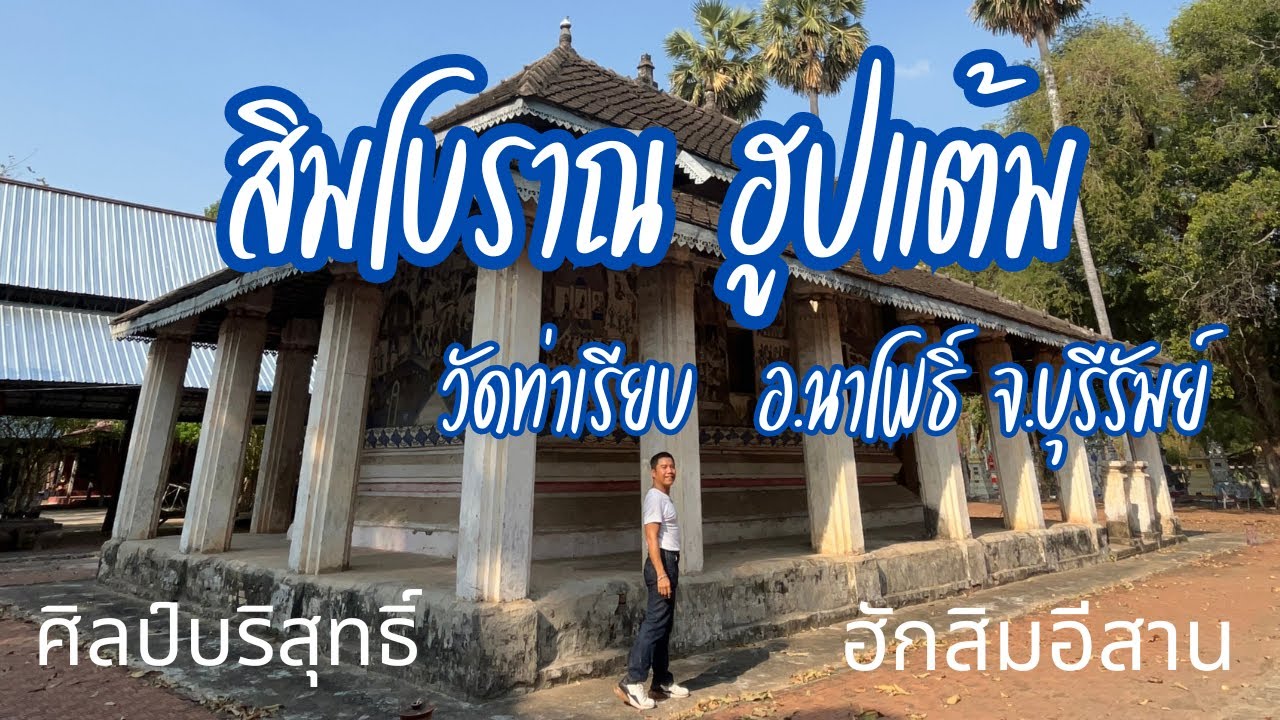
 Click to Access the Navigation Map GPS
Wat Tha Riab Map
Recommend

 Art, Culture and Heritage
 Historical Sites and Monuments(14)
 Landmarks and Memorials(2)
 Art, Craft Centres, Tradition(6)
 Museums(3)
 Educational Places
 Museum for Study(1)
Temple(74)
Museum for Study(1)
Temple(74)
 Other Sacred Sites(5)
 Suburban Living
 Village, Community(3)
 Nature and Wildlife
 National Parks and Marine Reserves(2)
 Mountain (Doi)(1)
 Dam, Reservoir, Lake(14)
 River, Canal(1)
 Bays and Beaches(1)
 Other natural attractions(2)
 Entertainment and Agricultural
 Animal camps and shows(1)
 Stadium(2)
 Farms, Parks and Ecotourism(2)
 Waterpark(1)


