
lovethailand home >Central Travel Attractions >Samut Sakhon Travel Attractions >Muang Samut Sakhon >Ban Koh > Wat Bang Pla
TL;DR: Wat Bang Pla is located at Moo 4, Ban Bang Pla, Ban Ko Subdistrict, Mueang Samut Sakhon District, Samut Sakhon, open Open Daily, hours Open All Day (typical temple hours).
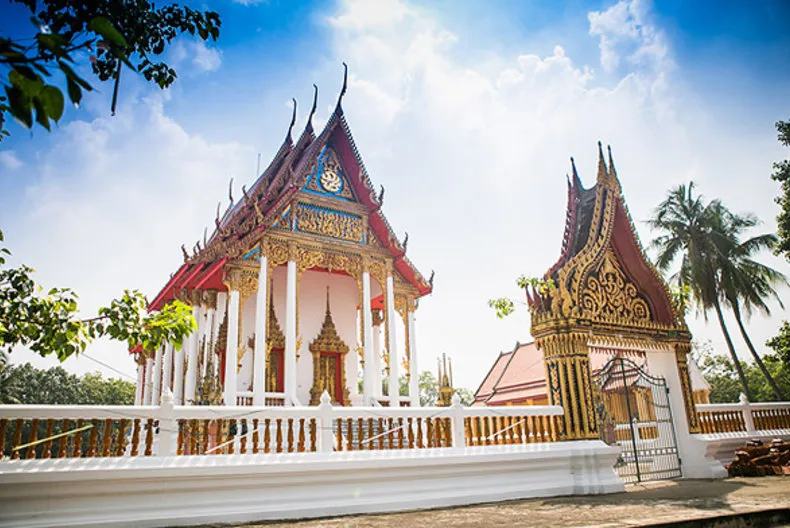
Wat Bang Pla
Open Days: Open Daily
Opening Hours: Open All Day (typical temple hours)
Wat Bang Pla is an old riverside temple in Ban Ko Subdistrict, Mueang Samut Sakhon District, Samut Sakhon, standing along the Tha Chin River and holding deep importance in the historical and cultural life of the local Mon community. For many travelers, this is not the kind of temple that appears first on a mainstream sightseeing list. Its appeal is quieter and more substantial. It is a place for people who enjoy old temples, local history, riverside communities, and the layered atmosphere of a sacred site that still carries its original cultural identity. Wat Bang Pla is not simply a place to stop and pay respect. It is a place where history, art, memory, and community tradition still exist side by side.
One of the temple’s strongest qualities is its role as an important Mon temple in Samut Sakhon. That cultural identity is not just something preserved in writing. It is still reflected in religious practice. On important Buddhist occasions such as Visakha Bucha and the end of Buddhist Lent, monks from other Mon temples gather here for ceremony, giving Wat Bang Pla a role that extends far beyond being a neighborhood temple. In cultural terms, it functions as a spiritual center for a broader network of Mon communities along the Tha Chin River. For travelers interested in Mon heritage in Thailand, this is one of the places where that living tradition can still be meaningfully observed.
According to local records, the temple was established in 1904 and has long stood beside the Tha Chin River, one of the most important waterways in Samut Sakhon. That riverside setting matters because the river was historically central to transport, settlement, trade, and cultural exchange. When seen in that wider context, Wat Bang Pla is more than a Buddhist compound. It is part of a historical river landscape that reflects the way faith and everyday life were connected in old Samut Sakhon. The temple’s location helps explain why it developed into such an important religious and communal landmark.
A major historical point that gives the temple national significance is its connection with King Chulalongkorn. On 31 July 1905, during his journey along the Tha Chin River, King Rama V stopped at Wat Bang Pla, where the royal party prepared food and took a meal. This episode gives the temple a place in the story of royal travel and provincial history. For readers searching for historical temples in Samut Sakhon, that royal connection is one of the most distinctive reasons to visit. It turns the temple from a local religious site into a place linked with a recognizable moment in Thai historical memory.
Architecturally, Wat Bang Pla is especially interesting because of its older structures and decorative details. The old ubosot and pediment are adorned with porcelain and stucco dragon motifs featuring the image of dragons chasing a pearl. This style reflects visible Chinese artistic influence, which is fitting for a riverside region historically shaped by trade, migration, and multicultural exchange. These decorative elements are not merely ornamental. They are part of the temple’s identity and one of the clearest reminders that old religious architecture in central Thailand often absorbed and transformed outside artistic influences into something locally distinctive.
The old viharn is another important part of the temple, especially because it contains Buddhist narrative paintings said to be more than 200 years old and associated with Sri Lankan and European painters. This detail makes the temple particularly compelling for visitors interested in temple art. It suggests that Wat Bang Pla was part of a much broader cultural world than its modest present-day appearance might initially imply. Rather than being culturally isolated, the temple appears to preserve traces of wider artistic connections, which adds real depth to a visit.
Another meaningful feature within the temple grounds is the group of funerary urns containing the ashes of four former abbots: Luang Pu Nut, Ajarn Plian, Luang Pu Khaek, and Luang Pu Song. These are not minor details. They show the continuity of leadership within the temple and help visitors understand the temple as a living institution shaped by generations of respected monks. This kind of continuity is often what gives old temples their emotional depth. The buildings tell one story, but the monks who cared for the temple over time tell another.
Wat Bang Pla also has a notable architectural element associated with Prince Chumphon Khet Udomsak, who is said to have commissioned a long pavilion-like structure with beautifully carved eaves along a walkway in the temple. This adds another historical layer to the site and broadens its significance beyond local community history alone. For temple lovers and heritage-minded travelers, such details make a difference because they show how a seemingly quiet local temple can still hold links to larger national historical figures and artistic traditions.
As a place to visit, Wat Bang Pla suits travelers who prefer slower, more reflective temple experiences. It is not about spectacle. It is about atmosphere and detail. The temple rewards those who walk carefully, observe the older decorative work, think about the royal visit, and appreciate the way Mon religious traditions remain attached to the site. For this reason, Wat Bang Pla works very well in a Samut Sakhon cultural itinerary, especially for visitors who want more than seafood markets and coastal photo stops.
Getting There is relatively straightforward. From Mahachai, take Setthakit Road for about 5 kilometers, then turn left onto the same route used for Wat Pa Chai Rangsi and continue for about 4 kilometers. The temple is in Moo 4, Ban Bang Pla, Ban Ko Subdistrict, along the Tha Chin River. A private car is the most convenient option. Travelers without a car can first reach central Samut Sakhon or Mahachai and then continue by local taxi or hired transport. Since the temple’s value lies in its details rather than its scale, it is worth allowing enough time to walk around slowly instead of treating it as a quick stop.
Today, the temple remains active and open for worship, merit-making, and religious events. Local information lists a contact number for the temple, and recent temple data names Phra Khru Wutthisakhontham as the current abbot. That matters because it confirms that Wat Bang Pla is not simply an old site remembered for the past. It is still part of the religious life of the community. For foreign travelers looking for an authentic cultural temple in Samut Sakhon, this combination of living tradition, old architecture, Mon identity, and historical depth makes Wat Bang Pla one of the most rewarding temples in the Ban Ko area.
| Name | Wat Bang Pla |
| Location | Moo 4, Ban Bang Pla, Ban Ko Subdistrict, Mueang Samut Sakhon District, Samut Sakhon |
| Address | Moo 4, Ban Ko, Mueang Samut Sakhon, Samut Sakhon 74000 |
| Coordinates | 13.585206, 100.232317 |
| Highlights | Old ubosot and pediment with porcelain dragon stucco, old viharn, Buddhist narrative paintings, important Mon temple on the Tha Chin River |
| History | Established in 1904; King Rama V stopped here during his Tha Chin River journey on 31 July 1905 |
| Distinctive Features | Chinese-influenced decorative work, old viharn, 200-year-old Buddhist paintings, ashes of former abbots kept in grouped urns, elegant carved pavilion structure |
| Travel Information | From Mahachai, take Setthakit Road for about 5 km, then turn left toward Wat Pa Chai Rangsi and continue about 4 km; private car is the easiest option |
| Current Status | Still active and open for worship, temple visits, merit-making, and religious activities |
| Open Days | Open Daily |
| Opening Hours | Open All Day (typical temple hours) |
| Main Areas / Zones | Old ubosot, dragon pediment, old viharn, Buddhist paintings, former abbots’ urn area, long carved pavilion walkway |
| Abbot / Caretaker | Phra Khru Wutthisakhontham |
| Main Contact Number | 099 064 9017 |
| Official Website / Official Page | Bang Pla Municipality travel information page |
| Nearby Tourist Attractions | 1) Wat Pa Chai Rangsi 4 km 2) Wat Sutthiwat Wararam (Wat Chong Lom) 8 km 3) Mahachai Market 9 km 4) Tha Chalom Community 11 km 5) Phanthai Norasing Shrine 17 km |
| Nearby Restaurants | 1) Ruen Sakhon Cafe & Restaurant 3 km 2) Krua Chom Suan 4 km Tel. 088-662-1456 3) Kinlamoon 4 km Tel. 081-357-8333 4) PlantB Cafe 5 km Tel. 065-687-6484 5) Tha Rua Phattakhan 9 km Tel. 084-229-5159, 093-946-4954, 034-421-935 |
| Nearby Accommodations | 1) At Samut Sakhon Mahachai 9 km Tel. 099-095-4541, 065-464-7459 2) The Seaport Mahachai 10 km Tel. 083-436-5434, 034-836-880 3) Orchid Hotel Samut Sakhon 10 km 4) Thongchen Residence 11 km Tel. 034-425-191 5) Scotland Honeymoon Inn 12 km Tel. 087-681-4987 |
Frequently Asked Questions (FAQ)
Q: Where is Wat Bang Pla located?
A: Wat Bang Pla is in Moo 4, Ban Bang Pla, Ban Ko Subdistrict, Mueang Samut Sakhon District, Samut Sakhon, along the Tha Chin River.
Q: What is Wat Bang Pla known for?
A: It is known for its old ubosot with porcelain dragon decoration, old viharn, historic Buddhist paintings, and its importance in the Mon religious tradition of Samut Sakhon.
Q: Did King Rama V really stop at this temple?
A: Yes. Historical accounts note that King Chulalongkorn stopped here during his Tha Chin River journey on 31 July 1905.
Q: Is Wat Bang Pla still an active temple?
A: Yes. The temple remains active and open for temple visits, worship, merit-making, and religious ceremonies.
Q: Is this temple worth visiting for cultural travelers?
A: Yes. It is especially worthwhile for travelers interested in local history, Mon culture, old temple architecture, and quieter heritage sites.
Q: What else can I visit near Wat Bang Pla?
A: You can continue to Wat Pa Chai Rangsi, Wat Chong Lom, Mahachai Market, Tha Chalom, or the Phanthai Norasing Shrine in the same trip.
 Category: ●Places of Worship
 Group: ●Temple
Last Update : 5 MonthAgo
 Last Update : 5 MonthAgo
 Click to Access the Navigation Map GPS
 Art, Culture and Heritage
 Historical Sites and Monuments(3)
 Landmarks and Memorials(4)
 Art, Craft Centres, Tradition(2)
 Museums(1)
 Historic Homes and Cities(1)
 Educational Places
 Museum for Study(1)
Temple(31)
Museum for Study(1)
Temple(31)
 Other Sacred Sites(12)
 Research and Development
 Royal Project(1)
 Suburban Living
 Village, Community(4)
 Local Market(2)
 Floating Market(2)
 Nature and Wildlife
 National Parks and Marine Reserves(1)
 River, Canal(4)
 Bays and Beaches(1)
 Other natural attractions(3)
 Entertainment and Agricultural
 Zoos and Aquariums(1)
 Shopping
 Shopping and Night Market(1)


