
lovethailand home >North Travel Attractions >Lampang Travel Attractions >Soem Ngam >Soem Sai > Ban Mae Tam Arts and Crafts Center
TL;DR: Ban Mae Tam Arts and Crafts Center is located at Ban Mae Tam, Village No. 1, Soem Sai Subdistrict, Soem Ngam District, Lampang Province, open Daily, hours 08.00 – 16.00.

Ban Mae Tam Arts and Crafts Center
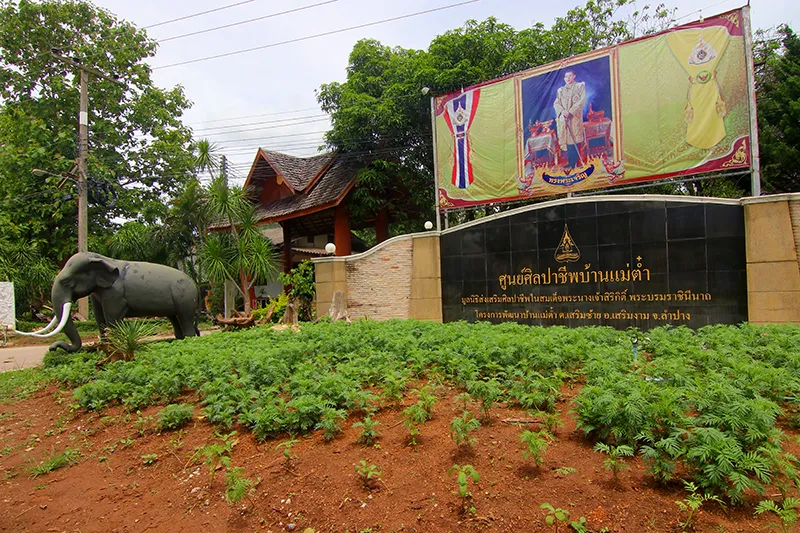
Open Days: Daily
Opening Hours: 08.00 – 16.00
Ban Mae Tam Arts and Crafts Center and Ban Mae Tam Development Project in Lampang Province is one of the most meaningful examples of royal-initiated rural development in northern Thailand. Located in Ban Mae Tam, Soem Sai Subdistrict, Soem Ngam District, the project shows how arts and crafts training, demonstration farming, land allocation, irrigation, and forest restoration can work together to improve people’s lives while protecting natural resources. It is not simply a place to see handicrafts. It is a living development landscape where community livelihood and forest conservation are closely connected.
The project began from the royal initiative of Her Majesty Queen Sirikit The Queen Mother. On 17 January 1984, during a visit to communities in Soem Ngam District, Her Majesty learned that people in Ban Mae Tam were living with unstable income, limited farmland, and heavy dependence on cutting timber, hunting, and collecting forest products. The special arts and crafts project was introduced to create honest supplementary occupations for local people and to reduce pressure on the surrounding forests.
After the arts and crafts activities had started, it became clear that occupation training alone could not solve all of the community’s problems. The people also needed farmland, water, agricultural knowledge, and a long-term framework for forest conservation. Therefore, the Ban Mae Tam Development Project was established on 25 February 1988 in cooperation with relevant government agencies. The goal was to develop the area more comprehensively by combining livelihood improvement, agriculture, livestock, irrigation, and forest protection.
The project covers more than 32,000 rai and has been organized into different functional areas. About 100 rai are used for the arts and crafts service center, which serves as a training and knowledge-transfer area for local handicrafts. Another 63 demonstration agricultural plots, covering about 125 rai, are used to teach sustainable farming, mixed cropping, animal raising, and soil-water management. Around 1,000 rai are allocated as farmland for local residents, while more than 30,775 rai are reserved for reforestation and ecological restoration.
This land-use structure is the heart of the project. It shows that rural development cannot rely on only one solution. Arts and crafts help create supplementary income. Demonstration farms provide practical agricultural knowledge. Farmland gives families a secure livelihood base. Forest restoration protects water sources, biodiversity, and environmental stability. Together, these components create a system in which people can live with dignity without returning to destructive forest use.
The arts and crafts center has promoted several craft skills, including pottery, wood carving, weaving, and basketry. These occupations are important because they allow villagers to earn income from skill, creativity, and local knowledge rather than from extracting natural resources. Women, elderly people, and household members who may not be able to do heavy work outside the village can participate in craft training and produce items that support household income.
Pottery at Ban Mae Tam reflects both local skill and the broader ceramic identity of Lampang Province. Through training in shaping, firing, decoration, and finishing, villagers can develop products that function as household goods, decorative items, or souvenirs. Each piece is part of a larger story of livelihood creation and community self-reliance.
Weaving is another important craft activity because woven textiles are deeply connected with northern Thai culture. Learning to prepare fibers, set patterns, weave fabric, and refine product quality helps preserve local knowledge while creating real economic value. The craft is not only about producing cloth; it is also about keeping cultural memory alive through practical work.
Wood carving and basketry demonstrate how natural materials can be used with awareness and respect. Under the development concept of the project, craft production must be connected with conservation. Local people are encouraged to understand the source of materials, the value of forests, and the importance of using resources responsibly. In this way, craft training becomes part of environmental education as well as income generation.
The demonstration farm is another major learning component of the project. It supports practical training in fruit growing, chemical-safe vegetables, livestock, water management, and diversified farming. Farmers can learn by seeing real examples in the field, then adapt suitable methods to their own farmland. This type of hands-on learning is especially important in rural development because it helps families improve productivity without expanding into forest areas.
Irrigation development has also played a crucial role. Water storage and water distribution systems support household use, farming activities, and the arts and crafts center. Reliable water access helps reduce uncertainty in agricultural production and gives farmers more confidence to work within allocated land rather than clearing new forest areas.
From an environmental perspective, Ban Mae Tam is an important example of solving forest problems through livelihood development. If people have no income, no land, and no alternatives, forest conservation campaigns alone cannot succeed. The project addresses the root causes by giving communities better occupational choices, practical knowledge, and a stake in protecting the land. As people see the value of the forest for water, food, climate, and long-term security, conservation becomes a shared community responsibility.
One of the strongest results of the project is the change in community awareness. Local residents have gained a clearer understanding that forests are not only places to collect resources, but living systems that support the community. This awareness has helped create a stronger local network for protecting natural resources. The success of Ban Mae Tam therefore lies not only in physical development, but in the transformation of mindset.
The geography of Ban Mae Tam also adds to the importance of the project. The village lies in a lowland area between foothills and forests, with significant natural resources and watershed value. Development in such an area requires careful balance. If the land is used carelessly, the impact can affect not only Ban Mae Tam but also downstream communities and ecosystems. This is why the project’s integrated approach is especially meaningful.
For visitors, Ban Mae Tam Arts and Crafts Center is best understood as a learning destination rather than a conventional tourist attraction. Visitors can observe the relationship between craft training, farming, land-use planning, community livelihood, and forest restoration. The experience helps explain how a rural community can move from dependence on forest exploitation toward sustainable income and environmental stewardship.
One of the most interesting things to observe is how the project area is organized. The arts and crafts center is linked with demonstration farms, community farmland, local settlements, and reforested areas. This structure shows that development is most effective when different activities support one another. Supplementary income reduces economic pressure. Agriculture provides food and livelihood. Land security reduces forest encroachment. Forest restoration maintains water and ecological balance.
The center is suitable for students, researchers, family travelers, government groups, and anyone interested in royal development principles. It provides a practical case study of integrated rural development. Visitors can learn why handicraft training matters to rural households, how farming knowledge supports long-term livelihood, and why environmental conservation must be linked with human well-being.
For travelers interested in Thai handicrafts, the center offers a valuable source-area experience. Seeing products in the community where they are made helps visitors appreciate the meaning behind each item. The crafts are not only decorative or functional objects. They represent training, patience, local skill, supplementary income, and the community’s effort to stand on its own.
Within the broader tourism image of Lampang, Ban Mae Tam adds an important dimension. Lampang is known for old temples, horse carriages, ceramics, and historic neighborhoods, but Ban Mae Tam shows another side of the province: rural development, community resilience, craft knowledge, and forest restoration. A visit here gives travelers a deeper understanding of Lampang as a province shaped by both culture and social development.
Getting There is most convenient by private car from Lampang city. Travel toward Soem Ngam District, then continue to Soem Sai Subdistrict and Ban Mae Tam. The route is suitable for a day trip, but visitors should check directions in advance, especially when traveling as a group. Some sections are rural roads, so driving at moderate speed and respecting local community traffic is recommended.
Groups planning to visit for study purposes should contact the center or local authority in advance. The arts and crafts center and demonstration farm are real working areas, not commercial entertainment venues. Visitors should follow local guidance, avoid disturbing training activities, respect craft products and farming plots, and ask permission before entering specific areas or taking close-up photographs of people at work.
A half-day visit can focus on the arts and crafts center, demonstration farming areas, and community products. A full-day route can include nearby reservoirs, temples, and local attractions in Soem Ngam District. Travelers who want to stay longer can choose accommodation in Soem Ngam, Ko Kha, or Lampang city depending on travel plans and comfort needs.
Visitors should dress comfortably and politely, wear shoes suitable for walking, and bring drinking water, a hat, and sun protection if they plan to walk through outdoor learning areas. They should avoid entering agricultural plots without permission, touching products without asking, littering, or interrupting local work. Responsible visiting helps ensure that educational tourism benefits both guests and the community.
Ban Mae Tam Arts and Crafts Center and Development Project is worth visiting for anyone interested in royal initiatives, Thai handicrafts, sustainable agriculture, forest restoration, and community development. It shows that poverty reduction and conservation are not separate goals. When people have skills, land, water, knowledge, and participation, forests can recover and communities can become more secure.
Overall, the Ban Mae Tam Development Project is a powerful example of balanced development. It began with a deep understanding of people’s real problems and expanded into a comprehensive system of craft training, farming, land allocation, water management, and forest restoration. The result is not only a project site but a living proof that people and forests can recover together when development is guided by compassion, knowledge, and long-term responsibility.
| Name | Ban Mae Tam Arts And Crafts Center And Ban Mae Tam Development Project, Lampang |
| Location | Ban Mae Tam, Village No. 1, Soem Sai Subdistrict, Soem Ngam District, Lampang Province |
| Address | Ban Mae Tam, Village No. 1, Soem Sai Subdistrict, Soem Ngam District, Lampang 52210 |
| Coordinates | 17.9248069673223, 99.1504767537117 |
| Highlights | Royal-initiated arts and crafts center and demonstration farm integrating occupation training, sustainable agriculture, farmland allocation, and forest restoration |
| History | The arts and crafts initiative began in 1984 to support poor villagers and reduce forest destruction. In 1988, the Ban Mae Tam Development Project was established to expand support into agriculture, livestock, irrigation, and natural resource conservation. |
| Name Origin | The project is named after Ban Mae Tam, the community in Soem Sai Subdistrict where the arts and crafts and development activities are located. |
| Distinctive Features | The project covers more than 32,000 rai, including about 100 rai for the arts and crafts service center, 63 demonstration agricultural plots covering about 125 rai, around 1,000 rai of community farmland, and more than 30,775 rai for reforestation and ecological restoration. |
| Travel Information | Travel from Lampang city toward Soem Ngam District, then continue to Soem Sai Subdistrict and Ban Mae Tam. Private car or organized group transport is recommended, and groups should contact the center or local authority in advance. |
| Current Status | Open as a learning center for arts and crafts, demonstration farming, sustainable agriculture, and royal development principles |
| Open Days | Daily |
| Opening Hours | 08.00 – 16.00 |
| Fees | No Admission Fee |
| Facilities | Arts and crafts service center, handicraft training areas, demonstration agricultural plots, model farm learning areas, parking where available, and nearby community areas |
| Main Areas / Zones | Arts and crafts center, pottery group, wood carving group, weaving group, basketry group, model farm, demonstration plots, community farmland, and reforestation areas |
| Caretaker | Ban Mae Tam Arts and Crafts Center, Ban Mae Tam Development Project, relevant government agencies, and Soem Sai Subdistrict Municipality as the local authority |
| Main Contact Number | Ban Mae Tam Arts and Crafts Center, Tel. 0-5423-9208, 0-5423-3744 / Soem Sai Subdistrict Municipality, Tel. 0-5483-6230 |
| Nearby Tourist Attractions | 1. Ban Mae Tam Community, about 0 km 2. Mae Chong Reservoir, about 8 km 3. Mae Ang Reservoir, about 12 km 4. Mae Tiang Reservoir, about 15 km 5. Wat Luang Nang Oi, about 18 km 6. Soem Ngam Town Center, about 20 km 7. Wat Phra That Lampang Luang, about 34 km |
| Nearby Restaurants | 1. Local Food Shops In Ban Mae Tam, about 0 – 3 km 2. Local Restaurants In Soem Sai Subdistrict, about 5 – 10 km 3. Kin Fae Bo Chao, Thung Ngam Subdistrict, about 18 km, Tel. 082-979-8058 4. Restaurants In Soem Ngam Town Center, about 20 km 5. Food And Drink Shops Around Soem Ngam Municipality, about 20 km |
| Nearby Accommodations | 1. Noppakao Resort Soem Ngam, about 20 km, Tel. 089-264-7968, 080-129-5125 2. Huen View Dee Soem Ngam Resort, about 22 km, Tel. 081-952-9618 3. Baan Praew Farm Stay, about 25 km 4. Homestays And Local Accommodations In Soem Ngam District, about 15 – 25 km 5. Accommodations In Ko Kha District, about 35 km 6. Accommodations In Lampang City, about 55 – 65 km |
Frequently Asked Questions (FAQ)
Q: Where is Ban Mae Tam Arts and Crafts Center located?
A: It is located in Ban Mae Tam, Village No. 1, Soem Sai Subdistrict, Soem Ngam District, Lampang Province.
Q: Why is Ban Mae Tam Arts and Crafts Center important?
A: It is a royal-initiated development area that combines arts and crafts training, model farming, sustainable agriculture, farmland allocation, and forest restoration to improve community livelihoods while protecting natural resources.
Q: When did the Ban Mae Tam project begin?
A: The arts and crafts initiative began in 1984, and the Ban Mae Tam Development Project was later established in 1988.
Q: What kinds of crafts are promoted at the center?
A: The center promotes pottery, wood carving, weaving, and basketry, along with model farming and demonstration agriculture.
Q: What are the opening hours?
A: The center is open daily from 08.00 to 16.00.
Q: Is there an admission fee?
A: No. Visitors can enter without an admission fee. Groups planning a study visit should contact the center or local authority in advance.
Q: How can travelers get to Ban Mae Tam Arts and Crafts Center?
A: Travel from Lampang city toward Soem Ngam District, then continue to Soem Sai Subdistrict and Ban Mae Tam. Private car or organized group transport is recommended.
Q: What nearby attractions can be visited after Ban Mae Tam?
A: Nearby places include Mae Chong Reservoir, Mae Ang Reservoir, Mae Tiang Reservoir, Wat Luang Nang Oi, Soem Ngam town center, and Wat Phra That Lampang Luang.
 Category: ●Research and Development
 Group: ●Royal Project
Last Update : 3 MonthAgo
 Last Update : 3 MonthAgo
 Click to Access the Navigation Map GPS
Ban Mae Tam Arts and Crafts Center Map
Recommend

 Art, Culture and Heritage
 Historical Sites and Monuments(2)
 Landmarks and Memorials(5)
 Art, Craft Centres, Tradition(10)
 Museums(4)
 Historic Homes and Cities(1)
 Places of Worship
 Temple(86)
 Other Sacred Sites(9)
Royal Project(2)
Other Sacred Sites(9)
Royal Project(2)
 Suburban Living
 Village, Community(3)
 Local Market(2)
 Nature and Wildlife
 National Parks and Marine Reserves(5)
 Mountain (Doi)(4)
 Dam, Reservoir, Lake(11)
 Waterfalls(15)
 Hot Springs(1)
 Caves(12)
 Flower Field(1)
 River, Canal(1)
 Bays and Beaches(1)
 Other natural attractions(4)
 Entertainment and Agricultural
 Animal camps and shows(1)
 Farms, Parks and Ecotourism(2)
 Outdoor and Adventure Activities(2)
 Shopping
 Shopping and Night Market(2)
 Spas and Wellness
 Spas and Wellness(1)


