
lovethailand home >North Travel Attractions >Lampang Travel Attractions >Mueang Lampang >Kluai Phae > Wat Phra That Muang Kham
TL;DR: Wat Phra That Muang Kham is located at Kluai Phae Subdistrict, Mueang Lampang District, Lampang Province, open Daily, hours 08.00 – 17.00.
Wat Phra That Muang Kham
Open Days: Daily
Opening Hours: 08.00 – 17.00
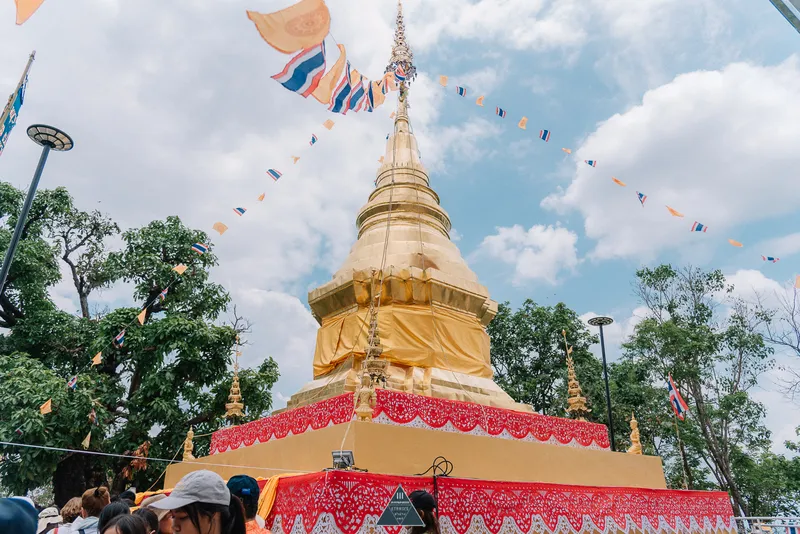
Wat Phra That Muang Kham, also known locally as Wat Doi Muang Kham, is a hilltop Buddhist temple in Kluai Phae Subdistrict, Mueang Lampang District, Lampang Province. Located about 17 kilometers from Lampang city, the temple is known for its steep staircase of approximately 484 steps, its sacred hilltop pagoda, a large reclining Buddha image along the way, and beautiful panoramic views from the upper level. For travelers who enjoy quiet temples, local legends, and scenic viewpoints, Wat Phra That Muang Kham offers one of the most distinctive cultural experiences near Lampang city.
The temple is a local Buddhist temple of the Mahanikaya order and covers an area of about 13 rai and 2 ngan. Before the temple was established, the area was forested hill land. Later, an old chedi base was discovered, which was believed to correspond with the ancient local legend of the Golden-Haired Dog, known in Thai as the legend of Ma Khon Kham. This discovery reinforced the sacred meaning of the hill and encouraged the development of the site as a Buddhist temple.
The temple was established in 1925 by Phra Khru Rattana Sophon, also known as Luang Pho In, a former district ecclesiastical chief of Mae Tha and former abbot of Wat Mueang Sat. He worked together with Luang Pho Mueang of Wat Tha Haen, a respected monk of Lampang Province. The construction was supported by many monks, local devotees, villagers from Mae Tha District, people from Kluai Phae Subdistrict, and supporters from many other areas.
Phra Khru Rattana Sophon served as the first acting abbot from 1925 to 1969, a period of 44 years, until his passing. After that, Wat Phra That Muang Kham was abandoned for about 21 years. In 1990, Phra Athikan Thinphan Thinnawaro from Wat Mueang Sat in Mueang Lampang District came to serve as abbot, allowing the temple to return to active religious life and once again become a center of devotion for the surrounding community.
One of the most memorable experiences at Wat Phra That Muang Kham is the climb up the steep staircase. The approximately 484 steps require some physical effort, but the journey itself is meaningful. Many visitors see the climb as a practice of patience and mindfulness before reaching the sacred pagoda at the top. Along the route, the surrounding hill atmosphere gives the temple a peaceful and contemplative character.
Before reaching the highest level, visitors will find a large reclining Buddha image enshrined in a pavilion. This is an important resting and worship point for those climbing to the pagoda. Many people stop here to pay respect, rest, and prepare themselves before continuing upward to the main sacred area.
At the upper level of the temple, the hilltop pagoda is the main object of worship. Visitors come to make merit, pray for blessings, and enjoy the open views over Lampang’s landscape. The elevated location gives the temple a quiet and spacious feeling, especially in the morning and late afternoon when the weather is more comfortable and the light is softer.
Wat Phra That Doi Muang Kham also hosts an annual water-pouring ceremony for the pagoda. This local tradition takes place every year on the waning moon of the eighth day of the ninth northern lunar month. The ceremony includes merit-making, offerings, processions, and devotional activities that help preserve the cultural traditions of Kluai Phae and the wider Lampang community.
The temple is especially famous as the origin site of the legend of Ma Khon Kham, or the Golden-Haired Dog. According to the legend, during the time of the Buddha, the Lord Buddha and 1,500 arahant disciples traveled through the sky and came to rest on this hill. The Buddha taught the Four Noble Truths to Ananda, the disciples, celestial beings, Indra, Brahma, Yama, Garuda, Naga, and the Buddhist assembly gathered there.
When one of the disciples asked about the past of this hill, the Buddha explained that in former times, Buddhas of the present fortunate aeon had come to this place during their path toward supreme enlightenment. The Buddha then touched his head and gave 8 strands of hair to be enshrined in a deep pit. Indra instructed Vishvakarma to place a mango branch as a marker. The Buddha then predicted that the place would later be known as Doi Muang Kham and that, after his passing, disciples would bring the left jawbone relic to be enshrined here.
The legend then tells of a hunter who owned a female dog with golden hair. Because there were no male dogs in the area, the hunter was shocked when the dog became pregnant. Fearing that villagers would mock him, he decided to get rid of the dog. One evening, he removed the ladder to his raised forest house and left the dog below, hoping that a tiger would take her away.
The dog escaped and ran to Doi Pha Sam Sao near Doi Muang Kham, where she gave birth to twin baby girls. Each day, the dog searched for food to feed them and carried clothes from village drying lines so the girls could wear them. As time passed, the twins grew into beautiful young women. The elder sister was named Chetaka, and the younger sister was named Bua Tong.
Their beauty became known in the city. When King Plamma Khosa heard the news, he wished to take the twins as his queens. He sent a golden palanquin procession to bring them from Doi Pha Sam Sao while the dog was away. Bua Tong cried and mourned for her mother, while Chetaka felt excited about entering the palace.
The king built 2 palaces, one for each sister. When the dog returned to Pha Sam Sao and found her daughters gone, she howled and scratched the cliff in grief, leaving marks that local people called the footprints of the Golden-Haired Dog. Indra took pity on her and gave her the power of speech so she could search for her daughters.
The dog first reached Chetaka’s palace. When guards asked how she was connected to Chetaka, the dog said that Chetaka had once been her former master. When Chetaka heard this, she was ashamed that people might learn she had been raised by a dog. She ordered the guards to hurt the dog, forcing the wounded animal to flee.
The injured dog then reached Bua Tong’s palace. Bua Tong immediately welcomed her mother, cared for her wounds, gave her food and water, and hid her in a large chest. After 7 days, the dog died from her injuries. Indra transformed the dog’s body into jewels and treasure. When the king saw the chest filled with riches, he favored Bua Tong greatly and asked her to bring more treasure from Pha Sam Sao.
Grieving for her mother, Bua Tong went to Pha Sam Sao and intended to leap from the cliff. Below the cliff lived a giant suffering from a painful abscess. When Bua Tong fell onto him, the abscess burst and the giant was cured. In gratitude, he gave her many treasures, which she brought back to the king.
Chetaka became jealous and asked to go to Pha Sam Sao as well. Following Bua Tong’s advice, she jumped from the cliff, but because of the sin of harming her own mother, the giant caught and ate her. He then attacked the elephant and horse procession, causing many deaths. This place became known as Thok Hua Chang, which today is a community area in Mueang Lampang District.
At the end of the legend, the Buddha explained the karmic identities of the characters. The hunter was reborn as Devadatta. The golden-haired dog was reborn as Patacara. Bua Tong was reborn as Princess Yasodhara. Chetaka was reborn as Cinca Manavika, who falsely accused the Buddha and was swallowed by the earth into Avici hell. King Plamma Khosa was reborn as the Buddha himself. The legend therefore carries strong moral lessons about gratitude, compassion, karma, loyalty, and the consequences of rejecting one’s benefactor.
For travelers, Wat Phra That Muang Kham is valuable not only as a religious site but also as a place where landscape, pilgrimage, and storytelling come together. The hill, the steep staircase, the pagoda, the reclining Buddha image, the annual ceremony, and the legend of the Golden-Haired Dog all create a distinctive cultural identity that is different from many other temples in Lampang.
Visitors should prepare appropriately for the climb. Comfortable footwear, drinking water, and a slower pace are recommended because the staircase is steep. Morning and late afternoon are good times to visit, as the weather is cooler and the light over the landscape is more beautiful. The visit is best experienced slowly, with time for worship, rest, and reflection on the story of Doi Muang Kham.
Getting There is convenient by private car or rental vehicle from Lampang city. Travel toward Kluai Phae Subdistrict, about 17 kilometers from the city center. The temple can be combined with other cultural attractions in Lampang, such as Wat Phra That Lampang Luang, Wat Lai Hin Luang, Wat Si Rong Mueang, Kad Kong Ta Walking Street, and Ratsadaphisek Bridge.
| Name | Wat Phra That Muang Kham / Wat Doi Muang Kham |
| Location | Kluai Phae Subdistrict, Mueang Lampang District, Lampang Province |
| Temple Type | Local Buddhist temple of the Mahanikaya order |
| Area | 13 rai, 2 ngan |
| Highlights | Hilltop pagoda, approximately 484 steep steps, large reclining Buddha image in a pavilion, panoramic Lampang views, and the legend of the Golden-Haired Dog |
| History / Significance | Built in 1925 by Phra Khru Rattana Sophon, or Luang Pho In, together with Luang Pho Mueang of Wat Tha Haen and local devotees; later abandoned for about 21 years before returning to active monastic care in 1990 |
| Main Sacred Sites | Phra That Muang Kham, the large reclining Buddha image along the climbing route, and the upper viewpoint area |
| Important Festival | Annual water-pouring ceremony for the pagoda on the waning moon of the eighth day of the ninth northern lunar month |
| Important Legend | Legend of Ma Khon Kham, or the Golden-Haired Dog, an important local legend of Doi Muang Kham and Lampang Province |
| Travel Information | From Lampang city, travel toward Kluai Phae Subdistrict, about 17 km away; private car or rental vehicle is recommended, followed by a climb of about 484 steps to the pagoda |
| Current Status | Open for merit-making, pagoda worship, and hilltop viewpoint visits |
| Open Days | Daily |
| Opening Hours | 08.00 – 17.00 |
| Fees | No admission fee |
| Abbot / Caretaker | Phra Athikan Thinphan Thinnawaro |
| Nearby Tourist Attractions | 1. Wat Phra That Lampang Luang, about 15 km 2. Wat Lai Hin Luang, about 16 km 3. Wat Si Rong Mueang, about 17 km 4. Kad Kong Ta Walking Street, about 18 km 5. Ratsadaphisek Bridge, about 18 km |
| Nearby Restaurants | 1. Local restaurants in Kluai Phae area, about 5 km 2. Restaurants in Mae Tha area, about 10 km 3. Long Jim New York Pizza, about 18 km 4. Baan Phraya Suren by Madame Musur, about 18 km, Tel. 054-222317 5. Krua Nua Hom Lampang, about 19 km, Tel. 054-323999 |
| Nearby Accommodations | 1. Tree Tara Hotel Lampang, about 14 km, Tel. 099-1322256 2. B2 Lampang City Boutique & Budget Hotel, about 16 km, Tel. 052-009161 3. Wienglakor Hotel Lampang, about 17 km 4. Hop Inn Lampang City Center, about 17 km 5. The Coconut Hotel Lampang, about 19 km |
Frequently Asked Questions (FAQ)
Q: Where is Wat Phra That Muang Kham located?
A: Wat Phra That Muang Kham is located in Kluai Phae Subdistrict, Mueang Lampang District, Lampang Province, about 17 kilometers from Lampang city.
Q: How many steps lead up to the pagoda?
A: There are approximately 484 steep steps leading up to the pagoda area.
Q: What is another name for Wat Phra That Muang Kham?
A: It is also commonly known as Wat Doi Muang Kham.
Q: When is the annual water-pouring ceremony held?
A: The ceremony is held every year on the waning moon of the eighth day of the ninth northern lunar month.
Q: What is the legend of the Golden-Haired Dog?
A: It is a local legend connected with Doi Muang Kham, teaching moral lessons about gratitude, karma, compassion, and loyalty.
Q: Is Wat Phra That Muang Kham open daily?
A: Yes. The temple is open daily from 08.00 to 17.00.
Q: Is there an admission fee?
A: No. Visitors can make merit, worship at the pagoda, and enjoy the viewpoint free of charge.
 Category: ●Places of Worship
 Group: ●Temple
Last Update : 3 WeekAgo
 Last Update : 3 WeekAgo
 Click to Access the Navigation Map GPS
Wat Phra That Muang Kham Map
Recommend
 Art, Culture and Heritage
 Historical Sites and Monuments(2)
 Landmarks and Memorials(5)
 Art, Craft Centres, Tradition(10)
 Museums(4)
 Historical Houses and The Ancient City(1)
Temple(86)
Historical Houses and The Ancient City(1)
Temple(86)
 Other religious and spiritural sites(9)
 Research and Development
 Royal Project(2)
 Suburban Living
 Village, Community(3)
 Local Market(2)
 Nature and Wildlife
 National Parks and Marine Reserves(5)
 Mountain (Doi)(4)
 Dam, Reservoir, Lake(11)
 Waterfalls(15)
 Hot Springs(1)
 Caves(12)
 Flower Field(1)
 River, Canal(1)
 Bays and Beaches(1)
 Other natural attractions(4)
 Entertainment and Agricultural
 Animal camps and shows(1)
 Farm, Parks, Gardens and Ecotourism(2)
 Outdoor and Adventure Activities(2)
 Shopping
 Shopping and Night Market(2)
 Spas and Wellness
 Spas and Wellness(1)


