
lovethailand home >North Travel Attractions >Phitsanulok Travel Attractions >Chat Trakan >Bo Phak > Phu Soi Dao National Park
TL;DR: Phu Soi Dao National Park, Phitsanulok attractions : Nature and Wildlife, National Parks and Marine Reserves.
Phu Soi Dao National Park
Open Days: Daily, Subject To National Park Announcements
Opening Hours: Registration For The Pine Plateau Trek Is Recommended From 08.00 – 13.00 During The Open Season
Phu Soi Dao National Park is one of the most impressive highland national parks in lower northern Thailand. Covering areas of Uttaradit and Phitsanulok Provinces, especially Nam Pat District in Uttaradit and Chat Trakan District in Phitsanulok, the park lies close to the Thai-Lao border and forms part of a rugged mountain landscape of forests, cliffs, ridges, waterfalls, grasslands, and pine-covered highlands. It is best known for the Phu Soi Dao Pine Plateau, three-needle pine forest, blooming fields of Murdannia gigantea, mountain mist, Phu Soi Dao Waterfall, Sai Thip Waterfall, and a challenging 6.5-kilometer trekking route that leads visitors from the lower waterfall area to the camping ground on the high plateau.
Phu Soi Dao is not a destination for passive sightseeing alone. It is a national park for travelers who want to experience nature through effort, patience, and preparation. To reach the pine plateau, visitors must walk uphill through forest, streams, slopes, and several well-known steep sections. The route is not extremely long compared with some multi-day treks in Thailand, but its continuous uphill sections make it physically demanding. This is part of the reason Phu Soi Dao is so memorable. The beauty at the top feels earned, and the experience of walking through changing forest zones becomes part of the journey itself.
The highest peak of Phu Soi Dao reaches approximately 2,102 meters above sea level. This elevation gives the park a cooler climate than surrounding lowland areas. During the rainy season, the forest becomes lush and the grasslands turn vivid green. During the cool season, temperatures can drop sharply, especially early in the morning. On some cold mornings, frost-like ice crystals may appear on grass and leaves. The combination of cold air, mist, pine forest, and open sky gives Phu Soi Dao a highland atmosphere that feels different from many other Thai mountain destinations.
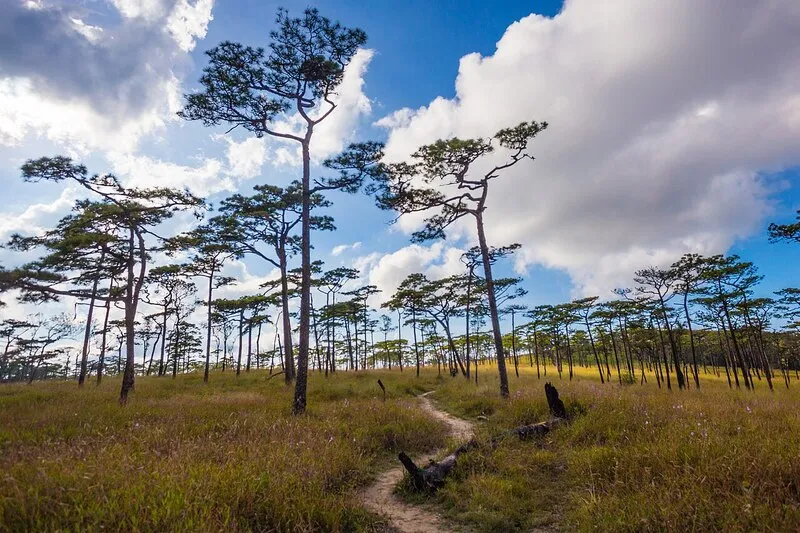
The most iconic landscape in the park is the Phu Soi Dao Pine Plateau. This wide highland area is covered with tall three-needle pine trees, grasslands, and seasonal wildflowers. In the early morning, mist often drifts between the pine trunks while soft sunlight filters through the trees. The atmosphere is quiet, cool, and almost dreamlike. For many Thai hikers, the pine plateau is one of the most memorable camping landscapes in the country because it combines wilderness, simplicity, and highland beauty in one place.
One of the most famous seasonal highlights is the blooming of Murdannia gigantea, locally associated with the flower known in Thai as dok ngon nak. This delicate purple-blue wildflower blooms across open areas of the plateau during the rainy season, especially around August and September. When the flowers appear in large numbers, parts of the grassland take on a soft violet tone against the green ground and pine forest. This seasonal bloom is one of the main reasons travelers plan their trek during the rainy season, despite the extra challenge of wet trails.
Phu Soi Dao is also rich in other plant life. Wild orchids, ferns, mosses, highland grasses, seasonal flowers, and small plants grow in different microhabitats across the mountain. The park lies within a broader mountain system connected with the Phetchabun range and the Luang Prabang range in Laos, giving it ecological significance as a highland biodiversity area. Visitors who walk slowly and observe carefully will see that the beauty of Phu Soi Dao is not only in grand views, but also in small details: flowers along the trail, moss on wet stones, pine needles underfoot, and orchids clinging to trees.
Phu Soi Dao Waterfall is an important lower-area attraction and is often visited before or after the trek. The waterfall flows through forest and rock layers, creating a refreshing atmosphere near the trailhead area. Higher up on the plateau, Sai Thip Waterfall offers another beautiful natural feature for those staying overnight. Though smaller and more remote in feeling, Sai Thip Waterfall is valued for its peaceful pine-forest surroundings and the sense of discovery it gives to campers who explore beyond the tent area.
The trekking route to the pine plateau is about 6.5 kilometers long and includes several named sections familiar to Thai hikers. These include Noen Song Yat, Noen Prap Sian, Noen Pa Ko, Noen Suea Khrong, and Noen Morana. The names reflect the difficulty and character of each part of the ascent. Some sections are steep, some are long and tiring, and some require careful pacing. Most visitors take around 4 – 6 hours to reach the plateau, depending on fitness, weather, trail condition, and pack weight.
Local porters are an important part of the Phu Soi Dao trekking experience. Many visitors hire porters to carry tents, food, sleeping gear, and personal equipment to the plateau. This service helps reduce the physical burden on hikers and provides income to local workers who know the mountain route well. Travelers should pack responsibly, avoid bringing unnecessary heavy items, and follow the park’s rules on weight and porter services.
The camping area on the pine plateau provides basic facilities such as tent areas and restrooms, but it is not a luxury campsite. Visitors should prepare for simple highland camping. Essential items include warm clothing, rain protection, a sleeping bag, a sleeping mat, a headlamp or flashlight, food, drinking water, personal medicine, and trash bags. The simplicity of the campsite is part of the experience. At night, visitors can hear wind moving through the pines, insects in the grass, and, on clear nights, see thousands of stars above the dark mountain landscape.
Morning mist is one of the greatest rewards of staying overnight. After a cold night on the plateau, hikers often wake to soft white mist filling the valleys below. As the sun rises, the mist slowly changes color and reveals layers of mountains. The experience is quiet and powerful. For many travelers, this moment makes the long uphill walk feel completely worthwhile.
The social history of Phu Soi Dao is also meaningful. In the past, some highland areas were connected with Hmong communities and shifting cultivation before the area became a protected forest. After national park protection and ecological recovery, parts of the landscape gradually returned to forest, grassland, pine stands, and wildflower fields. This transformation makes Phu Soi Dao an important example of how damaged highland landscapes can recover when given time, protection, and careful management.
The park is also an important watershed. Mountain forests help regulate water, protect soil, feed streams and waterfalls, and support communities in lower areas. The value of Phu Soi Dao therefore extends beyond tourism. Its forests, grasslands, and streams support biodiversity, water systems, local livelihoods, and climate balance. Protecting the park is essential not only for hikers but also for people and ecosystems beyond the mountain itself.
Wildlife in the park includes birds, small mammals, reptiles, insects, and other forest species adapted to highland environments. Visitors may hear birds in the morning or see signs of animal activity along trails. Wildlife observation should be quiet and respectful. Feeding animals, approaching them, or leaving food scraps can harm the ecosystem and change animal behavior. Responsible travel is especially important in a fragile highland environment like Phu Soi Dao.
Compared with other famous Thai mountain destinations, Phu Soi Dao has a distinctive identity. Phu Kradueng is known for its cliffs and broad plateau, while Doi Inthanon is famous as Thailand’s highest mountain. Phu Soi Dao stands out for its challenging trek, three-needle pine plateau, and seasonal wildflower fields. The climb may feel demanding, but the combination of effort, cool air, pine forest, flowers, mist, and camping makes the experience deeply rewarding.
The travel season must be checked carefully because the pine plateau closes annually for ecological recovery and fire prevention during part of the year. For 2026, the pine plateau is closed from 1 February to 30 June 2026. Travelers should always follow the latest national park announcement before planning a trek, camping trip, or porter service. The park’s seasonal management helps protect the fragile plateau ecosystem and keeps the destination sustainable for future visitors.
The most popular period to visit is from the rainy season into early cool season. August and September are especially popular for viewing Murdannia gigantea flowers, while late rainy season to early cool season offers mist, green landscapes, and cool weather. November to January is suitable for cold-weather camping before the annual closure period. Travelers should prepare warm clothing because temperatures on the plateau can be much lower than in lowland towns.
Getting There is possible from both Uttaradit and Phitsanulok. The main access for the pine plateau trek is in the Nam Pat District area of Uttaradit, near Huai Mun Subdistrict. From Phitsanulok, travelers can travel toward Chat Trakan and Bo Phak or connect to routes leading toward Nam Pat depending on road conditions. From Bangkok, travelers can plan a route through Phitsanulok or Uttaradit before continuing to the park office. A private car or rental car is the most convenient option because public transport is limited and the park lies in a mountainous area.
Travelers using public transport should plan carefully. It may be possible to reach Nam Pat or nearby districts first and then continue by local transport or chartered vehicle to the park. Because services may vary by season, visitors should contact the park, local accommodation, or transport providers before departure. Arriving early is important because trekkers must register and prepare before walking to the plateau.
During the open season, visitors must register and follow park rules before ascending to the pine plateau. The park may control the number of visitors and the registration period for safety and environmental management. Travelers should arrive in the morning, prepare identification, pay required fees, organize luggage, arrange porters if needed, and begin walking within the allowed time. Arriving too late may result in not being permitted to ascend on that day.
Essential preparation includes trekking shoes, raincoat, warm clothing, gloves, hat, headlamp, sleeping bag, sleeping mat, dry food, drinking water, personal medicine, blister plasters, insect or leech protection depending on season, and trash bags. Good preparation reduces risk and helps visitors enjoy the mountain safely. Because the weather can change quickly, waterproof packing is strongly recommended during the rainy season.
Visitors must respect the park’s environmental rules. Do not pick wildflowers, step into flower fields, cut branches, leave trash, feed wildlife, make fires outside permitted areas, or disturb other visitors. The pine plateau is a fragile ecosystem that needs time to recover. A single careless action, such as trampling flowers or leaving food waste, can affect the area more than expected.
Phu Soi Dao is suitable for well-prepared beginners, experienced hikers, photographers, wildflower lovers, camping groups, couples, and travelers who want to test themselves on a highland route. It is not ideal for visitors with serious health problems, those who cannot walk uphill for several hours, or those who are uncomfortable with basic camping conditions. Honest physical preparation is essential.
In summary, Phu Soi Dao National Park offers one of Thailand’s most memorable highland trekking experiences. Its pine plateau, wildflower fields, misty mornings, waterfalls, challenging trail, starry nights, and cool mountain climate make it far more than a scenic destination. A journey here teaches patience, respect for nature, and the value of protected forests. For foreign travelers seeking an authentic Thai mountain trekking experience, Phu Soi Dao is a powerful and unforgettable destination.
| Name | Phu Soi Dao National Park |
| Location | Covering areas of Uttaradit and Phitsanulok Provinces, especially Nam Pat District in Uttaradit and Chat Trakan District in Phitsanulok |
| Address | Huai Mun Subdistrict, Nam Pat District, Uttaradit 53110, Thailand |
| Highlights | Phu Soi Dao Pine Plateau, three-needle pine forest, Murdannia gigantea flower fields, Phu Soi Dao Waterfall, Sai Thip Waterfall, sea of mist, 6.5 km trekking route, and highland camping |
| History | The area was formerly connected with Hmong highland land use and later became a protected national park landscape known for forest recovery, pine forests, and seasonal wildflowers |
| Landscape | High mountains near the Thai-Lao border with hill evergreen forest, pine forest, mixed forest, grassland, waterfalls, streams, and the highland pine plateau |
| Elevation | The summit of Phu Soi Dao is about 2,102 meters above sea level |
| Plants and Ecosystems | Three-needle pine forest, Murdannia gigantea, wild orchids, ferns, mosses, seasonal wildflowers, hill evergreen forest, and highland watershed ecosystems |
| Recommended Activities | Trekking to the pine plateau, camping, viewing Murdannia gigantea flowers, watching morning mist, visiting Phu Soi Dao Waterfall and Sai Thip Waterfall, stargazing, and nature photography |
| Travel Information | The main trekking access is near the park office in Nam Pat District, Uttaradit. Private car or rental car is recommended. Visitors should arrive early for registration before trekking to the pine plateau. |
| Current Status | The Phu Soi Dao Pine Plateau is closed for annual recovery from 1 February to 30 June 2026. Other areas are subject to the latest national park announcements. |
| Open Days | Daily, subject to national park announcements; the pine plateau opens seasonally |
| Opening Hours | Registration for the pine plateau trek is recommended from 08.00 – 13.00 during the open season |
| Fees | Thai visitors: adults 40 baht, children 20 baht / Foreign visitors: adults 200 baht, children 100 baht |
| Facilities | Visitor center, registration point, porter service, camping ground, restrooms, seasonal water service points, welfare shop, and designated camping areas |
| Main Areas / Zones | Park office, Phu Soi Dao Waterfall, trekking route, Noen Song Yat, Noen Prap Sian, Noen Pa Ko, Noen Suea Khrong, Noen Morana, Phu Soi Dao Pine Plateau, Murdannia gigantea fields, and Sai Thip Waterfall |
| Caretaker / Related Authorities | Department of National Parks, Wildlife and Plant Conservation, through Phu Soi Dao National Park. Park Chief: Mr. Farut Jaithatkun |
| Main Contact Number | 095-6299528, 0-5543-6001-2 |
| Official Website / Official Page | Phu Soi Dao National Park Official Page |
| Nearby Tourist Attractions | 1. Phu Soi Dao Waterfall, about 0.5 km 2. Sai Thip Waterfall, about 6.5 km from the trailhead 3. Phu Soi Dao Pine Plateau, about 6.5 km from the trailhead 4. Pai Na Ma Km.44, about 20 km 5. Ban Bo Phak, Chat Trakan District, about 25 km 6. Phu Soi Dao National Park area in Chat Trakan side, about 30 km 7. Sirikit Dam, about 40 km |
| Nearby Restaurants | 1. Phu Soi Dao National Park Welfare Shop, about 0 km, Tel. 095-6299528 2. Nong Miao Ahan Tam Sang, about 1 km, Tel. 089-0950573 3. Soi Dao Cafe, about 13 km 4. Pai Na Ma Km.44 Cafe, about 20 km, Tel. 065-4311499 5. Local restaurants in Ban Bo Phak, about 25 km |
| Nearby Accommodations | 1. Phu Soi Dao National Park Accommodation and Camping Area, about 0 km, Tel. 095-6299528 2. Pai Na Ma Km.44, about 20 km, Tel. 065-4311499 3. Sirikit Dam Guesthouse, about 40 km 4. Sirikit Dam Accommodation, about 41 km 5. Phu Pha Nam Resort, about 50 km 6. Phurua Sanctuary Resort & Spa, about 49 km |
Frequently Asked Questions (FAQ)
Q: Where is Phu Soi Dao National Park located?
A: Phu Soi Dao National Park covers areas of Uttaradit and Phitsanulok Provinces. The main access to the pine plateau is in Nam Pat District, Uttaradit, near the Thai-Lao border.
Q: What are the main highlights of Phu Soi Dao?
A: Highlights include the 6.5 km trek to the pine plateau, three-needle pine forest, Murdannia gigantea flower fields, morning mist, Phu Soi Dao Waterfall, Sai Thip Waterfall, camping, stargazing, and cool highland scenery.
Q: When is the Phu Soi Dao Pine Plateau open?
A: The pine plateau opens seasonally and closes annually for ecological recovery. In 2026, it is closed from 1 February to 30 June 2026. Travelers should check the latest national park announcement before planning a trip.
Q: Is the trek to Phu Soi Dao difficult?
A: The trek is about 6.5 km and includes several steep sections. Most hikers take around 4 – 6 hours to reach the pine plateau, so good physical preparation and proper footwear are important.
Q: When is the best time to see Murdannia gigantea flowers?
A: The best period is usually around August to September, during the rainy season, when the soil is moist and the wildflowers bloom beautifully across the plateau.
Q: Can visitors camp at Phu Soi Dao?
A: Yes. Camping is available on the pine plateau during the open season. Visitors must register, follow park rules, and prepare for basic highland camping conditions.
Q: What should visitors prepare before trekking?
A: Visitors should bring trekking shoes, rain protection, warm clothing, headlamp, sleeping bag, food, drinking water, personal medicine, seasonal leech protection, and trash bags for carrying waste back down.
Q: How much is the entrance fee?
A: Thai visitors pay 40 baht for adults and 20 baht for children. Foreign visitors pay 200 baht for adults and 100 baht for children.
Tel : 6655419234
 Tel : 6655419234
 Category: ●Nature and Wildlife
 Group: ●National Parks and Marine Reserves
Last Update : 5 MonthAgo
 Last Update : 5 MonthAgo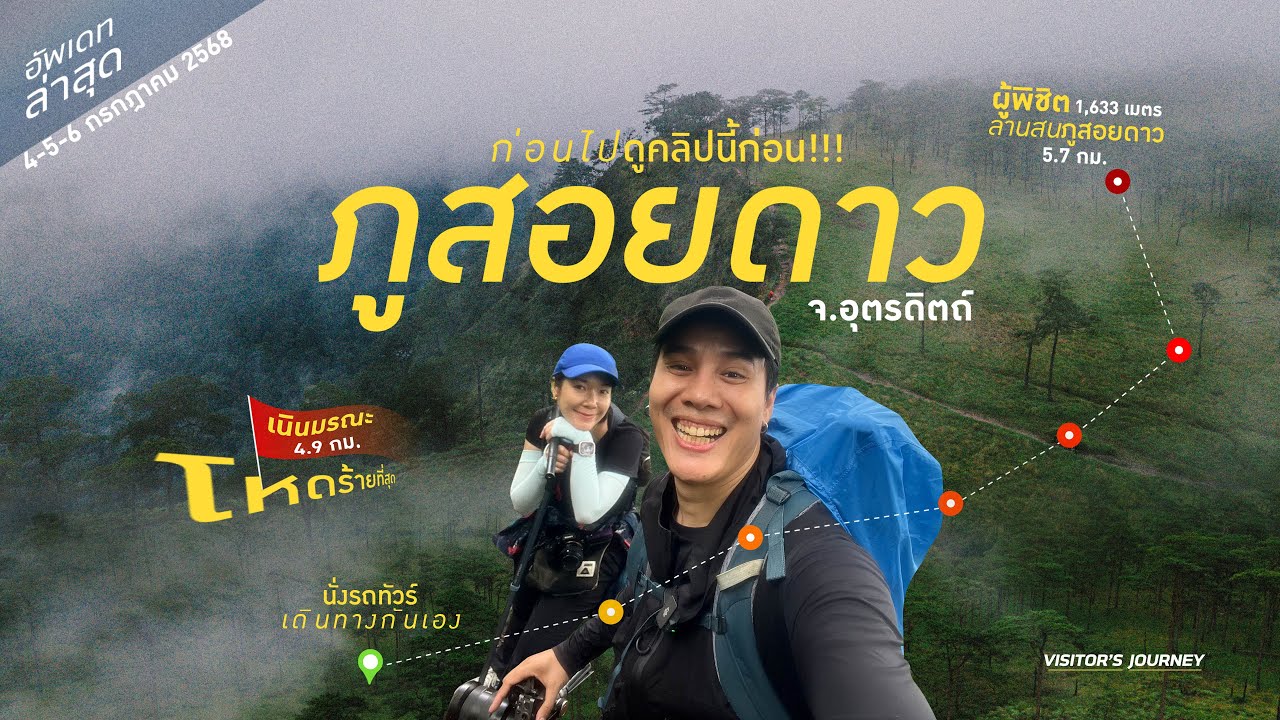
 Click to Access the Navigation Map GPS
Phu Soi Dao National Park Map
Gellery
Recommend

 Art, Culture and Heritage
 Historical Sites and Monuments(1)
 Landmarks and Memorials(2)
 Art, Craft Centres, Tradition(3)
 Museums(3)
 Educational Places
 Educational Gardens, Farm(1)
 Places of Worship
 Temple(29)
 Mosque(1)
 Other Sacred Sites(3)
 Research and Development
 Royal Project(1)
 Suburban Living
 Village, Community(1)
National Parks and Marine Reserves(7)
Village, Community(1)
National Parks and Marine Reserves(7)
 Mountain (Doi)(4)
 Dam, Reservoir, Lake(5)
 Waterfalls(19)
 Caves(3)
 River, Canal(9)
 Other natural attractions(1)
 Entertainment and Agricultural
 Farms, Parks and Ecotourism(2)
 Outdoor and Adventure Activities(1)
 Travel Articles, Recipes
 Travel Review, Food Review(1)


