
lovethailand home >North Travel Attractions >Phitsanulok Travel Attractions >Nakhon Thai >Nakhon Thai > Wat Klang Sri Buddharam
TL;DR: Wat Klang Sri Buddharam is located at Nakhon Thai Subdistrict, Nakhon Thai District, Phitsanulok Province, open Daily, hours 08.00 – 17.00.
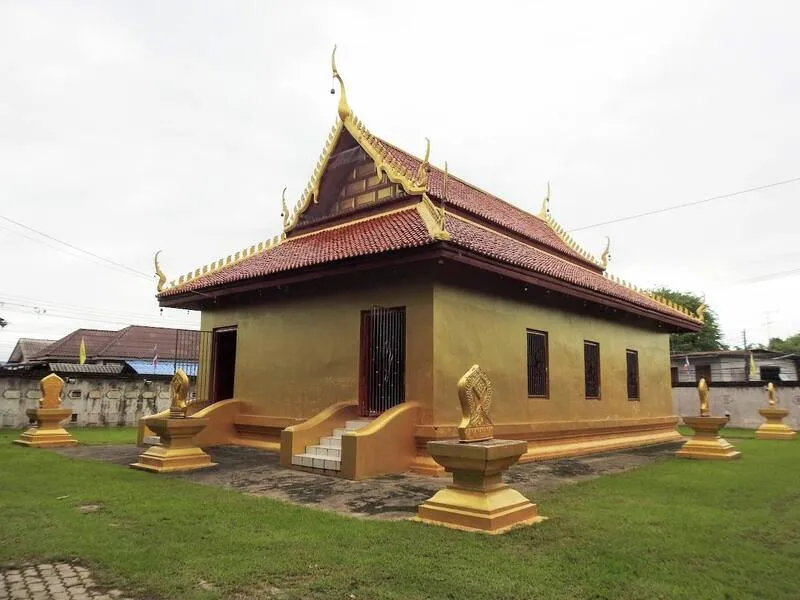
Wat Klang Sri Buddharam
Open Days: Daily
Opening Hours: 08.00 – 17.00
Wat Klang Sri Buddharam, also known as Wat Klang Nakhon Thai, is an important local Buddhist temple in Nakhon Thai Subdistrict, Nakhon Thai District, Phitsanulok Province. The temple stands in the historic area of old Nakhon Thai, formerly associated with the ancient town of Bang Yang. It is strongly connected with the memory of Pho Khun Bang Klang Hao, later known as Pho Khun Si Inthrathit, the first king of the Sukhothai Kingdom. For visitors interested in Thai history, Buddhist art, and local cultural heritage, Wat Klang is one of the most meaningful places to visit in Nakhon Thai.
Nakhon Thai is more than a mountain gateway in Phitsanulok. It is a historically important district with deep connections to the early formation of the Sukhothai Kingdom. Wat Klang helps visitors understand this historical layer. The temple is not only a place for worship but also a cultural landscape where religion, local memory, ancient art, and royal history meet. Within the temple grounds, visitors can see traces of old Buddhist architecture, red sandstone boundary markers, the monument of Pho Khun Bang Klang Hao, and the old white champa tree associated with local legend.
According to Buddhist administrative records, Wat Klang was established in B.E. 1887 and received its official consecrated boundary in B.E. 2400. This long timeline shows the temple’s importance as a Buddhist center in Nakhon Thai for many centuries. The consecrated boundary is significant because it defines the sacred area used for formal monastic ceremonies. Wat Klang therefore has both historical depth and a continuing religious role for the local community.
One of the most important features of Wat Klang is the old ordination hall. Local tradition links this structure with the period of Pho Khun Bang Klang Hao. Although the building has been renovated over time to support modern use and preservation, it remains an important symbol of the temple’s antiquity. Around the ordination hall are red sandstone boundary markers, or bai sema. These markers define the sacred monastic space and are among the key pieces of evidence showing the religious significance of the temple site.
The red sandstone boundary markers are especially worth observing. They are not merely decorative stones around the ordination hall. In Thai Buddhist tradition, boundary markers define the sacred area where important Sangha ceremonies are performed. Their material and age also reflect local craftsmanship and ancient religious practice. For visitors, the markers provide a clear link between architecture, ritual, and the sacred organization of a Buddhist temple.
Wat Klang was once home to several important Buddha images that reflected both Sukhothai and Lopburi artistic traditions. These included a bronze Sukhothai-style Buddha image with a lap width of 53 centimeters and a height of 68 centimeters, as well as 2 stone naga-protected Buddha images in Lopburi style. One of the naga-protected images was complete but damaged, with a lap width of 65 centimeters and a height of 177 centimeters, while the other remained unfinished. These images were dated to around the 18th–19th Buddhist centuries and were considered local works rather than objects moved from elsewhere.
The combination of Sukhothai and Lopburi artistic evidence makes Wat Klang important for the study of Buddhist art in the Nakhon Thai area. Lopburi-style naga-protected Buddha images reflect earlier cultural and religious influences, while Sukhothai-style bronze Buddha images represent a later artistic development associated with one of Thailand’s most celebrated Buddhist art traditions. The presence of both styles in the same temple area shows that Nakhon Thai was part of a broader cultural transition in the region.
Some of the temple’s important ancient Buddha images, including the bronze Sukhothai-style image and the complete Lopburi-style naga-protected image, were stolen and are no longer present. This loss is an important reminder of the need to protect local heritage. Wat Klang therefore offers not only a lesson in art history, but also a lesson in conservation. Ancient objects in local temples are part of national cultural memory and require care from temples, communities, government agencies, and visitors alike.
Another key feature of Wat Klang is the monument of Pho Khun Bang Klang Hao, or Pho Khun Si Inthrathit. His name is central to the historical identity of Nakhon Thai and old Bang Yang. The presence of the monument within the temple grounds makes Wat Klang a place where Buddhist worship and historical remembrance exist together. Visitors can pay respect at the temple and also learn about the local roots of the Sukhothai story.
The old white champa tree at Wat Klang is one of the temple’s most beloved symbols. Local tradition says that Pho Khun Bang Klang Hao planted the tree before going to battle to reclaim Sukhothai. He is believed to have made a solemn wish that if he succeeded, the tree would grow and bloom with white flowers. Today, the tree is regarded as more than an old living plant. It is a sacred symbol of faith, victory, memory, and the enduring spirit of Nakhon Thai.
The white champa tree is said to be more than 700 years old. Its trunk is about 3 meters in circumference and it stands about 9–10 meters tall. Although age has affected its condition, it remains a meaningful focus of local devotion. The area beneath the tree has been improved so local people and visitors can pay respect more conveniently. This makes the tree a living heritage object, linking the present-day community with stories from the earliest period of Sukhothai history.
For cultural travelers, Wat Klang is an excellent place to understand Nakhon Thai beyond its natural attractions. Many travelers pass through the district on the way to Phu Hin Rong Kla National Park, but Wat Klang shows that Nakhon Thai also has a deep historical identity. A visit to the temple adds context to the landscape, showing that this district was once part of an important historical and cultural world connected with Bang Yang and Sukhothai.
The temple remains active in the present. Local residents continue to use Wat Klang for merit-making, Buddhist ceremonies, worship, and community religious activities. This living role is important because it means the temple is not only an archaeological site. It continues to serve the spiritual needs of the Nakhon Thai community. Visitors can therefore experience both ancient heritage and living Buddhism in the same place.
Visitors should explore Wat Klang slowly. Begin by paying respect inside the temple, then observe the old ordination hall, the red sandstone boundary markers, the monument of Pho Khun Bang Klang Hao, and the white champa tree. Each feature tells a different part of the story. The ordination hall and boundary markers speak of Buddhist practice. The former Buddha images speak of ancient art. The monument speaks of political history. The tree speaks of faith and local memory.
For those interested in Thai art, Wat Klang is especially valuable because it brings together Sukhothai and Lopburi artistic references. The temple’s lost bronze and stone Buddha images are still important in historical memory because they show how Nakhon Thai participated in the wider artistic and religious development of the region. Even though the original images are no longer present, their documented history helps explain the cultural importance of the temple.
For local people, Wat Klang is a source of pride. It preserves the memory of Pho Khun Bang Klang Hao, the ancient town of Bang Yang, the old champa tree, and the Buddhist heritage of Nakhon Thai. The temple functions like a living cultural archive. Its buildings, trees, markers, and stories all help preserve the identity of the district. This makes the temple important not only to worshippers but also to students, historians, teachers, and travelers.
Getting There is convenient once visitors are in Nakhon Thai District. From Phitsanulok city, travel along the route toward Nakhon Thai District, then continue into Nakhon Thai Subdistrict. The temple is located in the district center and can be found by searching for Wat Klang Sri Buddharam or Wat Klang Nakhon Thai on a navigation map. Because Nakhon Thai is farther from Phitsanulok city than temples in Mueang District, the trip is best planned as a full-day cultural route or combined with a visit to Phu Hin Rong Kla National Park.
The best time to visit is in the morning or late afternoon, when the weather is more comfortable and natural light is suitable for viewing the old ordination hall, boundary markers, and the white champa tree. Visitors should allow about 45 minutes to 1 hour to see the main features of the temple. Respectful dress and quiet behavior are recommended because Wat Klang is still an active Buddhist temple used by the local community.
Wat Klang is suitable for history lovers, Buddhist pilgrims, students, cultural travelers, photographers, and visitors interested in the early Sukhothai period. It is also a valuable stop for travelers who want to understand Phitsanulok beyond the famous temples in the provincial capital. The temple offers a deeper local perspective on the relationship between Nakhon Thai, Bang Yang, Pho Khun Bang Klang Hao, and the rise of Sukhothai.
Overall, Wat Klang Sri Buddharam is one of the most important historical temples in Nakhon Thai District. It brings together ancient Buddhist art, Sukhothai-related history, local legend, sacred trees, and living community faith. A visit here offers both spiritual calm and cultural knowledge, making it a meaningful destination for anyone who wants to explore the historical depth of Phitsanulok Province.
| Name | Wat Klang Sri Buddharam / Wat Klang Nakhon Thai |
| Location | Nakhon Thai Subdistrict, Nakhon Thai District, Phitsanulok Province |
| Address | Udon Damri Road, Nakhon Thai Subdistrict, Nakhon Thai District, Phitsanulok 65120 |
| Coordinates | 17.1009389529, 100.842771184 |
| Highlights | Old ordination hall, red sandstone boundary markers, Pho Khun Bang Klang Hao monument, 700-year-old white champa tree, and evidence of Sukhothai and Lopburi Buddhist art |
| History | Ancient temple in old Nakhon Thai or Bang Yang, associated with Pho Khun Bang Klang Hao or Pho Khun Si Inthrathit. Established in B.E. 1887 and granted its consecrated boundary in B.E. 2400. |
| Name Origin | The name Wat Klang reflects its central location in old Nakhon Thai, while Wat Klang Sri Buddharam is the full name of this important temple. |
| Distinctive Features | Local Mahanikaya Buddhist temple and historical art site in central Nakhon Thai, connecting Sukhothai history with local religious heritage |
| Key Evidence | Old ordination hall, red sandstone boundary markers, stolen Sukhothai-style bronze Buddha image, Lopburi-style naga-protected Buddha images, Pho Khun Bang Klang Hao monument, and the ancient white champa tree |
| Travel Information | From Phitsanulok city, travel toward Nakhon Thai District, then continue into Nakhon Thai Subdistrict. The temple is located in the district center and is accessible by private car, local taxi, or ride-hailing service. |
| Current Status | Active local Buddhist temple, historical site, and cultural learning place open for worship and heritage visits |
| Open Days | Daily |
| Opening Hours | 08.00 – 17.00 |
| Facilities | Temple grounds, worship area, old ordination hall, heritage viewing area, area around the white champa tree, pavilions, nearby or on-site parking, and shops in Nakhon Thai town |
| Main Areas / Zones | Old ordination hall, red sandstone boundary markers, Pho Khun Bang Klang Hao monument, white champa tree, worship area, and temple heritage area |
| Abbot / Caretaker | Phra Khru Sathit Chayanun |
| Official Website / Official Page | Wat Klang Sri Buddharam / Wat Klang Nakhon Thai |
| Nearby Tourist Attractions | 1. Pho Khun Bang Klang Hao Monument, about 0.1 km 2. Wat Na Phra That or Wat Nuea, about 1 km 3. Wat Hua Rong, about 2 km 4. Nakhon Thai Old Market and Community, about 1 km 5. Phu Hin Rong Kla National Park, about 55 km |
| Nearby Restaurants | 1. Hia Tum Nakhon Thai Egg Noodle, about 1 km 2. Khrua Khun Rin, about 1 km 3. Kuay Teow Bai Toey, about 1 km 4. Larb Nuea Nakhon Thai, about 2 km 5. De Frong’ce Cafe, about 2 km, Tel. 084-091-6897 |
| Nearby Accommodations | 1. Panya Garden Resort, about 2 km 2. Petch Nakhonthai Homestay, about 2 km 3. Prem’s Place Nakhon Thai, about 3 km 4. Jom Resort Nakhon Thai, about 3 km, Tel. 086-032-4872 5. Panya Kalae Resort Nakhon Thai, about 4 km, Tel. 097-924-0916 |
Frequently Asked Questions (FAQ)
Q: Where is Wat Klang Sri Buddharam located?
A: Wat Klang Sri Buddharam, also known as Wat Klang Nakhon Thai, is located in Nakhon Thai Subdistrict, Nakhon Thai District, Phitsanulok Province.
Q: Why is Wat Klang Nakhon Thai important?
A: The temple is important because it is connected with old Nakhon Thai or Bang Yang and the history of Pho Khun Bang Klang Hao, later known as Pho Khun Si Inthrathit, the first king of Sukhothai.
Q: When was Wat Klang established?
A: Wat Klang was established in B.E. 1887 and received its official consecrated boundary in B.E. 2400.
Q: What is special about the white champa tree at Wat Klang?
A: The white champa tree is believed to be more than 700 years old and is linked with the legend of Pho Khun Bang Klang Hao, who is said to have planted it before going to reclaim Sukhothai.
Q: What ancient objects or sites can visitors see at Wat Klang?
A: Visitors can see the old ordination hall, red sandstone boundary markers, the Pho Khun Bang Klang Hao monument, the white champa tree, and the temple area associated with Sukhothai and Lopburi Buddhist art.
Q: Who is the abbot of Wat Klang Sri Buddharam?
A: The abbot of Wat Klang Sri Buddharam is Phra Khru Sathit Chayanun.
Q: What are the opening hours of Wat Klang Nakhon Thai?
A: The temple is open daily from 08.00 to 17.00.
Q: What nearby attractions can be visited with Wat Klang Nakhon Thai?
A: Nearby attractions include Pho Khun Bang Klang Hao Monument, Wat Na Phra That or Wat Nuea, Wat Hua Rong, Nakhon Thai Old Market, and Phu Hin Rong Kla National Park.
 Category: ●Places of Worship
 Group: ●Temple
Last Update : 3 MonthAgo
 Last Update : 3 MonthAgo
 Click to Access the Navigation Map GPS
Wat Klang Sri Buddharam Map
Recommend

 Art, Culture and Heritage
 Historical Sites and Monuments(1)
 Landmarks and Memorials(2)
 Art, Craft Centres, Tradition(3)
 Museums(3)
 Educational Places
 Educational Gardens, Farm(1)
Temple(29)
Educational Gardens, Farm(1)
Temple(29)
 Mosque(1)
 Other Sacred Sites(3)
 Research and Development
 Royal Project(1)
 Suburban Living
 Village, Community(1)
 Nature and Wildlife
 National Parks and Marine Reserves(7)
 Mountain (Doi)(4)
 Dam, Reservoir, Lake(5)
 Waterfalls(19)
 Caves(3)
 River, Canal(9)
 Other natural attractions(1)
 Entertainment and Agricultural
 Farms, Parks and Ecotourism(2)
 Outdoor and Adventure Activities(1)


