
lovethailand home >North Travel Attractions >Nakhon Sawan Travel Attractions >Phai Sali >Samrong Chai > Old Vesali City
TL;DR: Old Vesali City is located at Samrong Chai Subdistrict, Phaisali District, Nakhon Sawan Province, open Open Daily, hours Daytime Visits Are Recommended.

Old Vesali City
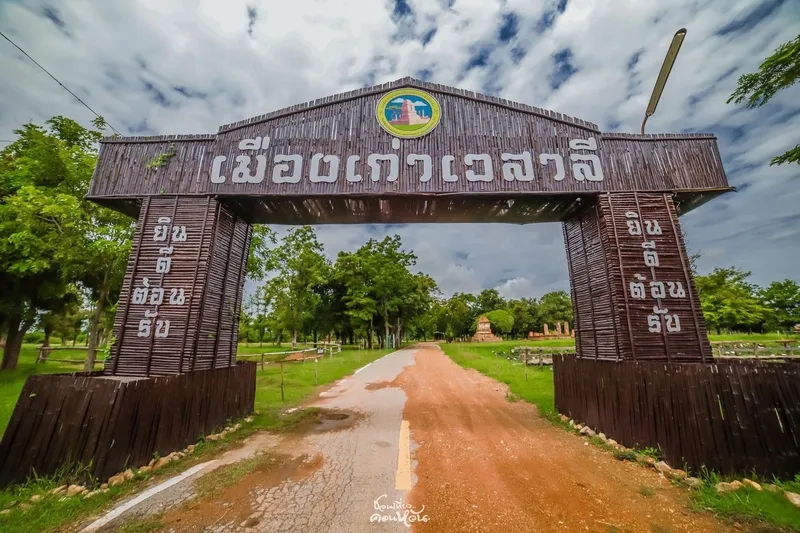
Open Days: Open Daily
Opening Hours: Daytime Visits Are Recommended
Old Vesali City is an important archaeological site in Nakhon Sawan Province, located in Samrong Chai Subdistrict, Phaisali District. It is a suitable destination for travelers interested in history, archaeology, ancient cities, and the development of communities in the upper Central Plains of Thailand. This old city preserves traces of an ancient urban layout, earthen ramparts, moats, and archaeological remains that reflect continuous human settlement across several periods, from the late prehistoric era and the Dvaravati period to the Ayutthaya period.
According to a survey by the Fine Arts Department in 1968, Old Vesali City has a rounded rectangular layout, with 2 layers of earthen ramparts and a moat between them. The city measures approximately 700 meters in length and 500 meters in width. This urban form corresponds with the moat-and-rampart settlement pattern commonly found in Dvaravati-period communities, making Old Vesali City an important piece of evidence for understanding settlement patterns and spatial organization in the past.
The area of Old Vesali City lies on lowland terrain with waterways running through it. Such an environment was suitable for settlement, agriculture, transportation, and defense. The moats and earthen ramparts were not only physical markers of the city but also reflected the community’s ability to organize space, define urban boundaries, and use the surrounding landscape for both habitation and protection.
Excavation and restoration work in 1996 revealed archaeological remains on the eastern side of the city, including an ordination hall, a mondop, a vihara, and a chedi. These structures show artistic characteristics associated with the middle to late Ayutthaya period. This evidence indicates that Old Vesali City was not significant only during the Dvaravati period; the area continued to be used in later periods, with religious structures built within or near the former city area.
Archaeological soil layers provide a deeper understanding of the development of Old Vesali City. Before the construction of later religious buildings, the area had already been occupied by a settled community from the late prehistoric period. It later developed into a moat-and-rampart settlement during the Dvaravati period. This transition makes Old Vesali City a valuable learning site for understanding the development of ancient communities in Nakhon Sawan.
Old Vesali City is also connected to historical narratives involving Lavo and Suvarnabhumi. It is said that Vesali once served as a small frontier town of Lavo, with traces of ancient objects and architectural remains such as prangs, a scripture hall, and Khmer-style Buddha images. These stories reflect the city’s importance as a borderland connected with political power, trade networks, and cultural exchange in ancient times.
Between approximately 557 and 857 CE, Khmer influence expanded across many parts of Suvarnabhumi, including the Khotrabun, Yonok, and Dvaravati regions, with Lavo as an important center. Vesali is therefore often linked to a network of ancient towns that emerged around the same period as other major cities such as Sukhothai, Yonok, Okhaburi, and Si Thep. Although some historical details require further study, the overall picture shows that Vesali played a role within the ancient urban network of the upper Central Plains.
Later, Vesali came under the influence of Sukhothai and was abandoned for a long period. During the reign of King Narai the Great of Ayutthaya, Lavo was restored as another royal city and renamed Lopburi. At that time, northern frontier towns remained strategically important. Vesali, located on fertile lowland suitable for rice cultivation and frontier defense, was restored as an area useful for protecting routes and overseeing northern towns.
When visitors enter Old Vesali City today, the most noticeable feature is the atmosphere of an open-air archaeological site. Ancient brick remains, building foundations, and traces of old structures are scattered throughout the area. The overall setting is calm, simple, and suitable for slow exploration. The appeal of this site does not lie in grandeur, but in the experience of standing among the remains of an ancient city that has passed through hundreds of years of history.
What makes Old Vesali City especially interesting is its clear layering of time. This was not a city of only one historical period. It contains traces of settlement and land use from multiple eras, including the late prehistoric period, Dvaravati, Lavo, and Ayutthaya. Walking through the old city is like reading overlapping pages of history within a single landscape.
For those interested in Dvaravati history, Old Vesali City is worth visiting because its moat-and-rampart layout remains clearly identifiable. Many Dvaravati-period settlements were located on lowland plains, surrounded by moats and defined by earthen ramparts. These features reflect water management, defensive planning, and increasingly complex social organization.
For visitors interested in Ayutthaya art, Old Vesali City also preserves archaeological remains associated with the middle to late Ayutthaya period, including an ordination hall, mondop, vihara, and chedi. These ruins show that the old city area was not completely abandoned after the Dvaravati period but was reused or developed as a religious area in later times. Studying this site therefore reveals the continuity of belief and land use across different historical periods.
Old Vesali City is better suited to slow cultural and educational travel than rushed sightseeing. Visitors should walk carefully, avoid climbing on archaeological remains, avoid touching or removing bricks or objects from the site, and keep the area clean. Archaeological sites are cultural heritage that cannot be recreated once damaged. Respectful travel helps preserve this place as a learning site for future generations.
The atmosphere of Old Vesali City is suitable for visitors who enjoy photographing archaeological landscapes, old brick ruins, pathways through ancient remains, and the rural scenery of Phaisali District. Morning and late afternoon are the best times to visit, as the light is softer and the weather is more comfortable than at midday. During the rainy season, visitors should wear comfortable walking shoes because some areas may become damp or soft underfoot.
Getting There to Old Vesali City is most convenient by private car. From Nakhon Sawan city, travel toward Phaisali District and continue to Samrong Chai Subdistrict. The site is located quite far from the city center, so visitors should check the route before departure and allow enough travel time, especially if planning to visit other places in Phaisali District on the same trip.
Travelers without a private vehicle should plan ahead because Old Vesali City is located in Samrong Chai Subdistrict rather than in a central tourist zone. Hiring a local vehicle or arranging transport from Phaisali District will make the trip more convenient. For a smoother itinerary, visitors may combine the visit with nearby temples, viewpoints, or local restaurants in Phaisali District.
Old Vesali City is ideal for travelers who want to discover another side of Nakhon Sawan beyond Bueng Boraphet, Pasan, Nakhon Sawan Tower, or Sawan Park. This site shows that Nakhon Sawan is not only a province of natural scenery and riverside urban life, but also a place with deep archaeological heritage and historical importance in the upper Central Plains.
A visit to Old Vesali City is not simply about seeing brick ruins or earthen ramparts. It is a journey into the traces of a community that once lived, organized its city, built religious structures, and participated in the historical networks of the region. The old city is suitable for those who appreciate Thai history, archaeology, ancient settlements, and peaceful cultural tourism away from crowded destinations.
In summary, Old Vesali City is a valuable archaeological site in Phaisali District, Nakhon Sawan Province. Its key evidence includes a moat-and-rampart city plan, 2 layers of earthen ramparts, moats, archaeological remains, and traces of settlement across multiple periods. Visitors who want a meaningful historical experience should allow time to walk through the area, read the information signs, and explore the site respectfully, as this is a place that tells a deeper story of Nakhon Sawan beyond ordinary tourism.
| Name | Old Vesali City |
| Location | Samrong Chai Subdistrict, Phaisali District, Nakhon Sawan Province |
| Address | Moo 5, Ban Nong Phai, Samrong Chai Subdistrict, Phaisali District, Nakhon Sawan 60220 |
| Highlights | An ancient rounded rectangular city with 2 layers of earthen ramparts, moats, and archaeological remains from several periods |
| History / Period | The site contains traces of late prehistoric settlement, later developed into a Dvaravati moat-and-rampart community, with archaeological remains from the middle to late Ayutthaya period |
| Distinctive Features | A rounded rectangular city plan, approximately 700 meters long and 500 meters wide, with 2 layers of earthen ramparts and a moat between them |
| Key Evidence | Ordination hall, mondop, vihara, chedi, earthen ramparts, moat, and archaeological soil layers |
| Caretaker | Samrong Chai Subdistrict Administrative Organization |
| Travel Information | From Nakhon Sawan city, travel toward Phaisali District and continue to Samrong Chai Subdistrict. Private car or local hired transport is recommended |
| Current Status | An archaeological site and historical tourism destination in Phaisali District |
| Open Days | Open Daily |
| Opening Hours | Daytime Visits Are Recommended |
| Admission Fee | Free Admission |
| Main Contact Number | Samrong Chai Subdistrict Administrative Organization, Tel. 056-009-887 |
| Nearby Tourist Attractions | 1. Wat Tham Phon Sawan, about 18 km 2. Khao No - Khao Kaeo, about 40 km 3. Ancient Chan Sen City, about 55 km 4. Bueng Boraphet, about 70 km 5. Nakhon Sawan Tower, about 85 km |
| Nearby Restaurants | 1. Krua Si Phon, Phaisali Intersection, about 16 km, Tel. 056-373-054 2. EAT SLEEP, about 18 km 3. Supha Cafe, about 18 km 4. Milky Som Tam Zaap, about 18 km 5. Kuai Tiao Luk Chin Mu Je Khiao, about 19 km |
| Nearby Accommodations | 1. Phaisali Hill Resort, about 20 km, Tel. 088-429-3331, 087-732-1598 2. Daily Accommodations In Phaisali District, about 18 km 3. Accommodations In Central Phaisali District, about 18 km 4. Accommodations In Tha Tako Area, about 45 km 5. Accommodations In Nakhon Sawan City, about 85 km |
Frequently Asked Questions (FAQ)
Q: Where Is Old Vesali City Located?
A: Old Vesali City is located at Moo 5, Ban Nong Phai, Samrong Chai Subdistrict, Phaisali District, Nakhon Sawan Province.
Q: Why Is Old Vesali City Important?
A: It is an archaeological site that shows the development of ancient communities across several periods, from the late prehistoric era and the Dvaravati period to the Ayutthaya period.
Q: What Can Visitors See At Old Vesali City?
A: Visitors can see earthen ramparts, moats, archaeological ruins, an ordination hall, a mondop, a vihara, a chedi, and the atmosphere of an open-air ancient city.
Q: Is There An Admission Fee For Old Vesali City?
A: There is no admission fee.
Q: What Is The Best Time To Visit Old Vesali City?
A: Morning or late afternoon is the best time to visit because the weather is more comfortable and suitable for walking around the open-air archaeological site.
Q: How Can Travelers Get To Old Vesali City?
A: From Nakhon Sawan city, travel toward Phaisali District and continue to Samrong Chai Subdistrict. A private car or local hired transport is recommended.
Q: Who Is Old Vesali City Suitable For?
A: It is suitable for travelers interested in history, archaeology, ancient cities, Dvaravati art, Ayutthaya art, and peaceful cultural tourism.
 Category: ●Art, Culture and Heritage
 Group: ●Landmarks and Memorials
Last Update : 5 MonthAgo
 Last Update : 5 MonthAgo
 Click to Access the Navigation Map GPS
Old Vesali City Map
Recommend

 Historical Sites and Monuments(3)
Landmarks and Memorials(4)
Historical Sites and Monuments(3)
Landmarks and Memorials(4)
 Art, Craft Centres, Tradition(9)
 Museums(3)
 Educational Places
 Museum for Study(1)
 Places of Worship
 Temple(34)
 Other Sacred Sites(4)
 Research and Development
 Royal Project(1)
 Suburban Living
 Village, Community(4)
 Local Market(2)
 Floating Market(1)
 Nature and Wildlife
 National Parks and Marine Reserves(3)
 Mountain (Doi)(3)
 Dam, Reservoir, Lake(6)
 Waterfalls(3)
 Caves(8)
 River, Canal(6)
 Other natural attractions(3)
 Entertainment and Agricultural
 Zoos and Aquariums(2)
 Animal camps and shows(1)
 Farms, Parks and Ecotourism(6)
 Accommodation
 Hotel(1)
 Travel Articles, Recipes
 Travel Review, Food Review(3)


