
lovethailand home >North Travel Attractions >Chiang Rai Travel Attractions >Mae Sai >Pong Pha > Tham Luang–Khun Nam Nang Non Forest Park
TL;DR: Tham Luang–Khun Nam Nang Non Forest Park is located at Pong Pha Subdistrict, Mae Sai District, Chiang Rai, open Open Daily, hours 08:00–16:00.

Tham Luang–Khun Nam Nang Non Forest Park
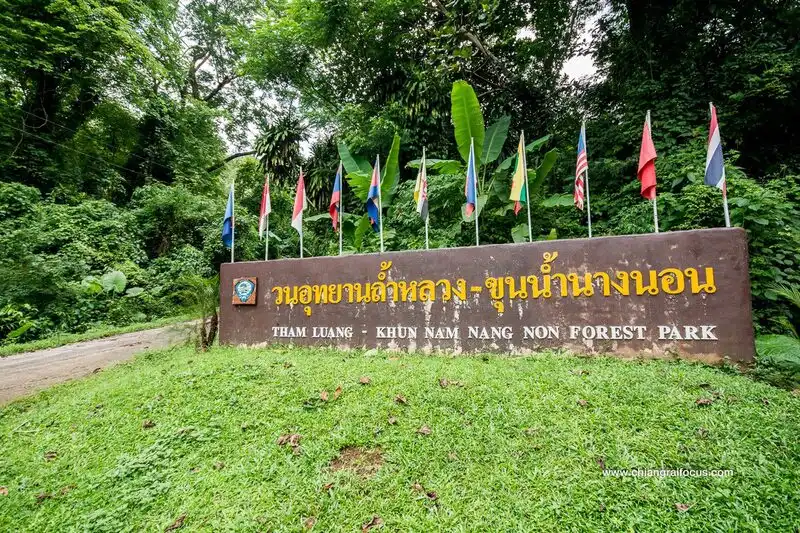
Open Days: Open Daily
Opening Hours: 08:00–16:00
Tham Luang–Khun Nam Nang Non Forest Park is one of Chiang Rai’s most distinctive natural attractions, bringing together cave exploration, mountain scenery, local legend, and modern historical significance in one place. It is far more than a cave destination. The wider Doi Nang Non landscape, with its mountain ridges, natural springs, forest setting, and geological character, gives the area a depth that makes it stand out among northern Thailand’s nature attractions.
Tham Luang–Khun Nam Nang Non Forest Park is located in Pong Pha Subdistrict, Mae Sai District, Chiang Rai, within the Doi Nang Non National Forest Reserve. The forest park covers around 5,000 rai, or about 8 square kilometers, and was officially established by the Royal Forest Department on October 1, 1986. The area extends across the upper section of Doi Nang Non, a large mountain formation whose unique shape has long given rise to one of the region’s best-known local legends.
The park has 2 main visitor service zones. The first is the Tham Luang area, covering about 12 rai in Ban Nam Cham, Pong Pha, where the park office is located. The second is the Khun Nam Nang Non area, covering about 8 rai in Ban Chong, also in Pong Pha. These 2 zones help visitors experience the area from more than one angle, with the cave zone focusing on underground geology and the spring zone offering a more open and peaceful natural atmosphere.
The wider forest park is bordered by Doi Chong and Huai Nam Chong to the north, Doi Phu Thao and Huai Nam Khang to the south, lowland areas along the eastern side of the mountain, and a larger mountain range extending from the Myanmar border to the west. This setting creates a natural system of ridges, slopes, forest, streams, and underground water flow, all of which help shape the character of the cave and the spring below.
The landscape of Doi Nang Non is made up of several connected mountain masses with an average elevation of around 779 meters. The terrain slopes downward toward the east. One of the area’s most memorable features is the outline of the mountain itself, which resembles a reclining woman when seen from certain angles. This visual form is closely tied to the legend of Nang Non and gives Khun Nam Nang Non both its name and its cultural identity.
The forest in the area is mainly mixed deciduous forest and remains relatively rich in plant diversity. Species recorded here include teak, teng, rang, hiaeng, phluang, padauk, makha, takhian, wild noni, and many bamboo stands growing along the streams and waterways. This gives the park a shaded and natural atmosphere, especially in the approach areas near the cave and the spring.
Wildlife in the forest park includes elephants, leopards, deer, barking deer, wild boar, civets, squirrels, egrets, coucals, mongooses, hares, bats, and small bird species such as spotted tailorbirds. While most visitors may not directly encounter these animals during a normal visit, their presence reflects the ecological value of the Doi Nang Non area and the broader forest system around the cave and spring zones.
The best-known attraction is Tham Nang Non, a vast cave system inside the mountain. The cave contains seepage water all year round, and during the rainy season water flow becomes much more significant. Inside, visitors can observe stalactites, stalagmites, moisture-shaped formations, and the cool underground environment that makes cave landscapes so different from other mountain attractions. Bats also inhabit the cave, adding to its ecological significance. This combination of geology, water, and wildlife makes Tham Luang especially interesting for visitors who enjoy caves and natural science.
From a travel perspective, Tham Luang offers a very different experience from waterfalls, temples, or mountain viewpoints. Entering the cave area brings a sense of moving into another world: cooler air, dim natural light, rock formations, and the physical presence of a mountain interior shaped by water over long geological time. This is why the park is especially appealing to travelers interested in cave tourism and geology.
Khun Nam Nang Non, the spring area, adds another layer to the experience. It offers a more open, green, and peaceful natural setting connected to the mountain and to the local legend. Visiting both the cave zone and the spring zone gives travelers a fuller understanding of why the Doi Nang Non landscape is so important in Mae Sai. It is not simply a cave attraction but an entire mountain environment linked by water, topography, and story.
Another strong advantage of Tham Luang–Khun Nam Nang Non Forest Park is how easy it is to reach. The site lies only about 2.2 kilometers from the Chiang Rai–Mae Sai highway, and the road is paved all the way to the park. It is around 60 kilometers from Chiang Rai city, 14 kilometers from Mae Chan, and only about 8 kilometers from Mae Sai. This makes it highly accessible for private cars, tour vans, and day-trip visitors.
Getting There is therefore very convenient, especially for travelers planning a half-day or full-day route in the Mae Sai area. Because the access is easy and the main attraction zones are close to road infrastructure, the park suits many types of visitors, including families, older travelers, and people who want a nature-based stop without needing a strenuous hike.
Basic visitor facilities include restrooms, parking areas, service points, and walking access to the main attraction zones. While the park is not designed as a large overnight nature complex, its location near Mae Sai means that restaurants, cafes, and accommodations are readily available nearby. That makes it easy to visit without complicated planning, especially for travelers staying in Mae Sai or passing through the northern border region.
The site also carries a meaning that goes beyond nature tourism alone. For many Thai and international visitors, Tham Luang is strongly associated with the dramatic cave rescue that drew worldwide attention. As a result, the location holds both natural and emotional significance. Yet when arriving in person, visitors quickly see that its deeper value still comes from the mountain, the cave, the water, and the unique environment of Doi Nang Non itself.
For travelers who want the best experience, checking the latest official updates before visiting is always advisable because cave access depends strongly on seasonal conditions. During normal open periods, visitors can explore the designated sections comfortably. In wetter periods, additional restrictions may apply for safety reasons. Keeping track of official announcements helps ensure a smoother visit.
Overall, Tham Luang–Khun Nam Nang Non Forest Park is one of Chiang Rai’s most distinctive destinations because it combines natural beauty, geology, local mythology, and contemporary historical memory. For travelers who want to see a side of Chiang Rai beyond temples, cafes, or standard mountain viewpoints, this is a place with real identity and lasting impact.
| Name | Tham Luang–Khun Nam Nang Non Forest Park |
| Location | Pong Pha Subdistrict, Mae Sai District, Chiang Rai |
| Address | Tham Luang zone at Ban Nam Cham and Khun Nam Nang Non zone at Ban Chong, Pong Pha, Mae Sai, Chiang Rai |
| Coordinates | Approx. 20.352, 99.876 |
| Highlights | Tham Nang Non cave, Khun Nam Nang Non spring, Doi Nang Non mountain landscape, stalactites, stalagmites, cave geology |
| History | Officially established as a forest park on October 1, 1986 |
| Name Origin | Named after Doi Nang Non mountain, whose shape resembles a reclining woman, and the natural spring known as Khun Nam Nang Non |
| Distinctive Features | A large connected mountain mass with mixed deciduous forest, a major cave system, natural springs, and strong geological interest |
| Travel Information | About 2.2 km from the Chiang Rai–Mae Sai highway, around 60 km from Chiang Rai city, 14 km from Mae Chan, and 8 km from Mae Sai |
| Current Status | Currently open to visitors during normal operation periods, with designated cave access and seasonal safety management |
| Open Days | Open Daily |
| Opening Hours | 08:00–16:00 |
| Fees | General admission is free |
| Facilities | Restrooms, parking, visitor service area, cave approach paths, spring area access |
| Main Areas / Zones | Tham Luang zone at Ban Nam Cham, Khun Nam Nang Non zone at Ban Chong, cave entrance, designated inner cave halls open to visitors |
| Main Contact Number | 081 595 1095, 081 022 0679, 080 792 5095 |
| Official Website / Official Page | Facebook: Tham Luang–Khun Nam Nang Non National Park (Preparatory Area) |
| Nearby Tourist Attractions | 1. Khun Nam Nang Non 1 km 2. Tham Pla 6 km 3. Doi Pha Mi 7 km 4. Mae Sai Market 8 km 5. Phra That Doi Wao 9 km |
| Nearby Restaurants | 1. Kung Ten Khun Nam Nang Non 1 km. Tel. 085 106 8202, 084 687 4858 2. Krua Sukhothai Mae Sai 2 km 3. Suan Khun Pu 3 km 4. Phurada Restaurant @ Mae Sai 5 km 5. Krua Nai Noom Mae Sai 4 km |
| Nearby Accommodations | 1. Rai Bao Noi Strawberry 1 km 2. Khun Nam Rim Than Resort 2 km 3. Pinmanee Resort 2 km 4. Phufa Sajeh Homestay 3 km 5. Khum Chao Resort 3 km |
Frequently Asked Questions (FAQ)
Q: Where is Tham Luang–Khun Nam Nang Non Forest Park located?
A: It is located in Pong Pha Subdistrict, Mae Sai District, Chiang Rai, close to the Chiang Rai–Mae Sai highway and about 8 kilometers from Mae Sai town.
Q: Is Tham Luang open every day?
A: The park currently operates daily from 08:00 to 16:00, but it is still advisable to check official announcements before visiting, especially during the rainy season.
Q: Is there an entrance fee?
A: General admission is free, although some special guided activities or packages may have separate charges.
Q: What is the main highlight of the park?
A: The main highlights are Tham Nang Non cave, the Khun Nam Nang Non spring area, the Doi Nang Non mountain formation, and the cave’s geological features.
Q: How far is it from Chiang Rai city?
A: The park is about 60 kilometers from Chiang Rai city, 14 kilometers from Mae Chan, and 8 kilometers from Mae Sai.
Q: Who would enjoy visiting this place?
A: It is ideal for travelers interested in nature, caves, geology, and places with both strong natural identity and historical significance.
 Category: ●Nature and Wildlife
 Group: ●National Parks and Marine Reserves
Last Update : 6 MonthAgo
 Last Update : 6 MonthAgo
 Click to Access the Navigation Map GPS
Tham Luang–Khun Nam Nang Non Forest Park Map
Recommend

 Art, Culture and Heritage
 Historical Sites and Monuments(3)
 Landmarks and Memorials(7)
 Art, Craft Centres, Tradition(6)
 Museums(8)
 Historic Homes and Cities(1)
 Educational Places
 Museum for Study(1)
 Library(1)
 Educational Gardens, Farm(3)
 Places of Worship
 Temple(38)
 Other Sacred Sites(5)
 Research and Development
 Royal Project(9)
 Suburban Living
 Village, Community(16)
 Local Market(5)
National Parks and Marine Reserves(18)
Local Market(5)
National Parks and Marine Reserves(18)
 Mountain (Doi)(20)
 Dam, Reservoir, Lake(8)
 Waterfalls(16)
 Hot Springs(6)
 Caves(8)
 River, Canal(10)
 Sea, Beach(1)
 Other natural attractions(3)
 Entertainment and Agricultural
 Animal camps and shows(1)
 Farms, Parks and Ecotourism(9)
 Shopping
 Shopping and Night Market(2)
 Call Customer Service in Tourism
 Call Customer Service in Tourism(1)
 Travel Articles, Recipes
 Travel Review, Food Review(1)
 Food Menu, North Recipes(1)


