
lovethailand home >North Travel Attractions >Kamphaeng Phet Travel Attractions >Muang Kamphaeng Phet >Nong Pling > Kamphaeng Phet Historical Park
TL;DR: Kamphaeng Phet Historical Park is located at Nong Pling Subdistrict and the ancient town area, Mueang Kamphaeng Phet District, Kamphaeng Phet Province, open Daily, hours 08.30 – 16.30.
Kamphaeng Phet Historical Park
Open Days: Daily
Opening Hours: 08.30 – 16.30
Kamphaeng Phet Historical Park is one of Thailand’s most important historical attractions and one of the best places to understand the urban, religious, and artistic legacy of the Sukhothai period. Located in Mueang Kamphaeng Phet District, Kamphaeng Phet Province, the park preserves ancient temples, laterite stupas, city walls, fortifications, palace remains, sacred shrines, and archaeological evidence that shows how Kamphaeng Phet functioned as a strategic frontier town of the Sukhothai Kingdom. For travelers interested in Thai history, ancient architecture, Buddhist art, and UNESCO World Heritage sites, this historical park offers a complete and highly rewarding cultural experience.
The park lies on the eastern side of the Ping River and is not far from Sukhothai. In the past, Kamphaeng Phet was an important associated town of Sukhothai, serving both defensive and administrative roles. Its location allowed the city to control travel routes, protect the kingdom, and connect communities along the Ping River basin. Today, visitors can still see traces of that ancient urban system through the city walls, moats, temple compounds, laterite structures, and the relationship between the inner city area and the forest-monastery zone to the north.
One of the most distinctive features of Kamphaeng Phet Historical Park is its use of laterite. Laterite was widely available in the region and became the principal construction material for walls, temple bases, pillars, platforms, stupas, and large architectural structures. This gives Kamphaeng Phet a character different from many other ancient cities in Thailand. The ruins feel strong, solemn, and deeply connected to the local landscape. Even after centuries, many laterite pillars, foundations, and walls remain clearly visible, allowing visitors to imagine the scale and importance of the ancient town.
The historical park can be understood in two main zones. The first is the inner city area, where visitors find Wat Phra Kaew, Wat Phra That, Sa Mon, the old palace area, city walls, fortifications, and sacred shrines. This zone reflects the relationship between royal authority, urban planning, and Buddhism. The second is the Aranyik or forest-monastery zone outside the city walls to the north. This area contains large and atmospheric ruins such as Wat Phra Si Iriyabot, Wat Chang Rob, Wat Phra Non, Wat Awat Yai, and Wat Sing. Together, the two zones show how religion, governance, defense, and monastic life were organized in the ancient city.
Wat Phra Kaew is one of the most significant monuments in Kamphaeng Phet Historical Park. It is located inside the old city near the palace area and was a major temple of the ancient town. The temple compound was built mainly of laterite and enclosed by a rectangular wall. Its central monument is a bell-shaped stupa influenced by the Lanka style. Around the base were niches that once contained lion figures, many of which are now damaged. Excavations revealed numerous stupa bases, several viharn structures, and ordination hall foundations, confirming that Wat Phra Kaew was a large and highly important religious site.
Wat Phra Kaew is also closely connected with local cultural memory. In the present day, Kamphaeng Phet is known for local traditions such as the Nop Phra Len Phleng festival and the Sart Thai Kluai Khai festival. These cultural events help visitors see that the city’s ancient heritage is not isolated from modern life. The ruins, festivals, local food, and community identity remain closely connected, making Kamphaeng Phet a destination where history and living culture meet.
Wat Phra That, sometimes regarded as the principal city temple, stands near Wat Phra Kaew and is another important monument in the inner city zone. The temple features a distinctive chedi with a multi-tiered octagonal base supporting a round stupa. The compound includes a principal chedi, a viharn, subsidiary chedis, and a rectangular pond at the front. The layout shows a sophisticated understanding of religious space and temple planning. Archaeological discoveries from this area include small gold and silver Buddha images, which are now preserved and displayed at Kamphaeng Phet National Museum.
Sa Mon is the former palace area of ancient Kamphaeng Phet and is located near Wat Phra Kaew. It is important because it helps visitors understand the urban layout of the old city. The placement of the palace zone near major temples reflects the close relationship between royal power and Buddhism in ancient Thai cities. Visiting Sa Mon after Wat Phra Kaew and Wat Phra That gives travelers a clearer picture of how the religious and administrative heart of the city was organized.
The northern Aranyik zone offers a different atmosphere from the inner city. This area was associated with forest monasteries and monastic practice. The ruins are spread among trees and low laterite hills, creating a calm and contemplative setting. For many travelers, this is the most atmospheric part of Kamphaeng Phet Historical Park because the monuments appear within a natural landscape rather than a dense urban setting. Walking through this zone allows visitors to appreciate both the architecture and the spiritual environment of the ancient forest monasteries.
Wat Phra Si Iriyabot, also known as Wat Phra Yuen, is one of the highlights of the Aranyik zone. Its main feature is a large four-sided mandapa that once housed Buddha images in four postures: standing, walking, sitting, and reclining. Although most of the images are now damaged, the large standing Buddha remains impressive and elegant. The monument demonstrates both religious symbolism and the technical ability of ancient craftsmen who worked with laterite and stucco on a monumental scale.
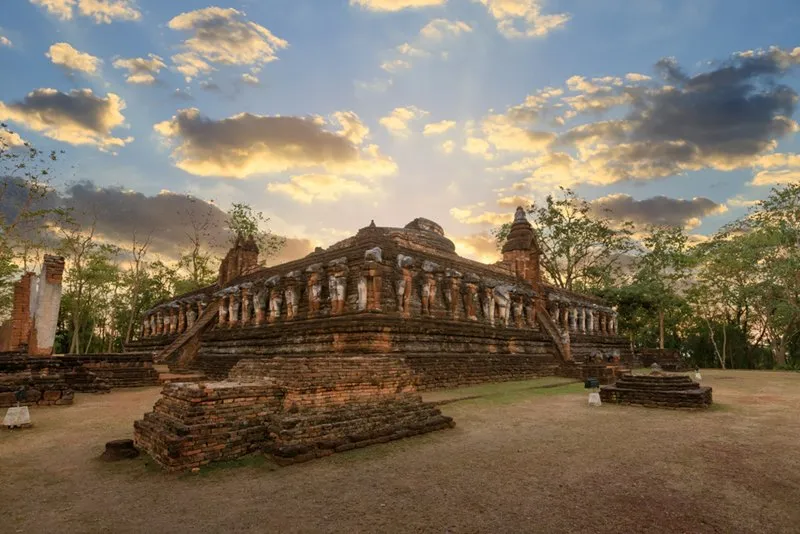
Wat Chang Rob is one of the most iconic sites in the park. Located on a hill in the northern part of the ancient city, it features a large bell-shaped stupa standing on a high base surrounded by 68 stucco elephant figures. The elephants face outward from the base, symbolically supporting the sacred monument. The idea of elephants surrounding a stupa is associated with Sukhothai artistic traditions, but at Kamphaeng Phet the use of laterite and the elevated setting give the monument a particularly powerful visual identity.
The temple also preserves traces of stairways, guardian figures, stucco decoration, and architectural details that reveal the skill of ancient artisans. Even though some elements are damaged, Wat Chang Rob remains one of the most memorable monuments in Kamphaeng Phet. It is especially suitable for photography, historical interpretation, and travelers who want to see one of the strongest visual symbols of the city.
Wat Phra Non is another important temple outside the city walls. It includes an ordination hall, a viharn, a round stupa, and several laterite structures. Inside the compound is a platform that once supported a reclining Buddha image. Although much of the image has deteriorated, the remaining foundations and laterite pillars still show the scale and importance of the temple. Wat Phra Non is a good place to observe how large laterite pillars were used in ancient religious architecture.
Beyond these major temples, the park also includes the city pillar shrine, Shiva shrine, fortifications, city walls, moats, and old city gates. These features remind visitors that Kamphaeng Phet was not only a religious center but also a fortified town. The walls and defensive structures marked the urban boundary, protected the city, and expressed its strategic importance within the Sukhothai cultural sphere.
Kamphaeng Phet National Museum is highly recommended for travelers who want to understand the historical park in greater depth. The museum displays Buddha images, ornaments, inscriptions, archaeological objects, and artifacts discovered in Kamphaeng Phet Province. Visiting the museum before or after the park helps connect the ruins with the objects and historical evidence found in the area. It is particularly useful for visitors who want a clearer understanding of Buddhist art, local craftsmanship, and ancient urban life.
Kamphaeng Phet Historical Park is part of the UNESCO World Heritage property known as the Historic Town of Sukhothai and Associated Historic Towns, together with Sukhothai Historical Park and Si Satchanalai Historical Park. The inscription in 1991 recognized the outstanding value of these historic towns as evidence of early Thai art, urban planning, Buddhist culture, and the development of the Sukhothai Kingdom. Kamphaeng Phet adds an important frontier-town dimension to that wider historical story.
For travelers, the best way to explore the park is to allow at least half a day. A short route should include Wat Phra Kaew, Wat Phra That, Sa Mon, Wat Phra Si Iriyabot, and Wat Chang Rob. A fuller visit should also include Wat Phra Non, Wat Awat Yai, Wat Sing, the city walls, the city pillar shrine, and Kamphaeng Phet National Museum. The park is large enough that travelers may prefer to combine walking with driving or cycling between zones.
The best time to visit is in the morning or late afternoon, when the weather is more comfortable and the light is ideal for photography. Visitors should bring drinking water, a hat, comfortable walking shoes, and a camera. Many areas are open and spacious, so planning the route in advance helps make the visit smoother. The Aranyik zone is especially pleasant for slow travel because the ruins are surrounded by trees and a quieter natural setting.
Getting There from Bangkok is possible by private car via Highway 32 through Ayutthaya, Ang Thong, Sing Buri, and Nakhon Sawan, then continuing on Highway 1 to Kamphaeng Phet. The distance is approximately 358 km. Travelers can also take a Bangkok–Kamphaeng Phet bus from the Northern Bus Terminal and continue to the historical park by local transport or hired vehicle. Having a private car or rental car is the most convenient option for exploring both the inner city zone and the Aranyik zone.
Kamphaeng Phet Historical Park is suitable for history lovers, students, families, photographers, cultural travelers, and anyone interested in seeing a quieter side of Thailand’s World Heritage landscape. Compared with Sukhothai and Si Satchanalai, Kamphaeng Phet has a distinctive identity shaped by laterite architecture, defensive urban planning, and the atmosphere of a frontier town. It completes the broader story of the Sukhothai cultural world and remains one of Thailand’s most valuable historical destinations.
| Name | Kamphaeng Phet Historical Park |
| Location | Nong Pling Subdistrict and the ancient town area, Mueang Kamphaeng Phet District, Kamphaeng Phet Province |
| Address | Moo 6, Kamphaeng Phet – Sukhothai Road, Ban Bo Sam Saen, Nong Pling Subdistrict, Mueang Kamphaeng Phet District, Kamphaeng Phet 62000, Thailand |
| Coordinates | Approximately 16.4871, 99.5215 |
| Highlights | UNESCO World Heritage historical park with major laterite monuments including Wat Phra Kaew, Wat Phra That, Wat Phra Si Iriyabot, Wat Chang Rob, Wat Phra Non, Sa Mon, city walls, and ancient fortifications |
| History | An important frontier and associated town of the Sukhothai Kingdom, especially significant during the 14th–15th centuries, and inscribed as part of a UNESCO World Heritage property on 12 December 1991 |
| Name Origin | The name “Kamphaeng Phet” suggests a strong and valuable fortified city, reflecting its historical role as a strategic frontier town |
| Distinctive Features | Large laterite architecture, clear ancient urban planning, and two main zones: the inner city and the northern Aranyik forest-monastery area |
| Travel Information | From Bangkok, drive via Highway 32 through Ayutthaya, Ang Thong, Sing Buri, and Nakhon Sawan, then continue on Highway 1 to Kamphaeng Phet, about 358 km. Buses from Bangkok to Kamphaeng Phet are also available, followed by local transport to the park |
| Current Status | Open to visitors and managed by the Fine Arts Department, Ministry of Culture |
| Open Days | Daily |
| Opening Hours | 08.30 – 16.30 |
| Fees | Thai nationals 10 baht; foreign visitors 30 baht |
| Facilities | Historical park office, parking area, walking routes, information signs, and open areas for exploring ancient monuments |
| Main Areas / Zones | Inner city zone: Wat Phra Kaew, Wat Phra That, Sa Mon, city walls, fortifications, and city pillar shrine Aranyik zone: Wat Phra Si Iriyabot, Wat Chang Rob, Wat Phra Non, Wat Awat Yai, and Wat Sing |
| Caretaker | The Fine Arts Department, Ministry of Culture, through Kamphaeng Phet Historical Park Office |
| Main Contact Number | 055-854736-7 |
| Official Website / Official Page | Fine Arts Department website for Kamphaeng Phet Historical Park and Facebook page: Kamphaeng Phet Historical Park |
| Nearby Tourist Attractions | 1. Wat Phra Kaew Kamphaeng Phet, about 1 km 2. Wat Chang Rob, about 2 km 3. Kamphaeng Phet National Museum, about 3 km 4. Kamphaeng Phet City Pillar Shrine, about 3 km 5. Wat Phra Borommathat Nakhon Chum, about 7 km 6. Phra Ruang Hot Springs, about 23 km |
| Nearby Restaurants | 1. Kayasart Cafe, about 1 km 2. Wara Drip Coffee, about 3 km 3. Kamphaeng Phet Phochana Nai Ya, about 3 km, Tel. 055-713035, 061-5544261 4. Thammarat Phochana, about 3 km, Tel. 055-714247, 088-2285449 5. Bami Chakangrao, about 3 km, Tel. 055-712446 6. Mango House Resort & Cafe, about 6 km, Tel. 092-9660991 |
| Nearby Accommodations | 1. Baan Din Baramee Resort, about 2 km, Tel. 081-4749885 2. Navarat Heritage Hotel, about 4 km, Tel. 055-711211, 055-711219 3. Chakungrao Riverview Hotel, about 5 km, Tel. 055-714900-4 4. P. Paradise Hotel, about 5 km, Tel. 055-741888, 092-0343747 5. La Riva Boutique Hotel, about 6 km, Tel. 089-7071360 6. FIG Boutique Hotel, about 6 km, Tel. 080-9583456 |
Frequently Asked Questions (FAQ)
Q: Where is Kamphaeng Phet Historical Park located?
A: It is located in Mueang Kamphaeng Phet District, Kamphaeng Phet Province, with important monuments in both the ancient inner city and the northern Aranyik zone.
Q: What are the opening hours of Kamphaeng Phet Historical Park?
A: The park is open daily from 08.30 to 16.30.
Q: How much is the entrance fee?
A: The entrance fee is 10 baht for Thai nationals and 30 baht for foreign visitors.
Q: What are the main highlights of the park?
A: Key highlights include Wat Phra Kaew, Wat Phra That, Wat Phra Si Iriyabot, Wat Chang Rob, Wat Phra Non, Sa Mon, laterite city walls, and ancient fortifications.
Q: Is Kamphaeng Phet Historical Park a UNESCO World Heritage Site?
A: Yes. It is part of the UNESCO World Heritage property called the Historic Town of Sukhothai and Associated Historic Towns, inscribed in 1991.
Q: How long should travelers spend at the park?
A: A half-day visit is enough for the main highlights, but a full day is better for exploring both the inner city and the Aranyik zone in detail.
Q: How can travelers get to Kamphaeng Phet Historical Park from Bangkok?
A: Travelers can drive via Highway 32 and Highway 1 for about 358 km, or take a Bangkok–Kamphaeng Phet bus and continue by local transport.
Q: What is the best route for first-time visitors?
A: Start with Wat Phra Kaew and Wat Phra That in the inner city, then continue to Sa Mon, Wat Phra Si Iriyabot, Wat Chang Rob, and Wat Phra Non in the Aranyik zone.
Tel : 0 5585 4736-7
 Tel : 0 5585 4736-7
 Category: ●Art, Culture and Heritage
 Group: ●Historical Sites and Monuments
Last Update : 4 MonthAgo
 Last Update : 4 MonthAgo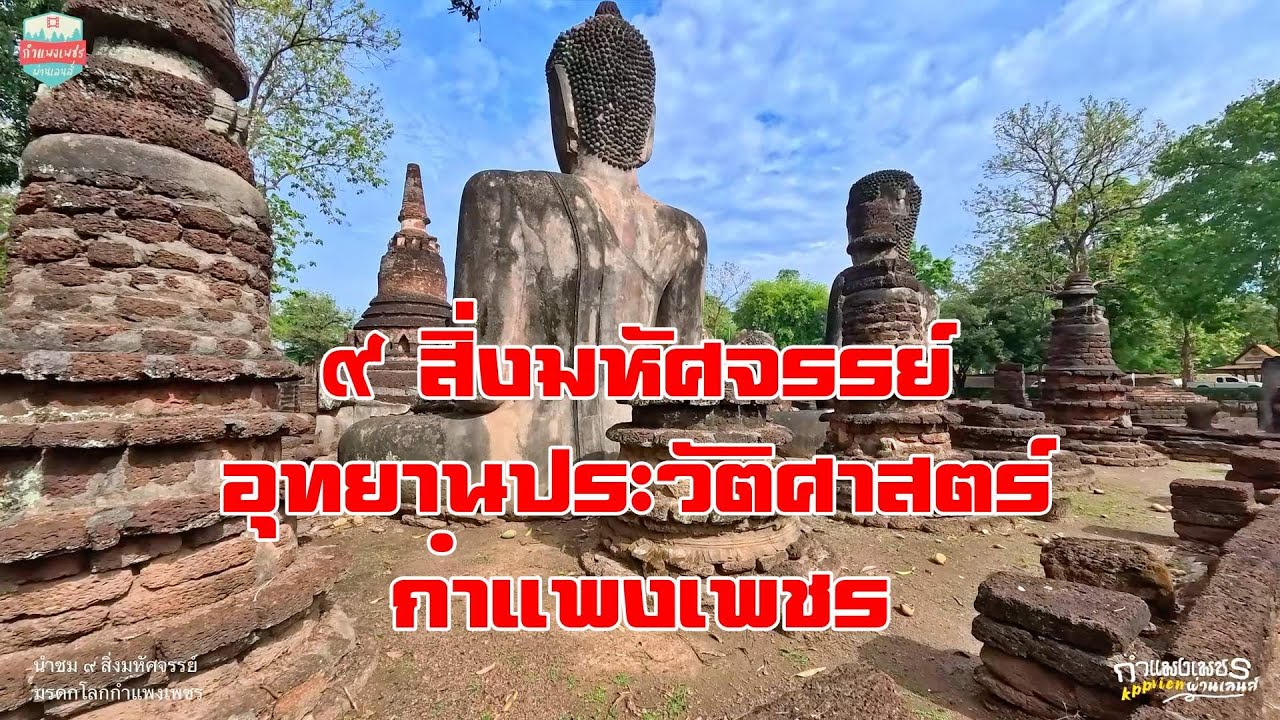
 Click to Access the Navigation Map GPS
Kamphaeng Phet Historical Park Map
Gellery
Recommend
 Historical Sites and Monuments(4)
 Landmarks and Memorials(1)
 Art, Craft Centres, Tradition(4)
 Museums(4)
 Historic Homes and Cities(1)
 Places of Worship
 Temple(25)
 Other Sacred Sites(8)
 Research and Development
 Royal Project(2)
 Suburban Living
 Village, Community(2)
 Local Market(2)
 Nature and Wildlife
 National Parks and Marine Reserves(4)
 Mountain (Doi)(2)
 Dam, Reservoir, Lake(4)
 Waterfalls(4)
 Hot Springs(1)
 River, Canal(3)
 Bays and Beaches(2)
 Other natural attractions(1)
 Entertainment and Agricultural
 Farms, Parks and Ecotourism(5)
 Waterpark(1)
 Shopping
 Shopping and Night Market(1)


