
TL;DR: Wat Chang (Chang Hai) is located at 55 Ban Nam Phueng, Moo 5, Ban It Subdistrict, Mueang Ang Thong District, Ang Thong 14000, open Daily, hours 06:00 – 18:00.
Wat Chang (Chang Hai)
Open Days: Daily
Opening Hours: 06:00 – 18:00
Wat Chang (Chang Hai), Ang Thong is a local Buddhist temple under the Mahanikai order, located at 55 Ban Nam Phueng, Moo 5, Ban It Subdistrict, Mueang Ang Thong District, Ang Thong Province. The temple sits near the Ang Thong intersection on the Bang Pa-in–Nakhon Sawan route, which makes it an easy stop for both locals and travelers passing through the province. If you are looking for a temple in Ang Thong that offers a calm atmosphere for merit-making while still giving you enough artistic details to observe at length, Wat Chang fits that pace well. Its appeal is not about instant grandeur; it is about craftsmanship that feels composed, respectful, and practical—the kind of temple architecture that has grown alongside a living community for a long time.
The charm of Wat Chang begins with the overall sense of space. The grounds feel relatively expansive and are laid out in a way that is comfortable to walk, without the tightness that sometimes comes with smaller urban temples. It works well for family visits and also for major Buddhist days when the crowd is naturally larger. Because the area is roomy, your visit can follow a pleasant rhythm: you can start with a focused moment of worship at the main shrine and then move on to read the temple through its buildings, one point at a time, without feeling rushed or squeezed. This is a key quality of an active community temple—it must accommodate religious practice and community life at the same time, and it needs to do so smoothly.
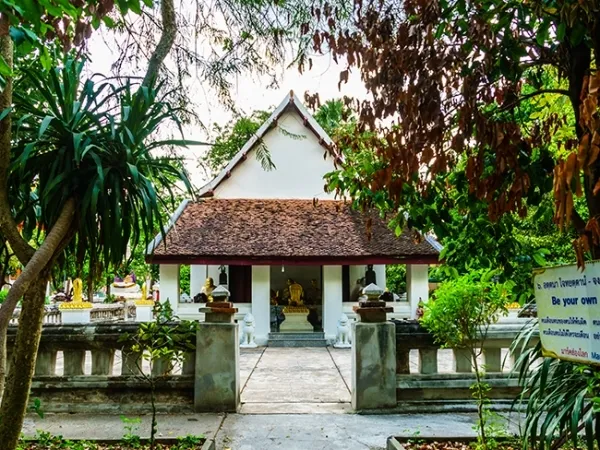
The architectural heart of Wat Chang is its ordination hall (ubosot), built in brick and plaster with a fish-scale tile roof. The design intentionally omits some elements commonly seen in Thai temple rooftops, such as chofa finials and bai raka ridge ornaments. This absence does not make the ubosot feel less like a temple; instead, it gives the structure a restrained, contemporary calm. Your attention naturally shifts to what matters most: the building’s proportions, the clean roofline, the smoothness of the plastered surfaces near the gable, and the composed lines that make the hall feel still and stable. That sense of stability suits the ubosot’s role as a sacred space for important monastic rites and ceremonies.
The carefully finished white-plastered gable strengthens the temple’s architectural identity. Its whiteness and simplicity create a feeling of cleanliness, quiet, and intention. Rather than relying on lavish decoration, the building tells its story through disciplined workmanship. This reflects a belief often embedded in Thai temple craft: sacredness does not have to be loud, but it must be steady and orderly every day. For a temple located near a busy intersection with constant movement around it, this kind of visual discipline matters. Orderliness is precisely what helps visitors instinctively treat the space with respect from the first step inside.
Another element that supports this sense of order is the choice of durable, easy-to-maintain materials in key areas, which signals that the temple is meant to be used in real life, not merely admired as a static landmark. A well-chosen floor surface that feels strong and clean supports everything a community temple needs to host: weekly merit-making, ordinations, funerals, and community gatherings that require flexible space. In that sense, Wat Chang reads as a “working temple”—a temple that continues to serve its traditional role fully and consistently, day after day.
Inside the ubosot, the highlight is the mural painting that narrates episodes from the Buddha’s life, a classic theme in Thai temples intended to “teach the Dhamma through images.” These murals matter to visitors on two levels. First is the devotional level: the imagery helps connect worship to the Buddha’s story and to practice in a way that feels immediate. Second is the cultural level: wall paintings are historical evidence of taste and worldview at the time they were created. Looking closely is not only about whether the painting is beautiful; it is also about reading what the community wanted to emphasize, what it wanted later generations to remember, and how moral lessons were meant to be passed on.
The ubosot also arranges religious imagery in a way that gives the interior more meaning than simply being a “beautiful room.” Many visitors notice the presence of symbolic imagery associated with the Buddha in a specific number and the way those elements are positioned in relation to the principal Buddha image. This kind of arrangement supports meditation and ritual order. The consistency of placement helps the space remain composed, even on days when many people visit. It is a quiet form of design that strengthens concentration and reinforces the ubosot as a place for reverence rather than spectacle.
Another scene that reflects the seriousness of Dhamma instruction is imagery linked to contemplation of impermanence and meditative practice that reminds viewers of life’s transient nature. In Thai temple contexts, themes like this are often used to bring the mind back to mindfulness and reality. A temple is not a place to escape truth; it is a place to face truth with understanding and calm. The presence of such imagery gives Wat Chang additional depth beyond being a convenient stop. Visitors can leave not only with the merit of worship, but also with a quieter, clearer perspective carried back into daily life.
The principal Buddha image in the ubosot is in the Mara-Vijaya posture, symbolizing victory over obstacles through the steadiness of the mind. This posture resonates strongly with a community-centered temple because many people come to temples seeking encouragement, calm, and the feeling of being able to stand firmly again. Sitting before the Buddha image, you can sense that Mara-Vijaya is not only about the gesture itself, but about the reminder to live with mindfulness, to avoid carelessness, and to hold virtue as the foundation—even when everyday life feels uncertain and changeable.
Wat Chang also has a sermon hall (sala kan parian) that supports a wide range of community functions, including listening to sermons, merit-making events, meetings, and ceremonies that require spacious and adaptable areas. In Thai temple life, the sermon hall naturally becomes the “bridge” between the monastic community and laypeople. It allows the temple to remain socially connected rather than separated from everyday life. When a temple has a well-functioning sermon hall, it has greater capacity to strengthen community cohesion, because people can gather without the atmosphere feeling overly formal or intimidating.
For many local communities, sacredness is not created by buildings alone. It grows through stories and relationships accumulated over time. Wat Chang carries this dimension through the community’s respect for teachers, elders, and past revered monks connected to the area. Remembering respected masters creates a shared memory—something that turns a temple into a true emotional anchor. Culturally, these stories act like threads that hold a community together. When people share reverence toward the same figures and values, a sense of belonging naturally forms, even without words.
If you visit Wat Chang as a cultural traveler, the most rewarding approach is to slow down and observe the craftsmanship without rushing. Start by viewing the ubosot from a distance to read its proportions, then walk closer to notice the plaster surface, the gable finish, and the roof details. After that, step inside and let your eyes move across the murals, one side at a time. This method helps you recognize Wat Chang’s main language: simplicity. The refinement is not loud, but it is present in the details that are easiest to overlook. That is the distinctive dignity of a community temple that does not need to announce itself.
For merit-makers, Wat Chang is especially pleasant in the morning, when the air feels open and the atmosphere is quieter. Visiting a temple near an urban intersection has a particular value: even if the city around it moves fast, the temple can still preserve a steady rhythm of calm. Entering the grounds becomes a simple pause button for the mind. You step in, pay respect, set your intention, and leave the noise outside. The temple fulfills its role in a direct and grounded way.
Beyond worship, it is worth paying attention to etiquette when viewing murals, because these works require ongoing care. Avoid touching the walls, do not lean on mural surfaces, and refrain from using flash photography in areas with paintings to help preserve pigments and surfaces over time. Courtesy in a temple is not only about good manners; it is also a practical way to protect cultural heritage so future visitors can still experience the artwork in a condition close to what it was meant to be.
As with any Thai temple visit, modest dress is recommended. Avoid sleeveless tops, shorts above the knee, or overly tight clothing. This is still an active religious space where monks carry out daily duties and local residents come to practice and make merit. If you take photos, do so quietly, without disturbing people who are praying or meditating, and keep a respectful distance—especially inside the ubosot, which is the most sacred zone of the temple.
Getting There is straightforward because Wat Chang is located in Mueang Ang Thong District and sits near an important junction of the province. By private car, use the Bang Pa-in–Nakhon Sawan route toward the Ang Thong intersection, then follow local signs toward Ban It Subdistrict. From central Ang Thong town, the drive is typically short, and the location works well for visitors who plan to visit multiple temples in one day.
If you travel by public transport, an easy approach is to reach Ang Thong town first and then take a local taxi service or motorbike taxi to Ban It Subdistrict, using the Ang Thong intersection and main-road area as your reference point. Because the temple is not far from the urban center and sits along a commonly used corridor, it is convenient for both drivers and visitors who need a short local connection.
Overall, Wat Chang is a temple that combines calmness with order in the same space. The ubosot feels restrained and composed, yet it reflects careful workmanship; the murals offer both devotion and Dhamma understanding; and the sermon hall and functional grounds support community life, keeping the temple active and meaningful. If you want to experience a temple in Ang Thong that is easy to reach, genuinely peaceful, and still rich enough in detail to observe thoughtfully, Wat Chang is an ideal place to stop with intention and give your attention to quietness in full.
| Place Name | Wat Chang (Chang Hai) |
| Address | 55 Ban Nam Phueng, Moo 5, Ban It Subdistrict, Mueang Ang Thong District, Ang Thong 14000 |
| Summary | A Mahanikai community temple near the Ang Thong intersection, noted for its restrained ubosot design, Buddha-life murals, and its role as a practical religious and community center |
| Highlights | Brick-and-plaster ubosot with fish-scale roof tiles (clean, composed style), finely finished white gable plaster, Buddha-life mural paintings inside the ubosot, spacious grounds that are comfortable to walk |
| Period | Rattanakosin (community-temple structure with ongoing real-life use and maintenance) |
| Key Evidence | Ubosot and interior murals, principal Mara-Vijaya Buddha image, community-activity functions supported by the sermon hall |
| Name Origin | “Wat Chang” is a longstanding local name used in the Ban It area, and the form “Chang Hai” is also found in some sources |
| Abbot (Current) | Phra Khru Suwat Worakit |
| Open Days & Hours | Daily, 06:00 – 18:00 |
| Fees | No admission fee |
| Facilities | Parking area, restrooms, worship/merit-making areas, sermon hall for community events |
| Travel | Private car: take the Bang Pa-in–Nakhon Sawan route toward the Ang Thong intersection and follow signs to Ban It; Public transport: reach Ang Thong town first, then take local taxi/motorbike taxi to Ban It |
| Current Status | Open for visits and merit-making during stated hours |
| Contact Number | 089-239-8483 |
| Nearby Tourist Attractions (Driving Distance) | 1) Ang Thong City Pillar Shrine – About 6 km 2) Wat Ton Son – About 7 km 3) Wat Ang Thong Worawihan – About 8 km 4) Wat Pa Mok Worawihan – About 18 km 5) Wat Chaiyo Worawihan – About 20 km |
| Popular Restaurants Nearby (Driving Distance + Phone) | 1) 10/6 Restaurant – About 9 km – 035-611-654 2) Lek Ban Ro Restaurant – About 8 km – 035-612-070 3) Khrua Pa Aed – About 10 km – 096-112-2000 4) Pad Thai Wat Thong Khung – About 14 km – 082-233-3887 5) Bohk Toh Restaurant – About 11 km – 065-246-2288 |
| Popular Accommodations Nearby (Driving Distance + Phone) | 1) Suphorn Grand Hotel – About 10 km – 081-551-2828 2) Bualuang Hotel – About 9 km – 035-611-116 3) Bualuang Boutique Resort – About 11 km – 081-495-8884 4) Ratchaphruek DC Resort – About 13 km – 080-193-3277 5) Rimchon Resort – About 12 km – 035-611-527 |
Frequently Asked Questions (FAQ)
Q: Is Wat Chang (Chang Hai) open every day?
A: Yes. The temple is open daily, making it convenient for both worship and a relaxed visit.
Q: What should I not miss when visiting Wat Chang?
A: The ubosot’s restrained architectural style with fish-scale roof tiles and the Buddha-life murals inside the ubosot.
Q: Where exactly is Wat Chang located, and is it easy to reach?
A: It is in Ban It Subdistrict near the Ang Thong intersection on a main provincial route, so it is easy to reach by car and also practical with a short local connection from Ang Thong town.
Q: How much time should I plan for a visit?
A: About 30–60 minutes for a standard worship-and-walk visit, or 60–90 minutes if you want to observe the murals and architectural details more carefully.
Q: What etiquette should I follow when viewing murals inside the ubosot?
A: Dress modestly, keep your voice low, avoid touching or leaning on walls, and avoid flash photography to help preserve the artwork.
Q: Who is the current abbot of Wat Chang (Chang Hai)?
A: Phra Khru Suwat Worakit.
 Category: ●Places of Worship
 Group: ●Temple
 Last Update : 1 MonthAgo
 Click to Access the Navigation Map GPS
 Art, Culture and Heritage
 Landmarks and Memorials(
 Royal Palace(
 Art, Craft Centres, Tradition(
 Museums(
 Historical Houses and The Ancient City(
 Educational Places
 Educational Gardens, Farm(
 Other religious and spiritural sites(
 Research and Development
 Royal Project(
 Suburban Living
 Village, Community(
 Local Market(
 Floating Market(
 Nature and Wildlife
 River, Canal(
 Other natural attractions(
 Entertainment and Agricultural
 Farm, Parks, Gardens and Ecotourism(
 Outdoor and Adventure Activities(
 Shopping
 Shopping and Night Market(
 Travel Articles, Recipes
 Travel Review, Food Review(
 Central Thai Cuisine, Central Thai food recipes(


