
lovethailand home >North Travel Attractions >Chiang Mai Travel Attractions >Hang Dong >Nong Tong > Wat Nong Tong
TL;DR: Wat Nong Tong is located at Moo 3, Nong Tong Subdistrict, Hang Dong District, Chiang Mai, open Daily, hours Please check with the temple before visiting.
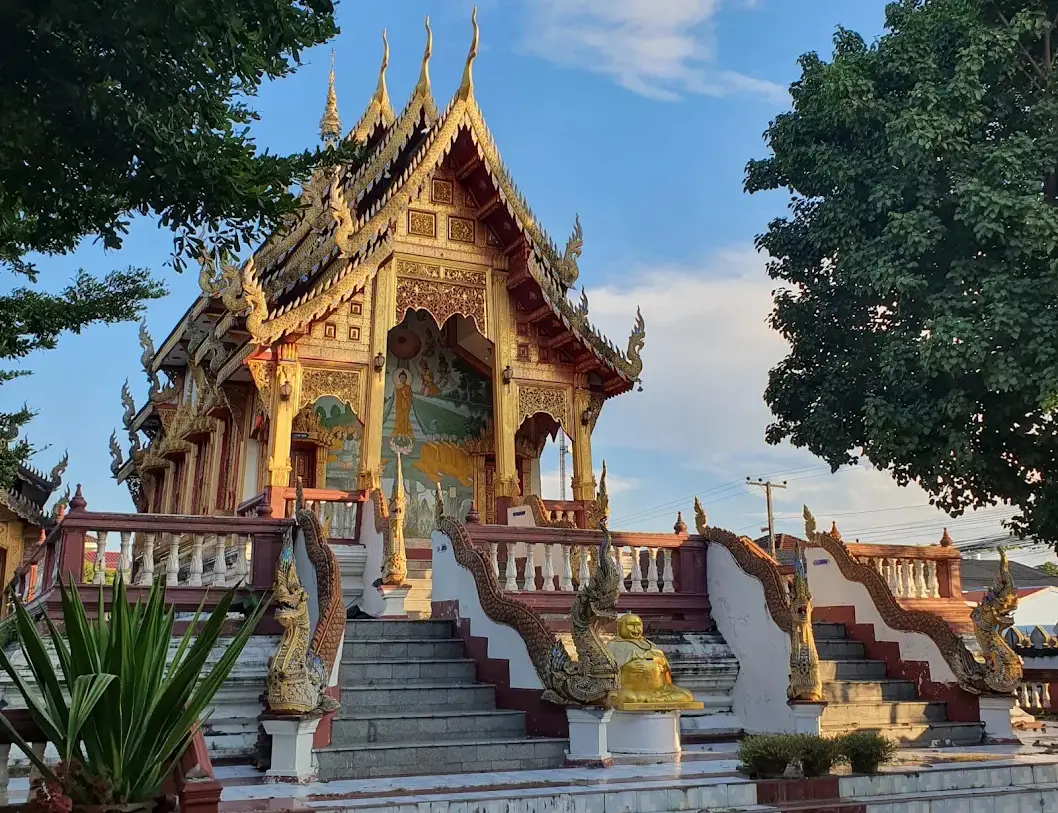
Wat Nong Tong
Open Days: Daily
Opening Hours: Please check with the temple before visiting
Wat Nong Tong is located at 188 Moo 3, Nong Tong Subdistrict, Hang Dong District, Chiang Mai 50340. It is a local Buddhist temple under the Maha Nikaya order and one of the most important temples in Nong Tong Subdistrict. The temple is deeply connected with Wiang Mano, an ancient settlement in the same area, and it has long served as a center of religion, education, community life, and local historical memory.
Wat Nong Tong stands in an area closely linked with the ancient city of Wiang Mano, a historical settlement associated with the Hariphunchai cultural sphere. The old landscape of Nong Tong included the former course of the Ping River, natural waterways, agricultural land, and settlement zones. This made the area suitable for movement, farming, and the growth of local communities. Wat Nong Tong should therefore be understood as a temple rooted in a much older cultural landscape, not merely as a village temple founded in isolation.
The history of Wat Nong Tong is layered. Temple history records that it was built in 1864, but local historical research found the temple name in the Chiang Mai monastic survey records from 1822. Older villagers also knew the temple as Wat Nong Tong Luang, with luang suggesting a major temple serving a large community. This older name reflects the temple’s role as a principal religious and community center of Nong Tong.
The temple received its consecrated boundary for monastic ceremonies on 23 June 1971. The boundary measures 40 meters wide and 80 meters long. This consecrated boundary is important because it allows formal Sangha ceremonies to be performed properly according to Buddhist monastic discipline. It confirms Wat Nong Tong’s status as a fully functioning Buddhist temple serving both monks and laypeople.
Wat Nong Tong’s temple land was recorded as 3 rai, 3 ngan, and 52 square wah in temple history, while later local records describe the current temple land as 3 rai, 1 ngan, and 7 square wah, with several additional monastic land plots. The temple’s northern boundary meets an irrigation channel and village area, while the southern side borders houses and a public road. This position shows how closely the temple is integrated with the community and local water-management landscape.
The main structures at Wat Nong Tong include an ordination hall, viharn, chedi, bell tower, sermon hall, monks’ residences, kitchen, Pariyatti study building, Sangha meeting hall, merit-making building, and Dhamma practice site. Sacred objects include Buddha images in various postures. These features make Wat Nong Tong a complete community temple supporting worship, education, ceremonies, merit-making, monastic residence, and public gatherings.
The temple has an especially strong educational role. Thai-language teaching was conducted in the temple from around 1912, and this later became connected with the development of local schools, including Ban Nong Tong School and Nong Tong Wittaya Municipal School. The temple also opened a Pariyatti Dhamma school in 1954 and a Sunday Buddhist Study Center in 1984. This history shows that Wat Nong Tong has long supported learning, not only ritual life.
Wat Nong Tong received recognition as a model development temple in 1990 and an outstanding development temple in 1991 from the Department of Religious Affairs. These awards reflect the temple’s role in improving facilities, organizing community religious life, supporting education, and serving local society. Wat Nong Tong is therefore an example of a community temple that continues to develop while preserving its historical identity.
The line of abbots at Wat Nong Tong shows continuity across generations. Names preserved in local history include Phra Ariya, Phra Sitthi, Phra Khru Ba Yana Yanramsi, Phra Biao, Phra Bunma Phothiko, Phra Chan, Phra Di, Phra Bunsoen Dhammadino, Phra Bunyung Yanawaro, and Phra Khru Athon Wisutthikhun, also known as Luang Pho Bun Tan Parisuttho, who has served as abbot from 1974 onward. The present abbot, Phra Khru Athon Wisutthikhun, remains closely associated with the development of the temple and its community role.
Under Phra Khru Athon Wisutthikhun, Wat Nong Tong has grown as a center of religious practice, education, and community development. The temple has supported summer novice ordination programs, Sunday Buddhist education, Dhamma teaching, and Lanna-style Mahachat sermons. Through these activities, the temple functions as both a religious center and a community institution that helps develop young people and sustain Buddhist values.
Important things to see at Wat Nong Tong begin with the viharn, the main worship hall where Buddha images are enshrined and devotees gather for ceremonies. The ordination hall is the sacred space for formal monastic rites. The chedi symbolizes Buddhist devotion, while the bell tower, sermon hall, study building, monks’ residences, kitchen, meeting hall, and merit-making building show the temple’s practical role in community life.
The Buddha images at Wat Nong Tong are important not only as sacred objects but also as historical links to the wider story of Wiang Mano. Local history records the discovery of a crowned Buddha image around 3 feet wide, associated with Lopburi-period art and the Hariphunchai cultural context. This image is now enshrined at Wat Nong Tong. It connects the temple directly with the ancient settlement history of the subdistrict.
Another important image is Phra Chao Kao Tue Samrit, a large bronze Buddha image with a lap width of 99 inches. The casting ceremony took place on 31 January 2018, and the image was enshrined in the temple’s viharn. It was created through the faith of monks, disciples, and local devotees, making it an important modern symbol of Buddhist devotion in Ban Nong Tong.
Wat Nong Tong also has Phra That Chedi Ket Kaeo Chulamani, built to enshrine old sacred relics of the temple. The chedi was completed and celebrated on 5 February 2019. Visitors should pay respect at the chedi and observe it as part of the temple’s living devotional landscape. It represents the continuity of relic worship and community support for the temple.
The Dhamma practice site of Wat Nong Tong expands the temple’s role beyond seasonal ceremonies. The site was created through the intention to provide land for Buddhist practice, Dhamma training, lodging for practicing monks, and spaces useful to both monks and laypeople. This makes Wat Nong Tong a place for merit-making, education, and spiritual training.
Wat Nong Tong is closely linked with Wiang Mano. The ancient city was about 900 meters wide and 750 meters long, with city walls on 3 sides and a moat about 19 meters wide on the eastern side near the old Ping River. Archaeological remains in the area include pottery fragments, household objects, Buddha-image fragments, and other Buddhist-related remains. A visit to Wat Nong Tong is therefore also a gateway to understanding the ancient history of Nong Tong.
The Mae Hin Bod Wiang Mano inscription was discovered in February 1968 near the earthen wall outside the western side of the ancient city. This inscription became an important basis for further study of Wiang Mano and its historical connections. For visitors interested in ancient settlements and Lanna-Hariphunchai history, Wat Nong Tong is one of the most meaningful starting points in the area.
Nong Tong Subdistrict today contains 14 villages and lies about 28 kilometers from Chiang Mai city. The area remains strongly connected with agriculture, waterways, local temples, and community traditions. Wat Nong Tong acts as a bridge between ancient settlement history and present-day village life. It connects Wiang Mano, Buddhist practice, education, and the social life of the local community.
Temple activities at Wat Nong Tong follow the Buddhist calendar and Lanna traditions. These include Buddhist holy days, Buddhist Lent, the end of Buddhist Lent, Kathin, forest robe offerings, Mahachat sermons, memorial merit-making, ancestor dedication, youth education, and Dhamma activities. These events bring together monks, elders, families, students, and local residents across generations.
The temple’s community role can be seen in several dimensions. Religiously, it is a place for worship, merit-making, sermons, and Sangha ceremonies. Educationally, it has supported Thai-language teaching, Pariyatti education, and Sunday Buddhist study. Historically, it is tied to Wiang Mano and the ancient settlement of Nong Tong. Socially, it serves as a gathering place, meeting space, and spiritual center for the subdistrict.
Visitors should pay respect to the Buddha images in the viharn, Phra Chao Kao Tue Samrit, Phra That Chedi Ket Kaeo Chulamani, ancient Buddha images, and other sacred objects inside the temple. Modest clothing, quiet speech, respect for monks and local devotees, and asking permission before photographing sensitive areas are appropriate. Since Wat Nong Tong is an active community temple, it should be visited as a living sacred place.
A connected cultural route can begin at Wat Nong Tong, then continue to Wiang Mano Ancient Settlement, Wat Phra Chao Lueam, Wat Sa Trai Nurak or Wat Na Wiang, Wat Sri Lanka, Wat Walukaram, Wat Tha Nak, and Wat Nak Nimit. This route is suitable for visitors interested in old temples, ancient settlement history, Lanna art, Hariphunchai connections, and the agricultural communities of southern Chiang Mai.
Getting There is easiest by private car, rental car, or ride-hailing service. From Chiang Mai city, travel toward Hang Dong District, then continue to Nong Tong Subdistrict via the San Pa Tong–Lamphun route or Highway 1015. The temple is located in Moo 3. Visitors can set the destination as Wat Nong Tong, Nong Tong Subdistrict, Hang Dong District, Chiang Mai.
Visitors should allow at least 1 hour to pay respect, see the viharn, ordination hall, chedi, bell tower, sermon hall, Phra Chao Kao Tue Samrit, Phra That Chedi Ket Kaeo Chulamani, and learn about Wiang Mano. Those planning to connect the temple with nearby historical places and temples should plan a half-day or full-day route.
Overall, Wat Nong Tong is the principal temple of Nong Tong Subdistrict and one of the most meaningful cultural sites in southern Hang Dong. Its value comes from its connection with Wiang Mano, its old monastic records, its complete temple structures, its Buddha images and chedi, its educational role, and its continuing function as a living community temple. For travelers seeking the deeper local side of Chiang Mai, Wat Nong Tong is an essential stop on the Nong Tong cultural route.
| Name | Wat Nong Tong |
| Old Community Name | Wat Nong Tong Luang |
| Location | Moo 3, Nong Tong Subdistrict, Hang Dong District, Chiang Mai |
| Address | 188 Moo 3, Nong Tong Subdistrict, Hang Dong District, Chiang Mai 50340, Thailand |
| Temple Type | Local Buddhist temple under the Maha Nikaya order |
| Temple Land Area | Historical record: 3 rai, 3 ngan, 52 square wah / Current temple land: 3 rai, 1 ngan, 7 square wah |
| Open Days | Daily |
| Opening Hours | Please check with the temple before visiting |
| History | Recorded as built in 1864, with the temple name appearing in Chiang Mai monastic survey records from 1822. The temple stands within the Wiang Mano ancient settlement area associated with Hariphunchai history. |
| Consecrated Boundary | Granted on 23 June 1971; 40 meters wide and 80 meters long |
| Highlights | Principal temple of Nong Tong Subdistrict, linked with Wiang Mano, ancient Buddha images, Phra Chao Kao Tue Samrit, Phra That Chedi Ket Kaeo Chulamani, and Buddhist education |
| Main Areas / Structures | Ordination hall, viharn, chedi, bell tower, sermon hall, monks’ residences, kitchen, Pariyatti study building, Sangha meeting hall, merit-making building, and Dhamma practice site |
| Sacred Objects / Key Features | Buddha images in various postures, ancient Buddha images, Phra Chao Kao Tue Samrit, and Phra That Chedi Ket Kaeo Chulamani |
| What To See | Viharn, ordination hall, chedi, bell tower, sermon hall, Phra Chao Kao Tue Samrit, Phra That Chedi Ket Kaeo Chulamani, Dhamma practice site, and the atmosphere of Nong Tong’s principal temple |
| What To Worship | Buddha images in the viharn, Phra Chao Kao Tue Samrit, Phra That Chedi Ket Kaeo Chulamani, ancient Buddha images, and sacred objects inside the temple |
| Abbot / Caretaker | Phra Khru Athon Wisutthikhun |
| Resident Monks | 6 monks according to the 2025 Kathin activity listing |
| Community Role | A center for merit-making, sermons, Buddhist education, community activities, and learning about Wiang Mano history |
| Awards / Recognition | Model development temple in 1990 and outstanding development temple in 1991 |
| Current Status | An active community temple with public 2025 Kathin activity information |
| Travel Information | From Chiang Mai city, travel toward Hang Dong District, then continue to Nong Tong Subdistrict via the San Pa Tong–Lamphun route or Highway 1015. Private car, rental car, or ride-hailing service is recommended. |
| Nearby Tourist Attractions | 1. Wiang Mano Ancient Settlement, about 1 km 2. Wat Phra Chao Lueam, about 3 km 3. Wat Sa Trai Nurak / Wat Na Wiang, about 4 km 4. Wat Tha Nak, about 3 km 5. Wat Nak Nimit, about 3 km |
| Nearby Restaurants | 1. Krua Malawin Nong Tong, about 2 km, Tel. 093-239-3442 2. The Dream Cafe Chiang Mai, about 3 km, Tel. 095-612-0683 3. GOOD LUCK CAFE Nong Tong, about 3 km, Tel. 064-494-1494, 083-535-9963 4. Ping Pang Khun Kru, about 4 km, Tel. 096-901-8566 5. Khao Soi Hang Dong Mae Ui Noo Branch 1, about 12 km, Tel. 053-443-069, 098-750-6214, 080-629-2528 |
| Nearby Accommodations | 1. Baan Tawai Lanna Resort, about 13 km, Tel. 063-654-7997 2. Soft Resort Kadfarang, about 15 km, Tel. 081-681-1739 3. Laan Mai Fai Chang Resort, about 17 km, Tel. 082-994-7888 4. Baan Suan Hill Lodge, about 18 km, Tel. 089-834-2329 5. Veranda High Resort Chiang Mai, about 23 km, Tel. 053-365-007, 062-398-6899, 098-913-7699 |
Frequently Asked Questions (FAQ)
Q: Where is Wat Nong Tong located?
A: Wat Nong Tong is located at 188 Moo 3, Nong Tong Subdistrict, Hang Dong District, Chiang Mai 50340, Thailand.
Q: When was Wat Nong Tong built?
A: Temple history records that Wat Nong Tong was built in 1864, while its name also appears in Chiang Mai monastic survey records from 1822.
Q: How is Wat Nong Tong connected with Wiang Mano?
A: Wat Nong Tong stands within the Wiang Mano ancient settlement area, a historical community linked with Hariphunchai and archaeological remains in Nong Tong Subdistrict.
Q: What important structures are found at Wat Nong Tong?
A: Important structures include the ordination hall, viharn, chedi, bell tower, sermon hall, monks’ residences, kitchen, Pariyatti study building, Sangha meeting hall, merit-making building, and Dhamma practice site.
Q: What should visitors worship at Wat Nong Tong?
A: Visitors should pay respect to the Buddha images in the viharn, Phra Chao Kao Tue Samrit, Phra That Chedi Ket Kaeo Chulamani, ancient Buddha images, and other sacred objects inside the temple.
Q: What educational role has Wat Nong Tong played?
A: The temple supported Thai-language teaching, Pariyatti Dhamma education, Sunday Buddhist study, and local school development, making it an important educational center for the community.
Q: What nearby places can be visited with Wat Nong Tong?
A: Nearby places include Wiang Mano Ancient Settlement, Wat Phra Chao Lueam, Wat Sa Trai Nurak, Wat Tha Nak, and Wat Nak Nimit.
 Category: ●Places of Worship
 Group: ●Temple
Last Update : 7 DayAgo
 Last Update : 7 DayAgo
 Click to Access the Navigation Map GPS
 Muang Chiang Mai(121)Chom Thong(47)Mae Chaem(25)Chiang Dao(33)Doi Saket(68)Mae Taeng(85)Mae Rim(69)Samoeng(29)Fang(71)Mae Ai(59)Phrao(70)San Pa Tong(103)San Kamphaeng(66)San Sai(73)Hang Dong(73)Hot(32)Doi Tao(22)Omkoi(11)Saraphi(74)Wiang Haeng(15)Chai Prakan(28)Mae Wang(32)Mae On(22)Doi Lo(33)Galyani Vadhana(1)


