
lovethailand home >North Travel Attractions >Chiang Mai Travel Attractions >San Pa Tong >Thung Satok > Wat Si Bun Rueang
TL;DR: Wat Si Bun Rueang is located at Ban Klang, Village No. 9, Thung Satok Subdistrict, San Pa Tong District, Chiang Mai Province.

Wat Si Bun Rueang
Operating day: Daily
Operating time: 08.00 - 17.00
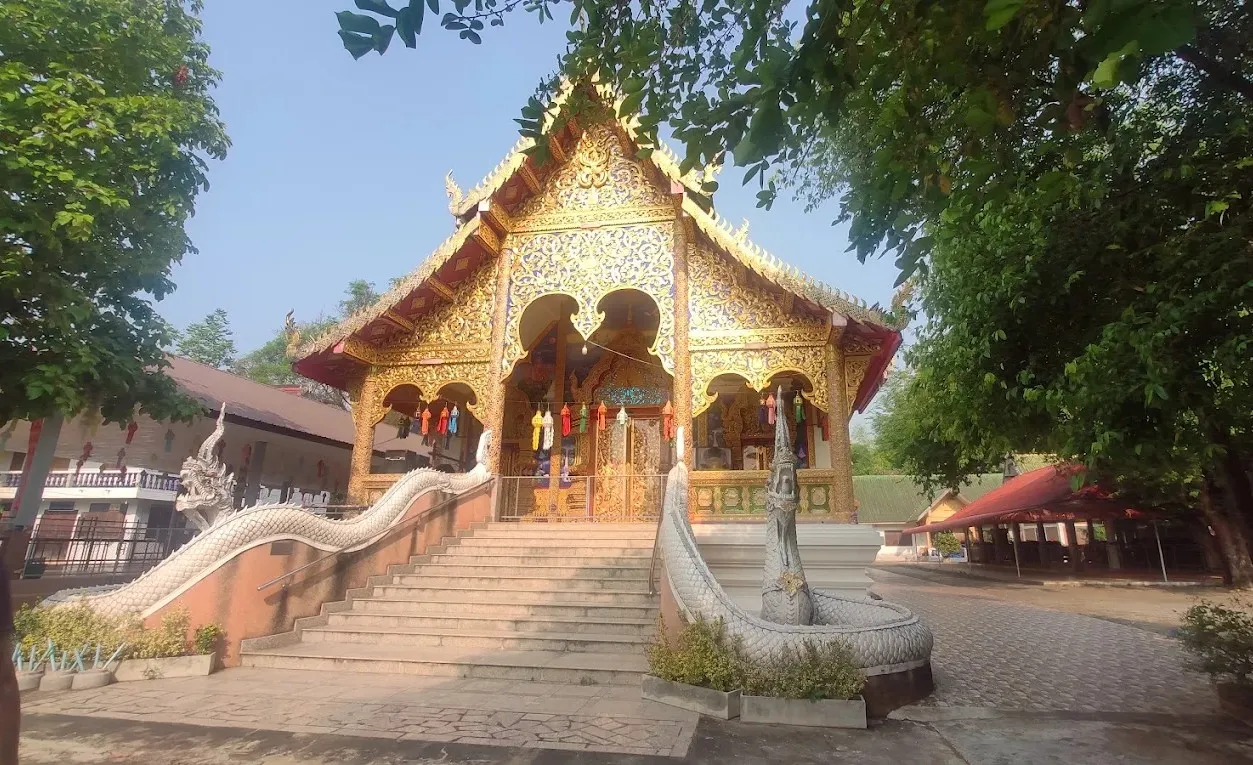
Wat Si Bun Rueang (Thung Satok) is a Mahanikaya community temple in Ban Klang, Village No. 9, Thung Satok Subdistrict, San Pa Tong District, Chiang Mai Province. Formerly known as Wat Hong, the temple’s original name reflected its low-lying landscape where rainwater often accumulated during the rainy season. It was later renamed Wat Si Bun Rueang for auspiciousness. With a history of more than 200 years, the temple is notable for its Lanna-style chedi built over an older small chedi in 1930, a renovated Lanna viharn, merit-making hall, dining hall, multipurpose hall, monks’ residence, and its long-standing role as a spiritual center of the Ban Klang community.
Wat Si Bun Rueang (Thung Satok) is an old community Buddhist temple in Ban Klang, Village No. 9, Thung Satok Subdistrict, San Pa Tong District, Chiang Mai Province. Today, it is a Mahanikaya temple and remains closely tied to the religious and social life of the local community. The temple was formerly called Wat Hong, a name connected to the low-lying nature of the area. During the rainy season, heavy rainfall frequently caused water to remain in the area each year. Later, when the authorities allowed the temple to adopt a more auspicious name, the abbot and temple committee changed the name from Wat Hong to Wat Si Bun Rueang, also known as Wat Si Bun Rueang Ban Klang.
The original name “Wat Hong” is important because it preserves the memory of the temple’s landscape. In a northern Thai context, “hong” can refer to a low-lying or basin-like area associated with water. As a temple name, it therefore reflects the actual environment in which the community lived: land affected by seasonal rain, standing water, and traditional water conditions. The newer name, Wat Si Bun Rueang, gives the temple a more auspicious meaning. “Si” suggests grace, prosperity, and sacred beauty, while “Bun Rueang” evokes the flourishing of merit. The name change therefore connects local memory with Buddhist auspiciousness and the community’s hope for continued growth.
Wat Si Bun Rueang is rooted in the Ban Klang community. In its early period, the temple was supported by approximately 40 local households. Over time, the number of households supporting the temple grew to about 120, including families in Ban Klang or Ban Si Bun Rueang, Village No. 9, and nearby Ban Klang communities. This development shows that the temple was not created as an isolated religious site. It grew through the effort, donations, labor, and faith of local residents who built, repaired, and sustained the temple across generations.
The temple has a history of more than 200 years. Its early construction began through the faith of villagers who first built basic monastic structures such as monks’ quarters and a merit-making hall. Over time, the temple developed further with the construction of a chedi, viharn, salabat hall, boundary wall, and a public school. The establishment of a public school in the temple context clearly reflects the traditional role of Thai and Lanna temples. A temple was not only a place for religious rites; it was also a center of education, youth development, social organization, and community improvement.
The former Wat Si Bun Rueang public school is an important part of the temple’s history. It was later merged by the authorities in 1990, but its presence reveals the temple’s role as a learning center for the Ban Klang community. In the past, children and local residents often learned within or around temple spaces, while adults used the temple for ceremonies, community meetings, and collective work. Wat Si Bun Rueang therefore functioned as both a religious site and a public-cultural space for several generations.
Restoration and development at Wat Si Bun Rueang have continued over time. Under the present abbot, Phra Khru Chamrat Panyatharo, several structures have been built or improved, including the dining hall, multipurpose hall, boundary wall, monks’ residence, and restrooms. These developments have made the temple more capable of supporting monastic duties, Buddhist ceremonies, community merit-making, and local gatherings. Wat Si Bun Rueang therefore combines historical depth with ongoing development.
The most important sacred monument at Wat Si Bun Rueang is its chedi. The present chedi was built over an older small chedi in 1930. It was constructed of brick and coated with white lime plaster, following the materials and building methods of that period. According to local elders, old Buddha images are enshrined within the chedi. The chedi measures 5.5 meters wide and 5.5 meters long, forming a square Lanna-style structure. Each side has a central niche, and each niche contains a newer standing Buddha image.
The chedi is more than a religious structure. It is a focal point of memory, merit, and devotion for the Ban Klang community. The act of building the present chedi over an older original chedi shows the community’s intention to preserve what already existed rather than erase it. This approach is found in many Lanna Buddhist sites, where older sacred objects and structures are protected through later construction and restoration. The chedi was repaired, replastered, and repainted in 1992, allowing it to remain a central sacred landmark of the temple today.
The old Buddha images enshrined inside the chedi are important sacred objects of the temple. Although detailed information about their number, size, or artistic period is not available, the account preserved by village elders shows that the community recognizes them as significant. Visitors should therefore approach the chedi respectfully and understand it as a site where religious faith, local history, and community memory meet.
The viharn of Wat Si Bun Rueang is another important structure. It measures 7.6 meters wide and 14 meters long and was renovated in 1965. The building follows a Lanna architectural form. Its walls are made of brick and plaster, its columns are reinforced concrete, and its beams and roof structure are made of hardwood. The roof is covered with ordinary cement tiles. These details show how the temple’s renovation combined local Lanna form with modern construction materials available at the time.
The viharn serves as the temple’s main worship space. It is used for paying respect to the Buddha, listening to Dhamma teachings, receiving precepts, chanting, and participating in important Buddhist ceremonies. Visitors should begin their visit by respectfully entering the viharn, then continue to the chedi and other temple structures. The viharn’s importance does not come from grand scale but from its role as the spiritual heart of a living community temple.
The merit-making hall measures 8 meters wide and 27 meters long. It was renovated and completed in 1984. The hall is built in a Lanna style, with reinforced concrete columns, a hardwood roof structure, and small corrugated roof tiles. This hall is highly important for community temple life because it supports merit-making ceremonies, memorial rites, lay gatherings, and activities that require a larger space. It is one of the buildings where villagers gather most actively during religious events.
The merit-making hall also reflects the relationship between the temple and the life cycle of the community. Merit-making is not limited to annual festivals; it also includes ceremonies connected with families, ancestors, funerals, memorial offerings, and local gatherings. For many households in Ban Klang, the hall is a place of memory as well as religious practice. It supports both Buddhist merit and social continuity.
The dining hall measures 6 meters wide and 15 meters long and was completed in 1989. It follows a Thai-Lanna style, with reinforced concrete columns and beams, exposed brick walls, hardwood roof structure, and green double-corrugated roof tiles. The dining hall is important for monastic meals, food offerings, and temple events. It helps organize the relationship between monks and lay supporters during ceremonies and merit-making days.
The multipurpose hall measures 8 meters wide and 20 meters long and was completed in 1996. It follows a Thai-Lanna style, with reinforced concrete columns and beams, plastered brick walls with paintings, hardwood roof structure, and green double-corrugated roof tiles. This hall reflects the temple’s later development and the need for a flexible space that can support Buddhist ceremonies, meetings, gatherings, and community activities. The wall paintings add artistic character to the building and enrich the atmosphere of the temple grounds.
The monks’ residence measures 7 meters wide and 28 meters long. It is a two-storey building completed in 1999. Its style is Thai-Lanna, with reinforced concrete columns and beams, a hardwood roof structure, and CPAC roof tiles. The monks’ residence is essential to the life of the temple because it supports monastic residence, study, religious duties, and daily practice. Its construction reflects the community’s intention to maintain the temple as a functioning Buddhist center for the long term.
Other supporting structures, including the boundary wall, restrooms, and open temple courtyard, are also important for practical use. Although they are not sacred monuments in the same sense as the chedi or viharn, they help organize the temple space and make ceremonies more convenient for monks and lay supporters. The courtyard connects the chedi, viharn, halls, and monks’ residence into one functional religious landscape.
Wat Si Bun Rueang serves as a spiritual center for the Ban Klang community. It supports merit-making, sermons, Buddhist holy day observances, Kathin, robe-offering ceremonies, memorial rites, community gatherings, and seasonal religious activities. The temple is a place where older residents, families, lay supporters, and younger generations come together. In this way, it holds not only religious meaning but also social memory and community identity.
The temple’s regular Buddhist activities should be understood within the context of Lanna community temples. Its viharn, chedi, merit-making hall, dining hall, multipurpose hall, and courtyard allow the community to organize Buddhist Lent activities, the end of Buddhist Lent, Kathin, robe offerings, memorial merit-making, and other ceremonies throughout the year. These activities keep the relationship between temple and village active across generations.
Important areas to see at Wat Si Bun Rueang include the Lanna-style chedi built over the old chedi, the Lanna viharn renovated in 1965, the merit-making hall completed in 1984, the dining hall completed in 1989, the multipurpose hall completed in 1996, the monks’ residence completed in 1999, and the temple courtyard. Walking through these areas slowly allows visitors to understand the temple’s development through different periods of restoration and community support.
The atmosphere of Wat Si Bun Rueang is suited to visitors interested in Lanna community temples, old temples of San Pa Tong, the history of Ban Klang, and temple architecture shaped by local restoration. The temple is not defined by large-scale tourism. Its value lies in its historical roots, the old name connected with the landscape, the preserved chedi, the Lanna-style structures, and the continuing faith of local people.
Wat Si Bun Rueang also reflects Lanna cultural life through its architecture, religious functions, and educational history. The former name connects the temple with lowland geography. The chedi preserves an older sacred core. The viharn and halls retain Lanna-style forms. The former public school shows the temple’s contribution to local education. Together, these elements make the temple a strong example of how religion, architecture, education, and community life come together in a northern Thai village temple.
Visitors should dress respectfully, keep their voices low, avoid disturbing monks’ living areas, avoid climbing or touching the chedi unnecessarily, and refrain from entering private or restricted spaces. If a ceremony or community activity is taking place, visitors should follow the guidance of monks or local caretakers. Wat Si Bun Rueang remains a sacred place for the Ban Klang community, so it should be visited with respect.
Getting There is most convenient by private car, rental car, or local hired transport. From Chiang Mai city, travel toward San Pa Tong District, then continue into Thung Satok Subdistrict and Ban Klang, Village No. 9. Because the name Wat Si Bun Rueang is used by many temples in Thailand, travelers should search with the additional terms Ban Klang, Thung Satok, or San Pa Tong to avoid confusion.
A meaningful cultural route can begin at Wat Si Bun Rueang, where visitors can pay respect at the chedi and observe the temple’s Lanna-style structures. The route can then continue to nearby temples such as Wat Sawang Arom, Wat Rong Som Poi, Wat Pa Mai Daeng, Wat Prasat, Wat Tha Champi, or Wiang Tha Kan Archaeological Site. This route helps travelers understand the network of community temples, villages, rice fields, and irrigation systems in southern Chiang Mai.
Overall, Wat Si Bun Rueang (Thung Satok) is a valuable religious and cultural site in San Pa Tong District. Its significance comes from its more than 200-year history, its former name Wat Hong, its auspicious renaming, its chedi built over an older sacred core in 1930, its Lanna-style viharn, its multi-period temple buildings, and the development work associated with Phra Khru Chamrat Panyatharo. For travelers seeking a quieter and deeper view of Chiang Mai’s living village temples, Wat Si Bun Rueang is a meaningful place to visit with care and respect.
| Name | Wat Si Bun Rueang (Thung Satok) |
| Former Name | Wat Hong |
| Local Name | Wat Si Bun Rueang Ban Klang / Wat Si Bun Rueang Ban Klang Tai |
| Location | Ban Klang, Village No. 9, Thung Satok Subdistrict, San Pa Tong District, Chiang Mai Province |
| Monastic Order | Mahanikaya; Community Temple |
| Highlights | More than 200-year-old Lanna community temple with an old chedi, Lanna-style viharn, and temple buildings developed through local faith |
| History | Originally known as Wat Hong; later renamed Wat Si Bun Rueang for auspiciousness |
| Community Context | Originally supported by about 40 local households; later supported by about 120 households in Ban Klang and nearby communities |
| Sacred Monument | Lanna-style chedi built over an older small chedi in 1930, with old Buddha images enshrined inside according to local elders |
| Chedi Features | 5.5 Meters Wide And 5.5 Meters Long; Square Lanna Form With A Central Niche On Each Side And Newer Standing Buddha Images In The Niches |
| Chedi Restoration | Repaired, replastered, and repainted in 1992 |
| Viharn | 7.6 Meters Wide And 14 Meters Long; Renovated In 1965; Lanna Style With Brick-Plastered Walls, Reinforced Concrete Columns, Hardwood Beams, And Cement Tile Roof |
| Merit-Making Hall | 8 Meters Wide And 27 Meters Long; Renovated And Completed In 1984; Lanna Style With Reinforced Concrete Columns And Hardwood Roof Structure |
| Dining Hall | 6 Meters Wide And 15 Meters Long; Completed In 1989; Thai-Lanna Style With Exposed Brick Walls And Green Double-Corrugated Roof Tiles |
| Multipurpose Hall | 8 Meters Wide And 20 Meters Long; Completed In 1996; Thai-Lanna Style With Painted Plastered Brick Walls And Green Double-Corrugated Roof Tiles |
| Monks’ Residence | 7 Meters Wide And 28 Meters Long; Two-Storey Thai-Lanna Style Building Completed In 1999 |
| Main Areas / Zones | Chedi, Viharn, Merit-Making Hall, Dining Hall, Multipurpose Hall, Monks’ Residence, Temple Courtyard, Boundary Wall, And Restrooms |
| Educational Role | The former Wat Si Bun Rueang public school was merged by the authorities in 1990 |
| Abbot / Caretaker | Phra Khru Chamrat Panyatharo |
| Current Status | Active community temple in Ban Klang, Village No. 9, Thung Satok Subdistrict, San Pa Tong District, Chiang Mai Province |
| Travel Information | Travel from Chiang Mai city toward San Pa Tong District, then continue into Thung Satok Subdistrict and Ban Klang, Village No. 9; private car, rental car, or local hired transport is recommended |
| Nearby Tourist Attractions | 1. Wat Sawang Arom, about 3 km 2. Wat Rong Som Poi, about 4 km 3. Wat Pa Mai Daeng, about 5 km 4. Wat Prasat (Thung Satok), about 6 km 5. Wiang Tha Kan Archaeological Site, about 10 km |
| Nearby Restaurants | 1. Sam Saep Ahan Tam Sang, about 4 km 2. Thung Satok@San Pa Tong, about 4 km 3. Aunt Phan’s Kitchen San Pa Tong, about 5 km, Tel. 084-609-6109 4. Lung Ta Coffee, about 6 km, Tel. 086-672-5722 5. Hong Lap Mae Wang 88, about 8 km, Tel. 081-062-2544 |
| Nearby Accommodations | 1. Home At 9, about 12 km, Tel. 088-636-2679 2. P Resort & W Resort, about 12 km, Tel. 064-334-4566 3. Fortune Hotel, about 12 km, Tel. 095-129-9564 4. Sompoinn Hotel, about 13 km, Tel. 053-025-112 5. Bannoi Himsuan, about 13 km, Tel. 090-329-6108 |
Frequently Asked Questions (FAQ)
Q: Where is Wat Si Bun Rueang (Thung Satok) located?
A: Wat Si Bun Rueang is located in Ban Klang, Village No. 9, Thung Satok Subdistrict, San Pa Tong District, Chiang Mai Province.
Q: What was the former name of Wat Si Bun Rueang?
A: The temple was formerly known as Wat Hong, a name linked to its low-lying landscape where water often accumulated during the rainy season.
Q: How old is Wat Si Bun Rueang?
A: The temple has a history of more than 200 years and began through the faith of about 40 local households before growing into an important community temple.
Q: What is the main highlight of Wat Si Bun Rueang?
A: The main highlight is the Lanna-style chedi built over an older chedi in 1930, along with the Lanna viharn and several temple buildings developed through community support.
Q: What is enshrined inside the chedi?
A: According to local elders, old Buddha images are enshrined inside the chedi.
Q: What important structures are found at Wat Si Bun Rueang?
A: Important structures include the chedi, viharn, merit-making hall, dining hall, multipurpose hall, monks’ residence, boundary wall, restrooms, and temple courtyard.
Q: Who is the abbot of Wat Si Bun Rueang?
A: The abbot listed in the temple history is Phra Khru Chamrat Panyatharo.
Q: What nearby places can be visited together with Wat Si Bun Rueang?
A: Nearby places include Wat Sawang Arom, Wat Rong Som Poi, Wat Pa Mai Daeng, Wat Prasat, and Wiang Tha Kan Archaeological Site.
 Category: ●Places of Worship
 Group: ●Temple
Last Update : 4 DayAgo
 Last Update : 4 DayAgo
 Click to Access the Navigation Map GPS
 Muang Chiang Mai(121)Chom Thong(47)Mae Chaem(25)Chiang Dao(33)Doi Saket(68)Mae Taeng(85)Mae Rim(69)Samoeng(29)Fang(71)Mae Ai(59)Phrao(70)San Pa Tong(103)San Kamphaeng(66)San Sai(73)Hang Dong(73)Hot(32)Doi Tao(22)Omkoi(11)Saraphi(74)Wiang Haeng(15)Chai Prakan(28)Mae Wang(32)Mae On(22)Doi Lo(34)Galyani Vadhana(1)


