
lovethailand home >North Travel Attractions >Chiang Mai Travel Attractions >San Sai >Paphai > Wat Mae Kaet Noi
TL;DR: Wat Mae Kaet Noi is located at Ban Mae Kaet Noi, Pa Phai Subdistrict, San Sai District, Chiang Mai Province, open Daily, hours 08.00 – 17.00.
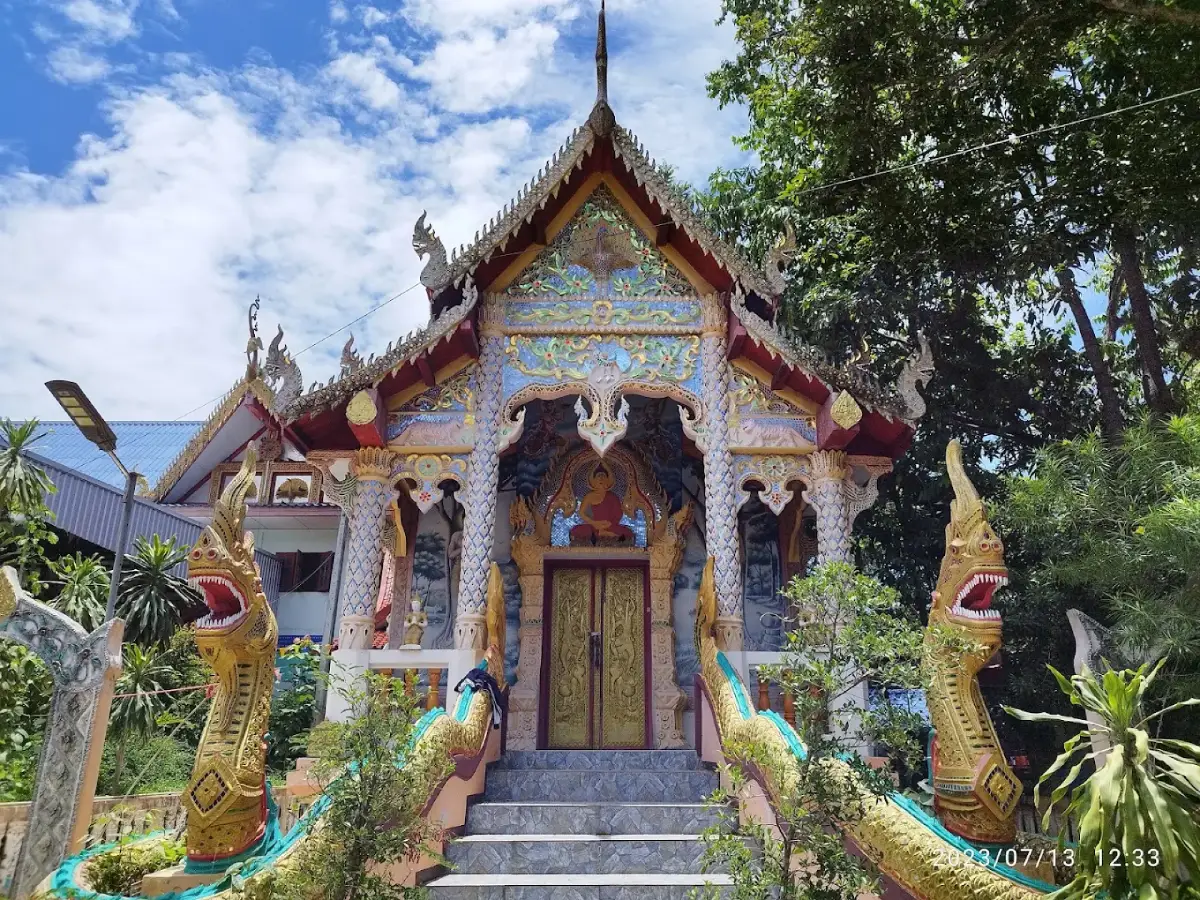
Wat Mae Kaet Noi
Open Days: Daily
Opening Hours: 08.00 – 17.00
Wat Mae Kaet Noi, also known locally as Wat Pa Tueng or Wat Nong Haeng, and historically named Wat Si Don Chai Pa Tueng Ngam, is an old local Buddhist temple under the Mahanikaya order. It is located at No. 287 on the San Sai–Phrao Road in Ban Mae Kaet Noi, Pa Phai Subdistrict, San Sai District, Chiang Mai Province. The temple was founded in 1684 and has become one of the most distinctive community temples in Pa Phai because it combines a long local history, Lanna Buddhist architecture, community education, Sunday Buddhist learning, and a moral learning park about heaven and hell.
The historical name Wat Si Don Chai Pa Tueng Ngam preserves the temple’s original landscape. The area around the temple once had many native trees, especially hiang and tueng trees. As the local community developed, the temple name changed with local memory: from Wat Si Don Chai Pa Tueng Ngam to Wat Pa Tueng, then Wat Nong Haeng, and later Wat Mae Kaet Noi. These name changes reveal the close relationship between the temple, the forested landscape, water sources, village identity, and the monastic connection with Wat Mae Kaet Luang.
Wat Mae Kaet Noi was founded on February 15, 1684 by Phra Khru Ba Nanthasen. The temple is closely connected with Wat Mae Kaet Luang in Nong Chom Subdistrict, San Sai District, because monks came to reside here from Wat Mae Kaet Luang. The name Mae Kaet Noi therefore reflects not only a local place name but also a wider Buddhist network within San Sai District.
The temple received Wisungkham Sima on February 12, 1918. The consecrated boundary measures 1 sen wide and 2 sen 16 wah long, and the boundary was formally bound on January 20, 1920. This made the temple fully equipped for important monastic rites under Buddhist discipline. The ubosot is therefore one of the most important religious areas of the temple.
The temple grounds and monastic land include both the Buddhavasa and Sanghavasa zones, with several plots of monastic land. The broader temple area is a flat landscape with many mature trees, some more than 100 years old. Local residents live around the temple and its monastic land, showing that Wat Mae Kaet Noi is deeply embedded in the village rather than separated from everyday community life.
The ubosot measures 5.5 meters wide and 10 meters long. It was built in 1920, originally with brick and timber, and was later restored as a reinforced masonry structure. The Lanna-style main vihara measures 8 meters wide and 24 meters long. It was built in 1937 and later restored. The vihara is the main worship area for villagers, used for paying respect to Buddha images, listening to sermons, and participating in religious activities.
Other important structures also show the temple’s community role. The multipurpose hall measures 8 meters wide and 20 meters long and was built in 1983. The reinforced-concrete kitchen hall measures 4 meters wide and 24 meters long and was built in 1985. The merit-making hall measures 5 meters wide and 20 meters long. These buildings support community ceremonies, food preparation, merit-making, and family religious activities.
The temple’s sacred objects include a metal principal Buddha image in the ubosot, the principal Buddha image in the vihara, 3 Buddha images in the vihara, 3 Buddha images in the sermon hall, and 3 Buddha images in the monks’ residences. These images are described as ancient Buddha images. The temple also has a chedi built on February 16, 1931, giving the temple a clear sacred focus within its Buddhavasa area.
One of the most distinctive features of Wat Mae Kaet Noi is its educational park honoring the 82nd birthday anniversary and its Buddhist learning area focused on ecology, heaven, hell, and moral reflection. This learning area is divided into zones. The heavenly realm includes Phra Chao Than Jai and scenes from the Buddha’s life, including birth, enlightenment, first sermon, and passing into Parinibbana. Another zone presents a simulated hell realm designed to teach moral lessons about karma, good conduct, bad conduct, and mindful living.
The heaven-and-hell learning park should be understood as a moral teaching space rather than only a visual attraction. It uses concrete imagery to communicate Buddhist ideas about action and consequence. For local children and visitors, the space makes Buddhist ethics easier to understand. For cultural travelers, it reveals how Thai temples can teach Buddhist values through architecture, sculpture, narrative, and public learning spaces.
Wat Mae Kaet Noi also has a strong educational role. The temple includes a Dhamma section Buddhist scripture school, a Sunday Buddhist Studies Center, primary and secondary educational links, and Buddhist learning areas. Wat Mae Kaet Noi School was established in 1938, and in its early stage the temple’s sala bat was used as a classroom. This reflects the traditional role of Thai and Lanna temples as community education centers before modern school buildings became fully established.
The relationship between temple and school makes Wat Mae Kaet Noi more than a place of worship. It is also a place where monks, teachers, students, parents, and villagers share a long educational and moral connection. Children in the community grow up with the temple through classroom history, religious activities, Buddhist holy days, and family merit-making.
Phra Khru Wisal Jariyakhun is the abbot of Wat Si Don Chai Pa Tueng Ngam, or Wat Mae Kaet Noi. He also has an important ecclesiastical role in Pa Phai Subdistrict. In a community temple, the abbot is responsible not only for monastic administration but also for temple development, community coordination, educational activities, and the temple’s function as a peaceful public religious space.
Wat Mae Kaet Noi has a strong relationship with the local community. It serves as a spiritual center, a place for merit-making, a venue for national and Buddhist observances, and a center for preserving local arts and culture. The temple grounds have also been developed with attention to ecology, interpretation signs, landscaping, and moral learning, strengthening the connection between Buddhism, community life, education, and the environment.
One of the temple’s notable cultural activities is Wan Ploi Phi during the Sib Song Peng tradition. The temple has hosted activities related to this Lanna tradition, which involves making merit and dedicating merit to departed relatives and spirits. In the setting of Wat Mae Kaet Noi, where the heaven-and-hell learning park already teaches about moral consequence, this tradition gains additional educational and cultural meaning.
Regular religious activities at the temple follow the Buddhist calendar and local Lanna practice. Important occasions include Buddhist holy days, Makha Bucha, Visakha Bucha, Asalha Bucha, Buddhist Lent, the end of Buddhist Lent, Kathin, robe-offering activities, Sib Song Peng, Wan Ploi Phi, and Ban Mae Kaet Noi community merit-making events.
Visitors should see the ubosot, Lanna vihara, chedi, principal Buddha images, ancient Buddha images, multipurpose hall, kitchen hall, merit-making hall, Sunday Buddhist Studies Center, and the heaven-and-hell learning park. A good visit should begin with respectful worship in the main religious area before moving through the learning zones calmly and thoughtfully.
Getting There is convenient by private car or motorcycle. From Chiang Mai city, travel toward San Sai and Mae Jo, then continue along the San Sai–Phrao Road into Pa Phai Subdistrict and Ban Mae Kaet Noi. The temple can be combined in the same trip with Wat Mae Kaet Luang, Wat Mueang Khon, Wat Pa Mueat, Pa Mueat Market, Wat Pa Daet, and Wat Nong Tao Kham.
Wat Mae Kaet Noi is suitable for visitors interested in old Lanna community temples, Buddhist education, local moral learning spaces, village history, and religious culture beyond the main tourist temples of Chiang Mai. Visitors should dress modestly, keep their voices low, avoid entering monks’ private areas without permission, and photograph sacred or educational areas respectfully.
Overall, Wat Mae Kaet Noi is one of the most meaningful community temples in Pa Phai Subdistrict. Its value lies in its founding in 1684, Wisungkham Sima in 1918, boundary binding in 1920, old names connected with forest and village history, Lanna vihara, ubosot, chedi, ancient Buddha images, Sunday Buddhist Studies Center, relationship with Wat Mae Kaet Noi School, and its heaven-and-hell learning park. It is a worthwhile stop for travelers who want to understand a deeper, quieter, and more educational side of Chiang Mai’s Lanna temple culture.
| Name | Wat Mae Kaet Noi / Wat Si Don Chai Pa Tueng Ngam |
| Location | Ban Mae Kaet Noi, Pa Phai Subdistrict, San Sai District, Chiang Mai Province |
| Address | No. 287, San Sai–Phrao Road, Ban Mae Kaet Noi, Pa Phai Subdistrict, San Sai District, Chiang Mai 50210, Thailand |
| Type | Local Buddhist temple under the Mahanikaya order |
| Abbot / Caretaker | Phra Khru Wisal Jariyakhun |
| Highlights | Old temple founded in 1684, with Lanna vihara, ubosot, chedi, ancient Buddha images, Sunday Buddhist Studies Center, and heaven-and-hell moral learning park |
| History | Founded on February 15, 1684 by Phra Khru Ba Nanthasen. The temple was formerly named Wat Si Don Chai Pa Tueng Ngam. |
| Wisungkham Sima | Granted on February 12, 1918. The boundary measures 1 sen wide and 2 sen 16 wah long, and was formally bound on January 20, 1920. |
| Temple And Monastic Land Area | Buddhavasa, Sanghavasa, and monastic land totaling 58 rai, 2 ngan, and 2 square wah; older temple-history information also records the original temple plot as a little over 2 rai. |
| Former Names / Local Names | Wat Si Don Chai Pa Tueng Ngam, Wat Pa Tueng, and Wat Nong Haeng |
| Name Origin | The former name reflects the original forest landscape with hiang and tueng trees; the later name Wat Mae Kaet Noi reflects the village name and the connection with Wat Mae Kaet Luang. |
| Main Areas / Zones | Ubosot, Lanna vihara, chedi, multipurpose hall, kitchen hall, merit-making hall, Sunday Buddhist Studies Center, educational park honoring the 82nd birthday anniversary, and heaven-and-hell learning park |
| Important Structures | Ubosot built in 1920, Lanna vihara built in 1937, multipurpose hall built in 1983, and kitchen hall built in 1985 |
| Important Sacred Objects | Metal principal Buddha image in the ubosot, principal Buddha image in the vihara, ancient Buddha images in the vihara, sermon hall and monks’ residences, and a chedi built on February 16, 1931 |
| Educational Role | Sunday Buddhist Studies Center, Buddhist scripture school in the Dhamma division, and historical link with Wat Mae Kaet Noi School, which began using the temple’s sala bat as a classroom |
| Community Role | Spiritual center of Ban Mae Kaet Noi, used for merit-making, sermons, Buddhist learning, national and Buddhist observances, community activities, and Lanna cultural traditions |
| Traditions / Merit-Making | Buddhist holy days, major Buddhist festivals, Buddhist Lent, the end of Buddhist Lent, Kathin, robe-offering activities, Sib Song Peng, Wan Ploi Phi, and Ban Mae Kaet Noi community merit-making events |
| Travel Information | From Chiang Mai city, travel toward San Sai and Mae Jo, then continue along the San Sai–Phrao Road into Pa Phai Subdistrict and Ban Mae Kaet Noi. |
| Current Status | Open as a local Buddhist temple, sacred community site, and Buddhist learning space of Ban Mae Kaet Noi, Pa Phai Subdistrict, San Sai District, Chiang Mai |
| Open Days | Daily |
| Opening Hours | 08.00 – 17.00 |
| Main Contact Number | 053-492-970 |
| Facilities | Worship area, temple courtyard, multipurpose hall, kitchen hall, merit-making hall, Buddhist learning zones, heaven-and-hell learning park, and parking area within the temple community |
| Nearby Tourist Attractions | 1. Wat Mae Kaet Luang, Nong Chom Subdistrict, about 3–4 km 2. Wat Mueang Khon, Pa Phai Subdistrict, about 3–4 km 3. Wat Pa Mueat, Pa Phai Subdistrict, about 4–5 km 4. Pa Mueat Market, about 4–5 km 5. Wat Pa Daet, Pa Phai Subdistrict, about 5–6 km 6. Wat Nong Tao Kham, Pa Phai Subdistrict, about 6–7 km |
| Nearby Restaurants | 1. Five Star Ban Mae Kaet Noi, about 0.5–1 km, Tel. 082-108-9063 2. MuengKhon Cafe&Restaurant, about 3–4 km, Tel. 090-326-6622 3. Rong Khao Ban Por Luang Pa Mueat, about 4–5 km, Tel. 093-259-5132 4. Khao Man Kai Suk Jai Pa Mueat, about 4–5 km, Tel. 088-415-2421 5. Mama Lui Fai Pa Mueat, about 4–5 km, Tel. 091-913-7658 6. Coffee Tale Pa Mueat Market, about 4–5 km, Tel. 061-375-4335, 094-607-2020 |
| Nearby Accommodations | 1. MonMin Farmstay, about 2–3 km 2. Baan View Na, about 5–7 km, Tel. 089-844-9675 3. Maejo Resort, about 8–10 km, Tel. 081-429-9935 4. Preme Apartment @Maejo, about 10–12 km, Tel. 086-329-2102 5. Boonthavon Maejo Hotel, about 10–12 km 6. Na Napa Wellness Spa & Resort, about 12–14 km, Tel. 053-106-575 |
Frequently Asked Questions (FAQ)
Q: Where is Wat Mae Kaet Noi located?
A: Wat Mae Kaet Noi is located at No. 287 on San Sai–Phrao Road, Ban Mae Kaet Noi, Pa Phai Subdistrict, San Sai District, Chiang Mai 50210, Thailand.
Q: When is Wat Mae Kaet Noi open?
A: Wat Mae Kaet Noi is open daily from 08.00 to 17.00.
Q: When was Wat Mae Kaet Noi founded?
A: Wat Mae Kaet Noi was founded on February 15, 1684 by Phra Khru Ba Nanthasen.
Q: Does Wat Mae Kaet Noi have other names?
A: Yes. The temple is also known as Wat Pa Tueng and Wat Nong Haeng, and its former name was Wat Si Don Chai Pa Tueng Ngam.
Q: When did Wat Mae Kaet Noi receive Wisungkham Sima?
A: Wat Mae Kaet Noi received Wisungkham Sima on February 12, 1918, and the consecrated boundary was formally bound on January 20, 1920.
Q: What is Wat Mae Kaet Noi known for?
A: The temple is known for its Lanna vihara, ubosot, chedi, ancient Buddha images, Sunday Buddhist Studies Center, and heaven-and-hell learning park that teaches Buddhist moral lessons.
Q: Who is the abbot of Wat Mae Kaet Noi?
A: The abbot of Wat Mae Kaet Noi is Phra Khru Wisal Jariyakhun.
Q: What nearby places can be visited on the same trip?
A: Nearby places include Wat Mae Kaet Luang, Wat Mueang Khon, Wat Pa Mueat, Pa Mueat Market, Wat Pa Daet, and Wat Nong Tao Kham.
 Category: ●Places of Worship
 Group: ●Temple
Last Update : 23 HourAgo
 Last Update : 23 HourAgo
 Click to Access the Navigation Map GPS
Wat Mae Kaet Noi Map
Recommend

 Muang Chiang Mai(121)Chom Thong(47)Mae Chaem(25)Chiang Dao(33)Doi Saket(68)Mae Taeng(85)Mae Rim(69)Samoeng(29)Fang(71)Mae Ai(59)Phrao(70)San Pa Tong(103)San Kamphaeng(66)San Sai(73)Hang Dong(73)Hot(32)Doi Tao(22)Omkoi(11)Saraphi(74)Wiang Haeng(15)Chai Prakan(28)Mae Wang(32)Mae On(22)Doi Lo(34)Galyani Vadhana(1)


