
lovethailand home >North Travel Attractions >Chiang Mai Travel Attractions >Samoeng >Mae Sap > Wat Nga Maeng
TL;DR: Wat Nga Maeng is located at No. 164, Ban Nga Maeng, Moo 3, Mae Sap Subdistrict, Samoeng District, Chiang Mai Province 50250.

Wat Nga Maeng
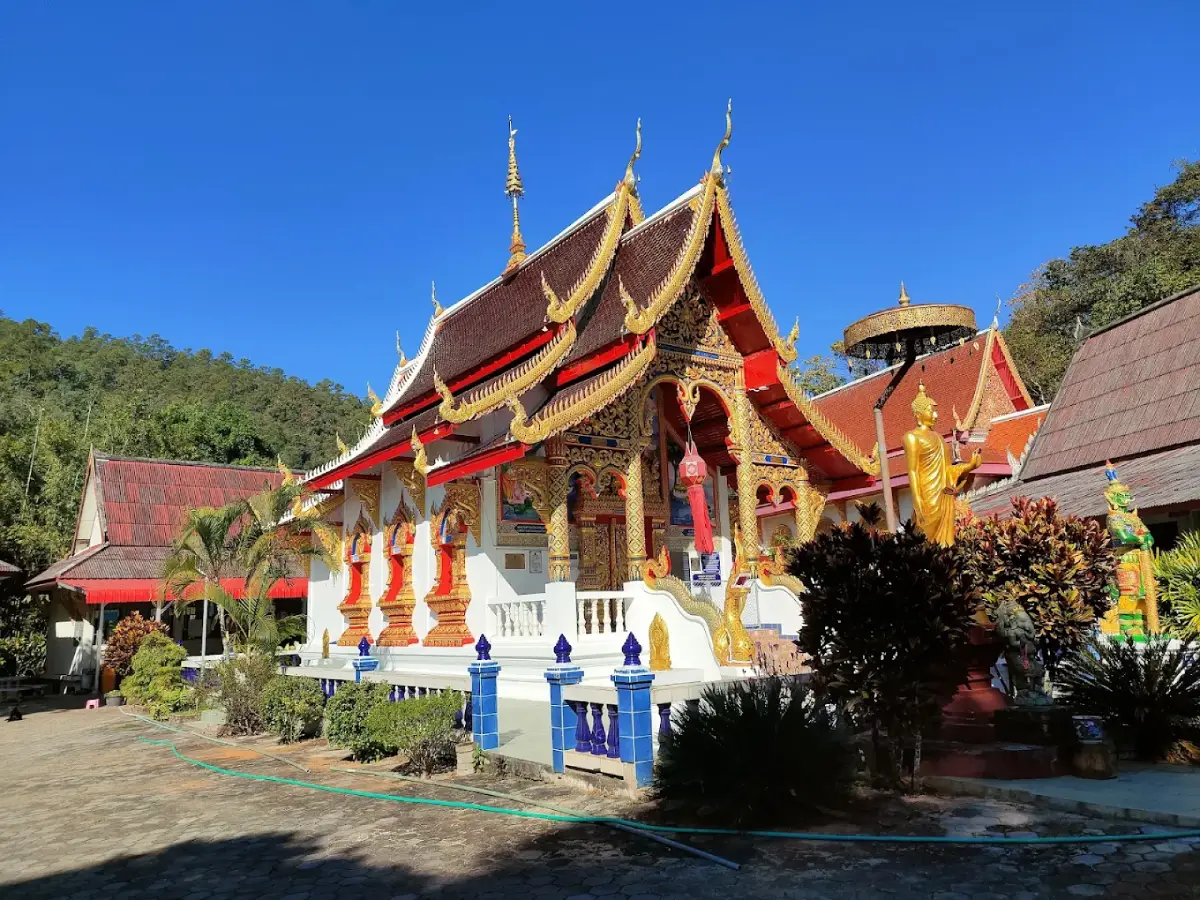
Operating day: Daily
Operating time: 08.00 - 17.00
Wat Nga Maeng is located at No. 164, Ban Nga Maeng, Moo 3, Mae Sap Subdistrict, Samoeng District, Chiang Mai Province. It is a non-royal Buddhist temple under the Mahanikaya order and is one of the most culturally distinctive community temples in Mae Sap. The temple was established in 1826 and received its royal boundary for monastic rites on March 28, 1985. The boundary measures 20 meters wide and 40 meters long, while the temple land covers 5 rai and 49 square wah. Set within a mountain valley community near Mae Sap Creek, Wat Nga Maeng reflects the close relationship between Buddhism, village life, water sources, agriculture, and the highland landscape of Samoeng.
The identity of Wat Nga Maeng is deeply tied to the origin story of Ban Nga Maeng. In the past, the area was covered with dense reed and khaem grass on both sides of Mae Sap Creek. Local memory describes the vegetation as so tall that it could rise above the back of an elephant. A male elephant with decayed tusks, locally described as “nga pen maeng,” suffered inflammation and died in the old grassland south of the present village. Later, Pho Thao Nan Man La established a village in the area. The settlement became known as Ban Nga Maeng, and the temple took the same name as the village.
This origin story makes Wat Nga Maeng more than a religious site. The temple name preserves local memory about elephants, forest grassland, Mae Sap Creek, and the early settlement of the village. Because the temple and the village share the same name, Wat Nga Maeng has become a cultural landmark that keeps the community’s oral history alive across generations.
Ban Nga Maeng is located in Moo 3 of Mae Sap Subdistrict, Samoeng District, Chiang Mai Province. The village sits on a flat area within a complex mountain valley of the Samoeng range and is connected with Mae Sap Creek, a key natural water source for local life. The surrounding land supports agriculture such as bananas, strawberries, and chrysanthemum flowers, along with livestock raising. Wat Nga Maeng therefore stands within a living landscape of mountains, water, farms, and local households.
The temple has long played a role in religious education and moral development. It is recognized as a place for ethical and moral development in Mae Sap Subdistrict and has offered Dhamma studies in the traditional Buddhist education system since 1976. This makes Wat Nga Maeng not only a place for worship, but also a center for Buddhist learning, discipline, and community values.
Phra Khru Suwat Woratham Thanawaro serves as the abbot of Wat Nga Maeng and holds the position of Deputy Ecclesiastical District Chief of Samoeng. His role connects the temple with wider Buddhist administration in Samoeng District. Through this leadership, Wat Nga Maeng functions both as a village temple and as a religious institution with district-level importance.
The temple’s important structures include an ordination hall, sermon hall, multi-purpose hall, monks’ residences, merit-making hall, chedi, Naga staircase, and kitchen. The ordination hall measures 6.50 meters wide and 15 meters long and was built in 1992. The sermon hall measures 6 meters wide and 20 meters long and was built in 1986. The multi-purpose hall measures 6 meters wide and 12 meters long and was built in 1995. The monks’ residences include one wooden building and one masonry building. Together, these structures support worship, monastic life, ceremonies, community gatherings, and merit-making events.
The ordination hall is one of the most important sacred areas of Wat Nga Maeng. Its principal Buddha image is an old brick-and-plaster Buddha image, which is an important object of devotion for local residents. The use of brick and plaster reflects local craftsmanship and older religious building traditions. Paying respect to this Buddha image allows visitors to experience the spiritual center of the temple and the faith of the Ban Nga Maeng community.
The temple also has a brass replica of Phra Phuttha Chinnarat as the principal Buddha image in the hall. This image is an important object of worship and gives the hall a strong devotional function. The space is used for merit-making, Dhamma listening, ceremonies, and community religious gatherings.
The chedi at Wat Nga Maeng was built on March 13, 2008. In Lanna Buddhist culture, a chedi represents devotion, accumulated merit, and the continuity of Buddhism within a community. Together with the ordination hall, Buddha images, and sermon hall, the chedi strengthens the temple’s sacred landscape and gives the site a complete Buddhist character.
The Naga staircase is one of Wat Nga Maeng’s most memorable features. It is 80 meters long and was built on May 18, 2010. In Lanna Buddhist architecture, the Naga is associated with protection, sacred passage, and the connection between the ordinary world and the Buddhist sacred space. Walking along the Naga staircase is therefore not merely physical movement; it is a symbolic approach into the temple’s peaceful religious area.
The sermon hall, multi-purpose hall, merit-making hall, and kitchen show how Wat Nga Maeng serves the everyday religious needs of the community. The sermon hall is used for Dhamma listening and Buddhist activities. The multi-purpose hall supports village events and ceremonies. The merit-making hall is used for memorial rites, funerals, and merit-making events. The kitchen reflects the cooperative nature of Lanna village temple life, where residents gather to prepare food, offer meals, and support religious functions.
Wat Nga Maeng continues to serve as a center of faith and community activity. It supports Buddhist holy days, Buddhist Lent, robe offering ceremonies, Kathin, Dhamma listening, memorial merit-making, funerals, and other village events. The temple has also hosted mobile Dhamma activities in Mae Sap Subdistrict, showing its continuing role as a shared space for monks, local residents, community leaders, and public agencies.
The temple’s religious traditions are closely tied to Lanna Buddhist practice. Kathin and robe offering ceremonies bring villagers together to support the temple and make merit. Dhamma activities and seasonal ceremonies help maintain the relationship between monks, residents, and the wider community. Wat Nga Maeng therefore represents a form of Buddhism rooted in participation, cooperation, and local continuity.
Ban Nga Maeng also has a strong community economy based on agriculture and local processing. The village is known for value-added banana products such as banana chips, dried bananas, and other banana-based snacks. This local economy helps explain the relationship between temple life and village life: the temple, homes, farms, water sources, and community enterprises are all part of the same local ecosystem.
The main highlights for visitors include the Lanna-style ordination hall, the old brick-and-plaster Buddha image, the brass Phra Phuttha Chinnarat replica, the chedi, the 80-meter Naga staircase, and the quiet atmosphere of a working village temple. Wat Nga Maeng is not a large commercial tourist attraction. Its value lies in its authenticity, community role, and cultural depth.
Travelers interested in local history should understand Wat Nga Maeng together with Ban Nga Maeng. The story of the elephant with decayed tusks, the old reed and khaem grassland, Mae Sap Creek, and the founding of the village are all part of the temple’s identity. The temple is therefore a place where oral history, landscape, and Buddhist faith meet.
Wat Nga Maeng can be combined with several nearby attractions in Mae Sap and Samoeng, including Tham Luang Mae Sap, Phra Borommathat Doi Pha Som, Mae Na Poe Waterfall, Phra That Mon Pia, and Khun Khan National Park. Tham Luang Mae Sap is a limestone cave known for naturally colored mineral walls and multiple cave chambers. Phra Borommathat Doi Pha Som is an important Buddhist site in Mae Sap. Mae Na Poe Waterfall and Khun Khan National Park offer natural landscapes for travelers who want to combine temple culture with mountain scenery.
Getting There is most convenient by private car or rental car. From Chiang Mai city, travel toward Samoeng District and continue to Mae Sap Subdistrict, Ban Nga Maeng, Moo 3. Roads in Samoeng include mountain curves and uphill sections, so careful driving is recommended, especially during rain, mist, early morning, or evening travel. A meaningful route can begin at Wat Nga Maeng and continue to Tham Luang Mae Sap, Phra Borommathat Doi Pha Som, and other natural attractions in Mae Sap.
Visitors should dress modestly, speak quietly, and respect monastic areas, especially around the ordination hall, sermon hall, monks’ residences, and active ceremonial spaces. If a merit-making event, funeral rite, or community ceremony is taking place, visitors should avoid disturbing the ritual area and should ask permission before photographing monks or local residents.
Wat Nga Maeng is suitable for travelers who want to see the deeper cultural side of Samoeng. It offers a rare combination of an early temple history dating to 1826, a distinctive village origin legend, important sacred objects, an 80-meter Naga staircase, a chedi, Buddhist education, and an active community role. The temple helps visitors understand how Buddhism, Lanna culture, mountain ecology, water sources, and village life are connected in northern Thailand.
| Name | Wat Nga Maeng |
| Place Type | Non-Royal Buddhist Temple Under The Mahanikaya Order |
| Location | No. 164, Ban Nga Maeng, Moo 3, Mae Sap Subdistrict, Samoeng District, Chiang Mai Province 50250 |
| Temple Code | 350080301 |
| Map Reference | WMJF+HWM, Mae Sap Subdistrict, Samoeng District, Chiang Mai Province |
| Temple Land Area | 5 Rai And 49 Square Wah |
| History | Established In 1826 |
| Royal Boundary | Granted On March 28, 1985; Boundary Size 20 Meters Wide And 40 Meters Long |
| Name Origin | Named After Ban Nga Maeng, Based On A Local Story About A Male Elephant With Decayed Tusks That Died In The Old Khaem Grassland |
| Abbot / Caretaker | Phra Khru Suwat Woratham Thanawaro, Deputy Ecclesiastical District Chief Of Samoeng |
| Contact Number | 081-387-9781 |
| Important Structures | Ordination Hall, Sermon Hall, Multi-Purpose Hall, Two Monks’ Residences, Merit-Making Hall, Chedi, Naga Staircase, Kitchen |
| Ordination Hall | 6.50 Meters Wide And 15 Meters Long, Built In 1992 |
| Sermon Hall | 6 Meters Wide And 20 Meters Long, Built In 1986 |
| Multi-Purpose Hall | 6 Meters Wide And 12 Meters Long, Built In 1995 |
| Sacred Objects | Old Brick-And-Plaster Principal Buddha Image In The Ordination Hall, Brass Phra Phuttha Chinnarat Replica In The Hall, Chedi |
| Chedi | Built On March 13, 2008 |
| Naga Staircase | 80 Meters Long, Built On May 18, 2010 |
| Buddhist Education Role | Dhamma Studies Have Been Offered Since 1976 |
| Current Status | A Non-Royal Buddhist Temple In Mae Sap Subdistrict, Samoeng District, Chiang Mai Province, Serving The Local Community |
| Facilities | Sermon Hall, Multi-Purpose Hall, Merit-Making Hall, Kitchen, Worship Area, Community Religious Space |
| Main Areas / Zones | Ordination Hall, Hall, Chedi, Naga Staircase, Monks’ Residences, Merit-Making Hall, Kitchen |
| Travel Information | Best Reached By Private Car Or Rental Car From Chiang Mai City Toward Samoeng District, Then To Mae Sap Subdistrict, Ban Nga Maeng, Moo 3 |
| Nearby Tourist Attractions | 1. Tham Luang Mae Sap, About 7 Km 2. Phra Borommathat Doi Pha Som, About 10 Km 3. Mae Na Poe Waterfall, About 15 Km 4. Phra That Mon Pia, About 18 Km 5. Khun Khan National Park, About 16 Km |
| Nearby Restaurants | 1. Coffee By Aitsara, About 5 Km, Tel. 084-378-0821 2. Ice Cream Café At Samoeng Chiang Mai, About 7 Km, Tel. 081-751-2191 3. Cafe De Mountain, About 8 Km, Tel. 098-506-5306 4. Samoeng Coffee, About 12 Km, Tel. 089-954-0293 5. Khwamsukh Cafe, About 28 Km, Tel. 064-339-2582 |
| Nearby Accommodations | 1. Forest Guesthouse, About 12 Km, Tel. 084-371-5055 2. Khum Samoeng-Samoeng Center, About 13 Km, Tel. 081-122-2324 3. The Terrace @Samuang, About 13 Km, Tel. 081-597-9514 4. Lhongkhao Samoeng, About 14 Km, Tel. 089-504-8108 5. Samoeng Resort, About 14 Km, Tel. 053-487-074-5 |
Frequently Asked Questions (FAQ)
Q: Where Is Wat Nga Maeng Located?
A: Wat Nga Maeng is located at No. 164, Ban Nga Maeng, Moo 3, Mae Sap Subdistrict, Samoeng District, Chiang Mai Province 50250.
Q: When Was Wat Nga Maeng Established?
A: Wat Nga Maeng was established in 1826 and received its royal boundary for monastic rites on March 28, 1985.
Q: What Is The Origin Of The Name Wat Nga Maeng?
A: The name comes from Ban Nga Maeng and a local story about a male elephant with decayed tusks, locally described as “nga pen maeng,” that died in the old khaem grassland area.
Q: What Important Structures Are Found At Wat Nga Maeng?
A: Important structures include the ordination hall, sermon hall, multi-purpose hall, monks’ residences, merit-making hall, chedi, Naga staircase, and kitchen.
Q: What Are The Main Sacred Objects At Wat Nga Maeng?
A: The main sacred objects include the old brick-and-plaster principal Buddha image in the ordination hall, the brass Phra Phuttha Chinnarat replica in the hall, and the chedi.
Q: Who Is The Abbot Of Wat Nga Maeng?
A: Phra Khru Suwat Woratham Thanawaro is the abbot of Wat Nga Maeng and serves as Deputy Ecclesiastical District Chief of Samoeng.
Q: What Type Of Traveler Is Wat Nga Maeng Suitable For?
A: It is suitable for travelers interested in Lanna village temples, local Buddhist history, Mae Sap community life, quiet worship, and cultural travel in Samoeng.
Q: What Nearby Places Can Be Combined With Wat Nga Maeng?
A: Travelers can combine the visit with Tham Luang Mae Sap, Phra Borommathat Doi Pha Som, Mae Na Poe Waterfall, Phra That Mon Pia, and Khun Khan National Park.
 Category: ●Places of Worship
 Group: ●Temple
Last Update : 2 WeekAgo
 Last Update : 2 WeekAgo
 Click to Access the Navigation Map GPS
 Muang Chiang Mai(121)Chom Thong(47)Mae Chaem(25)Chiang Dao(33)Doi Saket(68)Mae Taeng(85)Mae Rim(69)Samoeng(29)Fang(71)Mae Ai(59)Phrao(70)San Pa Tong(103)San Kamphaeng(66)San Sai(73)Hang Dong(73)Hot(32)Doi Tao(22)Omkoi(11)Saraphi(74)Wiang Haeng(15)Chai Prakan(28)Mae Wang(32)Mae On(22)Doi Lo(33)Galyani Vadhana(1)


